Finding Vector Paths (WJEC Eduqas GCSE Maths: Higher): Revision Note
Exam code: C300

Finding vector paths
How do I find the vector between two points?
A vector path is a path of vectors taking you from a start point to an end point
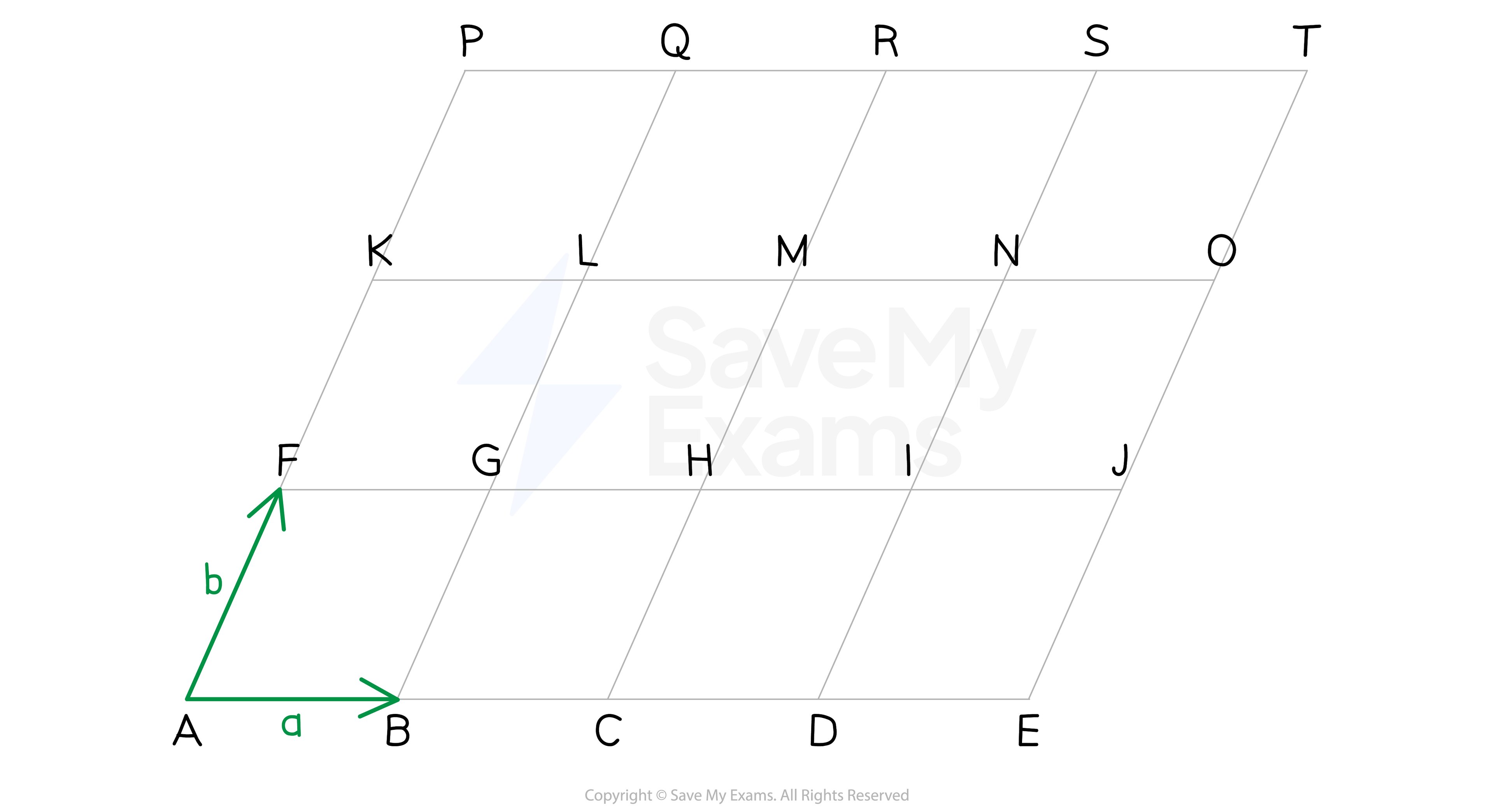
The following grid is made up entirely of parallelograms
The vectors a and b defined as marked in the diagram:
Any vector that goes horizontally to the right along a side of a parallelogram will be equal to a
Any vector that goes up diagonally to the right along a side of a parallelogram will be equal to b
To find the vector between two points
Count how many times you need to go horizontally to the right
This will tell you how many a's are in your answer
Count how many times you need to go up diagonally to the right
This will tell you how many b's are in your answer
Add the a's and b's together
E.g.
You will have to put a negative in front of the vector if it goes in the opposite direction
-a is one length horizontally to the left
-b is one length down diagonally to the left
E.g. or
Likewise,
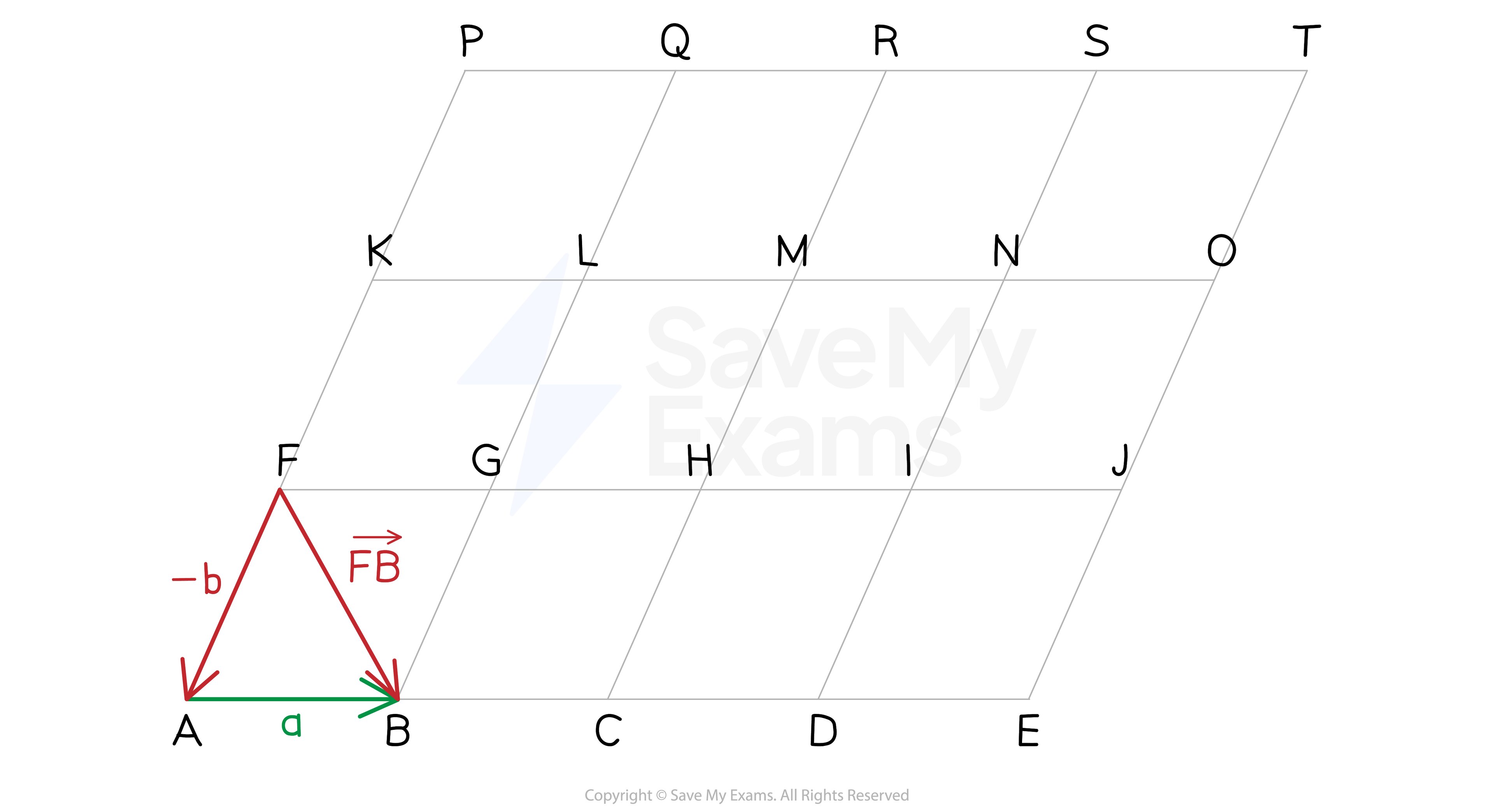
It is possible to describe any vector that goes from one point to another in the above diagram in terms of a and b
Examiner Tips and Tricks
Mark schemes will accept different correct paths, as long as the final answer is fully simplified
Check for symmetries in the diagram to see if the vectors given can be used anywhere else
Worked Example
The following diagram consists of a grid of identical parallelograms.
Vectors a and b are defined by and .
Write the following vectors in terms of a and b.
(a)
Answer:
To get from A to E we need to follow vector a four times to the right
(b)
Answer:
There are many ways to get from G to T
One option is to go from G to Q (b twice), and then from Q to T (a three times)
(c)
Answer:
There are many ways to get from E to K
One option is to go from E to O (b twice), and then from O to K ( -a four times)

Unlock more, it's free!
Join the 100,000+ Students that ❤️ Save My Exams
the (exam) results speak for themselves:

Was this revision note helpful?
Build on this topic
