Stars & Planets (WJEC GCSE Science (Double Award): Physics): Exam Questions

Exam code: 3430

1 hour8 questions
1a
Sme Calculator
3 marks

Our Sun is a low mass star. It is currently in the main sequence stage of its life.

Use words from the box to complete the life cycle of our Sun.

asteroid

protostar

supernova

white dwarf

red giant

............................................. → main sequence → ....................................... → .............................................

1b
Sme Calculator
2 marks

Tick () the two boxes next to the forces acting on our Sun that keep it stable.

gas pressurebox enclose space space space space space space end enclose

friction box enclose space space space space space space end enclose

magnetic box enclose space space space space space space end enclose

gravity box enclose space space space space space space end enclose

2a
Sme Calculator
5 marks

Jupiter has 79 moons in orbit around it. The table shows data for 4 of its moons.

Name of moon

Mean diameter (km)

Mean temperature (°C)

Orbit radius (km)

Orbit time (days)

Io

3 660

–163

421 700

1.8

Europa

3 120

–171

671 000

3.6

Ganymede

5 260

–163

1 070 400

7.2

Callisto

4 820

–139

1 882 700

16.7

Use information from the table above to answer the following questions.

(i) State which moon has the highest mean temperature.

[1]

(ii) For the solar system, as the orbit radius increases around the Sun, the mean temperature of the planets generally decreases.

Explain why the orbit radius of the moons around Jupiter does not affect their temperatures in the same way.

[2]

(iii) Peter states that as Callisto has the longest orbit time it must be the largest moon.

Determine whether Peter's claim is correct.

[1]

(iv) Peter correctly notices that Ganymede has an orbit time that is exactly double Europa's.

Peter suggests that as the orbit time doubles, the orbit radius also doubles.

Use only the data for Ganymede and Europa to determine whether Peter's claim is true.

[1]

2b
Sme Calculator
3 marks

(i) Two of the statements listed below are correct. One correct statement has already been ticked.

Tick (✓) one more box to show the other correct statement.

[1]

  • An Astronomical Unit (AU) is the mean distance that separates the Earth and the Sun. \boxed{\checkmark}

  • A light year is a measurement of time. box enclose space space space space space space end enclose

  • A light minute is the distance travelled by light in 60 seconds. box enclose space space space space space space end enclose

  • A light year is smaller than a light second. box enclose space space space space space space end enclose

(ii) Both Earth and Jupiter travel in elliptical paths around the Sun.

As they orbit the Sun the closest distance between Jupiter and Earth is 588 000 000 km. This is equivalent to 3.92 AU.

Calculate the distance, in km, that separates the Earth and the Sun.

[2]

(1 AU = Earth to Sun distance)

Distance = .......... km

3a
Sme Calculator
6 marks

Explain, in terms of forces and nuclear fusion, the life cycle of a high-mass star, from its position on the main sequence to its 'death'.

3b
Sme Calculator
3 marks

The number of planets in our Solar System totals eight.

Briefly outline the difference between the structure of the inner and outer four planets and explain how they originated.

4a
3 marks

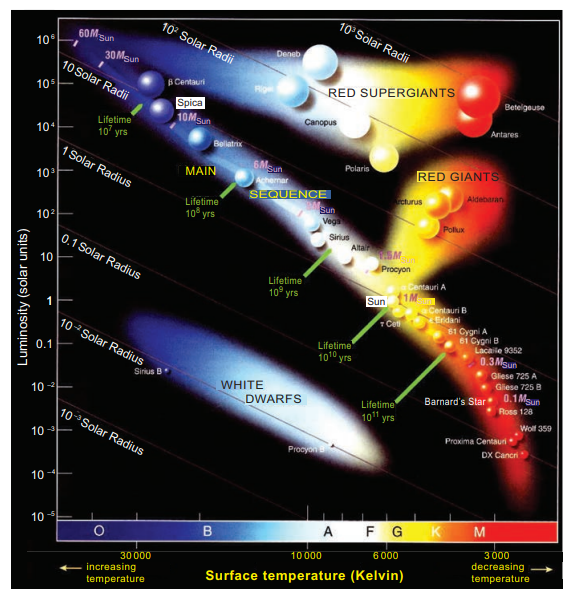
One of the most useful diagrams in astrophysics is the Hertzsprung-Russell (HR) diagram. It was developed separately by two astronomers, the Danish astronomer Ejnar Hertzsprung and the American astronomer Henry Norris Russell. Their combined diagram shows that the relationship between the temperature and luminosity of a star is not random and stars fall into distinct groups. These are seen in the Hertzsprung-Russell diagram below which shows the properties of stars.

Hertzsprung–Russell diagram showing star classes by colour, luminosity, radius, temperature and lifetime, including main sequence, red giants and white dwarfs

Spica is a very large blue star on the main sequence, approximately 10 times the mass of the Sun. Spica is 261 light-years from Earth.

(i) Explain, in terms of forces, why Spica is currently stable.

[2]

(ii) Spica is 261 light-years from Earth. State what this means.

[1]

4b
6 marks

The Sun is also on the main sequence. It is a yellow dwarf star.

Explain, in terms of forces, the reactions within the Sun and the properties shown on the HR diagram, how the Sun will change during the remainder of its life cycle.

5a
Sme Calculator
2 marks

Our solar system formed about 4.5 billion years ago.

Tick (✓) the boxes next to the two correct statements.

Our solar system originated from a cloud of gas and dust. box enclose space space space space space space end enclose

The heavy elements in our solar system originated from a supernova. box enclose space space space space space space end enclose

The Sun formed when large asteroids clumped together. box enclose space space space space space space end enclose

At the end of our Sun's life, heavy elements will be returned to space. box enclose space space space space space space end enclose

5b
Sme Calculator
4 marks

The table gives information about some planets in our solar system.

Planet

Mean distance from Sun
(AU)

Diameter
(1000 km)

Length of day
(Earth days)

Length of year i.e. time to orbit the Sun
(Earth years)

Venus

0.7

12

243

0.6

Earth

1.0

13

1

1

Mars

1.5

7

1

2

Saturn

9.5

120

0.4

29

Uranus

19.2

50

0.7

84

Neptune

30.0

50

0.7

165

Use the information in the table to answer the following questions.

(i) State which planet is closest in size to Earth.

[1]

(ii) State which planet has a day length longer than its year.

[1]

(iii) Natalie says the larger the gas giant planet the longer its days are.

Rhian says Natalie is wrong.

Explain whether you agree with Natalie or Rhian.

[2]

6a
Sme Calculator
4 marks

Arcturus is a red giant star, 37 light-years away from Earth.

(i) State how long light from Arcturus takes to reach the Earth.

[1]

time = ............................................................

(ii) Use your answer to (i) and an equation from page 2 to determine the distance of Arcturus from Earth in metres.

(1 year = 31 600 000 s, speed of light, c = 3 × 10⁸ m/s)

[3]

distance = ........................................................ m

6b
Sme Calculator
6 marks

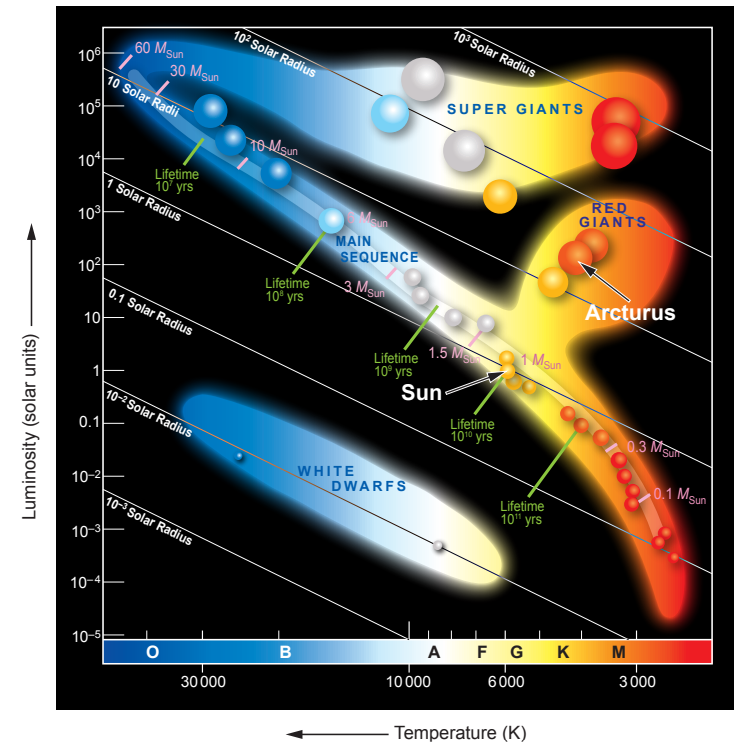
The Hertzsprung-Russell (HR) diagram below shows the properties of different stars.

Colourful Hertzsprung–Russell diagram showing star types and lifetimes, with luminosity versus temperature, including main sequence, supergiants, red giants and white dwarfs

(i) The Sun and Arcturus have different colours.

Use information from the diagram to compare their other properties.

[2]

(ii) The Sun is currently on the main sequence.

At the end of this stage of its life cycle it will become a red giant like Arcturus.

Explain, in terms of forces and fusion, why the Sun will become a red giant.

[4]

7a
Sme Calculator
4 marks

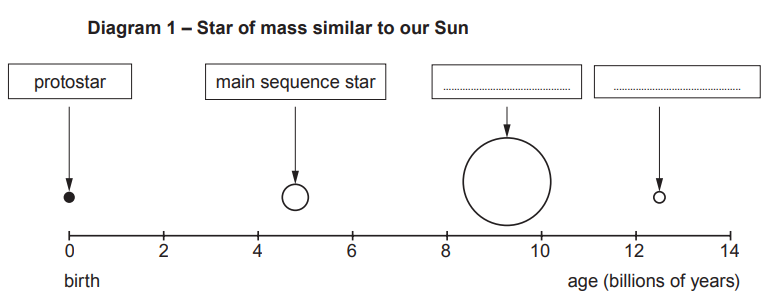
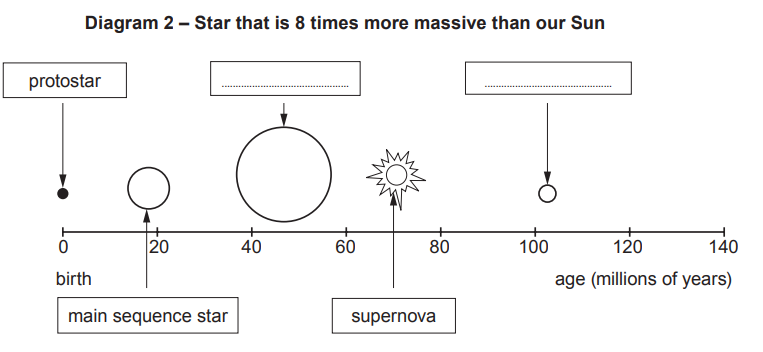
The following diagrams show the life cycle of two different mass stars.

Diagram 1 shows how a star that is similar in mass to our Sun changes with time.

Diagram 2 shows the changes for a star that is 8 times more massive than our Sun.

Complete the labelling on diagrams 1 and 2, using words or phrases from the box below.

Words or phrases can be used once, more than once or not at all.

asteroid

neutron star

red giant

supergiant

white dwarf

Diagram of life cycle of a Sun-like star, showing protostar, main sequence star, then two later unnamed stages over 0–14 billion years on an age scale
Timeline diagram of an 8-solar-mass star from protostar to main sequence, then supernova around 70 million years and final compact remnant stage
7b
Sme Calculator
4 marks

Underline the word or phrase in the brackets which correctly completes each sentence.

(i) A main sequence star is stable because its gravitational force is

( less than / equal to / greater than ) the force caused by its radiation pressure.

(ii) Stars generate their energy by the ( burning / fusion / fission ) of increasingly heavier elements.

(iii) During the final stages in the life cycle of some stars heavy elements are ejected when the star becomes a ( gaseous giant planet / supernova / supergiant ).

The collapse of a cloud of gas and dust combined with these heavy elements can eventually form a ( Solar System / galaxy / Universe ).

8a
2 marks

This question is about the Solar System.

Complete the following sentence.

The Solar System was formed by the collapse of a cloud of .......... and

.......... .

8b
6 marks

The table shows some information about planets in our Solar System.

Mercury

Venus

Earth

Mars

Jupiter

Saturn

Uranus

Neptune

Mean distance from Sun (AU)

0.4

0.7

1

1.5

5.2

9.5

19.2

30

Mass compared with Earth

0.055

0.815

1

0.107

318

95

15

17

Orbital time (years)

0.24

0.60

1

2

12

30

84

160

Mean temperature at surface on sunny side (°C)

430

465

20

−20

−150

−170

−200

−210

Number of moons

0

0

1

2

63

60

27

13

Use the information in the table to answer the questions that follow.

(i) Describe how the temperature on a planet depends on the distance from the Sun.

[1]

(ii) Identify the planet that does not follow this trend.

[1]

(iii) Pallas is an asteroid found in the asteroid belt.

I. Estimate its temperature. .......... °C

[1]

II. Estimate its orbital time. .......... years

[1]

(iv) It is suggested that the greater the mass of a planet, the more moons that will orbit around it. Explain whether the data agrees with this suggestion.

[2]