Energy, Work & Power (Cambridge (CIE) IGCSE Combined Science: Physics): Exam Questions

Exam code: 0653

15 mins4 questions
1
Sme Calculator
1 mark

The diagram shows a force of 200 N pulling an object up a slope. The object moves 5.0 m along the slope.

The object moves 3.0 m vertically upwards and 4.0 m horizontally.
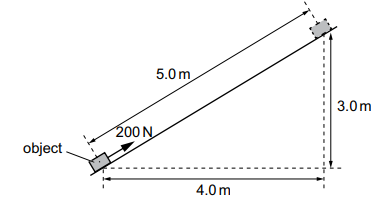
Diagram of an object pulled up a 5.0 m inclined plane by a 200 N force, forming a right triangle with 4.0 m base and 3.0 m vertical height

How much work is done by the 200 N force?

  • 600 J

  • 800 J

  • 1000 J

  • 1400 J

2
Sme Calculator
2 marks

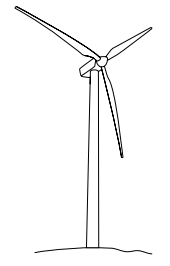
Fig. 7.2 shows a wind turbine used to generate electricity from the power of the wind.

Simple line drawing of a single wind turbine with three blades on a tall tower, standing on a gently curved ground line

Fig. 7.2

A wind turbine produces electrical power of 2200 W at a voltage of 240 V.

Calculate the energy transferred by the wind turbine in 15 seconds.

3
Sme Calculator
3 marks

The student climbs a step into the school.

The student has a mass of 55 kg. The step is 0.15 m high.

Calculate the increase in the gravitational potential energy Ep of the student climbing the step.

Include the unit in your answer.

(Take g = 9.8 N/kg)

4a
Sme Calculator
4 marks

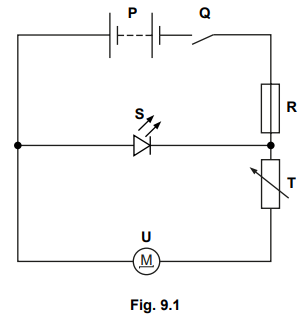
Fig. 9.1 shows a circuit used in a toy car.

Circuit diagram with cell P, switch Q, LED S, fixed resistor R, variable resistor T and motor U connected in series, forming a complete electrical circuit.

Fig. 9.1

(i) The resistance of component T is 5.4Ω. The resistance of component U is 3.5Ω.

Calculate the combined resistance of components T and U.

[1]

(ii) The current in component R is 2.7 A. The current in component T is 2.5 A.

Determine the current in component S and component U.

[2]

(iii) State the name of component S.

[1]

4b
5 marks

Component U is an electric motor. When the motor is switched on, the toy car moves.

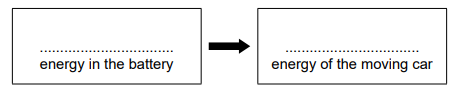
(i) Complete Fig. 9.2 to show one energy transfer that occurs.

Diagram showing energy transfer: from chemical energy in the battery to kinetic energy of the moving car, with an arrow between two labelled boxes.

Fig. 9.2

[2]

(ii) The toy car moves for 10 s.

The power input to the motor is 3.6 W.

The useful energy output by the motor is 32 J.

Show that the efficiency of the motor is 89%.

[3]