Transport Systems (Edexcel IGCSE Science (Double Award) (Modular): Biology Unit 2): Exam Questions

Exam code: 4XSD1

1 hour7 questions
1a
1 mark

The diagram shows the human heart with four blood vessels labelled A, B, C and D.

Figure 1
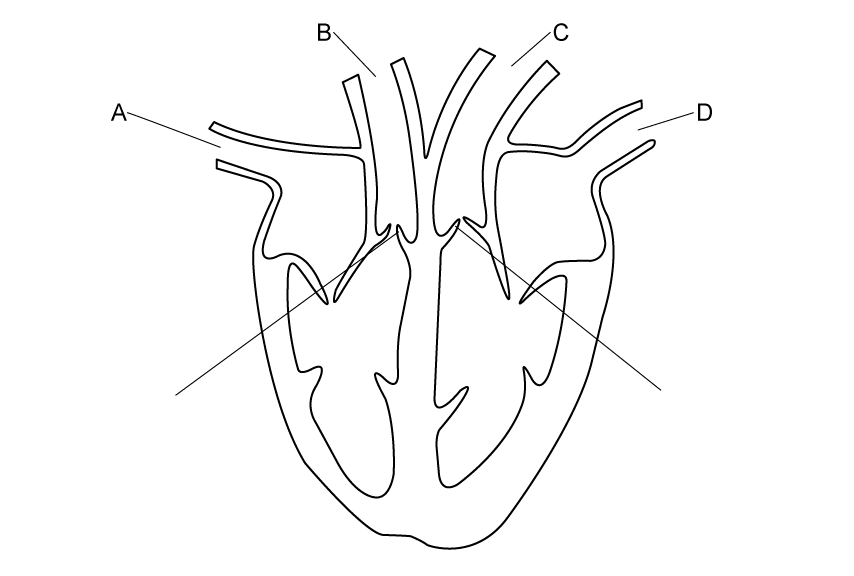
Line diagram of a vertical section through the human heart, drawn in outline with no named labels. Four blood vessels are indicated by label lines lettered A to D. A points to the vessel entering the top of the heart on the far left of the diagram. B and C point to the two central vessels that arise from the lower chambers and arch outwards, B to the left-hand one and C to the right-hand one. D points to the vessel entering the top of the heart on the far right of the diagram

Identify which blood vessel brings oxygenated blood to the heart.

  • A

  • B

  • C

  • D

1b
1 mark

Using Figure 1, identify which blood vessel contains blood at the highest pressure.

  • A

  • B

  • C

  • D

1c
3 marks

(i) Using Figure 1, draw a label line on the diagram to show the position of a semi-lunar valve.

[1]

(ii) Describe the function of the semi-lunar valves.

[2]

1d
5 marks

In the heart of a foetus, the two upper chambers (atria) are linked by a hole so that blood can pass between them.

(i) Explain why this hole is normally closed before the baby is born.

[2]

(ii) Sometimes the hole does not close.

Explain what effect this will have on the baby.

[3]

2a
4 marks

Sickle cell anaemia is a condition in which some of the person’s red blood cells develop abnormally.

The diagram shows red blood cells from a healthy person and red blood cells from a person with sickle cell anaemia.

Two simple diagrams of red blood cells shown side by side. On the left, captioned cells from a healthy person, is a rounded disc-shaped cell drawn with a shaded dip in the centre. On the right, captioned cells from a person with sickle cell anaemia, is a long curved crescent-shaped cell with pointed ends and no central dip

(i) A person with sickle cell anaemia often suffers pain as some of their blood vessels become blocked by the sickle cells.

Suggest why the person’s blood vessels may become blocked.

[1]

(ii) People with sickle cell anaemia have symptoms of tiredness and joint pain that get worse if they are exposed to cold temperatures and high altitudes.

Suggest why these symptoms get worse.

[3]

2b
3 marks

Sickle cell anaemia is caused by a single recessive allele.

(i) State what is meant by the term recessive.

[1]

(ii) A man and a woman who are both heterozygous for the sickle cell allele have a child.

Calculate the probability that the child will be female and not have sickle cell anaemia.

[2]

2c
1 mark

Sickle cell anaemia is more common in countries where malaria is found. This is because having an allele for sickle cell anaemia can reduce the likelihood of developing malaria.

Which type of organism causes malaria?

  • Bacterium

  • Fungus

  • Plant

  • Protoctist

2d
1 mark

Give the name of the pigment found in red blood cells.

  • chlorophyll

  • haemoglobin

  • iron

  • magnesium

2e
2 marks

Give two differences in structure between red blood cells and white blood cells.

3a
1 mark

Read the passage below. Use the information in the passage and your own knowledge to answer the questions that follow.

Numbered reading passage headed Heart transplant, 36 lines long, with line numbers printed in the margin every five lines. The text reads, with each line marked: (line 1) A heart transplant is an operation to replace a damaged or failing heart with a (2) healthy heart from a donor who has recently died. In the United Kingdom, 200 (3) heart transplants are carried out each year. (4) A heart transplant may be considered if you have severe heart failure and medical (5) treatments are not helping. Conditions that may eventually require a heart (6) transplant include coronary heart disease and cardiomyopathy, where the walls of (7) the heart have become stretched, thickened or stiff. Some people born with an (8) abnormal heart may also benefit from a heart transplant. (9) A heart transplant needs to be carried out as soon as possible after a donor heart (10) becomes available. The procedure is performed under general anaesthetic where (11) the patient is unconscious. During the operation, a heart-lung bypass machine is (12) used to keep the patient alive. (13) A cut is made in the middle of the patient's chest. The patient's heart is removed, (14) leaving behind a section of the right and left atria, the two upper chambers of the (15) heart. The new heart is connected to the aorta, the pulmonary artery, and the (16) remaining part of the atria. The new heart is stimulated to start beating and the (17) patient is taken off the bypass machine. (18) The patient will need to stay in hospital for around two or three weeks (19) after a heart transplant. The patient will also need to take medicines called (20) immunosuppressants for the rest of their life. Without these medicines, the (21) transplant will not be successful. (22) After going home, the patient is encouraged to take part in a cardiac (23) rehabilitation programme. This involves following an exercise plan to help regain (24) strength and mobility. They should avoid strenuous activities such as pushing, (25) pulling or lifting anything heavy for 6 to 12 weeks. Most people can start (26) returning to many of their normal activities within a few months. (27) The patient does not usually need to have a special diet after a heart transplant. (28) A balanced diet can ensure they stay as healthy as possible. They should not (29) smoke and should avoid drinking alcohol. (30) A balanced diet may also help reduce the risk of some of the side effects of the (31) immunosuppressant drugs including weight gain, osteoporosis and diabetes. (32) Immunosuppressants also make the patient more vulnerable to infections, (33) including food poisoning. (34) Most people can return to their normal activities after a heart transplant and (35) experience a significant improvement in their symptoms for many years. After a (36) heart transplant, 75% of people will live at least five years.

Suggest why cardiomyopathy can cause heart failure (lines 6 to 7).

3b
3 marks

During the transplant procedure the patient’s heart is removed, leaving behind a section of the right and left atria.

Describe the functions of the atria in the body.

3c
2 marks

Describe how the blood in the pulmonary artery differs from the blood in the aorta.

3d
3 marks

Explain the function of the heart-lung bypass machine (lines 11 to 12).

3e
2 marks

Explain why the patient needs to be given immunosuppressants (lines 19 to 20).

3f
2 marks

Explain why patients should not smoke after their heart transplant (lines 28 to 29).

3g
1 mark

State what is meant by the term balanced diet.

3h
2 marks

Calculate the number of patients in the United Kingdom who have a heart transplant in one year that are still alive five years later (lines 2 to 3 and lines 35 to 36).

3i
1 mark

Suggest why patients are advised to avoid strenuous activities after their heart transplant (line 24).

3j
1 mark

Suggest why patients are more likely to be at risk of food poisoning after their heart transplant (lines 32 to 33).

4a
2 marks

Aerobic respiration uses oxygen and produces ATP.

Complete the word equation for aerobic respiration.

oxygen + .......................... → .......................... + .......................... + ATP

4b
3 marks

A scientist investigates the rates of aerobic respiration of some animals.

The scientist calculates the rate of respiration per gram of each animal.

The results are shown in the table.

Animal

Rate of aerobic respiration per gram of animal in arbitrary units

Frog

150

Human

200

Mouse

1500

Explain why a mouse uses more oxygen per gram than a human.

4c
6 marks

(ii) Using Figure 1, give one difference between the structure of the frog heart and a human heart.

[1]

(iii) Humans can run for long periods of time. Frogs can only move for short periods of time.

Using Figure 1, explain how the structure of the heart of a frog means that it is unable to move for long periods of time.

[5]

4d
1 mark

The structure of a frog heart is different from the structure of a human heart.

The diagram shows a section of a frog heart with arrows showing the direction of blood flow.

Figure 1

Line diagram of a vertical section through a frog heart. A single large ventricle occupies the lower half of the heart. Above it sit two atria, one on each side. A vessel enters the left-hand atrium from the left of the diagram, labelled blood from body. A vessel enters the right-hand atrium from the right of the diagram, labelled blood from lungs, and a label line lettered X points to this right-hand vessel. Two vessels leave the top of the heart, each labelled blood to lungs, body, skin. Arrows show blood flowing in through both atria, down into the single ventricle, and up out through the two vessels at the top

Name the blood vessel labelled X.

  • aorta

  • pulmonary artery

  • pulmonary vein

  • vena cava

1a
1 mark

Human blood contains red blood cells and white blood cells.

The table shows the number of these blood cells in a sample of blood.

Type of cell

Number of cells per mm3

Number of cells per mm3 in standard form

Red blood cell

5 000 000

5.0 × 10⁶

White blood cell

6000


Complete the table to give the number of white blood cells per mm3 in standard form.

1b
1 mark

Calculate the number of red blood cells in 1000 cm3 of this person's blood?

  • 5.0 × 10⁶

  • 5.0 × 10⁹

  • 5.0 × 10¹¹

  • 5.0 × 10¹²

1c
4 marks

The table gives names, descriptions and symptoms of two blood conditions.

Name of condition

Description

Symptom

Anaemia

Low red blood cell count

Often tired

Leukopenia

Low white blood cell count

Likely to get infections

(i) Explain why a person with anaemia is often tired.

[2]

(ii) Explain why a person with leukopenia is more likely to get an infection.

[2]

2a
1 mark

Cholesterol is needed in the diet for making cell membranes.

State the role of the cell membrane.

2b
2 marks

Too much cholesterol is a health risk because fatty deposits build up in arteries.

The lumen of an artery had a diameter of 4.0 mm before the build-up of a fatty deposit.

The fatty deposit covers 45 % of the original area of the lumen.

Calculate the area in mm2 of the lumen that is available for blood flow.

  • area of the lumen = πr2

  • π = 3.14

2c
5 marks

A scientist tests the blood cholesterol concentration in a sample of men between 25 and 34 years old.

The scientist groups the men in ranges of blood cholesterol concentration and counts the number of men in each range.

The table gives the scientist’s results.

Range of blood cholesterol concentration in mg per cm3

Number of men in each range

80 to 119

13

120 to 159

150

160 to 199

442

200 to 239

299

240 to 279

115

280 to 319

34

320 to 359

9

360 to 399

5

Plot a suitable graph on the grid to show these results.

[5]

screenshot-2022-10-21-9-24-13-am
2d
1 mark

Identify which range of blood cholesterol levels is the mode for the sample in part c?

  • 80 to 119

  • 80 to 379

  • 160 to 199

  • 360 to 399

2e
2 marks

A blood cholesterol level greater than 239 mg per 100 cm3 means a person has a higher risk of heart disease.

Calculate the percentage of men in the sample at a higher risk of heart disease.

2f
4 marks

Statins are drugs that reduce blood cholesterol levels.

A scientist investigates the use of one type of statin on the risk of having a heart attack.

He gives the statin to one group of people and gives a control substance to another group of people.

He calculates the percentage of people in each group that has a heart attack during the next four years.

The table gives the scientist’s results.

Group

Percentage (%) having heart attacks

Statin

2.2

Control substance

3.8

A conclusion from this data is that statins reduce the risk of heart attacks.

Discuss this conclusion.

3a
7 marks

The diagram shows the human circulation system with some blood vessels labelled A to J. The arrows show the direction of blood flow.

edexcel-igcse-1b-jan-21-q3a

The table gives some statements about the content of blood vessels in this circulation system.

(i) Complete the table by giving the letter of the blood vessel that matches each statement.

[5]

Statement

Letter

Contains the least carbon dioxide


Contains the most glucose after a meal


Contains the least oxygen


Contains the least urea


Contains blood at the highest pressure


(ii) State two ways in which the structure of blood vessel A differs from the structure of blood vessel J.

[2]

3b
5 marks

Muscles in the legs contain capillaries.

A scientist investigates how long-term training affects the number of capillaries in an athlete’s leg muscles.

The scientist determines the mean number of capillaries per mm2 in samples of leg muscle from the athlete before and after a period of training.

The table shows the scientist’s results.

Muscle sample

Mean number of capillaries per mm2

Before training

313

After training

349

The scientist concludes that training improves the athletic performance.

Discuss this conclusion.