Roots in Intervals (Edexcel International AS Further Maths: Further Pure 1): Revision Note
Exam code: XFM01

Roots in Intervals
What is a root of an equation?
A root of the equation is a solution
If is a root of then
The Greek letter alpha is often used
To find exactly, you need to solve the equation algebraically (analytically)
Some equations cannot be solved algebraically
In which case you can approximate a root to a given accuracy
For example, to 3 decimal places
This is called solving equations numerically
What is an interval?
If you don't know the root but know that it lies between and , where , then
is an interval containing the root
Intervals can be written using bracket notation
is
is
How do I show that an interval contains a root?
Use the sign-change and continuity test to show that the interval contains a root to the equation
Show that and have different signs and check that is continuous across
Then the interval must contains a root
Continuous means no jumps or asymptotes in the interval
Check the equation does not divide by zero within the interval
(Jumps or asymptotes outside of the interval are fine)
You must write a conclusion to the test in words, for example:
" has a sign change in the interval and is continuous in the interval, so a root must lie in the interval "
Examiner Tips and Tricks
When writing your conclusion in the exam, don't forget to mention being continuous in the interval!
How do I show that an equation has a root to a given accuracy?
If asked to show that is the root of an equation to 2 decimal places
write an interval using the lower and upper bound of the root
use the sign-change and continuity test on this interval
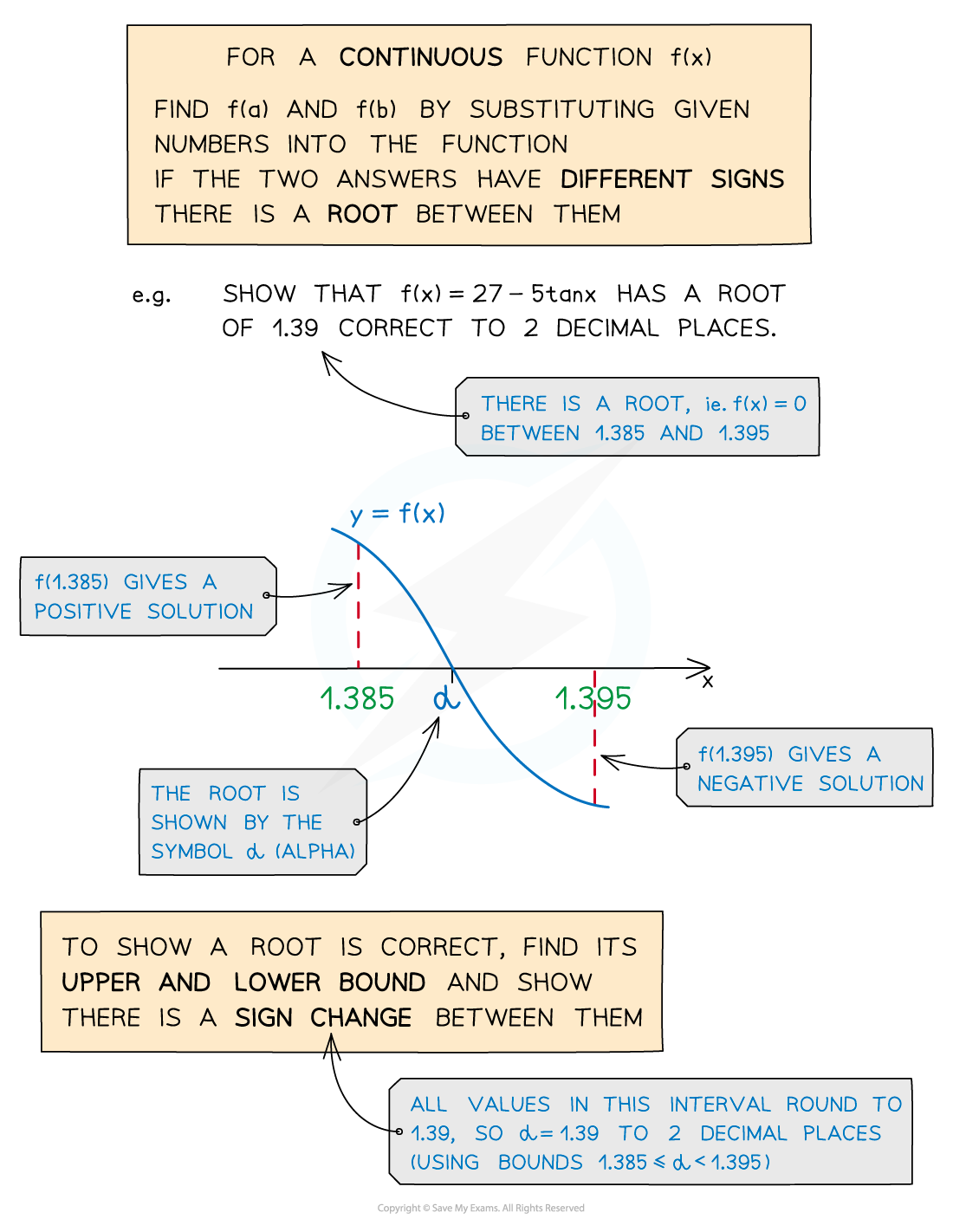
A suitable conclusion would be
has a sign change in the interval
and is continuous in the interval
so a root must lie in the interval
All values in the interval round to
so the root is to 2 decimal places
How do I know when the sign-change test fails?
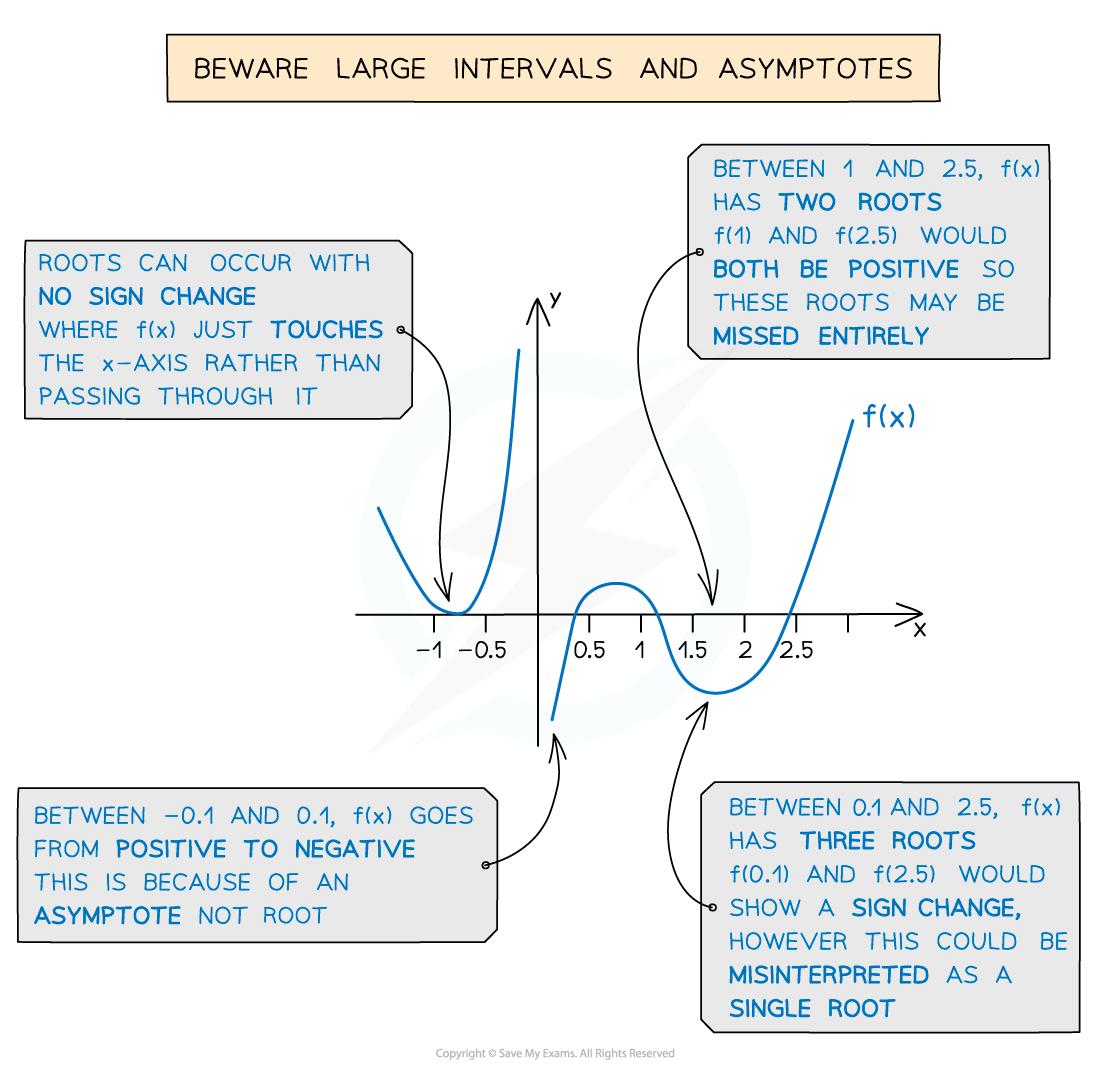
You need to know the three cases when the sign-change and continuity test fails to work properly:
If the curve only touches the -axis at the root, you will not see a sign change (even though there is a root)
If the curve has an asymptote in the interval, then you may see a sign change (but there is no root)
The asymptote means is not continuous
If the interval is too large, there may be more than one root in it
You may see a sign change (an odd number of roots)
Or you may not see a sign change (an even number of roots)
Worked Example
The equation where has exactly one positive root.
(a) Show that the intervals and both have a change of sign in .
Substitute , and into
Comment that the signs are different for each interval
and so there is a sign change in
and so there is a sign change in
(b) Determine, with a reason, which of the intervals contains the root.
An interval contains a root if has a sign change and is continuous in that interval
Check to see if is continuous in
You need to look for any asymptotes
is undefined when
The asymptote lies in the interval
There are no other asymptotes and only one root
The interval contains the root as there is a sign change and is continuous
The interval contains the asymptote so is not continuous

Unlock more, it's free!
Join the 100,000+ Students that ❤️ Save My Exams
the (exam) results speak for themselves:

Was this revision note helpful?
