Newton-Raphson Method (Edexcel International AS Further Maths: Further Pure 1): Revision Note
Exam code: XFM01

Newton-Raphson Method
How do I apply the Newton-Raphson method?
The Newton-Raphson method is a process for finding roots of equations
Equations must be rearranged into the form
If is a root of the equation , then you need to choose , the initial (first) approximation
This is usual given in the question (and is a value near to the root)
You can then find successive approximations , , , ... using the Newton-Raphson formula:
This is an iterative formula
is the derivative of
Work this out beforehand
Increasing the number of approximations improves the accuracy
The Newton-Raphson method usually converges quickly to the root compared to other methods
Examiner Tips and Tricks
The formula for the Newton-Raphson method is given in the Formulae Booklet.
How do I apply the Newton-Raphson method on my calculator?
If your calculator has a recursion function
Input the formula, start value and number of steps
The output is a table showing all the approximations
Alternatively:
Type in the value of and press =
This stores it in the "Ans" (answer) button
Type into your calculator and press =
This finds
Without pressing any other button, press = again
This finds
Repeatedly pressing = gives further approximations
The more you press it, the closer to the root it becomes
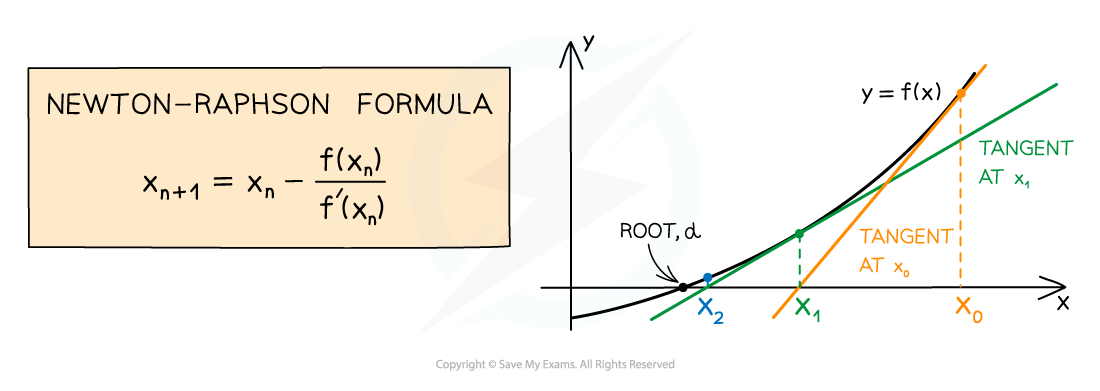
How does the Newton-Raphson method work geometrically?
The method works by drawing a tangent to the curve at
then finding where the tangent cuts the x-axis
This x-intercept is the new approximation,
This process is then repeated
Draw the tangent to at
Find its x-intercept and call it
The approximations get closer and closer to the root
How do I know if the Newton-Raphson method will fail?
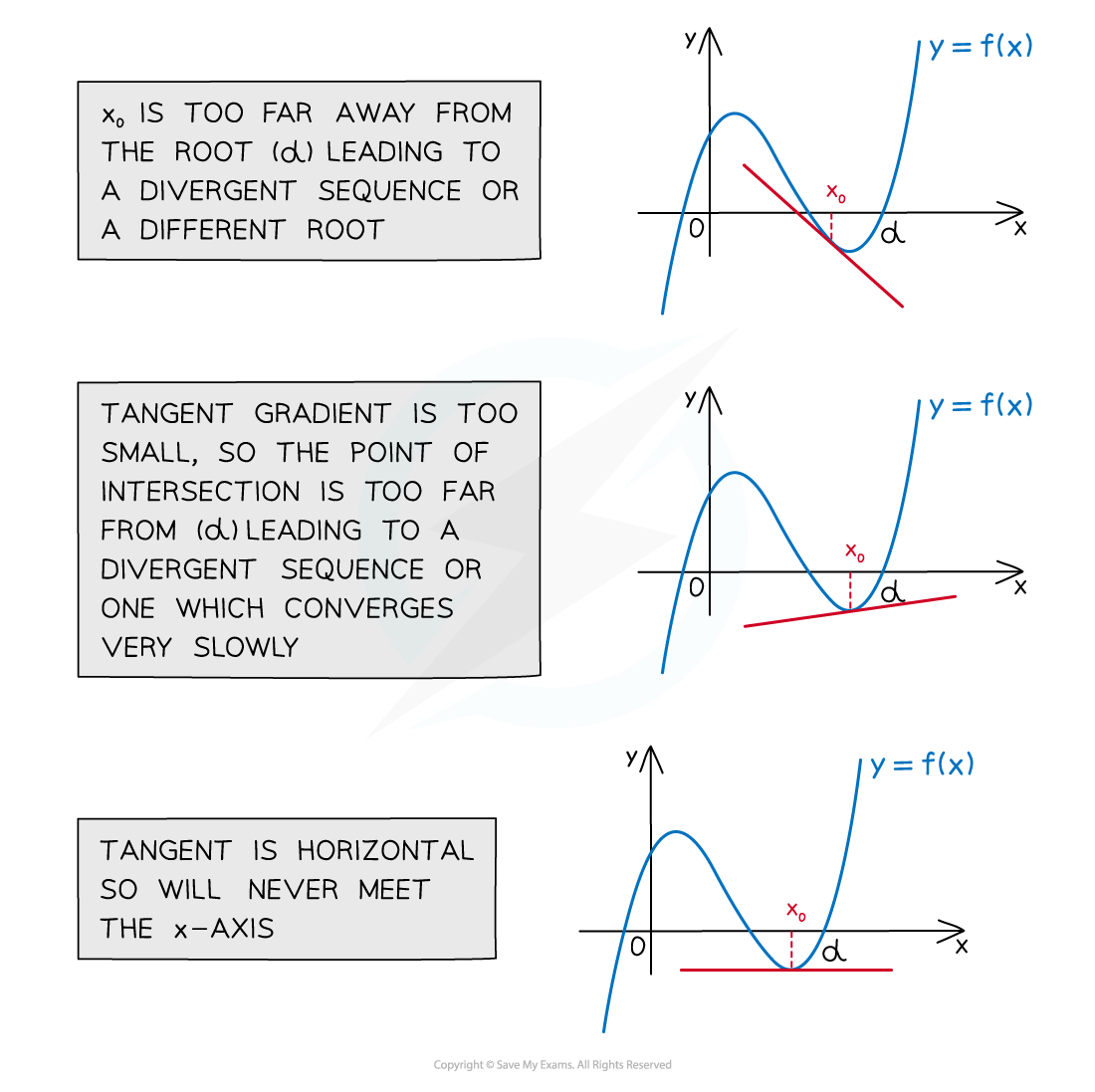
The Newton-Raphson method fails if the initial value, , satisfies
Algebraically, this is because the formula cannot divide by zero
Geometrically, this is because is at a stationary point on the curve
A tangent drawn at a stationary point is horizontal
This will never intersect the x-axis
The Newton-Raphson method also fails if the sequence , , , ... diverges
This can happen if is chosen:
too far away from the root
or at a point where the gradient is very small
The Newton-Raphson method is sometimes avoided when is too tricky to differentiate
Worked Example
The equation has a solution in the interval .
(a) Using as the first approximation to the solution, apply the Newton-Raphson method to find a second approximation.
Rearrange the formula into the form
so
(You could also use )
Find using differentiation
Substitute and into the Newton-Raphson formula
Substitute into the formula to get
Check this solution lies in the interval
is also accepted
(b) Explain why the midpoint of the interval cannot be used as the first approximation when applying the Newton-Raphson method.
The Newton-Raphson method fails if satisfies
Find the midpoint of the interval
Check if
Write a conclusion either about dividing by zero, or about having a horizontal tangent
, but you cannot divide by zero in the formula
So 1.5 cannot be used as the first approximation
You could also say that is at a stationary point where the tangent is horizontal, meaning it cannot intersect the x-axis to make

Unlock more, it's free!
Join the 100,000+ Students that ❤️ Save My Exams
the (exam) results speak for themselves:

Was this revision note helpful?
