Modulus & Argument (Edexcel International AS Further Maths: Further Pure 1): Revision Note
Exam code: XFM01

Argand Diagrams
What is an Argand diagram?
An Argand diagram is a 2D Cartesian grid used to visualise complex numbers
The complex number is represented by the point with coordinates
The real part is measured along the x -axis
called the real axis, written "Re"
The imaginary part is measured along the y -axis
called the imaginary axis, written "Im"
Complex numbers can be thought of as points, or as vectors from the origin


Examiner Tips and Tricks
If asked to sketch an Argand diagram, it does not need to be to scale (plotted), but should roughly show the correct positions.
Worked Example
Sketch, on the same Argand diagram, the complex numbers and .
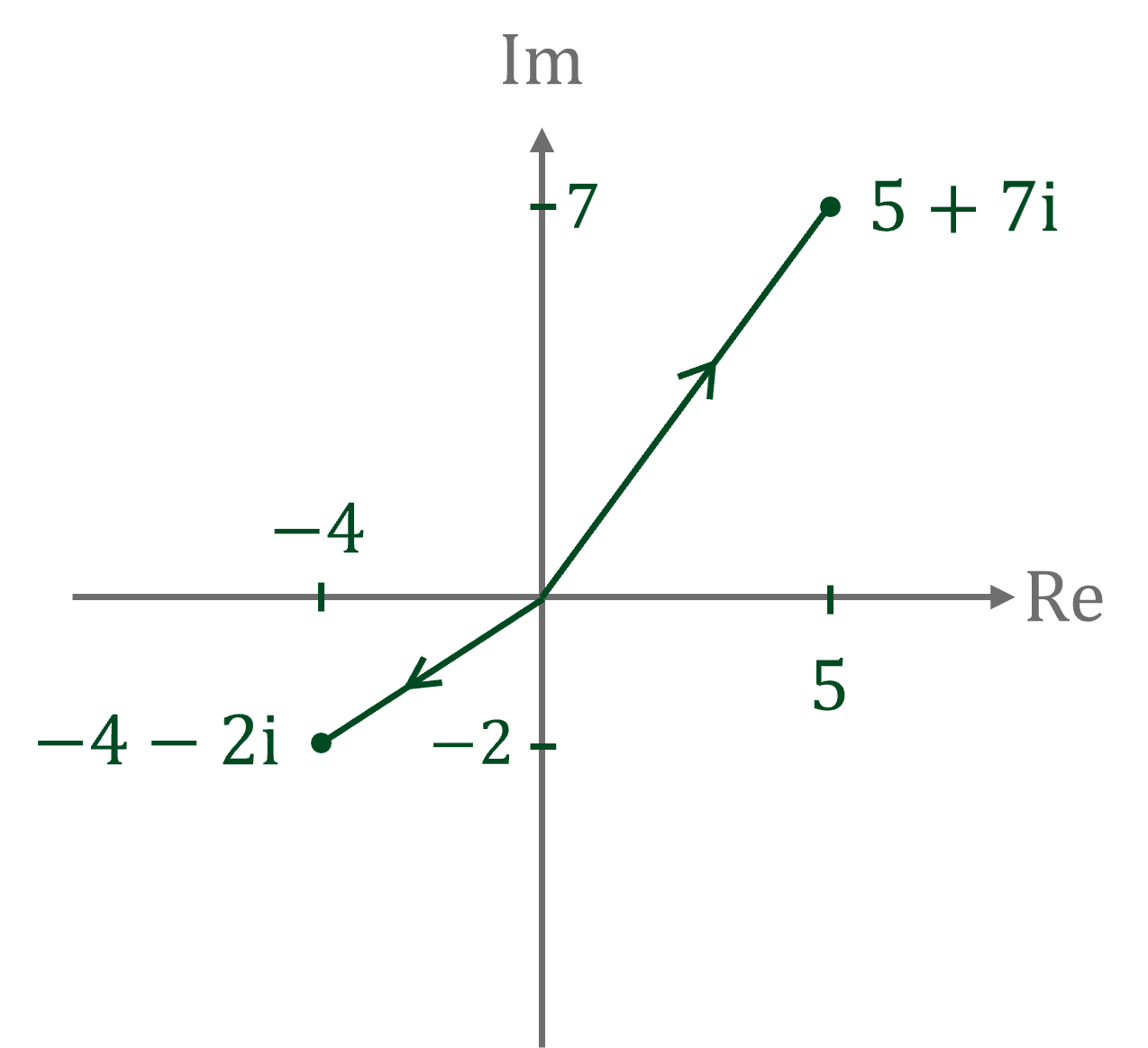
Modulus & Argument
How do I find the modulus of a complex number?

The modulus of a complex number is its distance from the origin on an Argand diagram
It is written
If , then by Pythagoras' theorem
A modulus is always positive or zero
It cannot be negative
For example
What rules does the modulus follow?
Helpful modulus rules are:
Proved using and
Be careful:
For example, and
and
so
but so
How do I find the argument of a complex number?
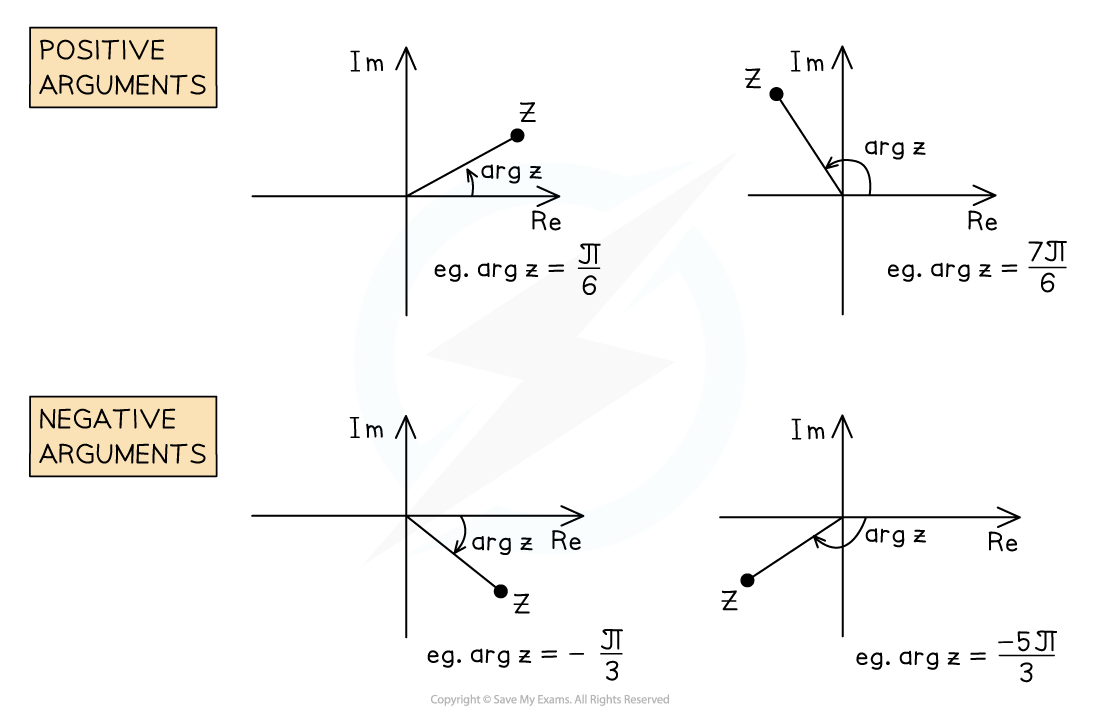
The argument of a complex number is the angle in radians that it makes to the positive real axis
It is written as
The positive direction is anticlockwise
The range normally used is
This is called the principal range
The sign of the angle depends on the quadrant:
The 1st quadrant is positive acute
The 2nd quadrant is positive obtuse
The 3rd quadrant is negative obtuse
The 4th quadrant is negative acute
Arguments are found by
drawing a sketch
forming a right-angled triangle
using trigonometry
The argument of the origin, , is undefined
No angle can be drawn
Examiner Tips and Tricks
Always draw a sketch to see which quadrant the complex number is in.
Worked Example
(a) Find the modulus and argument of , giving your answers correct to 3 significant figures.
Sketch this on an Argand diagram
Form a right-angled triangle
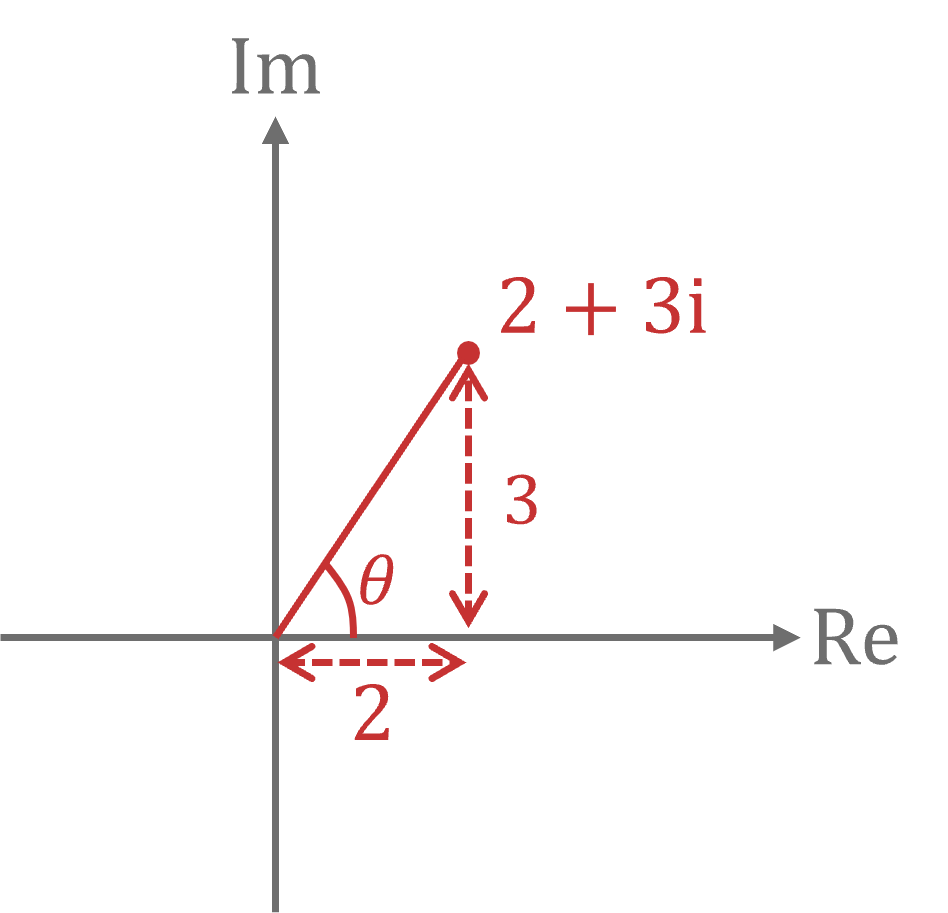
Use (or Pythagoras) to find the modulus
is in the first quadrant so the argument is positive and acute
Use trigonometry to find the argument in radians
Round the answers to 3 significant figures
and to 3 significant figures
(b) Find the modulus and argument of , leaving your answers as exact values.
Sketch this on an Argand diagram
Form a right-angled triangle
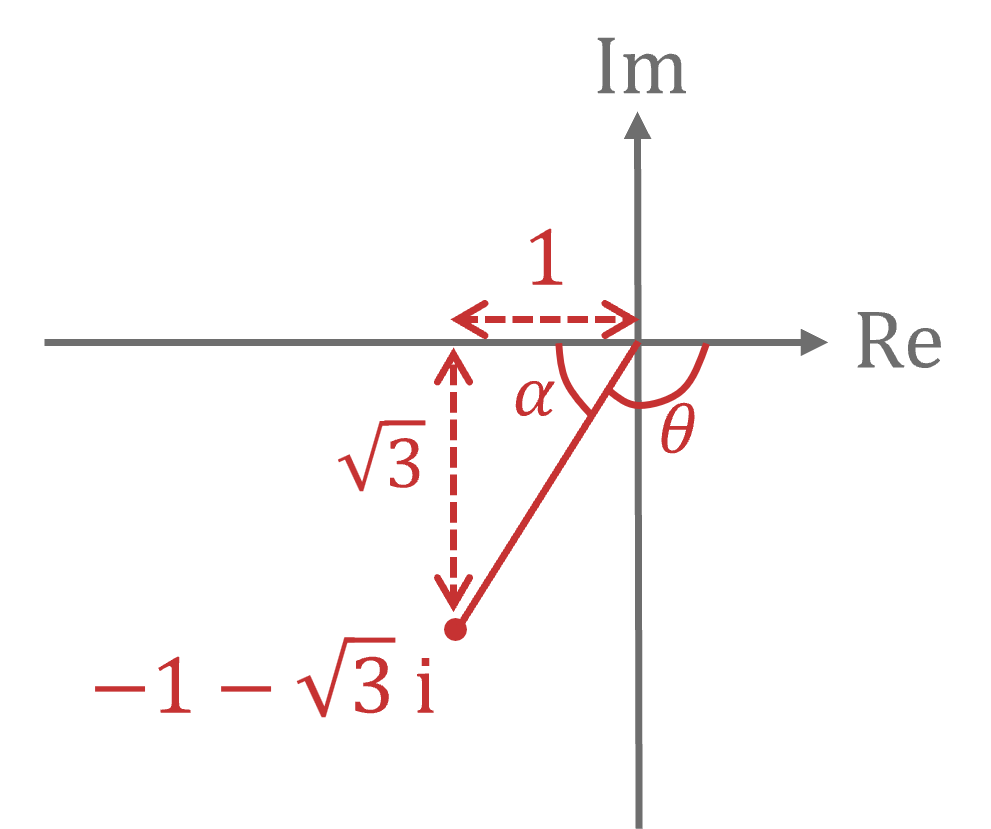
Use (or Pythagoras) to find the modulus
is in the third quadrant so the argument is negative and obtuse
Use trigonometry to first find in radians
Then find by subtracting from 180° ( radians)
Remember that the argument here must be a negative angle
and
These answers must be exact
Modulus-Argument Form
What is modulus-argument form?
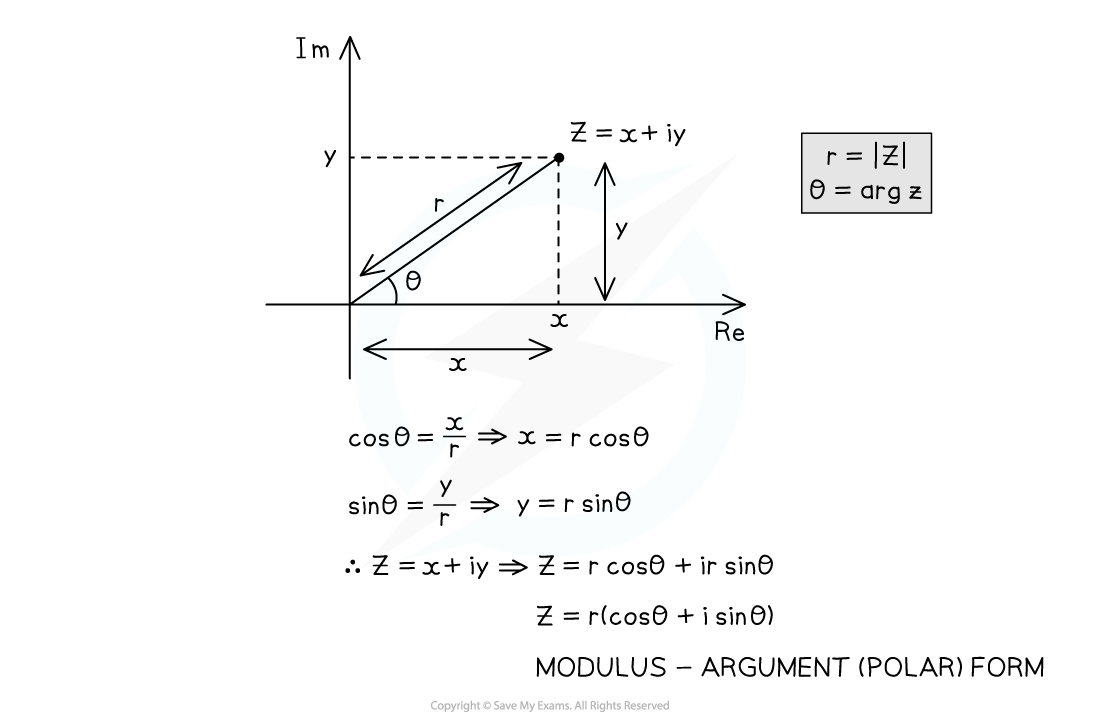
All complex numbers can be written in the form:
where and
This is called the modulus-argument (or polar) form
Negative arguments should be shown clearly without simplifying
Simplifying them gives the Cartesian form
Be careful: is not in modulus-argument form (due to the minus sign)
Rewrite it as
This uses the symmetries and
The argument is
Worked Example
Write in the exact form where and .
Draw a sketch to find the modulus, , and argument, , of
Form a right-angled triangle
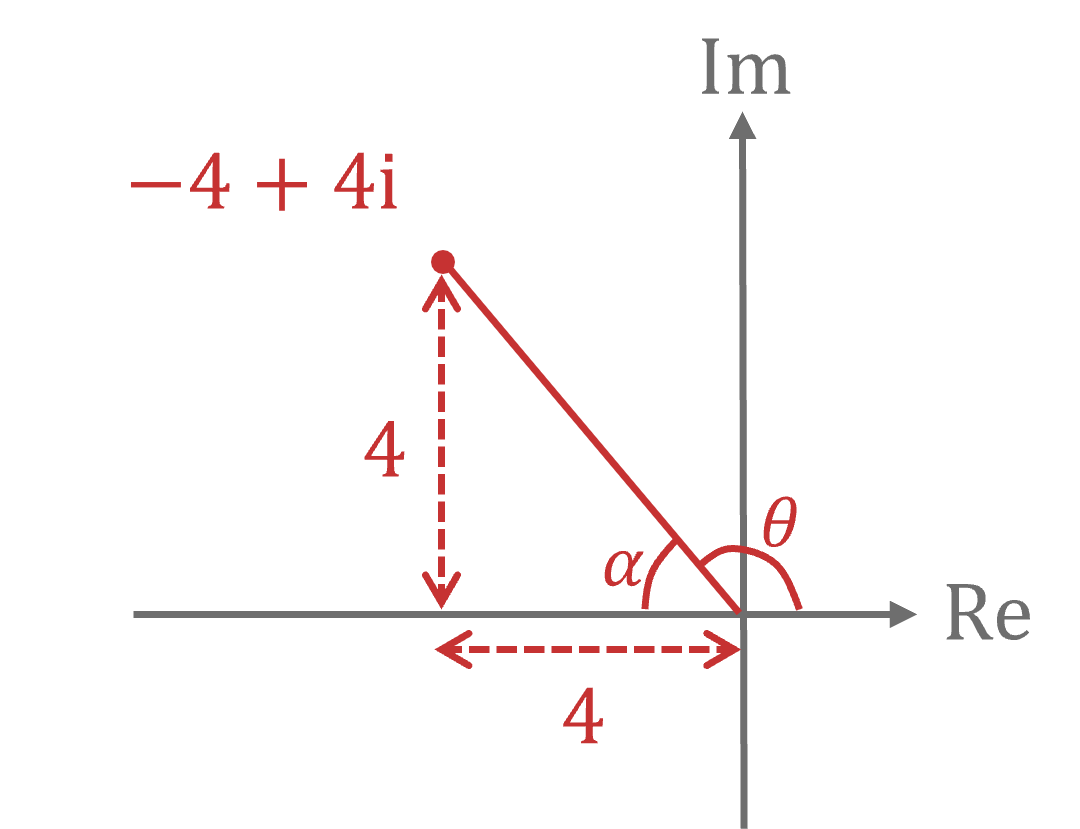
Use (or Pythagoras) to find the modulus
is in the second quadrant so the argument is positive and obtuse
Use trigonometry to first find in radians
Then find by subtracting from 180° ( radians)
Write the final answer in the form
Leave the modulus and argument exact

Unlock more, it's free!
Join the 100,000+ Students that ❤️ Save My Exams
the (exam) results speak for themselves:

Was this revision note helpful?
