Hardest A Level Further Maths Questions & How To Answer Them
The hardest A Level Further Maths questions are long, multi-part questions that chain several topics together — for example, a volume of revolution that also needs parametric differentiation, trigonometric identities and integration by parts. Pearson Edexcel examiners’ reports show that students usually handle the routine parts well, then lose marks at the point where it is not immediately obvious as to what they need to do next.
At Save My Exams, we aim to make even the hardest questions easy to understand through our A Level Further Maths revision resources.

Written by: Harry Williams
Reviewed by: Dan Finlay
Published

Contents
- 1. Key Takeaways
- 2. What Makes an A Level Further Maths Question 'Hard'?
- 3. Types of Difficult A Level Further Maths Questions
- 4. Example Hard Questions & How To Answer Them
- 5. Strategies for Tackling Hard A Level Further Maths Questions
- 6. How to Prepare for Hard A Level Further Maths Questions
- 7. Frequently Asked Questions
- 8. Final Thoughts
The final question on a Further Maths paper has a reputation, and it has earned it. It is usually worth ten marks or more, it arrives when you are tired, and it tends to combine three or four topics in a way you have never quite practised before.
If you have ever turned to that page and felt your confidence drain away, you are in good company.
This guide looks at what makes an A Level Further Maths question hard, the types of question that cause the most trouble, and four real Edexcel (9FM0) Core Pure questions that most students could not finish, with a step-by-step approach to each. Core Pure is the compulsory content every A Level Further Maths student studies, so the same skills apply to AQA and OCR papers.
Key Takeaways
The hardest Core Pure questions are rarely hard because of one difficult idea. They are hard because they chain several topics together — a parametric curve, a volume of revolution, a trigonometric identity and integration by parts, all inside a single question.
A correct answer typed into a calculator scores nothing when a question says "use calculus" or needs working.
Some of the lowest-scoring marks on recent papers are worth a single mark and involve no calculation at all – instead the question asks a student to explain what a model predicts, or why a result holds.
Before you use a result from an earlier part, check its conditions still apply. For example, a formula built for an even number of terms will not directly work for an odd one.
What Makes an A Level Further Maths Question 'Hard'?
Difficulty in Further Maths comes from a handful of recurring features.
Long chains of reasoning. The final questions on Core Pure papers are often worth 10 marks or more across three or four parts, each depending on the last. One early slip can follow you to the end, and can cause a ‘snowballing’ effect of lost accuracy marks.
Several topics in one question. A volume of revolution question might also need parametric differentiation, a double angle identity and integration by parts. Students who revised each topic separately often know how to understand the methods, but struggle in knowing when and how to combine multiple topics in the context of a problem-solving question.
Algebraic endurance. Differentiating a hyperbolic function four times without dropping a term is not conceptually difficult, but it demands sustained accuracy under time pressure. The algebra in Further Maths is often more fiddly, with far longer expressions, equations and chains of reasoning to deal with.
Unfamiliar contexts. Modelling questions about ‘vases’ and ‘journeys uphill’ dress familiar techniques in new clothing, that can make it trickier for students to identify the underlying mathematical ideas and challenge them to think creatively when the questions ask a student to comment on whether the mathematical model makes sense, or for a limitation of the mathematical model.
Precision in reasoning. "Explain why", "show that" and proof questions need complete, logical arguments. Examiners’ reports describe answers that are long and wordy but miss the key point the mark depended on.
Types of Difficult A Level Further Maths Questions
Almost every hard Core Pure question belongs to one of three families: multi-topic chain questions, modelling and interpretation questions, and extended reasoning and proof questions. Knowing which one you are facing tells you where the difficulty is likely to be hiding.
Multi-Topic Chain Questions
Multi-topic chain questions start with something routine and gradually pull in more of the specification, each part handing you a result to use in the next. The signal to watch for is a step that produces something you cannot finish — an integral that matches no form you recognise, or an expression that refuses to simplify. That usually means an identity or a substitution is needed before you can go further.
Modelling and Interpretation Questions
Core Pure papers regularly set questions in context. The mathematics in the middle is often well rehearsed; the difficulty comes at the end, when you are asked what the model predicts or what its limitations are. The common failure is the rote answer — "it tends to infinity", "the surface is not perfectly smooth" — written without checking whether it applies to this particular model, or without directly referring to the specific wording used in the exam question.
Extended Reasoning and Proof Questions
Extended reasoning and proof questions ask you to explain, justify or prove, and they carry marks that no amount of accurate arithmetic will earn. The key skills are:
applying a known result in an unfamiliar situation, and checking it genuinely applies
justifying every step when the answer is already printed
linking earlier parts of a question to the later ones
Example Hard Questions & How To Answer Them
The table below summarises the four questions, what examiners reported about each, and the key fix.
Question | Topic | What examiners reported | Main trap | Key fix |
|---|---|---|---|---|
Core Pure 2, June 2024, Q9 | Volumes of revolution (parametric) | Perhaps the most demanding question on the paper; many made no progress on part (b) | Setting up the integral, then being unable to integrate it | Use identities to split the integrand, then integrate term by term |
Core Pure 1, June 2023, Q7 | Series with alternating signs | Perhaps the most demanding question on the paper; part (c) very rarely fully correct | Using a formula built for an even number of terms with an odd limit | Check the required conditions of a result before you use it |
Core Pure 1, June 2025, Q8 | First order differential equations in context | Part (b) poorly answered overall; some students could not access parts (c) and (d) | Wrong integrating factor; missing sin t = 0 | Write the equation in standard form first, and find every solution |
Core Pure 2, June 2022, Q9 | Maclaurin series with hyperbolic functions | Only a minority found a completely correct fourth derivative | Dropping a term between derivatives | Differentiate one step per line and check as you go |
Example 1: The Volume of Revolution That Became an Integration Marathon
Edexcel A Level Further Maths, Core Pure 2 (9FM0/02), June 2024, Question 9
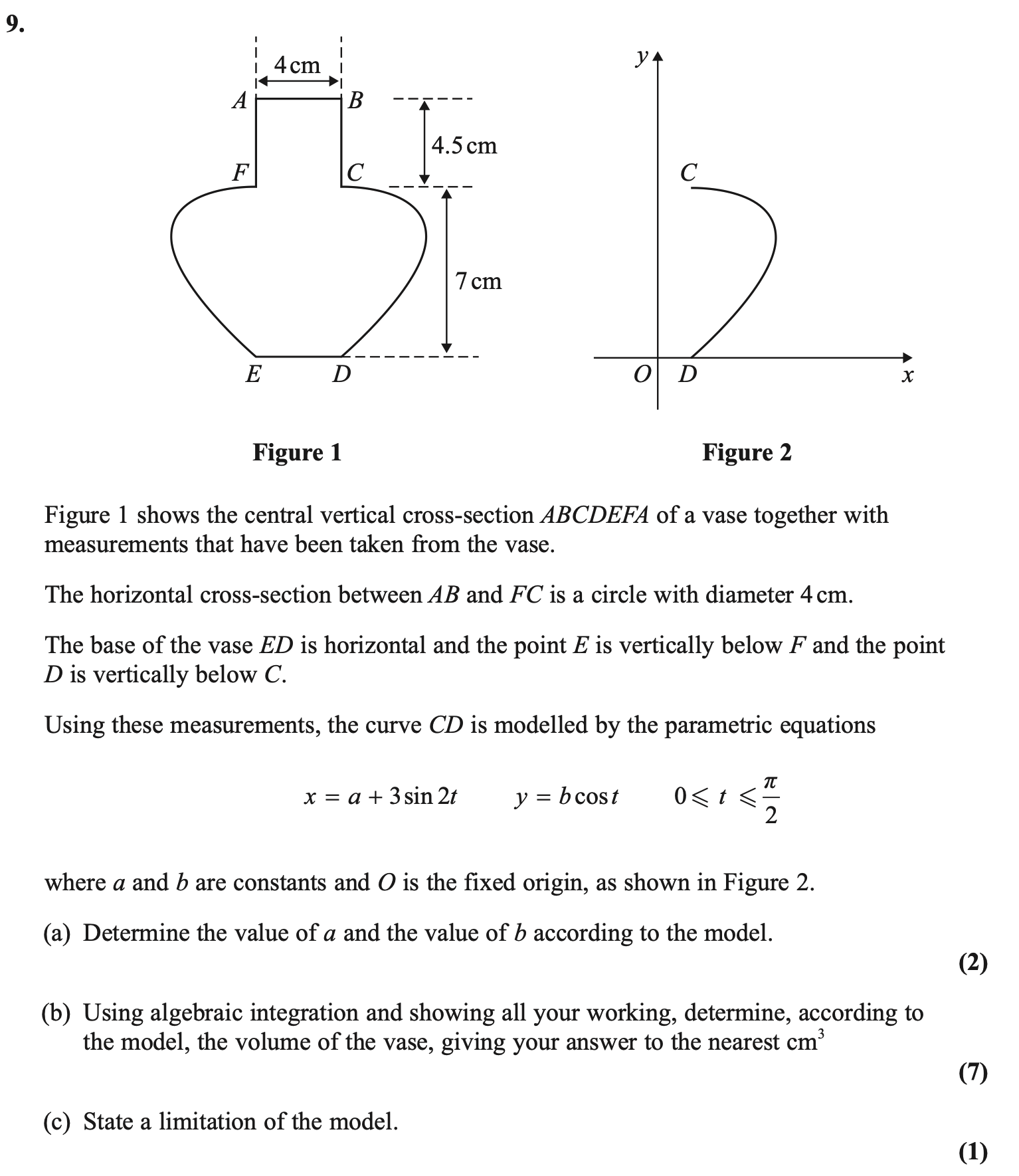
Why it is hard: The examiners’ report (opens in a new tab) for Edexcel’s June 2024 Core Pure 2 Question 9 (opens in a new tab) describes it as “perhaps the most demanding question on the paper”, and its part “(b) as by some margin the most technically demanding section of the whole paper”. It proved challenging for most students, many failed to make any progress at all on part (b), and many who did scored only one or two marks there.
The question models a vase using a parametric curve rotated about the y-axis. Part (a), finding two constants, was generally well answered. Part (b), finding the volume, is where the chains of reasoning begin with students needing to: set up the parametric volume formula, simplify using trigonometric identities, integrate (including by parts), and add the volume of a cylinder.
The trap: Many students set up the right integral and then stopped. They had the correct formula but could not turn the integrand into something they could integrate. Others found the correct answer, 588π/5, on their calculator and wrote it down with no working — and scored nothing for it.
How to approach it:
Write down the volume formula for rotation about the y-axis. With parametric equations, V = π∫x²(dy/dt) dt. Setting this up with your expressions substituted in earns credit even if you get stuck later.
Use identities to break the integrand into manageable pieces. In this question, the use of double angle identities was required to turn the integral into a form that can be integrated. Examiners noted that few students got this far.
Integrate term by term, choosing a technique for each. This question was most easily answered by transforming each term in the integral to a form that could be integrated ‘by inspection’.
Remember the rest of the shape. The question also needs the volume of a cylinder. That was one of the few marks students who got stuck still picked up — so even if you get stuck on the integration, it’s still very much worth writing this down.
Show every integration step. When a question says "use calculus", a calculator value on its own is not a method. You need to write down the key steps of your working without making big ‘leaps’.
Common mistakes: Stopping after setting up the integral; using identities that led away from an integrable form; writing a calculator answer with no working; and in part (c), giving limitations that did not apply to this model, such as the vase being solid.
Example 2: The Series Question Where One Sign Changes Everything
Edexcel A Level Further Maths, Core Pure 1 (9FM0/01), June 2023, Question 7
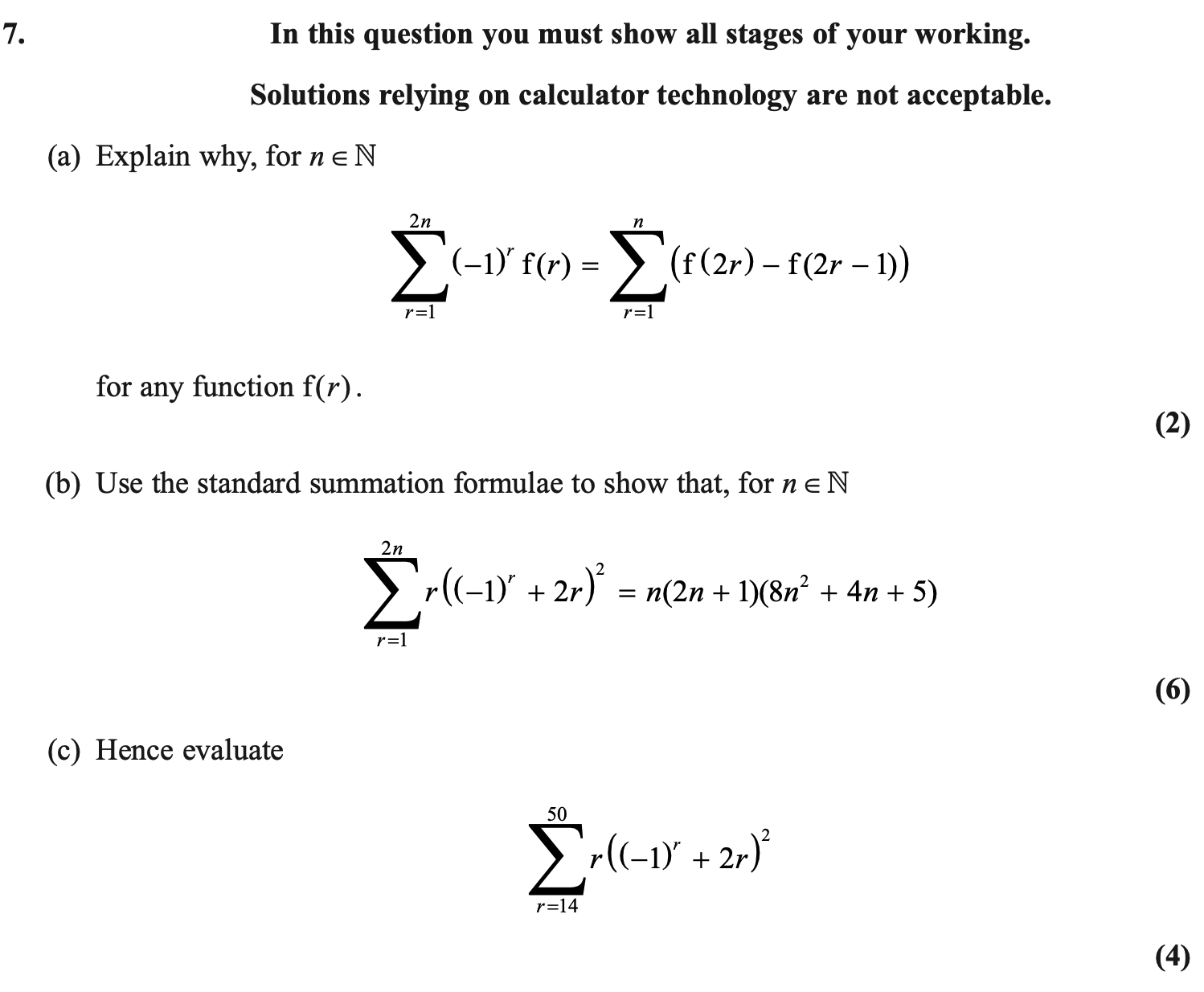
Why it is hard: The examiners’ report (opens in a new tab) for Edexcel’s June 2023 Core Pure 1 Question 7 (opens in a new tab) describes it as “perhaps the most demanding question on the paper”. It looks like a standard summation question, but every term carries a factor of (−1)ʳ, which makes the signs alternate — and that one change defeated many of the students who sat it. The final part was very rarely answered completely correctly.
The trap: There is one trap in each part.
In part (a), students had to explain why a result about the alternating sum holds. Many wrote long, unclear answers built around the word "alternating". Those who fared best kept it simple: they listed the terms, grouped them, and showed the two sides were equal. Very few also justified why the upper limit of the sum changed.
In part (b), the key step is spotting that (−1)²ʳ is always 1, because 2r is always even. That proved beyond a substantial number of students; some ignored it, while others treated it as though it still alternated.
In part (c), students needed to use the result from part (b) by splitting the sum into a subtraction of sums each starting at one. These sums would have the upper limits, 13 and 50. Most split it correctly into two sums. But the formula from part (b) only works when the upper limit is even — and 13 is odd. Very few noticed, and many incorrectly simply substituted n = 6.5.
How to approach it:
For "explain why" in part (a), use the number of marks available as a guide to how much to write. Write out the first few terms, group them, and show the two sides match. A short, clear argument beats a long description here.
Simplify every power of −1 first. Before expanding anything, ask what each power actually equals. (−1)²ʳ = 1 for every r, as 2r is always an even number when r is an integer, which removes a whole layer of difficulty.
Use part (a) where the question points you to it. Look for the connection between part (a) and part (b). The alternating term in part (b) is exactly what part (a) handles. Expanding it into cubics instead leads to long, error-prone algebra.
Check a result's conditions before you use it. Be careful, the formula in part (b) written in terms of 2n only covers even numbers of terms. When you attempt to work out part (c) through a subtraction, a sum with an odd limit needs an adjustment — for example, summing to 12 or 14 and correcting for the extra or missing term.
Treat a strange value as a warning. If your working gives n = 6.5, stop and think: remember that a sum cannot have six and a half terms.
Common mistakes: Wordy explanations that never make the key point; ignoring (−1)²ʳ; expanding into cubics rather than using part (a); substituting n = 6.5 into a formula that needs a whole number; and giving a calculator answer that does not match the working written down.
Example 3: The Differential Equation Where One Early Slip Closed Off the Rest
Edexcel A Level Further Maths, Core Pure 1 (9FM0/01), June 2025, Question 8
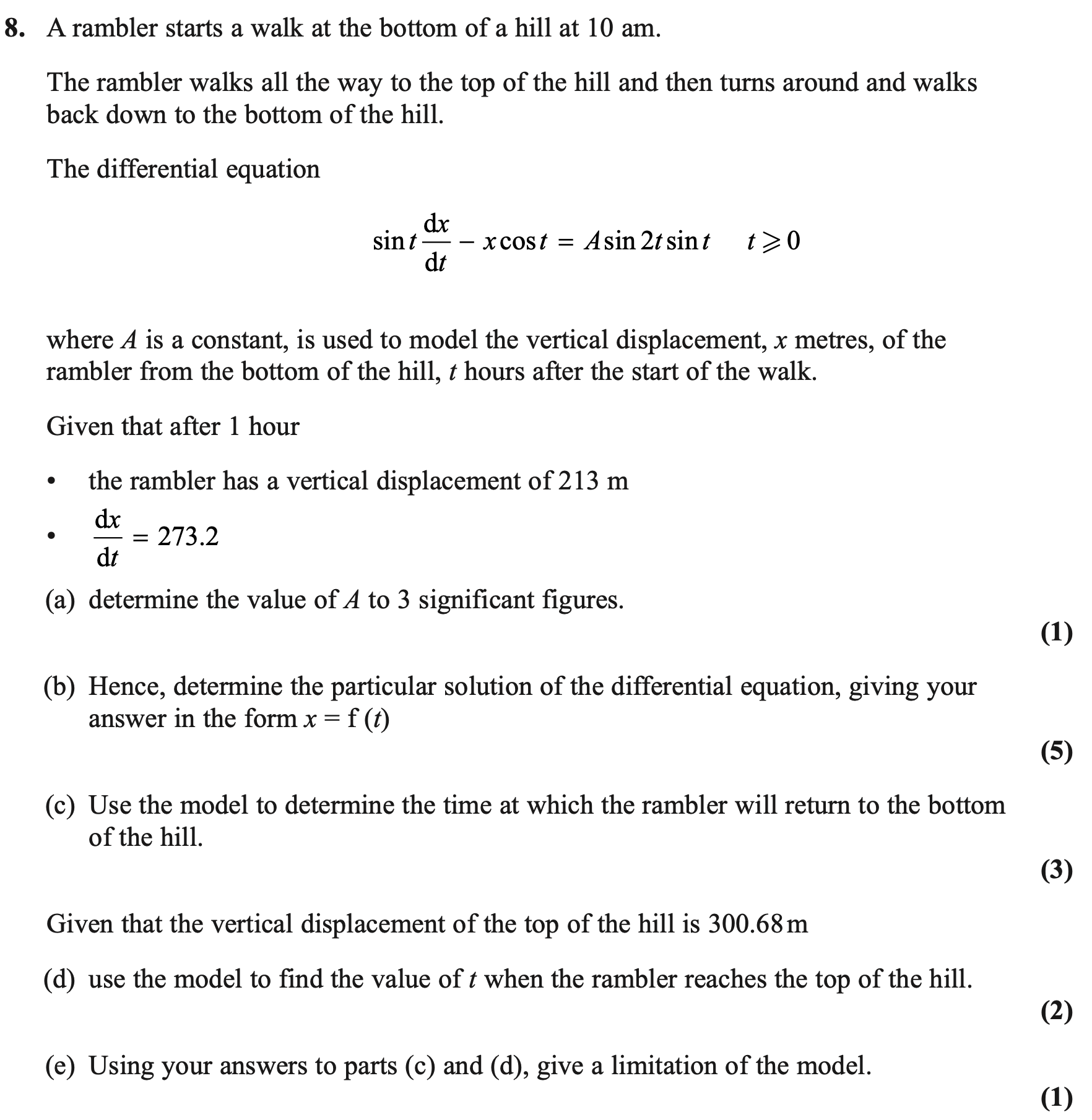
Why it is hard: The examiners’ report (opens in a new tab) for Edexcel’s June 2025 Core Pure 1 paper Question 8 (opens in a new tab), a five-part modelling question, as amongst the most demanding questions on the paper. Though art (a) was extremely well answered, part (b) — solving a first order differential equation using an integrating factor — was poorly answered overall. Because parts (c) and (d) both depended on the form found in part (b), several students could not access them at all. And the final part (e), linking the answers back to the context, was quite poorly answered even by students who had the correct values.
The trap: This question punishes small slips because every part feeds the next. In part (b), most students correctly found the integrating factor, cosec t, but a minority found sin t instead and could make little further progress. Integrating the right-hand side then needed a trigonometric identity, and a factor of 2 was often lost along the way. In part (c), many students struggled to solve the trigonometric equation to find the correct root, and some failed to convert their numerical value into a time; reading the question very carefully for the required form is crucial here. In part (d), students solving a quadratic in sin t frequently missed the solution sin t = 0 altogether, or incorrectly rounded a root very close to 1 - but not exactly 1 - to 1 — which led to a different, and inaccurate, value of t. In part (e), many students struggled to put their thoughts into sentences, and some didn’t use the specific values to parts (c) and (d) as was required by the question, and some failed to write a conclusion consistent with the reality of the problem as described in the question.
How to approach it:
Put the equation in standard form before finding the integrating factor. Rearrange to the form dx/dt + P(t)x = Q(t), keeping careful track of the sign of P(t). The integrating factor depends entirely on it, and an error here cannot be recovered later.
Use what you already know, and keep every factor. Use the numerical value you found in part (a) rather than carrying a letter through. Look for an identity before you integrate the right-hand side, and check that no factor of 2 disappears. Take care with the details is crucial.
Find every solution, including the obvious one. When a quadratic in sin t has a root of 0, that is a solution too. Make sure you list all the values of t in order rather than jumping ahead by 2π.
Don't round too early. A root of 0.9999 is not precisely 1, so do not round to an exact value. Rounding too early at this stage changes which values of t satisfy the equation.
Answer the question that was asked — then check it makes sense. If the question asks for a time, give a time. And test your answer to the final part against the reality of situation described in the question: here, many students failed to recognise that the stage going up the hill should take longer.
Common mistakes: Finding sin t instead of cosec t as the integrating factor; losing a factor of 2 when integrating; leaving a constant from part (a) as a letter; missing the solution sin t = 0; rounding too early by rounding a decimal of 0.9999 to precisely 1; working in degrees rather than radians; and not linking the final answer back to the context.
Example 4: The Maclaurin Question That Was Really About Differentiation
Edexcel A Level Further Maths, Core Pure 2 (9FM0/02), June 2022, Question 9
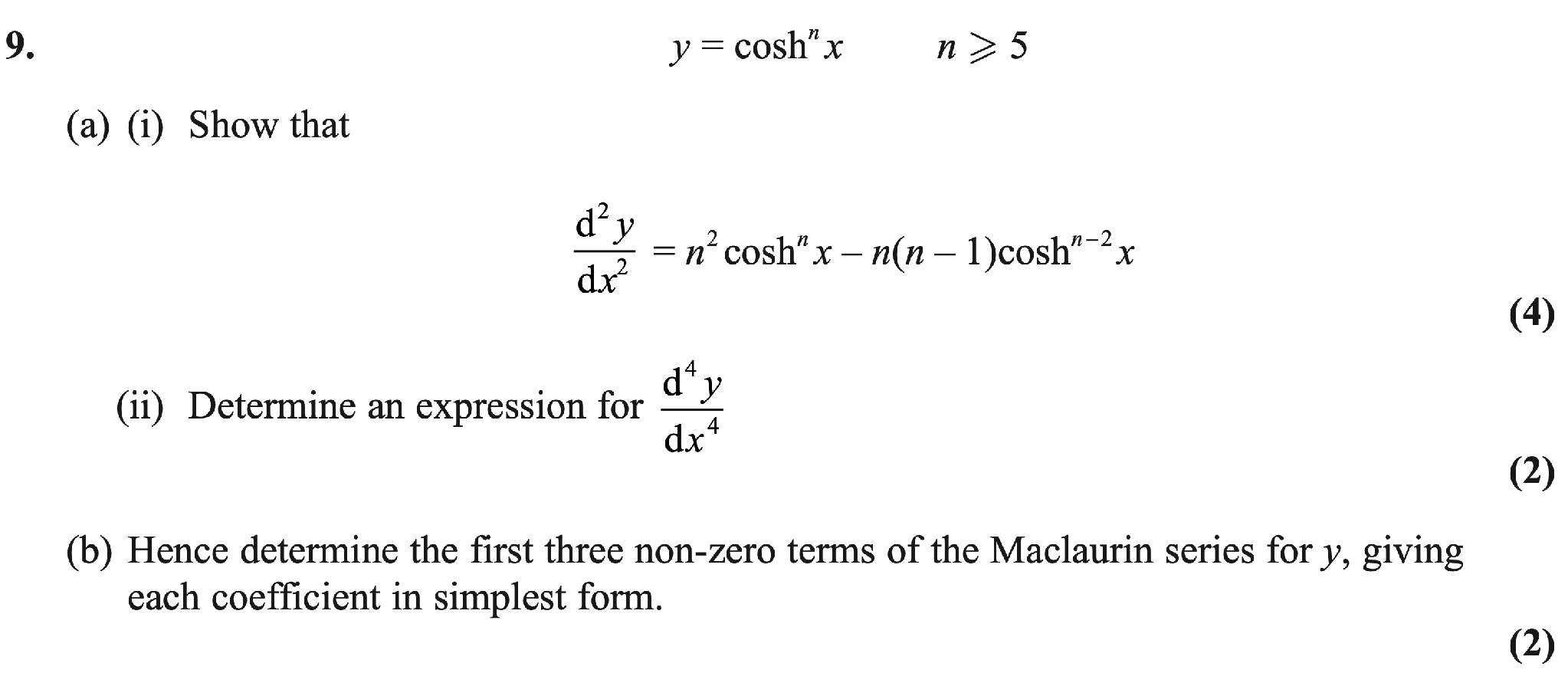
Why it is hard: The examiners’ report (opens in a new tab) for Edexcel’s June 2022 Core Pure 2 Question 9 (opens in a new tab) describes it as a “demanding question for many students”. The barrier for many students seemed not to be with their understanding of how a Maclaurin series work. In fact, the barrier was the differentiation involved. Only a minority produced a completely correct fourth derivative, and only the strongest students reached the final answer. The examiners' own verdict is striking: the complexity of the differentiation left many students unable to show whatever ability they had with Maclaurin series at all.
The trap: The function involves hyperbolic functions, and each derivative needs the chain rule and product rule together. By the third and fourth derivatives the expressions are long, and one small slip — a missing square, a missing x — carries through to everything after it. Students who got into a muddle in part (a) often abandoned part (b) entirely, and some simply stated values at x = 0 without showing how they found them.
How to approach it:
Look for a simplification before each derivative. Examiners noted that some students made the later derivatives easier by rewriting part of an expression in terms of y itself, rather than carrying long hyperbolic expressions through every step. The identity cosh²x − sinh²x = 1 is often the tool that makes this possible.
Differentiate one step at a time, on a new line. Label each derivative clearly. Long expressions squeezed into a cramped space on the page are where terms go missing and little slips can easily snowball.
Check as you go. Evaluating each derivative at x = 0 as soon as you find it makes errors easier to spot before they multiply.
Show every evaluation at x = 0. Write the substitution out for each derivative. Values that appear without working may not be credited.
Attempt part (b) even if part (a) went wrong. You may still pick up method marks for using the Maclaurin formula correctly with your own values.
Common mistakes: Dropping a square or an x between derivatives; abandoning part (b) after a muddle in part (a); and stating values at x = 0 without showing the substitution.
Strategies for Tackling Hard A Level Further Maths Questions
The four examples above come from different topics, but the habits that would have rescued most of the lost marks are the same. These strategies apply to any hard Core Pure question.
Read the Question Carefully and Identify What's Being Asked
Before writing anything, read the question very carefully and, as you do so, underline what you are given, what you are asked to find, and the command words. Four command words are particularly important to consider, especially in Further Maths:
Hence — use the previous result. Starting again usually costs time and marks.
Show that — the answer is printed, so your working is the whole answer.
Use calculus — a calculator value on its own will not score, however correct it is. When a question asks you to use calculus, it is asking you to show the steps using differentiation.
Explain why / Comment on — a sentence is required: the examiners usually aren’t looking for stock answers here: they want you to write a comment that reflects the specifics of the question.
Check the angle measure (degrees or radians), and exactly what form the final answer should take — a time rather than an angle, or every solution rather than just one. Example 3 shows how easily a correct method loses its final marks at the last step.
Use Diagrams, Working or Planning Where Helpful
Core Pure questions are long enough for disorganised working to lose you the thread of your own argument. Visualise the volume of revolution with a quick sketch (this can be especially helpful when identifying cylinders or cones). Write each step on a new line, lining up your terms to help reduce the chance of miscopying from line to line. Give every new constant a distinct label. And keep each part clearly separated, so a marker can follow your method even if you make a slip with your arithmetic.
Break Down Multi-Step Problems
Treat a long question as several short ones stacked together. If you get stuck on a later part:
Identify exactly what the questions ask you to find.
Work out what you would need in order to find it.
Check whether an earlier part has already given you that step.
Write down each intermediate result down clearly.
Before using any earlier result, check that its conditions still apply to what you are trying to repurpose it for.
If you cannot do an early part, attempt the later ones anyway — they are often accessible on their own. If you need a value from an earlier part that you didn’t complete, just invent a value!
Practise Under Timed Conditions
The hardest questions usually come last, so you meet them tired and short of time. Sitting full papers in one go is the only real rehearsal. Aim to reach the final question with time to attempt every part of it — its opening parts are often among the most accessible marks on the paper.
How to Prepare for Hard A Level Further Maths Questions
Use Past Papers Strategically
Work vertically rather than from front to back: take the final two questions from every Core Pure paper of the last few years and do them back to back. The same chains of topics keep recurring, and the traps in this article start to feel familiar rather than surprising.
Check out our Further Maths Mock Exams on Save My Exams, full practice papers created by expert teachers and examiners, fully aligned to your exam specification. You can practice online in real exam conditions, or save your progress and return later. Submit your paper and review your answers using AI, or against step-by-step model solutions that are written with students in mind to help you to understand exactly what you need to write to score the marks.
Understand Mark Schemes
When you mark your own work, look beyond the final answer. Method marks reward a correct approach even when the arithmetic goes wrong, which is why your method should always be written down. Accuracy marks often depend on an exact form or correct units. And some marks are for statements alone — a proof conclusion, a comment on a model — with no calculation attached.
Check out our Core Pure Exam Questions and answers, organised by topic, written by expert teachers and examiners. Every question has full model solutions that are written with students in mind: we explain every step, and show you exactly how the examiners award each mark.
Master Key Concepts and Knowledge
Most of the difficulties in this article trace back to a small set of skills worth securing early: trigonometric and hyperbolic identities; integration; parametric differentiation and the parametric volume formula; summation formulae and the conditions they need; and sustained algebra across many lines without losing terms.
For clear, concise notes on all of these, and every Core Pure topic, check out our Core Pure Revision Notes.
Work Through Worked Examples
Reading a solution is not the same as producing one. Read it, close it, and reproduce it — straight away, then again a few days later — before attempting a similar question you have not seen. Or, better still, read just enough of a solution to get ‘unstuck’ and then see if you can finish off the rest yourself. The gap between what you can follow and what you can produce on your own is where your revision time should go.
Frequently Asked Questions
Do I need to answer the hardest questions first in the exam?
No. Core Pure papers generally become more demanding towards the end, so working through in order lets you bank accessible marks while you are fresh. What matters is not leaving the final question untouched. As the examples above show, the first part of even the hardest question is often well answered by most students — so make sure you reach it with time to spare.
How can I improve my proof-writing skills for Further Maths?
Start with conclusions, because they are among the easiest marks to lose. Examiners regularly report proofs that stop without a final statement such as "LHS = RHS", and induction proofs that incorrectly end with "true for n = 1, n = k and n = k + 1, therefore true for all n" — which loses the mark, because it never states that truth for n = k implies truth for n = k + 1. Check out our Revision Notes on Proof by Induction and use our Flashcards to make sure you know these conclusions off heart.
Beyond that, keep explanations short but precise. In "show that" questions, make sure you include every step, because the answer is already on the page and the working is what earns the marks. And when a question says "explain why", use the number of marks available as a clue to how many distinct points you need to write.
Are A Level Further Maths exam questions getting harder?
Not systematically. Edexcel’s current A Level Further Maths specification (9FM0), first examined at A Level in 2019, places more emphasis on modelling, interpretation and questions that combine topics than the older modular course did, which can make papers feel harder. But difficulty varies from year to year rather than rising steadily — examiners described the June 2026 Core Pure 1 paper as accessible across the ability range — and grade boundaries are set each year to account for how demanding a paper turned out to be.
Final Thoughts
The hardest A Level Further Maths questions are not usually testing a single difficult idea. They are testing whether you can carry a long argument through several topics without losing track, whether you check that a result applies before you use it, and whether you can say clearly what your answer means.
There is no doubt that the four questions mentioned in this article are challenging problems. But the very best Further Maths students aren’t afraid of a challenge. The marks lost by students in previous years are cautionary tales that the very best students can study and learn from.
Work through the Core Pure revision notes until each method feels familiar, then test yourself under timed conditions with Mock Exams and model solutions that show you exactly what each mark was for. Plenty of students who now handle these questions confidently once found them impossible — with the right practice behind you, you can get there too.
The students who do well on these questions are not the ones who never get stuck. They are the ones who have been stuck often enough, in practice, to recognise the feeling and know what to try next.
References
Pearson Edexcel, A Level Further Mathematics (9FM0) Paper 2: Core Pure Mathematics 2, Examiners’ Report, June 2024
Pearson Edexcel, A Level Further Mathematics (9FM0) Paper 1: Core Pure Mathematics 1, Examiners’ Report, June 2023
Pearson Edexcel, A Level Further Mathematics (9FM0) Paper 1: Core Pure Mathematics 1, Examiners’ Report, June 2025
Pearson Edexcel, A Level Further Mathematics (9FM0) Paper 2: Core Pure Mathematics 2, Examiners’ Report, June 2022
Pearson Edexcel, A Level Further Mathematics (9FM0) Paper 1: Core Pure Mathematics 1, Examiners’ Report, June 2024
Pearson Edexcel, A Level Further Mathematics (9FM0) Paper 1: Core Pure Mathematics 1, Examiners’ Report, June 2026
The Pearson reports are published on Pearson’s past papers page (opens in a new tab).
Was this article helpful?
Sign up for articles sent directly to your inbox
Receive news, articles and guides directly from our team of experts.

Share this article



 written revision resources that improve your