Hardest A Level Further Maths Topics & How To Tackle Them
The hardest A Level Further Maths topics are 3D vectors, complex numbers (especially roots of unity and loci), polar coordinates, differential equations in context, and invariant points and lines in matrices. Pearson Edexcel’s Core Pure examiners’ reports show that marks in these topics are usually lost in three places: not seeing the geometry, not writing the concluding sentence, and not interpreting the model.
At Save My Exams, we aim to make even the hardest topics easy to understand through our A Level Further Maths revision resources.

Written by: Harry Williams
Reviewed by: Dan Finlay
Published

Contents
Almost every Further Maths student meets a topic in Year 13 that feels unlike anything they’ve done before. For the first time, maths feels difficult. That doesn’t mean you’ve taken the wrong subject.
Further Maths introduces ideas that are genuinely tricky to visualise and can feel counterintuitive: numbers that live in 2D space rather than a line, curves described by an angle instead of a coordinate, planes floating in three-dimensional space. Some of it is genuinely hard, and the examiners' reports say so plainly.
This article ranks the five topics in Core Pure — the compulsory content every A Level Further Maths student studies — that cause the most difficulty, explains where the marks go in each, and sets out what to do about it. The examples come from Edexcel (9FM0) papers, but the same topics are compulsory in AQA and OCR Further Maths too.
Key Takeaways
Core Pure difficulty clusters around three common themes: geometric intuition, concluding statements, and interpreting a model. These three themes come up again and again in the examiners’ reports.
Vectors tops this ranking. Most Core Pure examiners’ reports discuss vectors, often describing whole parts left unattempted, formulas lifted from the formula book but applied to the wrong vectors, and students unable to work out what the question actually wanted from them.
Some of the topics students fear most are not necessarily where the marks tend to be lost most frequently. The examiners report that students seem to understand the methods to solve second order differential equations. However, they say that students tend to lose marks in the substitution that sets the equation up in the first part of the question and also on the final part of the question that usually asks them to comment on some aspect of the model.
A diagram is worth more in Further Maths than in any other maths course. A quick sketch prevents several of the errors examiners report most often.
Why A Level Further Maths Can Be Challenging
Further Maths is not simply "more A Level Maths". Four things make it harder than A Level Maths:
The ideas become genuinely abstract. In A Level Maths, almost everything can be easily visualised: a graph, a gradient, an area. But Further Maths asks you to work with much more abstract concepts: complex numbers on an Argand diagram, planes in three dimensions and curves defined in polar form. That makes it harder to sense when a calculation has gone wrong.
The volume and pace increase sharply. Further Maths packs a large volume of content into the same two years as the whole of A Level Maths. There is far less time to let a topic settle before the next one arrives.
Questions combine topics deliberately. A single Core Pure question might use complex numbers, trigonometric identities and coordinate geometry together. Each part may feel manageable in a textbook exercise focused on one method. In an exam, the hard part is deciding which techniques to reach for, especially when the question looks unfamiliar.
Marks are awarded for reasoning, not just for answers. Show that questions, proof conclusions, geometric descriptions and comments on a model all carry marks for a sentence rather than a calculation. Students often lose these marks because they have rarely practised writing them, or don’t know what the mark scheme is looking for.
The Hardest A Level Further Maths Topics
Difficulty is partly personal; every student has their own strengths and weaknesses. But Pearson Edexcel’s Core Pure examiners’ reports (opens in a new tab) from 2019 to 2026 are strikingly consistent about where students struggle, and that consistency is what the ranking below is based on. The topics are listed hardest first.
The table below summarises the five topics, where students lose marks in each, and the key fix.
Rank | Topic | Where marks are lost | Key fix | Example question |
|---|---|---|---|---|
1 | 3D vectors: lines and planes | Using the right formula but with the wrong vectors; giving the angle to the normal instead of the plane; no sketch | Sketch first and label which vectors go into each formula | Core Pure 2, June 2022, Q8 |
2 | Complex numbers: roots of unity and loci | Using roots of unity geometrically; inaccurate loci diagrams; circular “show that” proofs | Draw the Argand diagram accurately and check it against your algebra | Core Pure 2, June 2024, Q5 |
3 | Polar coordinates | Choosing limits; doubling a region that isn’t half the shape; not knowing which area the integral gives | Shade the region before choosing limits | Core Pure 2, June 2022, Q7 |
4 | Differential equations in context | The opening substitution; interpreting the model at the end | Practise lots of past paper questions, studying the mark schemes carefully, especially for the first and last parts of past paper questions | Core Pure 1, June 2022, Q10 |
5 | Matrices: invariant points and lines | Confusing invariant points with invariant lines; using y = mx instead of y = mx + c | Learn the definitions. Always start from y = mx + c | Core Pure 2, June 2023, Q3 |
1. Vectors: Lines and Planes in 3D
Most Core Pure examiners’ reports discuss vectors, and some describe students making no attempt at vectors questions at all. Carrying out the routine methods isn’t usually the part that students find hard. The examiners’ reports repeatedly describe students quoting the right formula from the formula book but then applying it to the wrong vectors.
The difficulty is geometric understanding: knowing which formula to use depends on a student being able to visualise the problem: drawing a picture is key to this. Students are sometimes reluctant to draw a sketch and so can struggle to get started.
The recurring errors are remarkably stable year to year:
Giving the angle between a line and the normal to a plane, rather than between the line and the plane itself
Using the point-to-line distance formula when the question needs point-to-plane, or vice versa
Confusing a direction vector with a normal vector
Attempting to work through a whole question without ever drawing the situation
Pearson Edexcel Core Pure 2 (9FM0/02), June 2022, Question 8
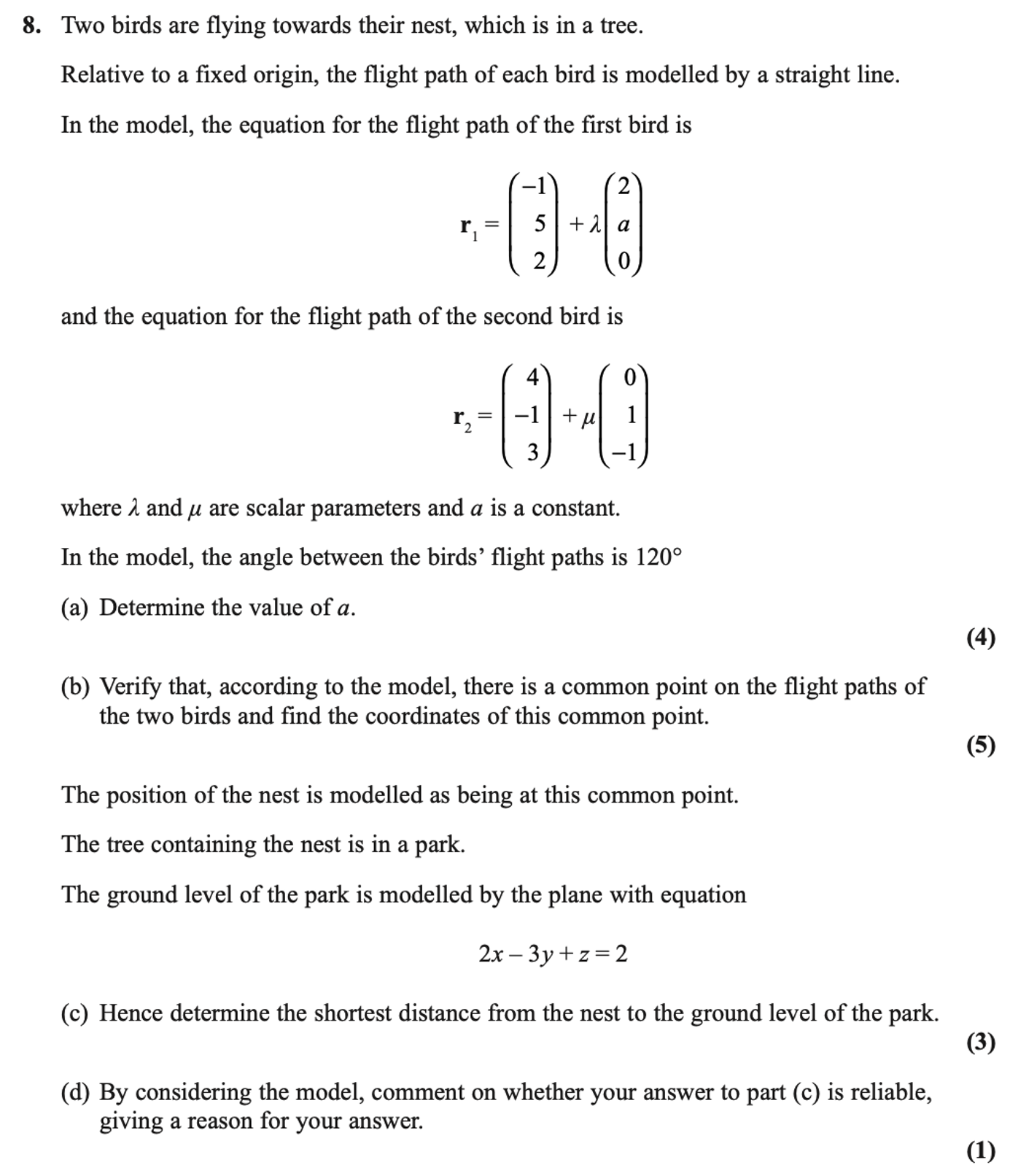
Students struggled with Edexcel’s June 2022 Core Pure 2 Question 8. The examiners’ report (opens in a new tab) notes that most students successfully set up the scalar product and found the point of intersection. However, many did not check their equations were consistent. The final mark, which asked for a comment, was rarely scored by students.
What to do about it: always draw a sketch. A rough sketch with the lines, the planes and the right angle marked on it takes thirty seconds and helps you to understand which formula applies. Then label explicitly which vectors you are putting into the formula. Examiners note that students who label their vectors score better, because the marker can see the method even when the arithmetic slips.
Check out the revision notes on vectors and test your understanding by attempting exam questions on vectors with model solutions written by teachers and examiners.
2. Complex Numbers: De Moivre, Roots of Unity and Loci
Basic complex number work is usually well answered: students find conjugates, solve cubics and plot Argand diagrams confidently. The difficulty begins the moment the topic turns geometric.
Roots of unity are the clearest example. Listing them is routine. However, using them — recognising that the nth roots sit at equal angles of 2π/n around a circle, and that a rotated or translated set of roots must be brought back to the origin before that structure can be used — is where reports describe only the most able students making progress, with very few gaining full marks.
Loci cause a different problem. A circle and a half-line are easy to describe but students find it surprisingly hard to draw them accurately. Students can produce misleading diagrams by not considering the angles carefully enough, and then base their subsequent work on them, losing marks in later parts they could otherwise have scored.
Proof questions add a third trap. In ‘show that’ proofs, some students wrongly assume the result they are trying to prove. The examiners’ reports describe circular arguments that often score only one mark.
Pearson Edexcel Core Pure 2 (9FM0/02), June 2024, Question 5
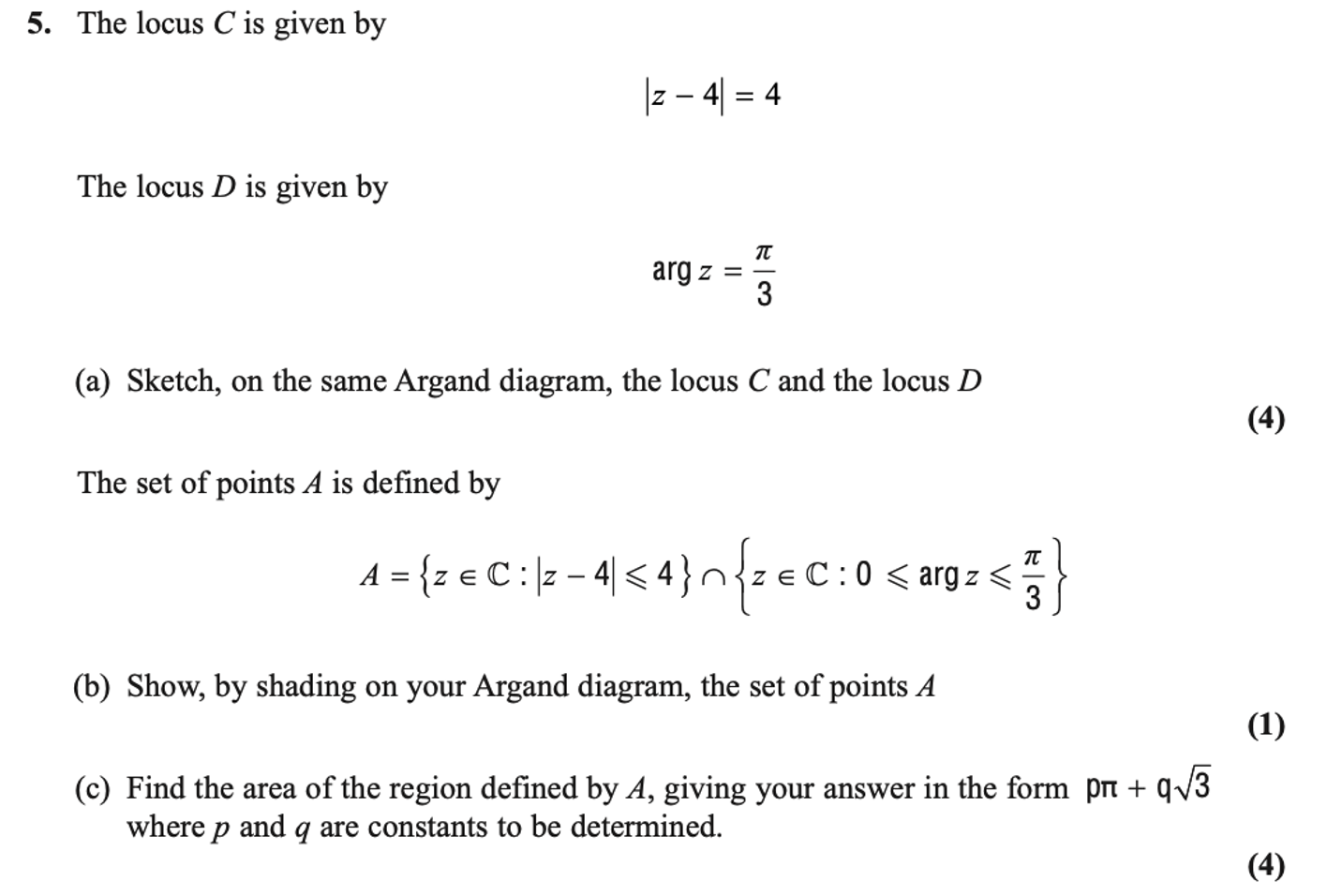
What to do about it: treat the Argand diagram as part of the working, not decoration. Mark the centre, the radius and the angle of the half-line, and check the half-line meets the circle where your sketch says it does.
Check out our revision notes on complex loci and exam questions on complex numbers and Argand Diagrams here on Save My Exams.
3. Polar Coordinates
Students often find questions involving polar coordinates tricky. They usually understand how to apply the area formula correctly, and often have good skills at integrating. But deciding what to integrate in the first place is often the biggest challenge!
Students often find it tricky to decide on the ‘limits’ for their integrals, or get confused about how to use the symmetry of a given shape to precisely set up an equation that describes a given area. Sometimes students integrate over half of an area, and attempt to double it, attempting to use the symmetry of the graph. Sometimes this is valid, but the examiners’ reports indicate that sometimes students are doubling a region that is not half of the whole shape, or tripling a third that is not a third.
The second trap is subtler. Sometimes the area asked for is not the area your integral gives. If a question asks for a region bounded partly by a curve and partly by a straight line, you may need to subtract your integral from a triangle or a circle. Visualising the addition and subtraction of areas can be the part that students find most challenging.
Pearson Edexcel Core Pure 2 (9FM0/02), June 2022, Question 7
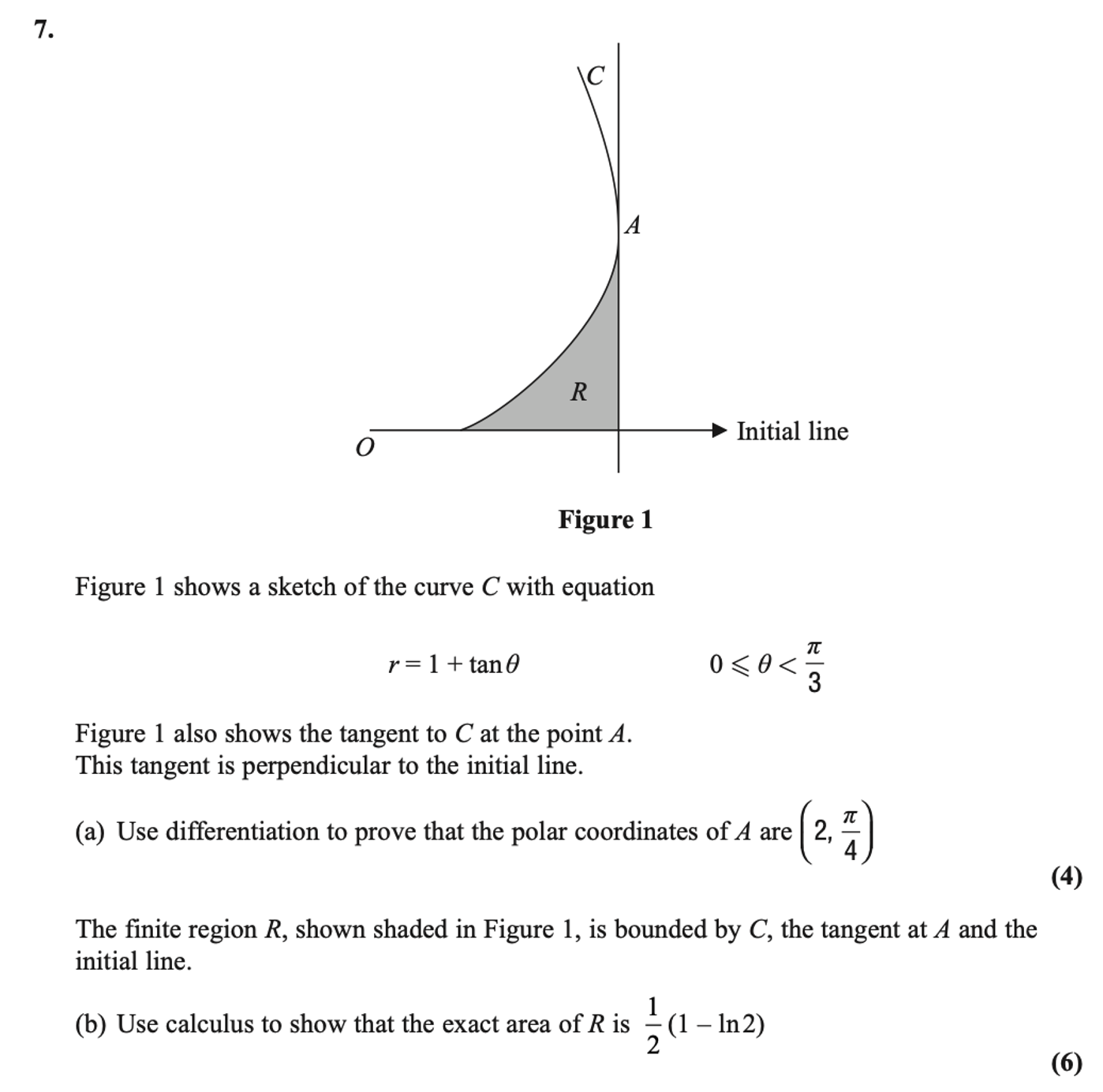
What to do about it: shade the region on the diagram before writing any integral, then ask which limits trace exactly that shaded shape. If the answer is given and your working does not reach it, go back and find the error rather than trying to ‘fudge it’ by adjusting signs. A wrong answer with honest working often scores far more than a right answer with fudged working.
Want to know more? Check out our polar coordinates revision notes and exam questions on polar coordinates.
4. Differential Equations and Modelling
Differential equations are the topic most likely to be misjudged. The actual procedure of solving a second order differential equation is described in report after report as well rehearsed, well versed, and a good source of marks for students at every grade. So where do students lose marks?
At the start of the question, many of these questions open with a substitution that transforms the equation into one you can solve. That part is worth several marks and is far less practised than the solving. Students who cannot get through it often abandon the question entirely, even though the later parts are usually accessible on their own.
At the end, there is almost always a part asking you to interpret the solution in context, or to comment on whether the model is reasonable. The examiners’ reports describe students failing to truly answer the question set. Students will often simply describe the model without saying whether it is valid. Sometimes students will give a very generic explanation that doesn’t match the precise context of the question. Writing a remark that matches the context of the question is usually the key.
Edexcel Core Pure 1 (9FM0/01), June 2022, Question 10
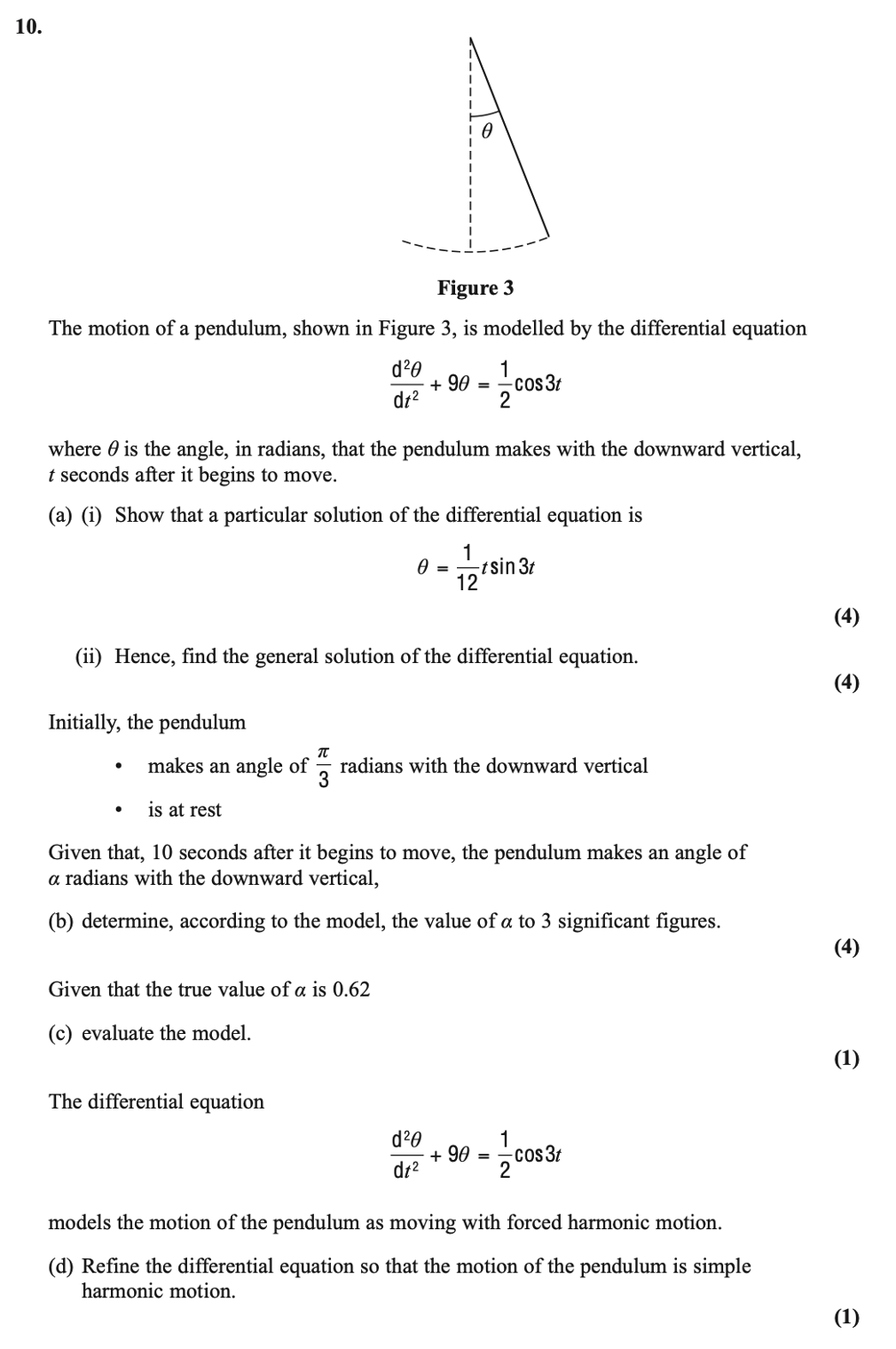
In Edexcel’s June 2022 Core Pure 1 Question 10, the examiners’ report (opens in a new tab) notes that fewer than a third of students used the most efficient method in the opening part, with many constructing a complementary function they did not need, and then repeating the same work later in the question.
What to do about it: undertake plenty of past paper practice, not just routine textbook practice, so you can practise the trickier opening and closing parts of the questions.
Study our Core Pure revision notes and test your understanding by attempting exam questions on differential equations.
5. Matrices: Invariant Points and Invariant Lines
Two ideas here have almost the same name but do very different jobs, and Pearson Edexcel examiners have recorded the resulting confusion repeatedly since 2019.
A line of invariant points is a line on which every single point stays exactly where it is. An invariant line is a line that maps onto itself — points on it can slide along the line, as long as they land somewhere on the same line. Every line of invariant points is an invariant line. The reverse is not true, and that is what questions are built to test.
The confusion produces two predictable errors. Asked for invariant lines, students solve for invariant points instead, setting Ax = x, which finds only the points that do not move. Or they set up the right method but write the line as y = mx rather than y = mx + c, which quietly restricts them to lines through the origin and loses every line that misses it.
There is a third trap at the end: questions often ask you not just to find the line but to say which of your lines is the line of invariant points, and why. Students routinely identify the right line and then cannot justify the choice, and so lose out on the final mark.
Pearson Edexcel Core Pure 2 (9FM0/02), June 2023, Question 3
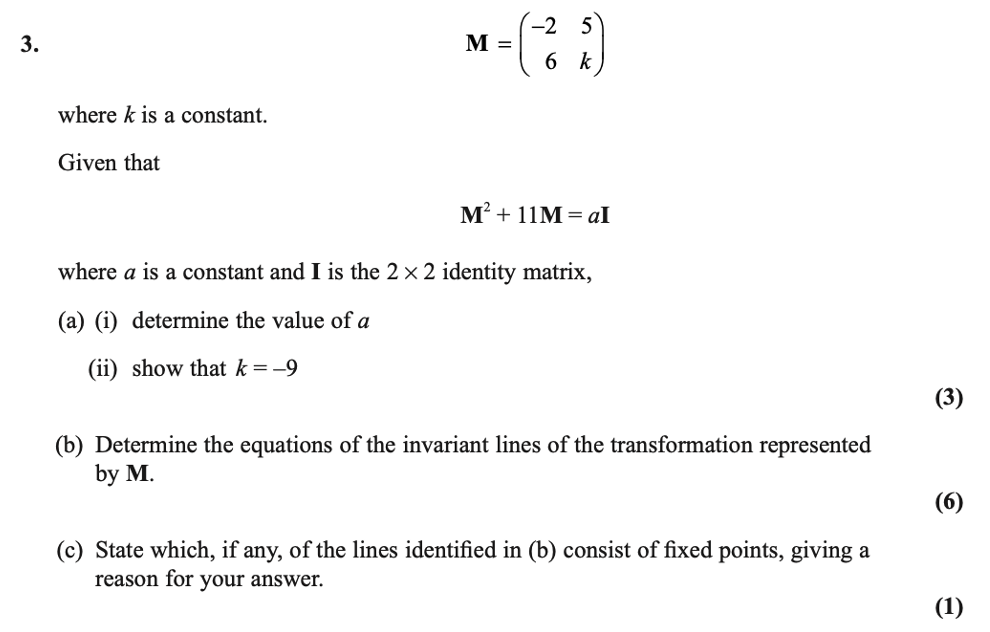
What to do about it: write out both definitions in your own words and keep them side by side until the difference is automatic. Always start from y = mx + c, even when you suspect c = 0, and let the algebra tell you — if c must be zero, the working will show it.
Then check the wording of the question one more time before you answer: invariant line and line of invariant points are different requests, and the whole method depends on which one you were asked for.
Check out our revision notes on invariant points and lines and test your understanding by attempting exam questions on matrices on Save My Exams.
Strategies for Mastering Difficult A Level Further Maths Topics
Beyond what each topic needs individually, a few habits help across all of them.
Practise Past Papers Strategically
Doing more papers is not the same as improving. The useful approach is vertical rather than horizontal: choose one topic from the list above, then do focused past paper practice on questions from that particular topic. You will see how narrow the variation actually is, and the traps start to feel familiar rather than surprising.
Timing matters too. The hardest Core Pure questions often sit at the end of the paper, so in practice you might meet them tired. Sitting full papers under proper timed conditions is the only way to rehearse that.
Save My Exams' Mock Exams are built for this: full papers under exam conditions, with full mark schemes and model solutions, so you can find out how you’re performing and fix any errors before the real exams. You can practise online in real exam conditions, or save your progress and return later; when you’re done, submit your paper and mark your answers with Smart Mark, our AI marking tool, or check them against the mark schemes and solutions.
Master the Fundamentals First
Difficulty in Core Pure often traces back to an earlier gap. Students who think they’re struggling with polar areas are often really struggling with trigonometric identities. Trouble with vectors can trace back to the scalar (dot) product from A Level Maths, and trouble with differential equations to integration techniques that haven’t been fully mastered.
The hard part is knowing which gap is yours, and self-assessment can be unreliable. Students tend to revise the topics they already find satisfying: everyone likes to feel successful when they’re revising. Save My Exams' Strengths & Weaknesses tool is genuinely useful here, because it shows you which topics your answers say you are weakest on rather than which ones feel hardest. If you fix these earlier topics first, it often makes the new Core Pure maths feel much more accessible.
Break Down Complex Problems
If you’re struggling to get started with a problem, try working backwards from what is asked, identify what you would need in order to find it, and keep going until you reach something you can calculate from the information given.
Two habits pay off particularly well. First, check whether an earlier part has already done a step for you — in a multi-part question, part (a) usually exists to help with part (b), and the word hence is an instruction, not a suggestion.
Second, if you cannot do part (a), still attempt the later parts. Reports note that students abandon whole questions after a difficult opening, missing marks that were fully accessible without it.
Draw the Diagram Before Doing the Algebra
This is the single highest-value habit in A Level Further Maths. That might be a 3D sketch for vectors, an Argand diagram for complex loci or a shaded region for polar areas. None takes more than a minute, and all of them prevent the specific errors examiners report most often. Working blind and hoping the algebra rescues you is the most common route to a low mark on a question you could have done had you visualised the problem first.
Write the Sentence That Finishes the Argument
Get into the habit of asking, at the end of every question, whether you have actually answered it. Don’t forget to write a conclusion to your proofs. If a question asks for a reason, make sure you don’t just give the answer: explain in words how you got there.
If you’re asked to interpret an answer, you need to write a judgement in the context of the question, not just a value. These are usually one-mark items, which makes them easy to dismiss — but across multiple papers they can add up to the difference between grades.
Frequently Asked Questions
What is the pass rate for A Level Further Maths?
Very high — but the figure matters less than it looks. In 2026, according to JCQ results data (opens in a new tab), 98.3% of A Level Further Maths entries were graded E or above, and 90.8% achieved a C or above. Very few Further Maths students fail, largely because the subject is taken by students who are already strong at maths and chose to add a second maths A Level.
The number worth paying attention to is the top-grade rate, and here Further Maths stands apart. In 2026, 58.9% of A Level Further Maths entries across the UK were graded A* or A — the highest proportion of any A Level subject, and far above the figure of roughly 42% for A Level Maths.
Close to 29% of Further Maths entries were awarded an A* outright. One caveat on grade boundaries: because A Level Further Maths is made up of Core Pure plus a choice of optional modules, the marks needed for each grade depend on which combination you sit, so check the boundaries for your own combination.
How much harder is A Level Further Maths compared to A Level Maths?
Substantially harder in content, but remember that Core Pure builds directly on A Level Maths techniques — differentiation, integration, trigonometric identities and coordinate geometry all reappear, applied to less familiar objects. So if you master the A Level Maths material, the Further Maths material becomes a lot more accessible. If you’re struggling with the Maths material, the difficulties can snowball into Further Maths.
The real differences are abstraction and pace. Further Maths asks you to work with more abstract ideas that can be harder to visualise. Due to the sheer volume of content, Further Maths courses have to move at a very quick pace: some students can find that it just moves too quickly for them if they don’t dedicate enough independent study time to practise and consolidate.
How long should I spend revising for A Level Further Maths?
Treat it as a full A Level in its own right, not an add-on. In practice that means roughly the same revision time you give A Level Maths, with the balance tilted towards the five topics above and towards full timed papers rather than solely textbook exercises.
Quality matters more than volume here. Two hours spent attempting past paper questions unaided, then marking them honestly against the mark scheme, is worth considerably more than a full day rereading notes or passively watching worked solutions.
Do I need to revise all A Level Further Maths topics?
Yes. Core Pure papers sample across the whole specification, and there is no reliable way to predict what will appear. Skipping content can be a very expensive gamble: it’s not recommended.
Due to the sheer volume of content, it’s important to prioritise efficiently. Spend a bit more time on the topics in this article, and on whichever areas your own past paper marks show are weakest, but cover everything at least well enough to make a confident start on any question.
Using the Flashcards here on Save My Exams are a quick way to revisit topics you’ve already studied and keep the knowledge fresh in your mind.
Final Thoughts
A Level Further Maths contains some genuinely difficult mathematics, and the topics in this article — vectors, complex numbers, polar coordinates, differential equations and matrices — are difficult for good reasons. But the examiners' evidence is consistent and, in its way, encouraging: the marks are not usually lost in the hardest algebra. They are lost in the diagram nobody drew, the limits chosen carelessly, the conclusion left unwritten and the model left uninterpreted.
Those are habits, and habits can be built. Draw the picture. Check what the question actually asked for. Write the sentence at the end. Do plenty of reflective past paper practice, making sure if you make mistakes, you understand what error you made, and crucially, make sure that what you do next time meets the requirements of the mark schemes. Do those things consistently and a large share of the marks that disappear on these topics stop disappearing.
Further Maths rewards students who are willing to be uncomfortable for a while before something clicks. If a topic on this list is not making sense yet, that is the normal path through it, not a sign you have gone wrong.
References
1. Pearson Edexcel, A Level Further Mathematics (9FM0) Paper 1: Core Pure Mathematics 1, Examiners’ Report, June 2022
2. Pearson Edexcel, A Level Further Mathematics (9FM0) Paper 2: Core Pure Mathematics 2, Examiners’ Report, June 2022
3. Pearson Edexcel, A Level Further Mathematics (9FM0) Paper 2: Core Pure Mathematics 2, Examiners’ Report, June 2023
4. Pearson Edexcel, A Level Further Mathematics (9FM0) Paper 2: Core Pure Mathematics 2, Examiners’ Report, June 2024
5. Pearson Edexcel, A Level Further Mathematics (9FM0) Core Pure examiners’ reports, 2019–2026
6. Joint Council for Qualifications (JCQ), A Level results data, summer 2026 (opens in a new tab)
7. MEI, Summary of 2026 AS/A level Mathematics and Further Mathematics entries and results (opens in a new tab)
The Pearson reports are published on Pearson’s past papers page (opens in a new tab).
Was this article helpful?
Sign up for articles sent directly to your inbox
Receive news, articles and guides directly from our team of experts.

Share this article



 written revision resources that improve your