Hardest A Level Maths Questions & How To Answer Them
The hardest A Level Maths questions are long, multi-part problems where the method isn’t given to you. This includes questions that link parts with “hence”, combine several topics, or ask you to explain an answer in context. At Save My Exams, we aim to make even the hardest questions easy to understand through our expert-written A Level Maths revision resources.

Written by: Harry Williams
Reviewed by: Dan Finlay
Published
Contents
- 1. Key Takeaways
- 2. What Makes an A Level Maths Question ‘Hard’?
- 3. Types of Difficult A Level Maths Questions
- 4. Example Hard Questions & How To Answer Them
- 5. Strategies for Tackling Hard A Level Maths Questions
- 6. How to Prepare for Hard A Level Maths Questions
- 7. Frequently Asked Questions
- 8. Final Thoughts
If you’ve ever read a question, understood every word, but it doesn’t seem obvious how to get started, this doesn’t necessarily mean that you’ve done anything wrong. This is exactly the reaction that the exam has been designed to provoke.
This guide looks at what actually makes an A Level Maths question difficult, the main types of hard questions you will meet across Pure, Statistics and Mechanics, and four real Edexcel A Level Maths (9MA0) past paper questions. Every example has been chosen because examiners specifically identified it as one that separated the strongest students from the rest. The same skills apply to AQA and OCR papers.
Key Takeaways
Most of the toughest A Level Maths questions don't use anything you haven't already been taught or studied before. Instead they’re tricky because the method isn’t obvious, the reasoning is long enough to be split across several parts, or you’re asked to explain your reasoning rather than just reach an answer.
Examiners’ reports repeatedly flag the word “hence”, which tells you to use something from an earlier part of the question. Students who ignored this instruction and restarted the subsequent part (b) from scratch often couldn’t finish.
Questions asking you to explain, justify or interpret in context are worth real marks and are easy to lose. Examiners regularly report answers with the right calculation but no conclusion in context.
A quick sketch or labelled diagram is one of the best habits you can build. Examiners repeatedly note that students who draw sketches succeed in problem-solving contexts where students who go straight to algebra do not. Visualising a problem graphically or geometrically can often shed light on how to solve a problem.
What Makes an A Level Maths Question ‘Hard’?
An A Level Maths question is hard when it hides the method: it links several parts, combines topics, uses an unfamiliar context, gives you the answer to prove, or asks you to explain in words. Students who practise a wide variety of questions learn to spot these patterns faster than those who only practise familiar ones.
Multi-step problem solving. Long questions ask you to reach an intermediate result, then use it. There is no prompt telling you what the intermediate result is for. Many students reach the result but don’t realise the next part needs it — even when the word “hence” is there to tell them.
Combining several topics at once. A single question might use trigonometric identities, algebraic manipulation and knowledge of solution ranges. Each concept might be manageable on its own, but when the concepts are combined in a single problem, you might struggle to see connections between them.
Unfamiliar or real-world contexts. Modelling questions about harbour tides, population growth or a children’s toy dress familiar mathematics in unfamiliar clothing. Students who have only practised abstract questions can freeze, or focus on superficial aspects and don’t spot the familiar idea hiding underneath.
Given answers. “Show that” questions tell you the destination. That sounds helpful, but it means every line of working has to be complete and correct, and you cannot fudge your way to the printed result. Examiners are strict here; some students take shortcuts (failing to show their methods when factorising, for example) and lose method marks and accuracy marks as a result.
Questions that ask you to explain. Some of the lowest-scoring marks on A Level Maths papers need an explanation in words. Students often struggle to explain, in clear sentences, why a solution should be rejected, why a model is unsuitable, or what a result means for the person in the question.
Types of Difficult A Level Maths Questions
Almost all of the genuinely hard questions across the specification fall into three families: multi-concept questions, data analysis and interpretation questions, and extended reasoning questions.
Multi-Concept Questions
Multi-concept questions require you to bring together two or more topics that you probably learned in separate lessons. A trigonometry question that becomes a ‘hidden’ quadratic. A coordinate geometry question that needs circle theorems that you might be struggling to remember from GCSE. A mechanics question that needs an understanding of vectors.
Often the clue that you’re missing a key concept is that your first method produces something you can’t finish. If you find yourself with an equation containing two different trigonometric functions that you can’t combine, or an expression you can’t integrate, that is usually a prompt to try a different approach to change the form of the problem rather than push harder.
However, students sometimes meet ‘unusual’ numbers or fiddly algebra, start to doubt themselves and give up midway through an otherwise correct answer. A useful test: if your working is getting simpler, keep going; if it is getting more complicated, step back and consider a different approach. Developing this judgement takes lots of practice, because occasionally the methods required are complicated!
Data Analysis and Interpretation Questions
Data analysis and interpretation questions give you data, a diagram or a model and ask what it tells you. They are most common in Statistics and in Pure modelling questions.
The difficulty is rarely in the calculations. It is that these questions want you to make a decision and back it up, using the words of the actual problem. Examiners' reports flag this over and over: you can get every calculation in a hypothesis test right, but if you only write 'reject H₀', you lose the final mark. You need to write a conclusion that matches the context of the question given.
Extended Reasoning or Application Questions
Extended reasoning questions are the long questions at the end of a paper, often worth 8 marks or more across several parts. They ask you to:
• apply a familiar method in an unfamiliar situation
• justify why your answer is valid, or why an alternative answer must be rejected
• link earlier parts of the question to later ones
The skill being tested is your ability to keep track of a long argument. Students who write their working out in a clear, linear way score noticeably better than those whose solutions sprawl chaotically across the page: this is often something that examiners refer to in their post-exam reports.
Example Hard Questions & How To Answer Them
The table below summarises the four Edexcel A Level Maths questions in this guide, what examiners reported about each, and the key fix.
Question | Topic | What examiners reported | Main trap | Key fix |
|---|---|---|---|---|
Paper 1, June 2022, Q14 (8 marks) | Trigonometry | Mean mark 4.0 out of 8; about 25% scored full marks | Ignoring “hence” and restarting part (b) | Substitute x = 2θ + 60 to reuse part (a) |
Paper 1, October 2020, Q11 | Circles and radians | Very few scored full marks; part (b) often scored only its first mark | Assuming both centres give the same angle | Annotate both circles and work from each centre separately |
Paper 31, June 2023, Q4 | Hypothesis testing | Only a few scored part (c) | Using the sample mean (177.2) instead of the H₀ mean (175.4) | Write the model under H₀ explicitly |
Paper 32, June 2022, Q3 | Forces and vectors | Worst-answered question on the paper; half scored 0 or 1 | Setting the resultant equal to the direction vector | Write the resultant as k(3i + j) |
Example 1: The Trigonometry Question With a Hidden Link
Edexcel A Level Maths, Paper 1 (9MA0/01), June 2022, Question 14 (8 marks)
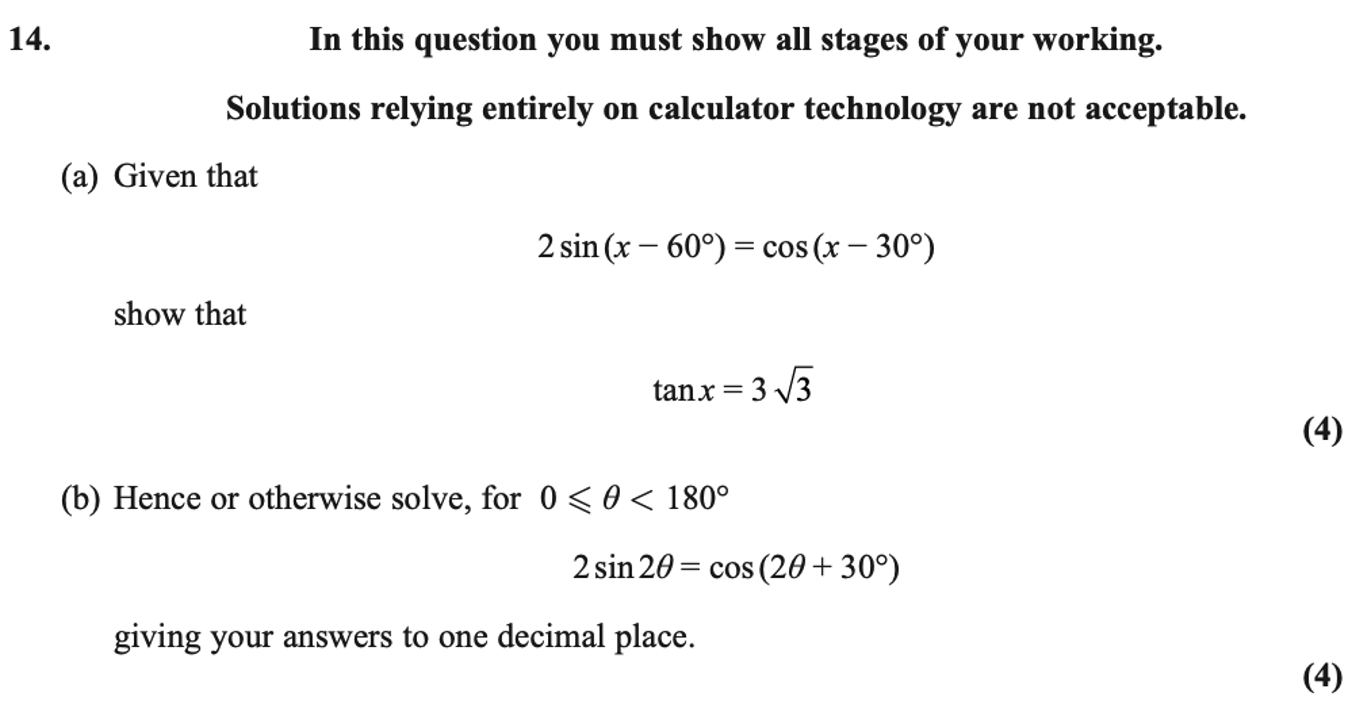
Why it is hard: The examiners’ report (opens in a new tab) for Edexcel’s June 2022 Paper 1 Question 14 gives a mean mark of 4.0 out of 8, and only around a quarter of students scored full marks. What makes it interesting is how students lost marks. Examiners noted that students tended to manage part (a) or part (b), but not both.
Part (a) asks you to prove a trigonometric result using the compound angle formulae. Part (b) then says “hence” solve a related equation.
The trap: Part (b) can be attempted from scratch, and a great many students did exactly that. They ignored part (a), reached for the compound angle formulae all over again, and ended up in long algebraic manipulation that they could not finish. Students who spotted that the two parts were connected by a simple substitution, x = 2θ + 60, got there in a few lines.
How to approach it:
1. Treat “hence” as an instruction, not a suggestion — it’s usually the case that if you try to invent your own “or otherwise” method, you’ll find it much trickier than finding a connection to something in a previous part of the question. The word “hence” means that the examiner has already given you the tool. Your first job in part (b) is to work out how part (a) fits.
2. Compare the two expressions. Look at what is inside the brackets in part (a) and what is inside the brackets in part (b). The link is almost always a substitution.
3. Substitute, then solve. Once you have x = 2θ + 60, part (a) converts part (b) into a single equation in one trigonometric function, in this case reducing to tan(2θ + 60°) = 3√3.
4. Find every solution in the range. Many students found one angle and stopped. Sketch the graph or use the symmetry of the function to check you have them all. If you have a CASIO CG-50 graphical calculator, you can also use the ‘SolveN’ function to check your answers.
Common mistakes: Restarting part (b) independently; finding only one solution; writing down correct answers without writing down the steps in the working which scores nothing when the question warns against relying on a calculator.
See the full model solution to June 2022 Paper 1 Question 14, or practise more Edexcel A Level Maths compound and double angle formulae exam questions, each with fully explained model answers.
Example 2: The Circles Question Where Algebra Is the Slow Route
Edexcel A Level Maths, Paper 1 (9MA0/01), October 2020, Question 11 (8 marks)
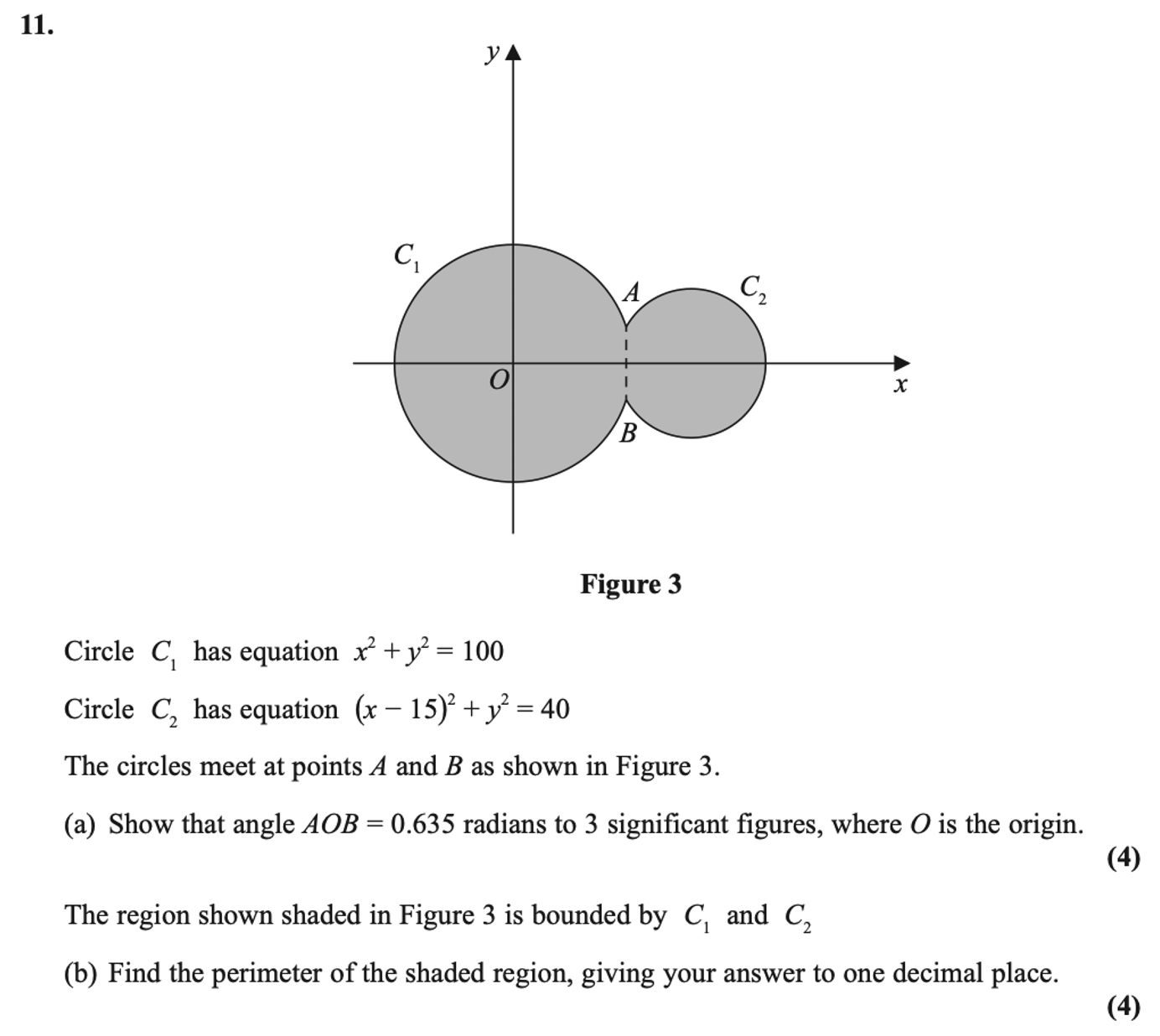
Why it is hard: The examiners’ report (opens in a new tab) for Edexcel’s October 2020 Paper 1 Question 11 notes that very few students scored full marks. Part (a) asks for an angle at the centre of one circle, where the two circles intersect. Part (b) then asks for a result that depends on the second circle.
The trap: In part (b), it was very common for students to score the first mark and nothing else, because they assumed the angle given in part (a), ∠AOB = 0.635 radians, was the same as the corresponding angle at the centre of the other circle. It is not. Different centres, different radii, different angles.
How to approach it:
1. Annotate the diagram carefully to show all the information you need. Consider the coordinates of both centres, both intersection points. Draw on the lengths and angles you already know. This single step might help prevent the mistake above, because once you can see two different triangles clearly you will be less likely to assume they share an angle.
2. Look for the geometry before the algebra. Students who found the radii and centres from the circle equations and then used the cosine rule in the triangle formed by the two centres and one intersection point often gained all four marks in part (a). Students who solved simultaneous equations to find the intersection points got there too, but more slowly and with more chances to slip.
3. Use what the circle equation gives you. If C₁ has equation x² + y² = 100, then OA = 10 because it is a radius. Several students calculated this with the distance formula, wasting time.
4. For part (b), start again from the second circle. Find the angle at its centre using its own radius and the same chord AB.
Common mistakes: Carrying an angle from one circle to the other; simplifying x² + y² = 100 into x + y = 10; stopping after finding the coordinates of the intersection points.
See the full model solution to October 2020 Paper 1 Question 11, or practise more Edexcel A Level Maths radian measure exam questions, each with fully explained model answers.
Example 3: The Hypothesis Test That Is Not Really About the Test
Edexcel A Level Maths, Paper 31 (9MA0/31) Statistics, June 2023, Question 4 (6 marks)
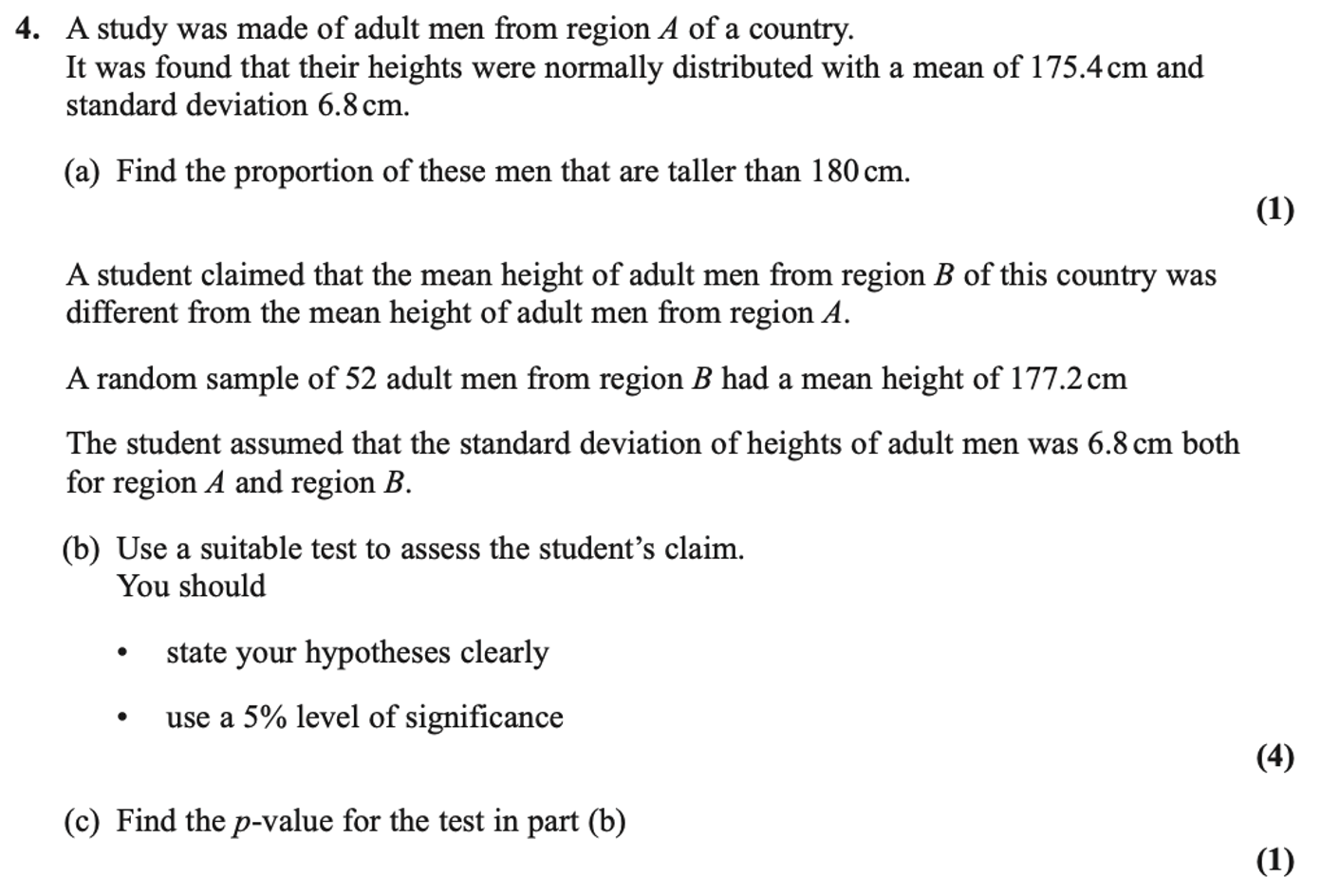
Why it is hard: On the surface, this question is a routine test on a sample mean, and most students stated their hypotheses correctly. The marks disappeared in the details: the examiners’ report (opens in a new tab) notes that only a few students scored part (c).
The trap: A hypothesis test is always carried out assuming the null hypothesis is true. A significant number of students built their model around the sample mean of 177.2 instead of the population mean of 175.4 given in H₀. The test is asking “if the original claim were true, how surprising is this sample?” — so the original value has to go into the model.
How to approach it:
1. State your hypotheses using the population parameter. For a mean, that is μ, the population mean — not the sample mean, and not a word description.
2. Write down the model explicitly. Under H₀, the sample mean follows N(175.4, 6.8² ÷ 52). Writing this line down earns a mark on its own. Examiners note that students who only listed the numbers they were typing into a calculator did not get credit.
3. Calculate the probability, not a critical value, when a p-value is coming later. Look ahead to the final part of the question to choose the most efficient method for part (b). Picking the most efficient route through a multi-part question saves you valuable time, avoiding the trap of doing the work twice.
4. Finish in context. Not just “reject H₀”, and not “the result is significant”. Say what it means for the situation described in the question. This is a mark students throw away in almost every single question like this.
Common mistakes: Using the sample mean in the model; giving answers to 2 significant figures when 3 are required; stopping at the statistical conclusion without translating it back into the context.
See the full model solution to June 2023 Paper 31 Question 4, or practise more Edexcel A Level Maths hypothesis testing exam questions, each with fully explained model answers.
Example 4: The Mechanics Question About Direction, Not Size
Edexcel A Level Maths, Paper 32 (9MA0/32) Mechanics, June 2022, Question 3 (9 marks)
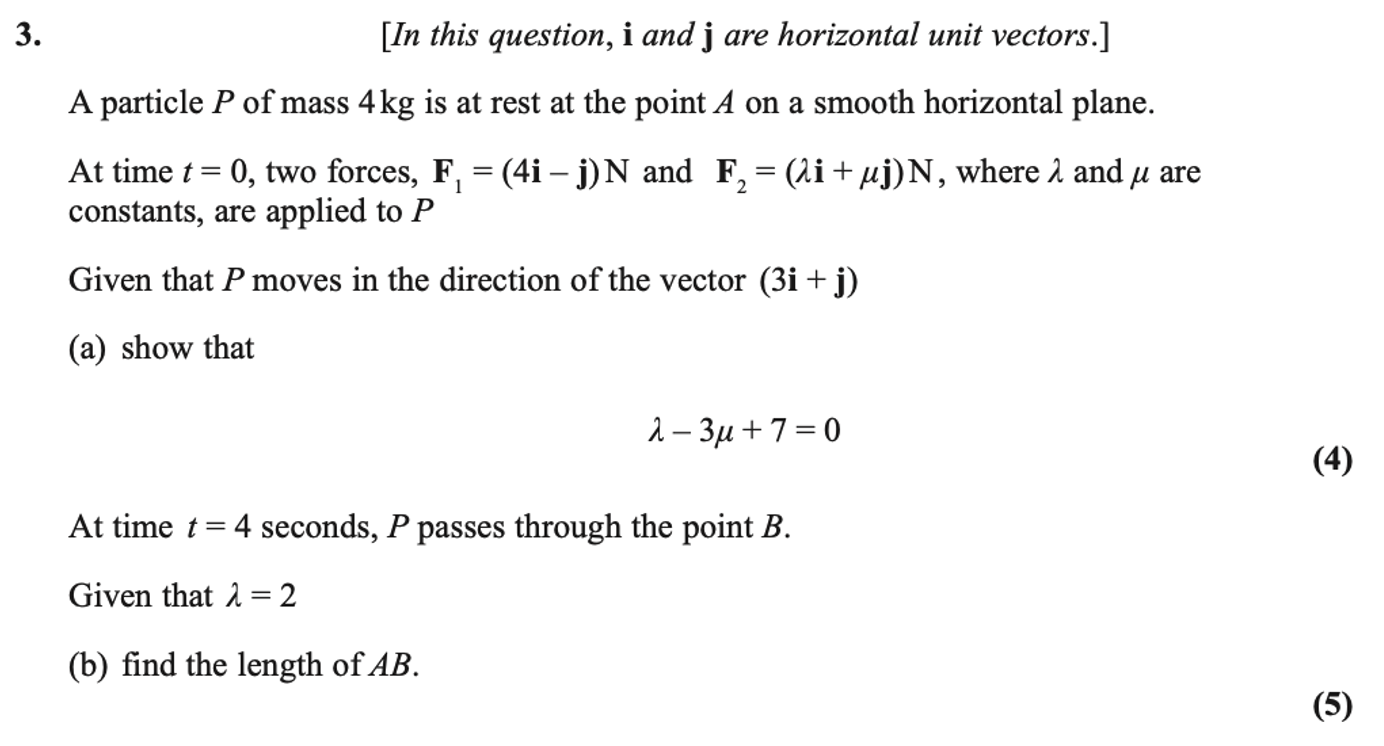
Why it is hard: The examiners’ report (opens in a new tab) describes Edexcel’s June 2022 Paper 32 Question 3 as the worst answered question on the paper. Half of all students scored either zero or one mark out of the whole question.
The trap: The question tells you that the resultant of two forces acts in the direction of (3i + j). Most students who lost marks set their resultant force equal to 3i + j. But a direction is not necessarily the resultant force itself. A resultant in the direction of 3i + jcould be 6i + 2j, or 30i + 10j, or any multiple.
How to approach it:
1. Add the forces and collect the i and j components. This is the mark almost everyone got, so always do it.
2. Turn “direction” into a ratio. If the resultant is ai + bj and it acts along 3i + j, then a : b = 3 : 1. Equivalently, set the force equal to F = k(3i + j), and so set the components equal to 3k and k and solve simultaneously.
3. Re-read the question before using the constant acceleration (suvat) equations. Several students used 3i + j as an initial velocity. The information that the particle starts at rest was given at the top of the question, not in the part they were answering.
4. Be clear on what you have calculated: keep force, velocity and displacement separate. The most damaging errors were students finding a resultant force correctly and then treating it as a displacement.
Common mistakes: Equating a resultant to a direction vector; missing information given in the question stem; using the wrong initial velocity.
See the full model answers to the June 2022 Paper 32 past paper, or practise more Edexcel A Level Maths working with vectors exam questions, each with fully explained model answers.
Strategies for Tackling Hard A Level Maths Questions
Read the Question Carefully and Identify What’s Being Asked
Before writing anything, underline three things: what you are given, what you are asked to find, and any command words.
Command words matter more in A Level Maths than students expect:
Hence — you must use the previous result. It is worth marks.
Show that — the answer is given, so your working is the whole answer. Do not skip steps. Every step needs to be there, and your final line should match the printed result exactly. Make sure that you write down the steps clearly, e.g. when solving a quadratic equation, write down your method — don’t skip straight to the roots.
Explain / Justify / Give a reason — a sentence is required. A calculation on its own will usually not score all the marks.
In context — refer to the situation in the question, using the language and context of the question itself.
Use Diagrams, Working or Planning Where Helpful
Examiners often comment on presentation, and not as a stylistic preference. Solutions that sprawl are harder to award marks to, and students who draw sketches to help themselves to visualise the problems tend to make fewer conceptual errors.
Practical habits worth building:
Sketch the graph when solving trigonometric equations, so you can see how many solutions lie in the range.
Draw and label a force diagram for every mechanics question, even simple ones. Ask yourself if you have included every force; don’t rush this step.
In coordinate geometry, draw the circles, lines and triangles rather than working blind.
Write one step per line, and keep parts (a), (b) and (c) clearly separated. Make it easy for your examiner to award you the marks you deserve.
Break Down Multi-Step Problems
Try to break longer problem-solving questions into discrete steps. If you get stuck, ask yourself, “Using the information given in the question, what could I work out?” Then if you’re still stuck:
1. Identify the final quantity you need.
2. Ask what you would need in order to find it.
3. Keep working backwards until you reach something you can calculate from the given information.
4. Then work forwards, writing each result down clearly so you can use it later.
5. Check whether earlier parts of the question have already given you a step for free.
That last point is often the one that separates grades. In a multi-part question, part (a) usually exists to help you with part (b).
Practise Under Timed Conditions
The hardest questions often sit at the end of the paper, which means you get to them when you’re tired and short of time. Examiners have noted answers to final questions that looked rushed or unfinished, and blank responses that may have been time pressure rather than lack of knowledge.
Knowing when to move on is a key exam skill. Some question parts are worth very few marks but take a disproportionate amount of time. You can always return to a question part if you have time after attempting everything else.
Build stamina by doing full papers in one sitting rather than always doing short bite-sized chunks. Practise scanning the whole paper first so you know what is coming; your brain will be ticking over what you’ve read whilst you’re solving the other problems.
Start with a question that looks ‘easy’ to you to settle your nerves. Feeling nervous at the start of an exam is normal, and a confident start stops your emotions getting the better of you.
You can find full Edexcel A Level Maths past papers on Save My Exams, each with clear, step-by-step model answers written by teachers.
How to Prepare for Hard A Level Maths Questions
Use Past Papers Strategically
Doing lots of past papers without strategy can be an inefficient way to improve. You need to make sure you are reviewing your work, reflecting on the mistakes, and making sure that you really understand the correct methods. Rather than marking a whole question, use the mark scheme to give you a hint, and then see if you can solve the problem yourself without using the rest of the mark scheme.
Once you’ve done a few past papers, reflect on the common themes in the mistakes you are making: pick a recurring question type, seek similar questions and unusual variants, and reflect upon what you’ll do differently when meeting similar questions in the future.
The final two or three questions on each paper are often the ones that separate the top grades. Make sure that you don’t just practise material that feels comforting or familiar to you; it’s important that you use your time wisely to focus on the aspects that you find challenging.
You can customise your own exam practice to target your weak spots on Save My Exams; you can choose the topics and the question types and we’ll build your personalised test through our Target Tests.
You can also check out the full range of official past papers, and also our own Mock Exams — full practice papers, created by our experts and fully aligned to your exam specification. You can attempt past papers online under real exam conditions, or save your progress and return later. Once submitted, you can mark your answers with Smart Mark, our AI marking tool, or check them against the mark scheme and model solutions.
Understand Mark Schemes
Marking your own work against the mark scheme is where most of the improvement happens. Look carefully at the notes for the examiners, so you understand what you need to write down to score the marks. Look out for:
Method marks, which reward the correct approach even with an arithmetic slip. This is why writing your method down matters even when you are unsure.
Accuracy marks, which require a specific level of rounding, correct units, or a final answer in the right form.
Where the mark scheme awards a mark for a statement rather than a calculation.
Official mark schemes are written for examiners, so they can take some getting used to. Save My Exams model answers explain each mark in plain English, so you can see exactly what you need to write to score it.
Master Key Concepts and Knowledge
There are several areas that examiners repeatedly flag that students find more challenging and cost students marks in exams. Make sure you give these areas extra attention in your revision:
Trigonometric identities, particularly the double angle and compound angle formulae, and knowing when to use them
Choosing an integration technique, especially substitution, parts and parametric integration
Modulus graphs, and knowing which solutions to reject
Hypothesis testing conclusions in context
Resolving forces and taking moments with clear, complete equations
Use the Revision Notes on Save My Exams for clear, concise notes on every A Level Maths topic, and our Flashcards to test yourself and keep that knowledge fresh over time.
Work Through Worked Examples
Reading a worked solution is not the same as being able to produce one yourself. Try this instead: read the solution, close it, and see if you can reproduce it after some time has passed (minutes, hours, days, weeks). Then attempt a similar but different question and see if you have answered this one correctly. The gap between what you can follow and what you can generate is where your revision should sit.
You can check out Exam Questions on any A Level Maths topic on Save My Exams, organised by topic, with downloadable PDFs written by expert teachers and examiners. These come with model solutions that show you exactly how to score each mark.
Frequently Asked Questions
Do I need to answer the hardest questions first in the exam?
No. Questions generally increase in difficulty across the paper, with more accessible material early on, so working through in order usually means you bank straightforward marks while you are fresh. What is worth doing is a quick read-through of the whole paper at the start so nothing takes you by surprise, and moving on if a question stalls you for more than a few minutes. You can always come back if you have time.
How can I improve my problem-solving skills for A Level Maths?
Practise challenging problem-solving style questions where the method is not immediately obvious, and you have to choose the method yourself. Rather than working through an exercise labelled “integration by substitution”, try mixed sets where you have to decide the technique yourself.
When you get stuck, ask yourself what you tried and why it did not work before looking at the solution. That reflection builds the decision-making that hard questions test.
As you work through exam questions on Save My Exams, the system will automatically show you your strengths and weaknesses by topic, giving you a strength score for each topic, so you know exactly where to prioritise your revision.
Are A Level Maths exam questions getting harder?
Not systematically. Edexcel’s current A Level Maths specification (9MA0), first examined in 2018, put more emphasis on problem solving, modelling and reasoning than the modular A Levels it replaced, and grade boundaries are adjusted each year to account for paper difficulty.
What has changed is the style of question: fewer questions that name their method, more that expect you to select it.
Final Thoughts
The hardest A Level Maths questions are not testing whether you can simply apply a method to a problem that feels familiar. They are testing whether you can find your way into an unfamiliar problem, keep track of a long argument, and explain what your answer means.
If you reflect on your mistakes thoughtfully, rather than just doing more practice, you will make more rapid improvements. Underline the command words. Sketch the diagram. Look for the link between parts. Finish your conclusion in context. Re-read the question to check you have fully answered it. None of these steps are complicated in themselves: they’re habits that you can build through practice, and all of them will help you to maximise the number of marks you might achieve.
The students who do well on these questions are not the ones who never get stuck, rather they are the ones who have got stuck often enough, in practice, to recognise the feeling and know what to try next.
References
1. Pearson Edexcel, A Level Mathematics (9MA0) Paper 1: Pure Mathematics 1, Examiners’ Report, June 2022
2. Pearson Edexcel, A Level Mathematics (9MA0) Paper 1: Pure Mathematics 1, Examiners’ Report, October 2020
3. Pearson Edexcel, A Level Mathematics (9MA0) Paper 31: Statistics, Examiners’ Report, June 2023
4. Pearson Edexcel, A Level Mathematics (9MA0) Paper 32: Mechanics, Examiners’ Report, June 2022
All four reports are published on Pearson’s past papers page (opens in a new tab).
Was this article helpful?
Sign up for articles sent directly to your inbox
Receive news, articles and guides directly from our team of experts.

Share this article

 written revision resources that improve your