Organic Synthesis (AQA A Level Chemistry): Revision Note
Exam code: 7405

Organic synthesis
A wide range of organic products can be made from just a few starting compounds, given the right reagents and conditions
Understanding how different organic functional groups interconvert is key to designing synthetic routes
The main functional groups you need to know are:
Alkanes
Alkenes
Halogenoalkanes
Alcohols
Carbonyls (aldehydes & ketones)
Carboxylic acids and derivatives
Amines
Nitriles
Arenes
Aliphatic reaction pathways
The key transformations between these functional groups are summarised in the diagram and table below:
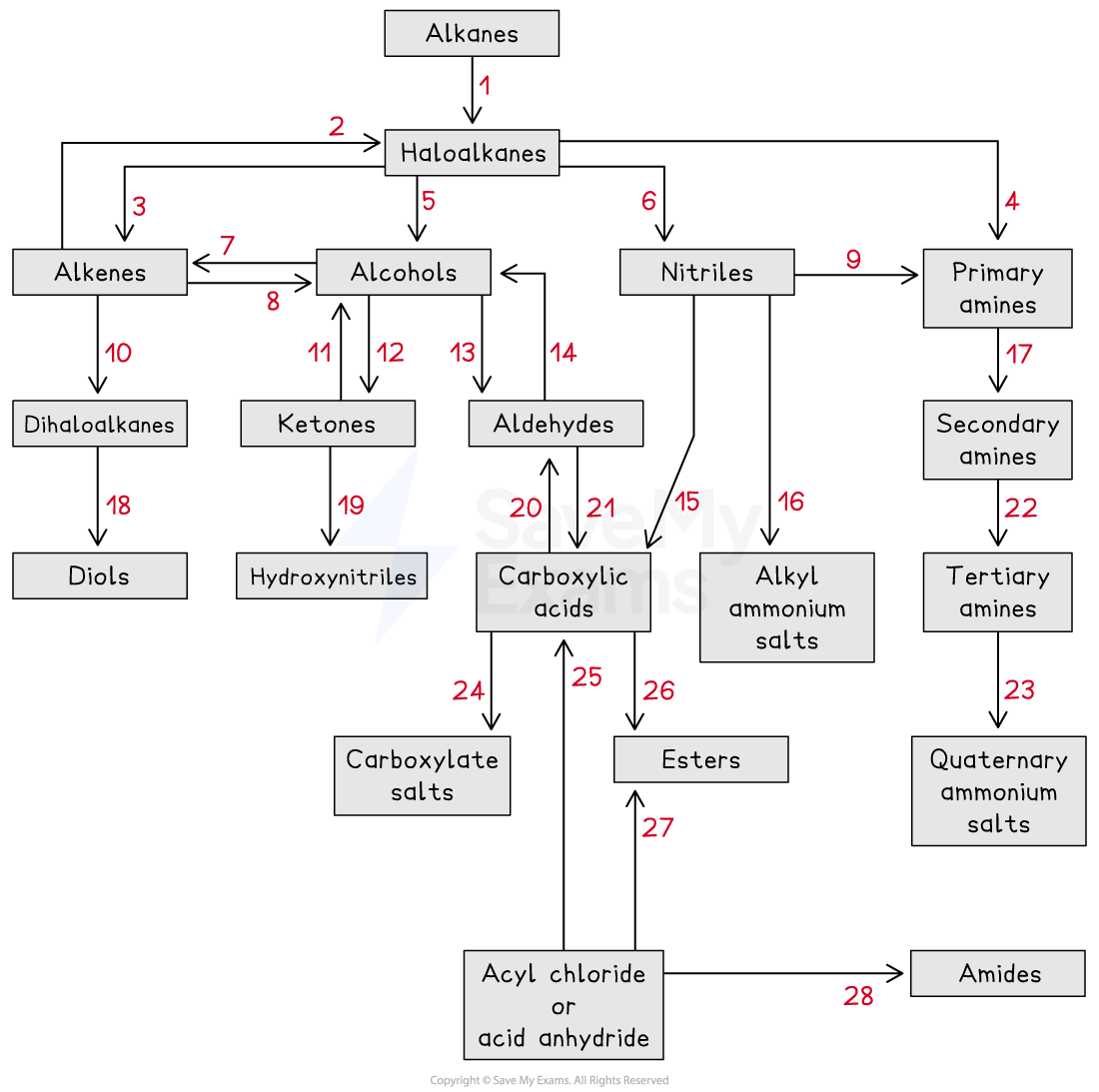
Aliphatic reactions table
Reaction | Reagent | Conditions | Mechanism | Reaction type |
|---|---|---|---|---|
1 | Halogen | UV light | Free radical | Substitution |
2 | Conc. NH3 | Heat, under pressure | Nucleophilic | Substitution |
3 | Dilute HCl | Room temperature | – | Acid–base |
4 | Halogenoalkane | Heat | Nucleophilic | Substitution |
5 | Halogenoalkane | Heat | Nucleophilic | Substitution |
6 | Halogenoalkane | Heat | Nucleophilic | Substitution |
7 | NaOH in ethanol | Heat | Elimination | Elimination |
8 | Hydrogen halide | Room temperature | Electrophilic | Addition |
9 | NaOH (aq) | Heat under reflux | Nucleophilic | Substitution |
10 | KCN in ethanol | Heat under reflux | Nucleophilic | Substitution |
11 | LiAlH4 in dry ether | Heat | – | Reduction |
12 | Halogen | Room temperature | Electrophilic | Addition |
13 | Steam + H2SO4 | Heat | – | Hydration |
14 | Al2O3 or Conc. acid | Heat | Elimination | Dehydration / Elimination |
15 | NaOH (aq) | Heat under reflux | Nucleophilic | Substitution |
16 | K2Cr2O7 / H2SO4 | Heat | – | Oxidation |
17 | NaBH4 (aq) | Heat | – | Reduction |
18 | K2Cr2O7 / H2SO4 | Heat | – | Oxidation |
19 | NaBH4 (aq) | Heat | – | Reduction |
20 | Dilute HCl | Heat | – | Hydrolysis |
21 | K2Cr2O7 / H2SO4 | Heat under reflux | – | Oxidation |
22 | LiAlH4 in dry ether | Heat | – | Reduction |
23 | Alcohol, H2SO4 | Heat | – | Esterification / Condensation |
24 | Alcohol | Room temperature | Nucleophilic | Addition–elimination / Acylation |
25 | NaOH (aq) | Room temperature | – | Acid–base |
26 | H2O | Room temperature | – | Hydrolysis |
27 | Amines | Room temperature | Nucleophilic | Addition–elimination / Acylation |
Aromatic reaction pathways
The most important reactions of aromatic compounds are summarised below:

Aromatic reactions table
Reaction | Reagent | Conditions | Mechanism | Reaction Type |
|---|---|---|---|---|
1 | Ethanoyl chloride + AlCl3 | Heat | Electrophilic | Substitution |
2 | Chloroethane + AlCl3 | Heat | Electrophilic | Substitution |
3 | Chlorine | UV | Free radical | Substitution |
4 | Chloromethane + AlCl3 | Heat | Electrophilic | Substitution |
5 | Conc. HNO3 + H2SO4 | 25–60°C | Electrophilic | Substitution |
6 | Conc. HNO3 + H2SO4 | 25–60°C | Electrophilic | Substitution |
7 | Sn + conc. HCl | Heat | – | Reduction |
8 | NaNO2 / HCl | Below 10°C | – | Diazotisation |
9 | Phenol | Heat | – | Coupling |
Choosing a reaction pathway
Chemists often have several possible ways to make a target molecule
The best route balances efficiency, safety, and sustainability

Choosing a route with fewer steps reduces waste and energy use
This is better for the environment and more cost-effective
Reactions with high atom economy are preferred
They maximise the use of starting materials
Safer solvents and less hazardous reagents are also key considerations
Designing a reaction pathway
Designing a reaction pathway involves planning a sequence of reactions to convert a starting molecule into a target molecule
Synthetic routes are designed to form this compound as efficiently as possible from the given starting material
Begin by drawing the structures of both the starting molecule and the target molecule
Compare the number of carbon atoms in each compound
If the target molecule contains more carbon atoms, the carbon chain may need to be extended
One method is to introduce a nitrile group (–CN) via nucleophilic substitution, which increases the carbon chain length by one carbon atom
Next, identify the functional groups present in the starting compound and determine which reactions it can undergo
Then consider which functional groups are present in the target molecule and how they can be formed
Look for possible intermediate compounds that could link the starting material to the target molecule
Match functional groups carefully and specify the appropriate reagents and conditions for each step in the pathway
Examiner Tips and Tricks
You could be asked to design a synthesis with up to four steps.
Worked Example
Suggest how the following syntheses could be carried out:
Chloroethane to ethanoic acid
Ethene to 1-aminopropane
Answer 1:

Answer 2:

Examiner Tips and Tricks
Being able to combine these reactions in multi-step syntheses is a key exam skill. Practise working backwards from target molecules

Unlock more, it's free!
Join the 100,000+ Students that ❤️ Save My Exams
the (exam) results speak for themselves:

Was this revision note helpful?
Build on this topic