Buffers (AQA A Level Chemistry): Revision Note
Exam code: 7405

Acid & Basic Buffers
A buffer solution is a solution that resists changes in pH when small amounts of acids or alkalis are added
A buffer solution is used to keep the pH almost constant
A buffer can consist of a weak acid - conjugate base or a weak base - conjugate acid
Ethanoic acid and sodium ethanoate as a buffer
A common acidic buffer solution is an aqueous mixture of ethanoic acid and sodium ethanoate
Ethanoic acid is a weak acid and partially ionises in solution to form a relatively low concentration of ethanoate ions
CH3COOH (aq) H+ (aq) + CH3COO- (aq)
Sodium ethanoate is a salt that fully ionises in solution
CH3COONa (s) → Na+ (aq) + CH3COO- (aq)
There are reserve supplies of the acid (CH3COOH) and its conjugate base (CH3COO-)
The buffer solution contains relatively high concentrations of CH3COOH (due to partial ionisation of ethanoic acid) and CH3COO- (due to full ionisation of sodium ethanoate)
In the buffer solution, the ethanoic acid is in equilibrium with hydrogen and ethanoate ions
CH3COOH (aq) H+ (aq) + CH3COO- (aq)
When H+ ions are added:
The equilibrium position shifts to the left as H+ ions react with CH3COO- ions to form more CH3COOH until equilibrium is re-established
As there is a large reserve supply of CH3COO-, the concentration of CH3COO- in solution doesn’t change much as it reacts with the added H+ ions
As there is a large reserve supply of CH3COOH, the concentration of CH3COOH in solution doesn’t change much as CH3COOH is formed from the reaction of CH3COO- with H+
As a result, the pH remains reasonably constant
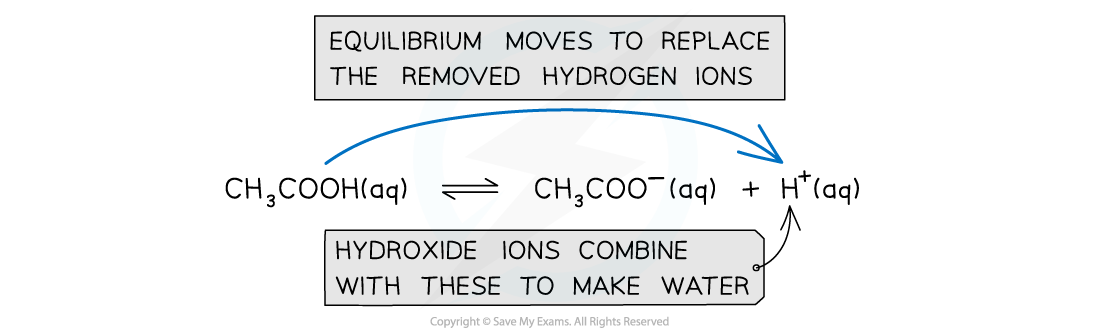
When OH- ions are added:
The OH- reacts with H+ to form water
OH- (aq) + H+ (aq) → H2O (l)
The H+ concentration decreases
The equilibrium position shifts to the right, and more CH3COOH molecules ionise to form more H+ and CH3COO- until equilibrium is re-established
CH3COOH (aq) → H+ (aq) + CH3COO- (aq)
As there is a large reserve supply of CH3COOH, the concentration of CH3COOH in solution doesn’t change much when CH3COOH dissociates to form more H+ ions
As there is a large reserve supply of CH3COO- the concentration of CH3COO- in solution doesn’t change much
As a result, the pH remains reasonably constant
Basic Buffers
A basic buffer can be made from ammonia (NH3) and ammonium chloride (NH4Cl)
Ammonia is a weak base. It reacts with water only partially:
NH3 (aq) + H2O(aq) NH4+ (aq) + OH-(aq)
Ammonium chloride dissolves completely in water to produce ammonium ions:
NH4Cl(s) NH4+ (aq) + OH-(aq)
The buffer therefore contains a significant amount of both NH3 and NH4+
When acid is added, the added hydrogen ions (H⁺) react with the ammonia:
NH3 (aq) + H+(aq) NH4+ (aq)
This removes most of the added H+ before it can significantly increase the hydrogen ion concentration. As a result, the pH decreases only slightly
When alkali is added, the added hydroxide ions (OH⁻) react with the ammonium ions:
NH4+ (aq) + OH-(aq) NH3 (aq) + H2O(aq)
This removes most of the added OH⁻ by converting it into water. Again, the pH changes only slightly
Examiner Tips and Tricks
Remember that buffer solutions cannot cope with excessive addition of acids or alkalis, as their pH will change significantly. The pH will remain relatively constant only if small amounts of acid or alkali are added.
Buffer Calculations
The pH of a buffer solution can be calculated using:
The Ka of the weak acid
The equilibrium concentration of the weak acid and its conjugate base (salt)
To determine the pH, the concentration of hydrogen ions is needed, which can be found using the equilibrium expression
Ka = which can be rearranged to [H+] = Ka x
To simplify the calculations, logarithms are used such that the expression becomes:
-log10[H+] = -log10Ka + (-log10 )
Since -log10 [H+] = pH, the expression can also be rewritten as:
pH = pKa + log10
This is known as the Henderson-Hasselbalch equation
Dilution
On dilution, the ratio [salt]/[acid] is unchanged, so [H+] and hence pH stay the same
Related topics
Examiner Tips and Tricks
When discussing the action of a buffer, examiners like to see students stating that "the pH remains reasonably constant" is supported with reasoning. From the Henderson-Hasselbalch equation, the ratio of salt to acid stays almost constant when both are in high concentration, so there is very little change in pH.
Note that when you change the sign of the log, the terms become inverted, so the salt concentration is on the top - be careful, it is very easy to get this the wrong way around.
-log (A/B) = +log(B/A)
Worked Example
Calculating the pH of a buffer solution.
Calculate the pH of a buffer solution containing 0.305 mol dm-3 of ethanoic acid and 0.520 mol dm-3 of sodium ethanoate.The Ka of ethanoic acid = 1.74 × 10⁻⁵ mol dm-3
Answer
Ethanoic acid is a weak acid that ionises as follows:
CH3COOH (aq) ⇌ H+ (aq) + CH3COO- (aq)
Step 1: Write down the equilibrium expression to find Ka
Step 2: Rearrange the equation to find [H+]
Step 3: Substitute the values into the expression
= 1.02 x 10⁻⁵ mol dm-3
Step 4: Calculate the pH
pH = - log [H+]
= -log 1.02 x 10-5
= 4.99
Worked Example
Calculate the pH of a solution made from a weak acid and a strong base.
25.0 cm3 of 0.200 mol dm-3 ethanoic acid (CH₃COOH) is mixed with 20.0 cm3 of 0.100 mol dm-3 sodium hydroxide (NaOH).
The pKa of ethanoic acid is 4.76. Calculate the pH of the resulting solution.
Answer
Step 1: Calculate the initial moles
Moles of ethanoic acid:
Moles of sodium hydroxide:
Step 2: Write the reaction
CH3COOH (aq) + OH- H+ (aq) + CH3COO- (aq) + H2O(l)
The reaction is 1 : 1.
OH- is the limiting reagent, so it reacts completely.
Step 3: Construct an ICE table
Substance | Initial (mol) | Change (mol) | Equilibrium (final) (mol) |
CH₃COOH | 0.00500 | -0.00200 | 0.00300 |
NaOH | 0.00200 | -0.00200 | 0 |
CH₃COO- | - | +0.00200 | 0.00200 |
Step 4: Apply the Henderson–Hasselbalch equation
pH = pKa + log10
Substitute the values:
pH = pKa + log10
pH = 4.76 + log10 (0.667)
pH = 4.76 -0.176
pH = 4.58
Examiner Tips and Tricks
The final pH must be given to exactly two decimal places (examiners penalise 1 dp or more than 2.
Applications of Buffers
Uses of buffer solutions in controlling the pH of blood
In humans, HCO3- ions act as a buffer to keep the blood pH between 7.35 and 7.45
Body cells produce CO2 during aerobic respiration
This CO2 will combine with water in the blood to form a solution containing H+ ions
CO2 (g) + H2O (l) ⇌ H+ (aq) + HCO3- (aq)
This equilibrium between CO2 and HCO3- is extremely important
If the concentration of H+ ions is not regulated, the blood pH would drop and cause ‘acidosis’
Acidosis refers to a condition in which there is too much acid in the body fluids, such as blood
This could cause body malfunction and eventually lead to a coma
If there is an increase in H+ ions
The equilibrium position shifts to the left until equilibrium is restored
CO2 (g) + H2O (l) ⇌ H+ (aq) + HCO3- (aq)
This reduces the concentration of H+ and keeps the pH of the blood constant
If there is a decrease in H+ ions
The equilibrium position shifts to the right until equilibrium is restored
CO2 (g) + H2O (l) ⇌ H+ (aq) + HCO3- (aq)
This increases the concentration of H+ and keeps the pH of the blood constant

Unlock more, it's free!
Join the 100,000+ Students that ❤️ Save My Exams
the (exam) results speak for themselves:

Was this revision note helpful?
Build on this topic