Reaction Feasibility (AQA A Level Chemistry): Revision Note
Exam code: 7405

Reaction Feasibility
The Gibbs equation can be used to calculate whether a reaction is feasible or not
ΔGꝋ = ΔHreactionꝋ - TΔSsystemꝋ
When ΔGꝋ is negative, the reaction is feasible and likely to occur
When ΔGꝋis positive, the reaction is not feasible and unlikely to occur
The borderline is when ΔGꝋ is = 0
Feasible and spontaneous are fairly similar terms to describe reactions
Feasible tends to be used to describe energetically favourable reactions, so reactions that should go
Spontaneous tends to be used to describe reactions that go of their own accord
Summary for temperature and Gibbs free energy
| The reaction is spontaneous | ||
|---|---|---|---|
negative | positive | always negative | always |
positive | negative | always positive | never |
negative | negative | negative at low T, positive at high T | only at low T when |
positive | positive | negative at high T, positive at low T | only at high T when |
Worked Example
Determining the feasibility of a reaction.
Calculate the Gibbs free energy change for the following reaction at 298 K and determine whether the reaction is feasible.
2Ca (s) + O2 (g) → 2CaO (s) ΔH = -635.5 kJ mol-1
Sꝋ[Ca(s)] = 41.00 J K-1 mol-1
Sꝋ[O2(g)] = 205.0 J K-1 mol-1
Sꝋ[CaO(s)] = 40.00 J K-1 mol-1
Answer:
Step 1: Calculate ΔSsystemꝋ
ΔSsystemꝋ = ΣΔSproductsꝋ - ΣΔSreactantsꝋ
ΔSsystemꝋ = (2 x ΔSꝋ [CaO(s)]) - (2 x ΔSꝋ [Ca(s)] + ΔSꝋ [O2(g)])
= (2 x 40.00) - (2 x 41.00 + 205.0)
= -207.0 J K-1 mol-1
Step 2: Convert ΔSꝋ to kJ K-1 mol-1
= -207.0 J K-1 mol-1÷ 1000 = -0.207 kJ K-1 mol-1
Step 3: Calculate ΔGꝋ
ΔGꝋ = ΔHreactionꝋ - TΔSsystemꝋ
= -635.5 - (298 x -0.207)
= -573.8 kJ mol-1
Step 4: Determine whether the reaction is feasible
Since the ΔGꝋ is negative, the reaction is feasible
Reaction Feasibility: Temperature Changes
The feasibility of a reaction can be affected by the temperature
The Gibbs equation will be used to explain what will affect the feasibility of a reaction for exothermic and endothermic reactions

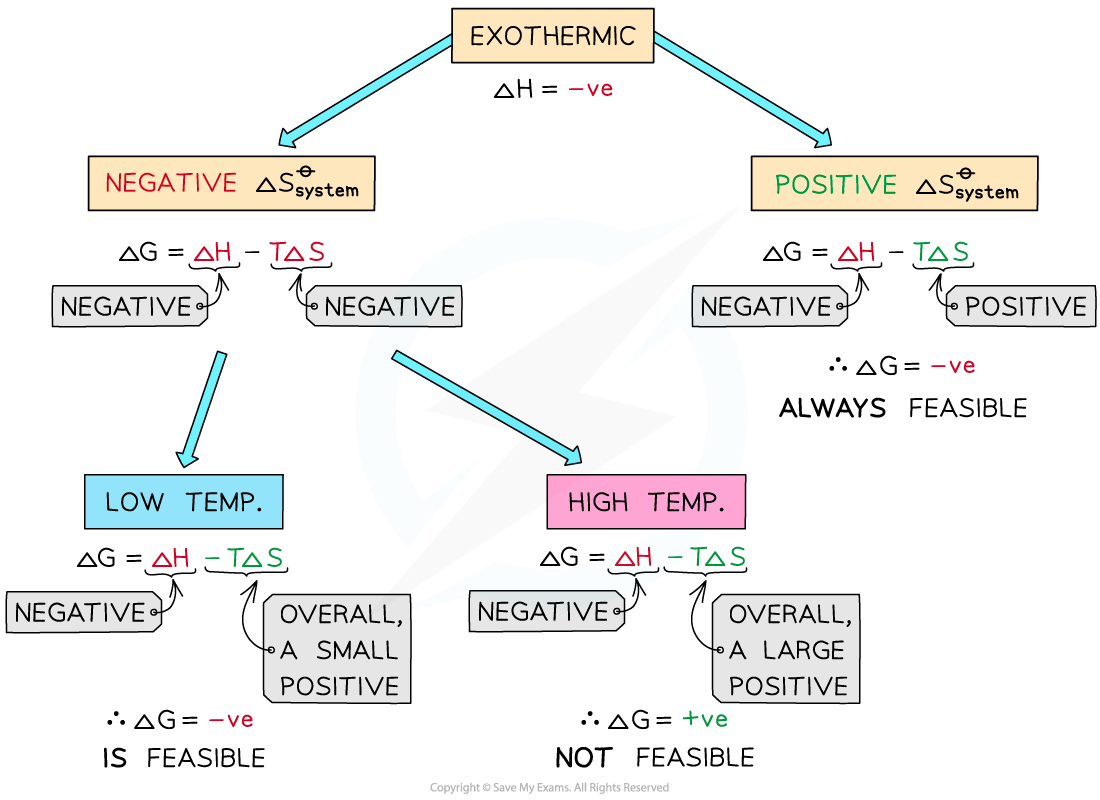
Exothermic reactions
In exothermic reactions, ΔHreactionꝋ is negative
If the ΔSsystemꝋ is positive:
Both the first and second terms will be negative
Resulting in a negative ΔGꝋ, so the reaction is feasible
Therefore, regardless of the temperature, an exothermic reaction with a positive ΔSsystemꝋ will always be feasible
If the ΔSsystemꝋ is negative:
The first term is negative, and the second term is positive
At very high temperatures, the -TΔSsystemꝋ will be very large and positive and will overcome ΔHreactionꝋ
Therefore, at high temperatures, ΔGꝋ is positive, and the reaction is not feasible
Since the relative size of an entropy change is much smaller than an enthalpy change, it is unlikely that TΔS > ΔH as temperature increases
These reactions are therefore usually spontaneous at normal conditions
Endothermic reactions
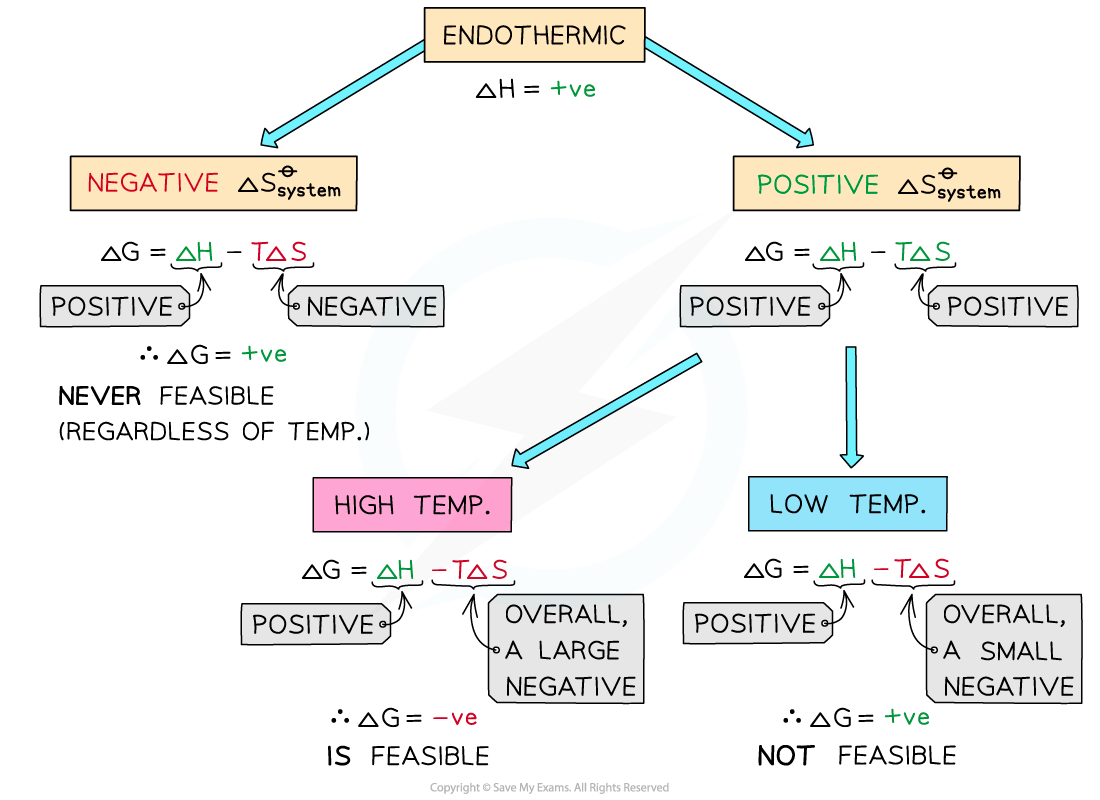
In endothermic reactions, ΔHreactionꝋ is positive
If the ΔSsystemꝋ is negative:
Both the first and second terms will be positive
Resulting in a positive ΔGꝋ, so the reaction is not feasible
Therefore, regardless of the temperature, endothermic with a negative ΔSsystemꝋ will never be feasible
If the ΔSsystemꝋ is positive:
The first term is positive, and the second term is negative
At low temperatures, the -TΔSsystemꝋ will be small and negative and will not overcome the larger ΔHreactionꝋ
Therefore, at low temperatures, ΔGꝋ is positive, and the reaction is not feasible
The reaction is more feasible at high temperatures as the second term will become negative enough to overcome the ΔHreactionꝋ resulting in a negative ΔGꝋ
This tells us that for certain reactions that are not feasible at room temperature, they can become feasible at higher temperatures
An example of this is found in metal extractions, such as the extraction of iron in the blast furnace, which will be unsuccessful at low temperatures but can occur at higher temperatures (~1500 C in the case of iron)
Free Energy Vs Temperature Graphs
Rearranging the Gibbs equation allows you to determine the temperature at which a non-spontaneous reaction becomes feasible
ΔGꝋ = ΔHreactionꝋ - TΔSsystemꝋ
For a reaction to be feasible, ΔGꝋ must be zero or negative
0 = ΔHꝋ - TΔSꝋ
ΔHꝋ = TΔSꝋ
T = ΔHꝋ / ΔSꝋ
Worked Example
At what temperature will the reduction of aluminium oxide with carbon become spontaneous?
Al2O3(s) + 3C(s) → 2Al(s) + 3CO(g)
ΔHꝋ = +1336 kJ mol-1 ΔSꝋ = +581 J K-1 mol-1
Answer:
If ΔG = 0 then , T = ΔHꝋ / ΔSꝋ
T = 1336 ÷ (581/1000)
T = 2299 K
Converting ΔS from J to kJ is the single most marked point. Mark schemes award a specific mark for dividing ΔS by 1000 to get kJ K⁻¹ mol⁻¹ before the TΔS term.
Keep the temperature in kelvin. Examiners report students wrongly converting T to °C, or subtracting 273 instead of adding.
Sign errors / reversing ΔH and ΔS. Units are essential, and a wrong-sign final answer loses a mark.
• Reading the ΔG-vs-T graph. "Relatively few students recognised that this equation can be taken as y = mx + c … a straight line with a gradient of −ΔS." Common errors: substituting the gradient in for ΔH, or missing the sign inversion (gradient = −ΔS, y-intercept = ΔH). The note's graph section covers this — add an explicit tip (7405/1 graph question; June 2018, 03.3).
• Temperature at which a reaction becomes feasible. Set ΔG = 0 → T = ΔH/ΔS, then state whether the reaction is feasible above or below that temperature from the sign of ΔS. Students struggle both with the unit conversion and with stating above/below correctly
Graphing the Gibbs Equation
The Gibbs equation can be expressed as the equation for a straight line
ΔGꝋ = ΔHꝋ - TΔSꝋ
ΔGꝋ = - ΔSꝋT + ΔHꝋ
y = mx + c
A graph of free energy versus temperature (in K) will give a straight line, with slope -ΔSꝋ and y-intercept ΔHꝋ.
The variation of ΔGꝋ against T for the synthesis of ammonia has been plotted below:
N2 (g) + 3H2 (g)⇌ 2NH3 (g)
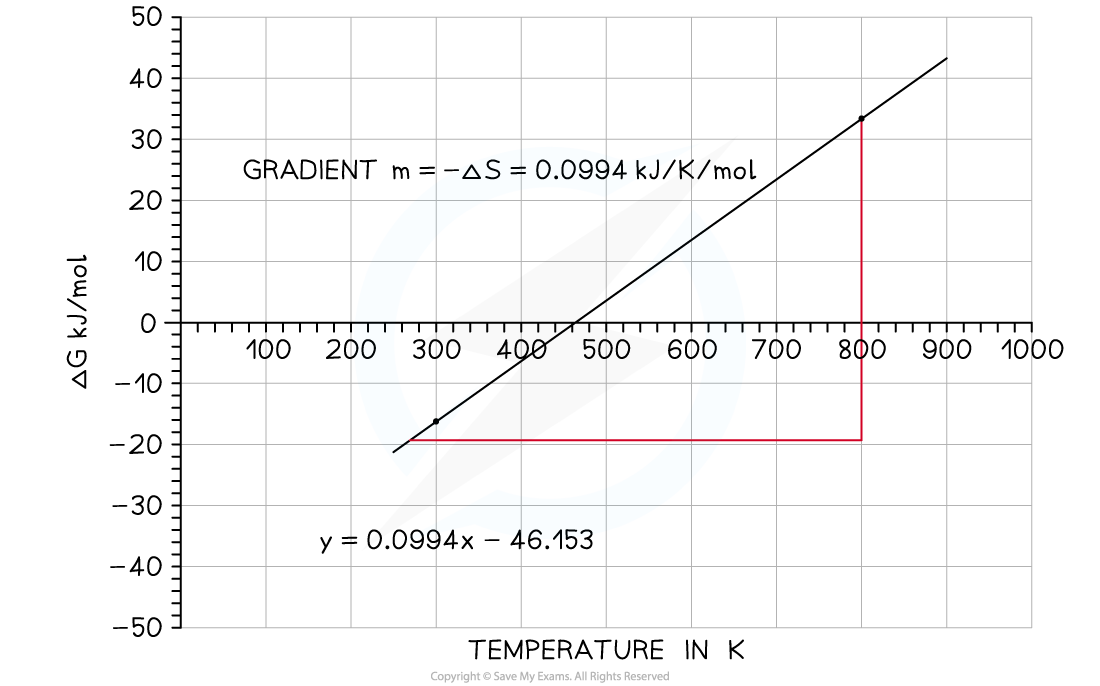
From this graph, you should be able to see some key features:
The x-intercept shows you where the reaction ceases to be spontaneous, in this case at 460 K (187 C)
Above this temperature, ΔGꝋ is positive, so the reaction is not feasible
However, you may recall that the operating conditions of the Haber process are higher than this temperature
This graph takes no account of the use of a catalyst, which affects the energetics of the system
It does not take into account anything about the rate of reaction or the fact that it is an equilibrium
The removal of the ammonia as soon as it is formed also tips the balance in favour of the product
The y-intercept shows that the reaction is exothermic, which can be seen from the enthalpy of formation; the value is approximately -46 kJ mol -1
Note in this example, the graph plot is per mole of ammonia
An exothermic equilibrium reaction would be favoured by lower temperatures - this is seen by the value of ΔGꝋ becoming increasingly negative as the temperature falls
Related topics
Examiner Tips and Tricks
You will notice that the line on the graph does not continue below 240 K. The simple reason for this is that at this point, the ammonia will have reached its boiling point, and so the gradient would change because it is now liquid ammonia.

Unlock more, it's free!
Join the 100,000+ Students that ❤️ Save My Exams
the (exam) results speak for themselves:

Was this revision note helpful?
Build on this topic