Fundamental Particles (AQA A Level Chemistry): Revision Note
Exam code: 7405

Structure of an Atom
All matter is composed of atoms
Atoms are the smallest parts of an element that can take part in chemical reactions
Atoms are mostly made up of space around a very small, dense nucleus that contains protons and neutrons
Protons and neutrons are sometimes referred to as nucleons because they are found in the nucleus
The nucleus has an overall positive charge
This is because the protons have a positive charge and the neutrons have a neutral charge
Negatively charged electrons are found in orbitals in the space around the nucleus
Our understanding of atomic structure has developed over time, from Thomson's 'plum pudding' model to the current nuclear model

Subatomic Particles
Subatomic particles are the particles that an element is made up of and include protons, neutrons, and electrons
These subatomic particles are so small that it is not possible to measure their masses and charges using conventional units (such as grams and coulombs)
Instead, their masses and charges are compared to each other using ‘relative masses’ and ‘relative charges’
These are not actual charges and masses, but they are charges and masses of particles relative to each other
Protons and neutrons have a very similar mass, so each is assigned a relative mass of 1, whereas electrons are 1836 times smaller than a proton and neutron
Protons are positively charged, electrons are negatively charged, and neutrons are neutral
The relative mass and charge of the subatomic particles are:
Relative mass & charge of subatomic particles table
Sub-atomic particle | Relative electrical charge | Relative Mass |
Proton | +1 | 1 |
Neutron | 0 (neutral) | 1 |
Electron | -1 |
Examiner Tips and Tricks
The relative mass of an electron is almost negligible.
When filling in a table of sub-atomic particles for an ion, remember to adjust the electron count — subtract electrons for positive ions, add for negative ions. This is the most common error examiners see on this topic.
If asked to compare the 'plum pudding' model to the modern model, make it clear which model you are referring to in each statement — vague comparisons lose marks
The charge of a single electron is -1.602 x 10⁻¹⁹ coulombs, whereas the charge of a proton is +1.602 x 10⁻¹⁹ coulombs; however, relative to each other, their charges are -1 and +1, respectively.
Atoms: Key Terms
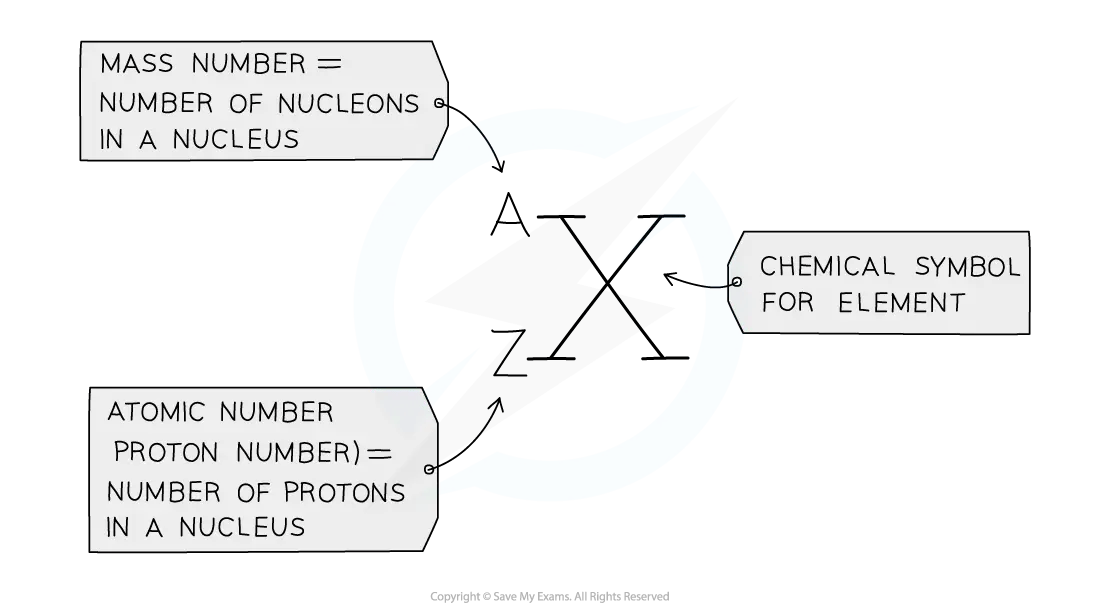
The atomic number (or proton number) is the number of protons in the nucleus of an atom and has the symbol Z
The atomic number is equal to the number of electrons present in a neutral atom of an element
e.g., the atomic number of lithium is 3, which indicates that the neutral lithium atom has 3 protons and 3 electrons
The mass number (or nucleon number) is the total number of protons and neutrons in the nucleus of an atom and has the symbol A
The number of neutrons can be calculated by:
Number of neutrons = mass number - atomic number
Protons and neutrons are also called nucleons
Related topics
Worked Example
Calculate the number of protons, neutrons, and electrons in the ion, .
Answer
Step 1: Number of protons
The atomic number gives the number of protons.
Atomic number = 26
Protons = 26
Step 2: Number of neutrons
Neutrons = Mass number − Atomic number
= 56 − 26
= 30
Neutrons = 30
Step 3: Number of electrons
A neutral iron atom has the same number of electrons as protons:
26 electrons
The 2+ charge means it has lost 2 electrons.
26 − 2 = 24
Electrons = 24
Examiner Tips and Tricks
When defining mass number, state it as 'the total number of protons and neutrons in the nucleus.' Never use the word 'mass' or 'average' in this definition — examiners will not award the mark if you confuse it with relative atomic mass

Unlock more, it's free!
Join the 100,000+ Students that ❤️ Save My Exams
the (exam) results speak for themselves:

Was this revision note helpful?
Build on this topic