Rate Determining Step (AQA A Level Chemistry): Revision Note
Exam code: 7405

Rate Determining Step
Rate-determining step and intermediates
A chemical reaction can only go as fast as the slowest part of the reaction
So, the rate-determining step is the slowest step in the reaction
If a reactant appears in the rate-determining step, then the concentration of that reactant will also appear in the rate equation
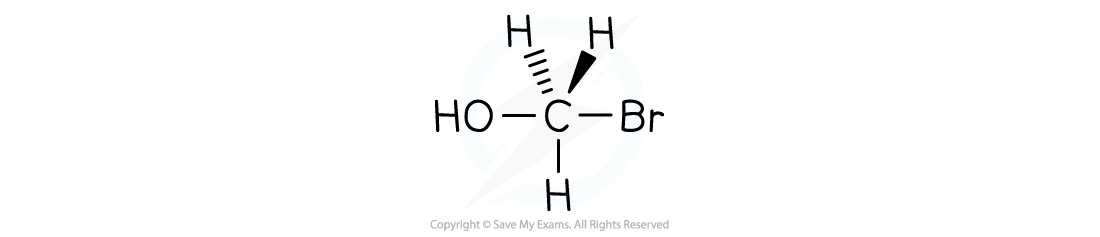
For example, the rate equation for the reaction below is rate = k [CH3Br] [OH-]
CH3Br + OH- → CH3OH + Br-This suggests that both CH3Br and OH- take part in the slow rate-determining step
This reaction is bimolecular
Unimolecular: one species involved in the rate-determining step
Bimolecular: two species involved in the rate-determining step
The intermediate is derived from substances that react together to form it in the rate-determining step
For example, for the reaction above, the intermediate would consist of CH3Br and OH-
Examiner Tips and Tricks
The most common way students lose marks: they define the rate-determining step as the "slowest step" but don't use the rate equation to justify which step is rate-determining.
Don't just state the RDS is the 'slowest step' — examiners expect you to show that the number of moles of each reactant consumed up to and including the RDS matches the orders in the rate equation.
Predicting the reaction mechanism
The overall reaction equation and rate equation can be used to predict a possible reaction mechanism of a reaction
This shows the individual reaction steps that are taking place
For example, nitrogen dioxide (NO2) and carbon monoxide (CO) react to form nitrogen monoxide (NO) and carbon dioxide (CO2)
The overall reaction equation is:
NO2 (g) + CO (g) → NO (g) + CO2 (g)
The rate equation is:
Rate = k [NO2]2
From the rate equation, it can be concluded that the reaction is zero order with respect to CO (g) and second order with respect to NO2 (g)
This means that there are two molecules of NO2 (g) involved in the rate-determining step and zero molecules of CO (g)
A possible reaction mechanism could therefore be:
Step 1:
2NO2 (g) → NO (g) + NO3 (g) slow (rate-determining step)
Step 2:
NO3 (g) + CO (g) → NO2 (g) + CO2 (g) fast
Overall:
2NO2 (g) + NO3 (g) + CO (g) → NO (g) + NO3 (g) + NO2 (g) + CO2 (g)
= NO2 (g) + CO (g) → NO (g) + CO2 (g)
Predicting the reaction order and deducing the rate equation
The order of a reactant and thus the rate equation can be deduced from a reaction mechanism if the rate-determining step is known
For example, the reaction of nitrogen oxide (NO) with hydrogen (H2) to form nitrogen (N2) and water
2NO (g) + 2H2 (g) → N2 (g) + 2H2O (l)
The reaction mechanism for this reaction is:
Step 1:
NO (g) + NO (g) → N2O2 (g) fast
Step 2:
N2O2 (g) + H2 (g) → H2O (l) + N2O (g) slow (rate-determining step)
Step 3:
N2O (g) + H2 (g) → N2 (g) + H2O (l) fast
The second step in this reaction mechanism is the rate-determining step
The rate-determining step consists of:
N2O2, which is formed from the reaction of two NO molecules
One H2 molecule
The reaction is, therefore, second order with respect to NO and first order with respect to H2
So, the rate equation becomes:
Rate = k [NO]2 [H2]
The reaction is, therefore, third-order overall
Examiner Tips and Tricks
Remember: reaction orders must be deduced from experimental rate data, not from the coefficients in the balanced overall equation.
Identifying the rate-determining step
The rate-determining step can be identified from a rate equation, given that the reaction mechanism is known
For example, propane (CH3CH2CH3) undergoes bromination in alkaline solutions
The overall reaction is:
CH3CH2CH3 + Br2 + OH- → CH3CH2CH2Br + H2O + Br-
The reaction mechanism is:

The rate equation is:
Rate = k [CH3CH2CH3] [OH-]
From the rate equation, it can be deduced that only CH3CH2CH3 and OH- are involved in the rate-determining step and not bromine (Br2)
CH3CH2CH3 and OH- are only involved in the first step of the reaction mechanism; therefore, the rate-determining step is:
CH3CH2CH3 + OH- → CH3CH2CH2- + H2O
Identifying intermediates and catalysts
When a rate equation includes a species that is not part of the chemical reaction equation, then this species is a catalyst
For example, the halogenation of butanone under acidic conditions
The reaction equation is:

The reaction mechanism is:

The rate equation is:
Rate = k [CH3CH2COCH3] [H+]
The H+ is not a reactant in the chemical reaction equation, but does appear in the rate equation
H+ must, therefore, be a catalyst
Furthermore, the rate equation suggests that CH3CH2COCH3 and H+ must be involved in the rate-determining (slowest) step
The CH3CH2COCH3 and H+ appear in the rate-determining step in the form of an intermediate (which is a combination of the two species)

Related topics

Unlock more, it's free!
Join the 100,000+ Students that ❤️ Save My Exams
the (exam) results speak for themselves:

Was this revision note helpful?
Build on this topic
