Nucleophilic Substitution (AQA A Level Chemistry): Revision Note
Exam code: 7405

Mechanism: Nucleophilic Substitution
A nucleophile is an electron-rich species that can donate a pair of electrons
‘Nucleophile’ means ‘nucleus/positive charge loving’ as nucleophiles are attracted to positively charged species
Nucleophilic refers to reactions that involve a nucleophile
Various species can behave as nucleophiles, and some make better nucleophiles than others

A nucleophilic substitution reaction is one in which a nucleophile attacks a carbon atom that carries a partial positive charge
An atom that has a partial negative charge is replaced by the nucleophile
Halogenoalkanes will undergo nucleophilic substitution reactions due to the polar C-X bond (where X is a halogen)


Halogenoalkanes undergo substitution reactions with the nucleophiles OH–, CN–, and NH3
Mechanism with OH-
For example, in the following reaction, a halogenoalkane reacts with aqueous alkali to form an alcohol

The mechanism for the reaction is as follows

Mechanism with CN-
The nucleophile in this reaction is the cyanide, CN- ion
Ethanolic solution of potassium cyanide (KCN in ethanol) is heated under reflux with the halogenoalkane
The product is a nitrile
For example, bromoethane reacts with ethanolic potassium cyanide when heated under reflux to form propanenitrile
The halogen is replaced by a nucleophile, :CN–
CH3CH2Br + :CN– → CH3CH2CN + :Br–
The nucleophilic substitution of halogenoalkanes with KCN adds an extra carbon atom to the carbon chain
This reaction can therefore be used by chemists to make a compound with one more carbon atom than the best available organic starting material

The mechanism for the reaction is as follows
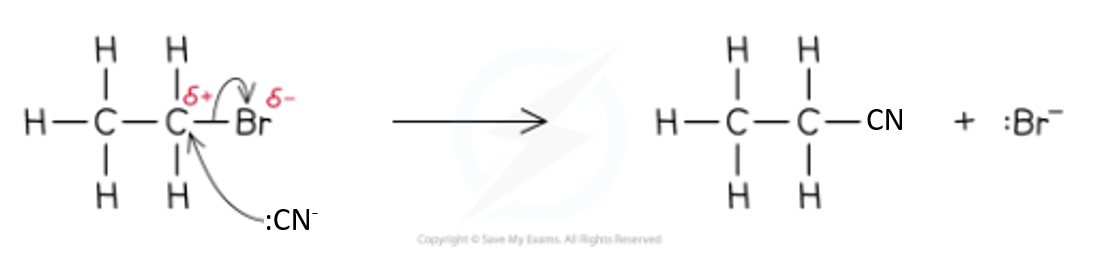
Mechanism with NH3
When ammonia reacts with a haloalkane, a nucleophilic substitution reaction takes place, forming a primary amine
For example, chloromethane reacts with ammonia in two steps to make methylamine and ammonium chloride
CH3Cl + NH3 → [CH3NH3]+Cl-
[CH3NH3]+Cl- + NH3 → CH3NH2 + NH4+Cl-
Excess ammonia is used to prevent further substitution and favour the formation of a primary amine

Related topics
Examiner Tips and Tricks
Make sure your arrows are clearly curly - if they are not curly enough, then you will not be awarded the mark. Your first arrow must start at the lone pair of the nucleophile and go clearly to the delta positive carbon atom. Your second arrow must start touching the C-X bond and move clearly to the delta negative X atom.
Make sure you show the products formed, including the :X- atom which has been substituted.
Arrows must be double-headed (half-headed "fishhook" arrows are only for free-radical substitution and are penalised here).
The nucleophile must be drawn as the free ion (:OH⁻, :CN⁻), since mark schemes penalise a covalent "NaOH / KOH / KCN" drawn with a bond to the metal.
The carbon should carry a partial charge (δ+), not a full positive charge (a full + is only accepted in an SN1 carbocation route).
Arrows must never start at an atom — always from a lone pair or a bond.

Unlock more, it's free!
Join the 100,000+ Students that ❤️ Save My Exams
the (exam) results speak for themselves:

Was this revision note helpful?
Build on this topic