Alkanes (Cambridge (CIE) A Level Chemistry): Exam Questions

Exam code: 9701

1 hour17 questions
1a
2 marks

Explain why alkanes are generally unreactive.

1b
2 marks

Methane reacts with chlorine to produce chloromethane, CH3Cl. The reaction is initiated by the formation of chlorine free radicals.

i) Explain what is meant by the term free radical.

[1]

ii) State the condition required to form chlorine free radicals from Cl2.

[1]

1c
1 mark

Name the type of bond fission that occurs in the initiation step.

1d
3 marks

i) Construct two equations to show the propagation steps in this mechanism.

[2]

ii) Ethane is produced as a by-product in this reaction.

Construct an equation for the termination step that forms ethane.

[1]

2a
3 marks

Describe the difference in conditions between the complete and incomplete combustion of octane.

Construct one equation for the complete combustion and one equation for the incomplete combustion of octane.

2b
3 marks

Carbon monoxide is an atmospheric pollutant produced in the internal combustion engines of motor vehicles.

i) State one adverse effect of carbon monoxide on human health.

[1]

ii) Identify one other pollutant produced in internal combustion engines. State the environmental consequence of this pollutant.

[2]

2c
3 marks

Octane can be cracked to form pentane and one other product.

i) Construct an equation for this reaction.

[1]

ii) State the reagent and conditions required for this cracking reaction.

[2]

2d
3 marks

Describe a chemical test and the expected observations to distinguish between the two organic products formed in (c).

1a
1 mark

A reaction scheme involving cyclohexane is shown in Fig. 1.1.

fig-4-1-9701-y22-sp-2-cie-ial-chem

Fig. 1.1.

Reaction 1 involves a free radical substitution mechanism.

State the essential condition required for reaction 1 to occur.

1b
5 marks

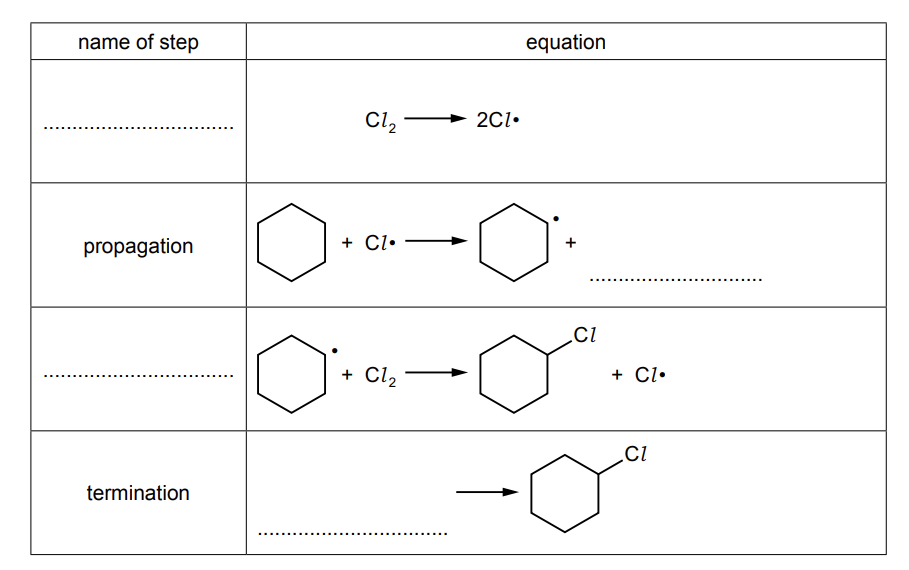
Complete Table 1.1 to give details of the mechanism in reaction 1. Include curly arrows to show the movement of electrons occurring in the termination step.

Table 1.1

GZyGrUb2_table-4-1-9701-y22-sp-2-cie-ial-chem
1c
1 mark

Deduce the type of reaction that occurs in reaction 2.

1d
2 marks

Hex-3-ene is an isomer of cyclohexane. Hex-3-ene can be converted into propanoic acid.

hex-3-ene rightwards arrow with reaction space 3 on top propanoic acid

Deduce the reagents and conditions for reaction 3.

2a
2 marks

i) Explain what is meant by the term cracking.

[1]

ii) Suggest why cracking is a useful process in the petroleum industry.

[1]

2b
3 marks

i) State the reagent and conditions required for the cracking of alkanes.

[2]

ii) Construct an equation for the cracking of tetradecane, C14H30, to form heptane, C7H16, and two other organic products.

[1]

2c
3 marks

The combustion of octane, C8H18, in internal combustion engines produces a mixture of pollutants, including carbon monoxide, nitrogen monoxide and unburnt hydrocarbons.

i) State one adverse effect of carbon monoxide on human health.

[1]

ii) State one environmental consequence of releasing nitrogen monoxide / oxides of nitrogen into the atmosphere.

[1]

iii) State one environmental consequence of releasing unburnt hydrocarbons into the atmosphere.

[1]

2d
1 mark

Construct an equation to demonstrate how a catalytic converter removes carbon monoxide and nitrogen monoxide from exhaust gases.

3a
5 marks

Methane reacts with chlorine gas under suitable conditions to form chloromethane.

i) Name the mechanism that occurs in this reaction.

[1]

ii) Two test tubes are set up, each containing a small amount of methane and pale green chlorine gas. One test tube is left in the dark, whereas the other is placed in direct sunlight.

State and explain the observations in each test tube.

[3]

iii) Construct an equation for the overall reaction that occurs in the sunlight.

[1]

3b
4 marks

The mechanism for this reaction involves an initiation step.

i) Name the type of bond breaking that occurs in the initiation step. Explain what happens to the electrons in the bond.

[2]

ii) Explain what is meant by the term free radical.

[1]

iii) Suggest why the Cl–Cl bond is broken in the initiation step rather than the C–H bond.

[1]

3c
3 marks

The mechanism also involves propagation and termination steps.

i) Construct two equations to show the propagation steps in this mechanism.

[2]

ii) Construct an equation to show one possible termination step.

[1]

1a
2 marks

1,2-dibromoethane reacts with bromine in the presence of ultraviolet light to produce a mixture of further substituted halogenoalkanes.

i) Construct an equation for the initiation step of this reaction.

[1]

ii) Explain why the bond breaking in the initiation step is described as homolytic fission.

[1]

1b
2 marks

Construct two equations to show the propagation steps in this mechanism that produce 1,1,2-tribromoethane.

1c
2 marks

Traces of 1,2,3,4-tetrabromobutane are found in the reaction mixture.

i) Construct an equation for the termination step that forms 1,2,3,4-tetrabromobutane.

[1]

ii) Construct an equation to show the overall reaction for the formation of hexabromoethane from 1,1,2-tribromoethane.

[1]

1d
2 marks

Suggest two reasons why free-radical substitution is not a good method for producing a single, pure halogenoalkane.