Similarities & Trends in the Properties of the Group 2 Metals, Magnesium to Barium, & Their Compounds (Cambridge (CIE) A Level Chemistry): Exam Questions

Exam code: 9701

3 hours43 questions
1a
2 marks

i) State the name of a Group 2 element that burns in air to give a bright white flame.

[1]

ii) Construct an equation for the reaction of this element with oxygen.

[1]

1b
4 marks

i) State the reagent and conditions required for magnesium to react to form magnesium hydroxide.

[2]

ii) Construct an equation for this reaction. Include state symbols.

[2]

1c
3 marks

Calcium is added to dilute hydrochloric acid.

i) State one observation for this reaction.

[1]

ii) Construct an equation for this reaction. Include state symbols.

[2]

1d
5 marks

i) Barium reacts with dilute hydrochloric acid. Construct an equation for this reaction. Include state symbols.

[2]

ii) Barium reacts with dilute sulfuric acid. Construct an equation for this reaction. Include state symbols.

[2]

iii) Explain why the reaction of barium with dilute sulfuric acid soon slows down and stops.

[1]

2a
2 marks

Group 2 oxides react with water to form Group 2 hydroxides.

Describe the general trends in solubility and pH of the Group 2 hydroxides as you move down Group 2.

2b
Sme Calculator
4 marks

3.71 g of calcium hydroxide, Ca(OH)2, is added to hydrochloric acid.

i) Construct an equation for this reaction.

[2]

ii) Calculate the mass of calcium chloride produced in this reaction. Show your working.

[2]

2c
4 marks

Strontium carbonate reacts with hydrochloric acid to form strontium chloride, water and carbon dioxide.

i) Describe a test to identify the gas produced as carbon dioxide.

[2]

ii) Carbon dioxide is also produced when strontium carbonate reacts with sulfuric acid. The effervescence observed in this reaction stops after a short period of time.

Suggest why the reaction stops even though the reactants have not been used up.

[2]

3a
1 mark

State the type of reaction that occurs when strontium carbonate is heated to form strontium oxide and carbon dioxide.

SrCO3 (s) → SrO (s) + CO2 (g)

3b
2 marks

When heated, strontium nitrate breaks down to form strontium oxide, nitrogen dioxide and oxygen.

Complete the balanced chemical equation for this reaction.

2Sr(NO3)2 (s) → .......... (.....) + .......... (.....) + .......... (.....)

3c
Sme Calculator
3 marks

5.00 g of magnesium carbonate breaks down to form 1.75 g of magnesium oxide and carbon dioxide when heated.

MgCO3 (s) → MgO (s) + CO2 (g)

Calculate the percentage yield of magnesium oxide. Show your working.

3d
1 mark

Describe the trend in the thermal stability of the Group 2 carbonates and nitrates as you move down Group 2.

4a
3 marks

Complete Table 4.1 to describe the general trends as you move down Group 2.

Table 4.1

Property

Trend

Melting point

Atomic radius

First ionisation energy

4b
1 mark

Name the Group 2 element that does not follow the general trend in melting point.

4c
2 marks

Construct equations for the first ionisation energy of barium and the second ionisation energy of calcium. Include state symbols.

4d
3 marks

The trend in ionisation energy down Group 2 can be explained by the factors shown in Table 4.2.

Complete Table 4.2 to show how each factor changes as you move down Group 2.

Table 4.2

Factor affecting ionisation energy

Increase / decrease

Distance between the nucleus and outer electron

Shielding

Nuclear attraction

5a
3 marks

A group of students are asked to prepare a sample of barium sulfate using barium carbonate.

Student A suggests adding sulfuric acid to the barium carbonate.

i) Construct an equation for the reaction of barium carbonate with sulfuric acid.

[1]

ii) Suggest a reason why this preparation of barium sulfate will not have a 100% yield.

[2]

5b
2 marks

Student B suggests that barium carbonate can be converted into barium sulfate in a two-step process.

barium carbonate rightwards arrow from heat to step space 1 of barium oxide rightwards arrow with step space 2 on top barium sulfate

i) Name the type of reaction that occurs in step 1.

[1]

ii) In step 2, barium oxide is reacted with sulfuric acid. Construct an equation for the reaction in step 2.

[1]

5c
2 marks

Student C makes an adaptation to student B's suggestion.

barium carbonate rightwards arrow from heat to step space 1 of barium oxide rightwards arrow from water to step space 2 of barium hydroxide rightwards arrow from sulfuric space acid to step space 3 of barium sulfate

State the solubility in water of barium hydroxide and barium sulfate.

5d
2 marks

Construct the ionic equation for the reaction in step 3 between barium hydroxide and sulfuric acid to form barium sulfate. Include state symbols.

1a
2 marks

Magnesium, calcium and barium are some of the Group 2 elements of the Periodic Table.

State and explain the trend in the atomic radius of the Group 2 elements from magnesium to barium.

1b
2 marks

Magnesium is frequently used in fireworks. It burns rapidly in oxygen, and it adds sparks which generally improves the appearance and brilliance of the firework.

Construct an equation to represent the reaction which takes place when a strip of magnesium is burned in oxygen and state an observation which would be made.

State symbols are not required.

1c
5 marks

Group 2 compounds, such as the hydroxides of magnesium and calcium, have a number of other uses.

i) Construct equations to show the formation of magnesium hydroxide and calcium hydroxide from their metals.

[2]

ii) Give an approximate pH value and a use for each of the hydroxides.

[3]

1d
3 marks

Group 2 elements will react with water.

A student added 20 cm3 of water to two boiling tubes. A small piece of calcium was added to one of the boiling tubes and a small piece of barium was added to the other.

State two observations that the student would make and how the observations would differ between the two boiling tubes.

2a
1 mark

Group 2 hydroxides, M(OH)2, can be used to neutralise acids.

Construct an equation for the reaction of barium with cold water. State symbols are not required.

2b
2 marks

Explain why a saturated solution of barium hydroxide is more alkaline than a saturated solution of magnesium hydroxide.

2c
3 marks

An unknown solution of a group 2 metal salt was tested for the presence of carbonate ions.

Dilute hydrochloric acid was added to the solution and the gas given off was bubbled through limewater. A white precipitate formed.

i) Construct the ionic equation for the formation of the gas. State symbols are not required.

[1]

ii) Construct an equation for the formation of the precipitate. Include state symbols.

[2]

2d
3 marks

Magnesium hydroxide can be used as an indigestion remedy to neutralise hydrochloric acid in the stomach.

Mg(OH)2 + 2HCl → MgCl2 + 2H2O

Calculate the minimum mass of magnesium hydroxide needed to neutralise 0.210 mol of hydrochloric acid. Give your answer to an appropriate number of significant figures. Show your working.

3a
3 marks

Group 2 metals and their compounds are used commercially in a variety of processes and applications.

Calcium carbonate is an insoluble solid that can be used to lower the acidity of lake water.

Explain why the rate of this reaction decreases when the water temperature falls.

3b
1 mark

Calcium carbonate reacts with lactic acid (Figure 3.1) to form calcium lactate, which is used to treat or prevent low blood calcium levels (hypocalcemia).

00jhfEA3_2-2-3b-m-2-2-q3b-lactic-acid

Figure 3.1

State the two other products of the reaction of calcium carbonate with lactic acid.

3c
4 marks

Magnesium can be used to extract titanium.

i) Construct an equation to show how magnesium is used as the reducing agent in the reaction of magnesium with titanium(IV) chloride. State symbols are not required.

[2]

ii) Explain, in terms of oxidation numbers, why magnesium is the reducing agent.

[1]

iii) The excess magnesium used in this extraction is removed by reacting it with dilute sulfuric acid to form magnesium sulfate.

Explain why the magnesium sulfate formed is easy to separate from the titanium.

[1]

3d
2 marks

Strontium metal is used in the manufacture of alloys.

Explain why strontium has a higher melting point than barium.

4a
4 marks

Calcium salts have a number of industrial, agricultural and medicinal uses.

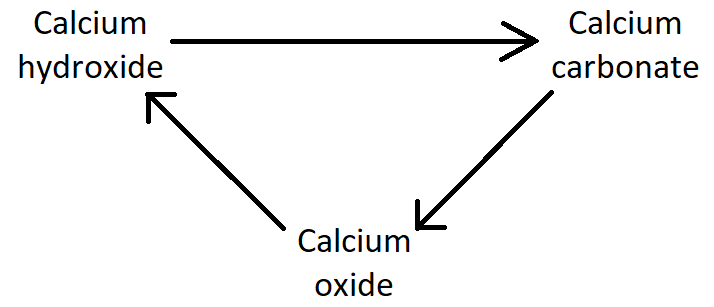
Calcium carbonate is used as an antacid to relieve heartburn, acid indigestion, and upset stomach. Calcium oxide is used to make porcelain, glass, mortars and cement. Calcium hydroxide is used in agriculture when a rapid change in the pH of soil is required.

These three calcium salts are connected by the Lime cycle shown in Fig. 4.1.

lime-cycle

Fig. 4.1

Construct three equations to demonstrate the reactions that occur in the Lime cycle. Include state symbols.

4b
4 marks

In agriculture, bulk lime spreaders are used to cover fields with solid calcium salts, including calcium carbonate, calcium oxide and calcium hydroxide.

i) Explain how solid calcium hydroxide increases the pH of acidic soil.

[3]

ii) Construct an ionic equation to show the reaction that causes the pH of the soil to increase. State symbols are not required.

[1]

4c
4 marks

When calcium carbonate is heated strongly it undergoes a process called calcination.


i) What is the chemical reaction that is described by calcination? 

[1]

 ii) Explain why strontium carbonate has greater thermal stability than calcium carbonate. 

[3]

4d
2 marks

A sample of hydrated calcium nitrate crystals was gently heated in a test tube. With further heating, a mixture of two gases was evolved. One of the gases was coloured and the other was colourless.

i) Identify the coloured gas and give its colour. 

[1]

 ii) Identify and describe a test, including the result, for the colourless gas. 

[1]

5a
2 marks

Explain why the first ionisation energy of calcium (590 kJ mol-1) is greater than that of strontium (550 kJ mol-1).

5b
3 marks

Strontium chloride is used in toothpaste for sensitive teeth.

i) Construct an equation for the formation of strontium chloride from strontium and hydrochloric acid. Include state symbols.

[2]

ii) Suggest why this reaction is not used to produce strontium chloride on an industrial scale.

[1]

5c
2 marks

Magnesium sulfate solution can be given as first aid to someone who has accidentally swallowed barium chloride.

Explain, with the help of an ionic equation, why drinking magnesium sulfate solution is an effective treatment for barium poisoning. State symbols are not required.

5d
2 marks

Milk of magnesia, Mg(OH)2, and calcium carbonate can both be used in the effective relief of acid indigestion.

By comparing the chemical equations for their reactions with hydrochloric acid, justify which remedy might cause the person taking it to have wind.

1a
4 marks

Barium is silvery white but blackens when exposed to air.

This is due to the formation of barium nitride and one other compound.

Construct equations for the two separate reactions that occur. Include state symbols.

1b
Sme Calculator
4 marks

Barium can also react with water.

A student reacted 0.20 g of barium with 250 cm3 of water.

i) Calculate the volume of gas, in cm3, produced in this reaction at room conditions. Show your working.

[3]

ii) Calculate the concentration, in mol dm-3, of the barium hydroxide solution produced.

[1]

1c
4 marks

Describe and explain the trend in the reactivity of Group 2 elements with water.

1d
2 marks

Explain why the reaction of calcium with water is a redox reaction.

Use oxidation numbers in your answer.

1e
3 marks

The trend in solubility and strength as a base can also be observed going down Group 2.

Explain how these two trends are connected.

2a
2 marks

Samples of calcium, strontium and barium are reacted with water to form their hydroxides. The resulting solutions are then filtered to collect the precipitates.

Explain the trend in the expected mass of the precipitates.

2b
Sme Calculator
2 marks

Table 2.1 shows the solubility data for the Group 2 metal hydroxides.

Table 2.1

Group 2 metal hydroxide

Solubility / g dm-3 at 20 °C

Magnesium hydroxide

0.140

Calcium hydroxide

1.730

Strontium hydroxide

17.70

Barium hydroxide

38.90

A student determined that a 50 cm3 solution of an unknown Group 2 metal hydroxide contained 802 mg of the metal hydroxide.

Identify the metal hydroxide in the unknown sample. Show your working.

2c
5 marks

Magnesium hydroxide reacts with sulfuric acid.

i) Construct an equation for the reaction between magnesium hydroxide and sulfuric acid. Include state symbols.

[2]

ii) Barium hydroxide also reacts with sulfuric acid. State and explain any differences in the observations between the two reactions.

[3]

3a
5 marks

i) Construct an equation for the thermal decomposition of calcium nitrate, Ca(NO3)2.

[1]

ii) State and explain how the thermal stabilities of the nitrates vary down Group 2.

[3]

iii) Predict what you would observe if a sample of lithium nitrate was heated.

[1]

3b
Sme Calculator
3 marks

The nitrates of calcium, strontium or barium are often added to firework mixtures to produce red or green flames. The equation for the decomposition of one such mixture is as follows.

Sr(NO3)2 (s) + 3C (s) → SrO (s) + N2 (g) + 2CO2 (g) + CO (g)

Calculate the volume of gas given off (measured at room temperature and pressure) when a 10.0 g sample of this mixture decomposes. Show your working.

[Mr: Sr(NO3)2 = 211.6]

3c
Sme Calculator
3 marks

One of the major ores of magnesium is the mixed carbonate called dolomite, CaMg(CO3)2.

Calculate the percentage loss in mass that would be observed when a sample of dolomite is heated at a high temperature until the reaction is complete. Show your working.