Aldehydes & Ketones (Cambridge (CIE) A Level Chemistry): Exam Questions

Exam code: 9701

2 hours29 questions
1a
2 marks

State the class of alcohol that can be oxidised to give:

i) an aldehyde

[1]

ii) a ketone

[1]

1b
2 marks

State the oxidation product of:

i) an aldehyde

[1]

ii) a ketone

[1]

1c
3 marks

Describe how 2,4-dinitrophenylhydrazine (2,4-DNPH) and melting point data can be used to determine the identity of an unknown carbonyl compound.

2a
4 marks

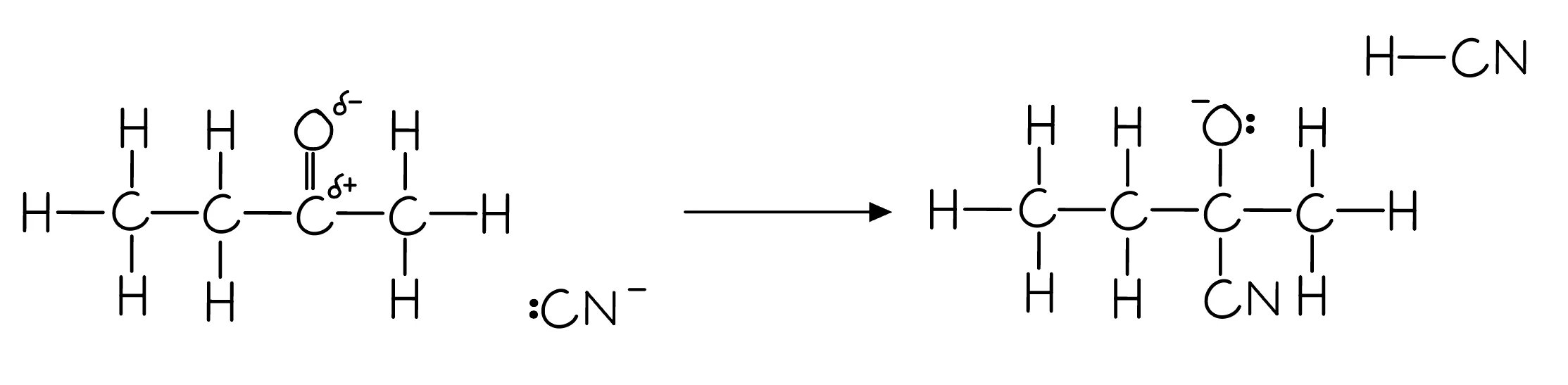
Butanone reacts with potassium cyanide, KCN, in the presence of a dilute acid catalyst to produce a hydroxynitrile by nucleophilic addition.

Complete the mechanism for this reaction.

Incomplete mechanism for the reaction of a cyanide ion with butan-2-one

Fig. 2.1

2b
1 mark

State the systematic name of the organic product formed in part (a).

2c
1 mark

Explain why a number is not required to indicate the position of the carbonyl group in the name butanone.

3a
2 marks

Complete Table 3.1 to show the observations when an aldehyde and a ketone are each tested with Tollens' reagent.

Table 3.1

Initial observation

Final observation

Ketone

Colourless solution

Aldehyde

Colourless solution

3b
2 marks

Complete Table 3.2 to show the observations when an aldehyde and a ketone are each warmed separately with Fehling's solution.

Table 3.2

Initial observation

Final observation

Ketone

Blue solution

Aldehyde

Blue solution

3c
2 marks

Ethanal and propanal are each warmed separately with alkaline iodine solution, I2(aq).

i) State which compound gives a yellow precipitate in this reaction.

[1]

ii) Explain your answer to part (c)(i).

[1]

1a
1 mark

Calcium and its compounds have a large variety of applications.

Calcium metal reacts readily with most acids.

When calcium metal is placed in dilute sulfuric acid, it reacts vigorously at first.

After a short time, a layer of calcium sulfate forms on the calcium metal and the reaction stops. Some of the calcium metal and dilute sulfuric acid remain unreacted.

Suggest an explanation for these observations.

1b
3 marks

Calcium ethanedioate is formed when calcium reacts with ethanedioic acid, HOOCCOOH.

Calcium ethanedioate contains one cation and one anion.

i) State the full electronic configuration of the cation in calcium ethanedioate.

[1]

ii) Deduce the charge on the cation.

 [1]

iii) Draw the fully displayed formula of ethanedioic acid.

[1]

1c
3 marks

Calcium chlorate(I), Ca(ClO)2, is used as an alternative to sodium chlorate(I), NaClO, in some household products.

i) The chlorate(I) ion is formed when cold aqueous sodium hydroxide reacts with chlorine.

Write an ionic equation for this reaction. State symbols are not required.

[1]

ii) The chlorate(I) ion is unstable and decomposes when heated as shown.

3ClO → 2Cl + ClO3

This reaction can be described as a disproportionation reaction. Describe what is meant by disproportionation reaction.

[1]

iii) Deduce the oxidation number of chlorine in each species for the equation in (c)(ii).

Complete the boxes.

Chemistry question showing 3ClO⁻ → 2Cl⁻ + ClO₃⁻ with three boxes to fill in oxidation numbers of chlorine; first box already has +1 filled in.

[1]

1d
8 marks

Calcium carbonate reacts with 2-hydroxypropanoic acid to form product Y.

Diagram showing structural formula of 2-hydroxypropanoic acid and its salt Y, labelled as calcium 2-hydroxypropanoate, Ca(CH₃CH(OH)COO)₂

Fig. 1.1

i) Identify the two other products of the reaction of 2-hydroxypropanoic acid with calcium carbonate.

 [1]

Two possible methods of making 2-hydroxypropanoic acid are shown in Fig. 1.2.

Reaction scheme showing conversion of ethanal to 2‑hydroxypropanoic acid and propane-1,2-diol to 2‑hydroxypropanoic acid

Fig. 1.2

ii) State suitable reagents and conditions for reactions 1 and 3.

reaction 1 .......................................................................

reaction 3 ........................................................................

[4]

iii) Deduce the type of reaction that occurs in reaction 2.

[1]

iv) The reagent for reaction 4 is NaBH4.

Identify the role of NaBH4 in this reaction.

[1]

v) 2-hydroxypropanoic acid has a chiral centre.

State what is meant by chiral centre.

[1]
2a
1 mark

Compound W can be converted into three different organic compounds as shown by the reaction scheme in Fig. 2.1.

Reaction scheme: propanal (W, CH₃CH₂CHO) forms product X with NaBH₄, product Y with HCN, and propanoic acid (CH₃CH₂COOH) with acidified K₂Cr₂O₇ under reflux

Fig. 2.1

Construct an equation for the formation of X, using [H] to represent one atom of hydrogen from the reducing agent.

2b
5 marks

Product Y is formed from compound W as shown in Fig. 2.1.

i) State the specific type of stereoisomerism shown by product Y.

[1]

ii) Draw the mechanism for the nucleophilic addition of HCN to compound W. Show all relevant curly arrows, dipoles, and lone pairs.

[3]

iii) Explain how the mechanism leads to the formation of optical isomers of Y.

[1]

2c
Sme Calculator
3 marks

When 5.00 cm3 of propanal (Mr = 58.0) were reacted with an excess of acidified potassium dichromate(VI) solution, 4.25 g of propanoic acid (Mr = 74.0) were obtained.

The density of propanal is 0.810 g cm−3.

Calculate the percentage yield for this reaction. Show your working.

2d
3 marks

A different carbonyl compound, Q, has an Mr of 72. Compound Q reacts with 2,4-dinitrophenylhydrazine but not with Tollens' reagent.

i) State the observation when Q reacts with 2,4-dinitrophenylhydrazine.

[1]

ii) State the functional group present in Q.

[1]

iii) Deduce the name or structural formula of compound Q.

[1]

2e
3 marks

Compound Q can be reduced to compound R.

i) State a suitable reducing agent for this reaction.

[1]

ii) State the functional group present in compound R.

[1]

iii) Draw the structural formula of compound R.

[1]

3a
6 marks

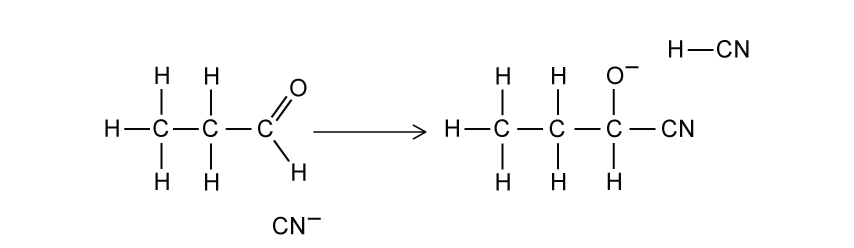
2-hydroxybutanoic acid can be synthesised from propanal via a reaction with hydrogen cyanide and subsequent hydrolysis of 2-hydroxybutanenitrile. A possible pathway is shown in Fig. 3.1. The incomplete mechanism for reaction 2 is shown in Fig. 3.2.

compound A rightwards arrow with reaction space 1 on top propanal rightwards arrow with reaction space 2 on top 2-bydroxybutanenitrile rightwards arrow with reaction space 3 on top 2-hydroxybutanoic acid

Fig. 3.1

Incomplete mechanism for the reaction of propanal with cyanide ion

Fig. 3.2

i) State the reagents and conditions required for reaction 2.

[2]

ii) Complete the mechanism for this reaction, showing all relevant curly arrows, lone pairs, and partial charges.

[4]

3b
2 marks

2-hydroxybutanenitrile contains a chiral centre. Draw the three-dimensional structures of the two optical isomers.


3c
1 mark

State the reagent(s) for reaction 3.

3d
1 mark

Compound A forms propanal when oxidised with acidified potassium dichromate(VI) under distillation conditions.

Draw the structural formula of compound A.

3e
3 marks

Compound A (propan-1-ol) and propanal are each tested with the reagents shown in Table 3.1.

Complete Table 3.1 by identifying which compound(s) give a positive result for each test. If neither gives a positive result, write 'neither'.

Table 3.1

Reagent

Compound(s) giving a positive result

Alkaline I2 (aq)

Na2CO3 (aq)

2,4-DNPH

1a
2 marks

Aqueous sodium tetrahydridoborate, NaBH4, is a common reducing agent.

State the systematic names of two isomers with the formula C3H6O that cannot be reduced by aqueous NaBH4.

1b
2 marks

State the systematic names of the two isomers with the formula C3H6O that can be reduced by aqueous NaBH4.

1c
4 marks

When NaBH4 is used as a reducing agent, carbonyl compounds are reduced to alcohols.

i) State the class of alcohol formed when each of the following is reduced by NaBH4:

an aldehyde (e.g. propanal)

a ketone (e.g. butanone)

[2]

ii) Explain why the reduction product of butanone can exhibit optical isomerism, but the reduction product of propanal cannot.

[2]

1d
2 marks

Explain why the reduction product of a carbonyl compound, by NaBH4 and acid, cannot be a tertiary alcohol.

2a
Sme Calculator
4 marks

This question is about the reactions of an organic compound R.

Analysis of 15.0 g of an organic compound, R, showed it to contain 69.8% carbon, 2.79 g of oxygen and the remaining mass was hydrogen.

i) Calculate the empirical formula of R. Show your working.

[3]

ii) The relative molecular mass, Mr, of compound R is 86.0. Deduce the molecular formula of compound R.

[1]

2b
4 marks

Compound R is a straight chain organic compound. Compound R reacts with HCN, followed by dilute acid, to form compound S, which shows optical isomerism.

Compounds R and S were tested with acidified potassium dichromate(VI) and Tollens' reagent. The results are shown in Table 2.1.

Table 2.1

R

S

Acidified potassium dichromate(VI)

Green solution

Green solution

Tollens' reagent

Silver mirror formed

No visible change

Using this information and your answer from part (a), deduce the identities of compounds R and S. Justify your answer.

2c
1 mark

Draw the three-dimensional structures of the two optical isomers of compound S.

2d
1 mark

Draw the skeletal formulae of two straight-chain positional isomers of compound S that do not exhibit optical isomerism.