Alcohols (Cambridge (CIE) A Level Chemistry): Exam Questions

Exam code: 9701

2 hours39 questions
1a
2 marks

Construct an equation for the complete combustion of butan-1-ol.

1b
3 marks

A reaction scheme for some reactions of butan-2-ol is shown in Fig. 1.1.

Flow diagram of organic reactions of butan-2-ol
Reaction 1 forms  but-2-ene
Reaction 2 is refluxing with acidified K2Cr2O7 to form compound A
Reaction 3 forms 2-bromobutane

Fig. 1.1

State the reagents and conditions required for:

i) Reaction 1

[2]

ii) Reaction 3

[1]

1c
1 mark

State the systematic name of compound A.

2a
4 marks

Complete Table 2.1 to classify each alcohol as primary, secondary or tertiary.

Table 2.1

Alcohol

Class of alcohol

2-methylpropan-2-ol

Butan-1-ol

Butan-2-ol

2-methylpropan-1-ol

2b
2 marks

Construct an equation for the dissociation of:

i) water

[1]

ii) butan-1-ol

[1]

2c
2 marks

Explain why alcohols are weaker acids than water.

3a
2 marks

Three different alcohols, A, B and C are shown in Fig. 3.1.

Three structural formulae of isomeric alcohols labelled A, B and C, showing different positions of the OH group and a methyl side group on a three‑carbon chain

Fig. 3.1

State the systematic name of alcohol C and whether it is primary, secondary or tertiary.

3b
2 marks

Alcohol A is heated under reflux with acidified potassium dichromate(VI).

i) State the systematic name of the organic product formed.

[1]

ii) State the colour change observed in this reaction.

[1]

3c
1 mark

Alcohols A, B and C are each heated separately with alkaline I2 (aq). Identify which alcohol gives a yellow precipitate.

1a
6 marks

Alcohol A has the formula (CH3)3CCH(OH)CH3 and alcohol B has the formula (CH3)3CCH2CH2OH

i) Draw the displayed formula of alcohol A and state its name.

[2]

ii) Draw the displayed formula of the organic product formed when alcohol A is heated under reflux with acidified potassium dichromate(VI) 

[1]

iii) When alcohol B is heated under reflux with acidified potassium dichromate(VI), a different organic product is formed. 

Draw the displayed formula of this product and explain why this product is different to the one formed in part (ii)

[4]

1b
2 marks

2-bromobutane can be prepared from butan-2-ol.

i) Name the type of reaction occurring.

[1]

ii) Suggest suitable reagents for this reaction.

[1]

1c
2 marks

Explain why both alcohols A and B are soluble in water.

1d
2 marks

Alcohols A and B are each heated separately with alkaline I2 (aq). State the observations for each alcohol.

2a
3 marks

When pentan-2-ol reacts with concentrated phosphoric acid under reflux, three alkenes are formed, X, Y and Z.

X and Y are stereoisomers of one another.

Draw the skeletal structures of alkenes, X, Y and Z.

2b
2 marks

Explain the origin of the stereoisomerism shown by the alkenes X and Y in part (a).

2c
3 marks

Construct an equation for the reaction of pentan-2-ol with:

i) oxygen

[1]

ii) sodium

[1]

iii) phosphorus(V) chloride

[1]

2d
2 marks

Pentan-2-ol can be oxidised to a ketone by heating under reflux with acidified potassium dichromate(VI). Draw a labelled diagram of the apparatus used.

3a
1 mark

2-bromobutane reacts with aqueous OH- to produce alcohol A.

Draw the structural formula of alcohol A.

3b
3 marks

Draw the reaction mechanism for the formation of alcohol A in part (a). Include charges, dipoles, lone pairs of electrons and curly arrows, as appropriate.

3c
1 mark

Alcohol A is heated under reflux with ethanoic acid and a concentrated sulfuric acid catalyst to form compound B.

Draw the structure of compound B.

3d
2 marks

Both alcohol A and water can act as weak acids. Explain why alcohol A is a weaker acid than water.

4a
2 marks

Butan-1-ol can be oxidised by acidified potassium manganate(VII) using two different methods.

In the first method, butan-1-ol is added dropwise to acidified potassium manganate(VII) and the product is distilled off immediately.

i) State the colour change observed in the reaction mixture.

[1]

ii) Construct an equation for this reaction. Use [O] to represent one atom of oxygen from the oxidising agent.

[1]

4b
1 mark

In a second method, butan-1-ol is heated under reflux with acidified potassium manganate(VII).

State the systematic name of the organic product formed.

4c
4 marks

Draw the structural formulae and state the systematic names of two branched-chain isomers of butan-1-ol, Isomer A and Isomer B. Only Isomer A is oxidised when warmed with acidified potassium manganate(VII).

Isomer A

Isomer B

Name

 Structure

4d
1 mark

Construct an ionic half-equation for the reduction of MnO4- in acidic conditions.

1a
3 marks

Four reactions on butan-2-ol are shown below

  • Reaction 1: Butan-2-ol rightwards arrow from Heat to straight H subscript 3 PO subscript 4 of compound A

  • Reaction 2: Butan-2-olrightwards arrow from blank to reagent space bold X of spacecompound B + HCl + SO2

  • Reaction 3: Butan-2-ol rightwards arrow from room space temp to PBr subscript 3 ofcompound C

  • Reaction 4: Butan-2-ol rightwards arrow from room space temp to reagent space bold Y of2-chlorobutane

Compound A is a stereoisomer of cis-but-2-ene.

i) Draw the structure of the stereoisomer of cis-but-2-ene.

[1]

ii) Explain why compound A is less soluble in water than butan-2-ol.

[2]

1b
3 marks

The reaction of butan-2-ol with reagent Y produces three products.

i) State the name of reagent Y.

[1]

ii) State the formulae of the two other products formed in this reaction.

[2]

1c
1 mark

Construct an equation for the overall reaction between butan-2-ol and phosphorus tribromide.

1d
2 marks

i) Identify reagent X.

[1]

ii) Draw the structure of compound B.

[1]

2a
3 marks

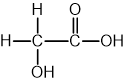
The structure of glycolic acid is shown in Fig. 2.1.

Structural formula of glyolic acid, CH2OHCOOH

Fig. 2.1

Complete Table 2.1 to show what you would observe when an aqueous solution of glycolic acid is added separately to each reagent. If a reaction occurs, state the functional group of glycolic acid responsible for the reaction.

Table 2.1

Reagent

Observation with glycolic acid

Functional group

Mg (s)

2,4-DNPH

Acidified KMnO4

2b
3 marks

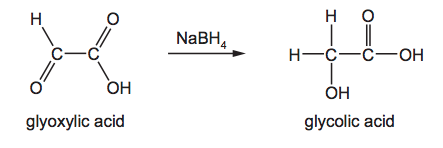
Glycolic acid can also be made by reacting glyoxylic acid with NaBH4 as shown in Fig. 2.2.

Chemical equation showing glyoxylic acid reduced by sodium borohydride (NaBH₄) to form glycolic acid, with structural formulae for both compounds

Fig. 2.2

i) State the role of NaBH4 in this reaction.

[1]

ii) Construct an equation for this reaction using molecular formulae. Use [H] to represent one atom of hydrogen from the reducing agent.

[1]

iii) Explain why NaBH4 is a suitable reducing agent for this reaction.

[1]

2c
4 marks

When glycolic acid is heated in the presence of a sulfuric acid catalyst, a new compound, Y, C4H4O4, is formed. The equation for the reaction is given.

2CH2(OH)CO2H → C4H4O4 + 2H2O

The infrared spectrum of Y is shown in Fig. 2.3.

IR spectrum infrared spectrum of Y, , showing transmittance versus wavenumber from 4000–500 cm⁻¹ with several deep absorption bands across the mid- and fingerprint regions

Fig. 2.3

i) State how this spectrum differs from an infra-red spectrum of glycolic acid. Using Table 2.1, explain your answer with particular reference to the peaks within the range 1500 – 4000 cm–1.

 Table 2.1

Bond 

Functional groups containing
the bond

Characteristic infrared absorption range (in wavenumber) / cm–1

C−O 

hydroxy, ester 

1040 – 1300

C=C 

aromatic compound, alkene 

1500 – 1680

C=O 

amide
carbonyl, carboxyl
ester

1640 – 1690
1670 – 1740
1710 – 1750

C≡N 

nitrile 

2200 – 2250

C−H 

alkane 

2850 – 2950

N−H  

amine, amide

3300 – 3500

O−H 

carboxyl
hydroxy

2500 – 3000
3200 – 3600

[2]

 ii) Suggest a structure for Y. 

[2]

3a
Sme Calculator
3 marks

Compounds W, X and Y are all straight chain carbohydrates with X and Y each containing five carbons. Compound W and a by-product, compound Z, are formed from the reaction between compounds X and Y.

Compound X can be fully oxidised by reaction with acidified potassium manganate(VII) to give compound Y. 5.508 g of compound Y contains 0.054 moles.

Deduce the systematic name of compound Y. Justify your answer.

3b
2 marks

i) Draw the displayed formula of compound W.

[1]

ii) Explain how compound Z is formed in the reaction.

[1]

3c
2 marks

Compound X will oxidise to compound Y if allowed to fully oxidise.

Explain how a student could stop the full oxidation of compound X.

3d
2 marks

i) Draw the structural formula of an isomer of compound X that will not react with acidified potassium manganate(VII).

[1]

ii) Suggest why this isomer will not react with acidified potassium manganate(VII).

[1]