Intermolecular Forces, Electronegativity & Bond Properties (Cambridge (CIE) A Level Chemistry): Exam Questions

Exam code: 9701

1 hour14 questions
1a
2 marks

State the three main types of intermolecular force and place them in ascending order of strength.

1b
2 marks

Draw a diagram to show hydrogen bonding between two molecules of methanol, CH3OH.

Your diagram should include all relevant lone pairs of electrons and dipoles.

1c
4 marks

Methanol, CH3OH, can be oxidised to methanal, CH2O, and then to methanoic acid, HCOOH.

State the strongest type of intermolecular force present between:

i) Methanal molecules

[1]

ii) Methanoic acid molecules

[1]

iii) A molecule of water and a molecule of methanal

[1]

iv) A molecule of water and a molecule of methanoic acid

[1]

1d
3 marks

Methanoic acid reacts with sodium hydroxide to form sodium methanoate:

HCOOH + NaOH → HCOONa + H2O

Explain why sodium methanoate is a solid at room temperature and methanoic acid is a liquid.

1e
2 marks

Complete the dot-and-cross diagram of methanol, CH3OH. Show outer shell electrons only.
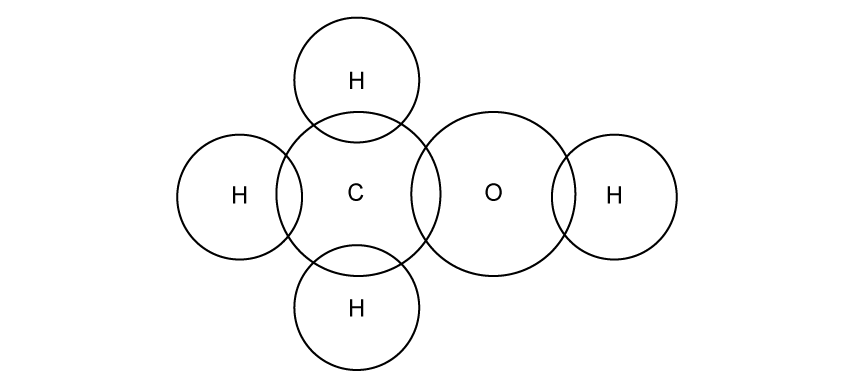
2-4_q4c-ocr-a-as--a-level-easy-sq
1a
4 marks

Ammonia, NH3, and methane, CH4, are simple molecules.

Complete Table 1.1 to show the dot-and-cross diagram and the shape of a molecule of each compound. Show outer shell electrons only.

NH3

CH4

dot-and-cross diagram

shape of molecule

1b
3 marks

Ammonia is a polar molecule whereas methane is non-polar.

i) Explain what is meant by the term bond polarity, using the N-H bond as an example.

[2]

ii) Explain why the ammonia molecule is polar.

[1]

1c
1 mark

State the strongest type of intermolecular force present in liquid ammonia.

1d
3 marks

Ammonia gas reacts with hydrogen chloride gas to form solid ammonium chloride, NH4Cl.

State the three types of bonding present in solid ammonium chloride.

2a
2 marks

The structural formulae of water, methanol and methoxymethane, CH3OCH3, are given below.

1-3-chemical-bonding-2a

i) State the number of lone pairs of electrons around the oxygen atom in a molecule of methoxymethane.

[1]

ii) Suggest a value for the C-O-C bond angle in methoxymethane.

[1]

2b
4 marks

The physical properties of covalent compounds depend on the intermolecular forces between their molecules.

Type of intermolecular force

A

Permanent dipole-permanent dipole (pd-pd) forces

B

Instantaneous dipole-induced dipole (id-id) forces

C

Hydrogen bonding

Using the letters A, B, or C, state the strongest intermolecular force present in each of the following compounds.

Compound

Formula

Strongest intermolecular force

ethanal

CH3CHO

ethanol

CH3CH2OH

methoxymethane

CH3OCH3

2-methylpropane

(CH3)2CHCH3

2c
4 marks

Methanol and water are completely soluble in each other.

i) Name the strongest type of intermolecular force between a molecule of methanol and a molecule of water.

[1]

ii) Draw a diagram to show this intermolecular force between one molecule of methanol and one molecule of water. Include all relevant dipoles and lone pairs of electrons.

[3]

2d
2 marks

Ethoxyethane, C2H5OC2H5, and water are immiscible.

Explain why ethoxyethane does not dissolve in water.

3a
2 marks

Explain why butan-1-ol has a higher boiling point than butanal.

3b
2 marks

Ethane, C2H6, and disilane, Si2H6, are hydrides of Group 14 elements.

Explain why disilane has a higher boiling point than ethane.

3c
3 marks

Ethanol is soluble in water, whereas ethane is insoluble.

Explain this difference.

1a
2 marks

Water has a relatively high surface tension compared to most liquids.

Explain this anomalous property of water.

1b
4 marks

Ammonia, NH3, is highly soluble in water.

Draw diagrams to show the two different ways a hydrogen bond can form between one molecule of water and one molecule of ammonia. Your diagrams should include all relevant dipoles and lone pairs of electrons.

1c
5 marks

Ammonia, NH3, hydrogen chloride, HCl, and fluorine, F2, all exist as gases at room temperature and pressure. The boiling point of NH3 is −33 °C.

Predict which gas, HCl or F2, has the lowest boiling point. Explain the relative boiling points of all three gases in terms of the intermolecular forces present.
