Formulas (Cambridge (CIE) A Level Chemistry): Exam Questions

Exam code: 9701

2 hours20 questions
1a
3 marks

Complete Table 1.1.

Table 1.1

Ion

Formula

Nitrate

NO3-

CO32-

Sulfate

OH-

NH4+

Zinc(II)

Ag+

HCO3-

Phosphate

1b
3 marks

Complete Table 1.2.

Table 1.2

Ionic compound

Formula

Sodium chloride

NaCl

Potassium oxide


Al2(CO3)3

Copper(II) nitrate


1c
3 marks

Aqueous silver nitrate should not be acidified with hydrochloric acid as it forms a white precipitate of silver chloride, AgCl, and nitric acid.

i) Write the chemical equation for the reaction of silver nitrate with hydrochloric acid. Your answer should include state symbols.

[2]

ii) Silver ions from the silver nitrate and chloride ions from the hydrochloric acid are responsible for the formation of silver chloride.

Ag+ + Cl- → AgCl

Suggest why the nitrate ions and hydrogen ions do not appear in this ionic equation.

[1]

1d
3 marks

Aqueous barium chloride should not be acidified with sulfuric acid as it forms a white precipitate of barium sulfate and hydrochloric acid.

i) Write the chemical equation for the reaction of barium chloride with sulfuric acid. Your answer should include state symbols.

[2]

ii) Write the ionic equation for the formation of barium sulfate. 

[1]

2a
2 marks

Define the terms empirical formula and molecular formula.

2b
4 marks

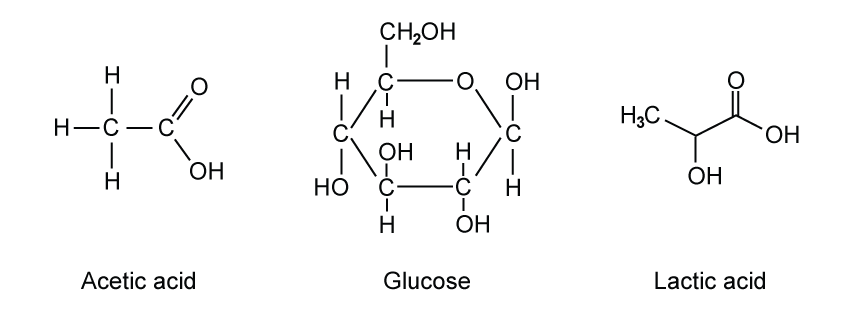
Three organic compounds are shown in Fig. 5.1.

Displayed structural formulas of acetic acid, glucose and lactic acid

Fig. 5.1

i) State the molecular formula of each compound.

Acetic acid ..............................

Glucose ..............................

Lactic acid ..............................

[3]

ii) State the empirical formula of all three compounds.

[1]

2c
Sme Calculator
5 marks

An unknown hydrocarbon contains 85.7% carbon. The relative molecular mass of the unknown hydrocarbon is 56.0. 

i) Calculate the empirical formula of the unknown hydrocarbon. Show your working.

[3]

 ii) Determine the molecular formula of the unknown hydrocarbon. Show your working.

[2]

2d
1 mark

State the difference between an anhydrous salt and a hydrated salt.

2e
Sme Calculator
3 marks

Gypsum is a salt that can contain water of crystallisation. In its anhydrous form, the chemical formula of gypsum is CaSO4. 1.80 g of water is added to 6.81 g of gypsum to form the hydrated salt, CaSO4•xH2O. 

Calculate the value of x in CaSO4•xH2O. Show your working.

1a
Sme Calculator
2 marks

Cobalt(II) sulfate is used in storage batteries, electroplating baths and as an additive to soils and animal feeds.

A sample of hydrated cobalt sulfate, CoSO4•xH2O, has a relative formula mass of 173.0.

Calculate a value for 'x'.

1b
Sme Calculator
4 marks

A student completed an experiment to determine the value of 'x' in a hydrated salt.

They heated a solid sample of the salt, CoSO4.xH2O, in a crucible for 60 seconds and recorded the following set of results.

Table 2.1

Mass of empty crucible (g)

29.22

Mass of crucible and solid before heating (g)

32.67

Mass of crucible and solid after heating (g)

32.02

Use the data obtained by the student in Table 2.1 to calculate a value for 'x'.

1c
3 marks

The actual value for x in CoSO4.xH2O is 7.

i) Suggest one reason for the difference between your calculated value in part (b) and the actual value.

[1]

ii) Explain how you could improve the experiment the student did, using the same equipment, to achieve a value closer to the correct value for x.

[2]

1d
1 mark

Cobalt(II) sulfate undergoes a displacement reaction with magnesium because magnesium is a more reactive metal than cobalt.

Write an ionic equation for this reaction. State symbols are not required.

2a
2 marks

Chevreul's salt or copper(I, II) sulfite dihydrate, Cu3(SO3)2•2H2O, is an unusual hydrated salt as it contains copper in both of its common oxidation states.

The first step in the formation of Chevreul's salt is the reaction of aqueous copper sulfate with a solution of potassium metabisulfite, K2S2O5.

Complete the equation for the reaction to form the anhydrous Chevreul's salt.

_CuSO4 + _K2S2O5 → _Cu3(SO3)2 + 4K2SO4 + _SO2

2b
Sme Calculator
3 marks

The chemical formula of Chevreul's salt is sometimes written as Cu2SO3•CuSO3•2H2O to show that it contains copper(I) sulfite and copper(II) sulfite.

Calculate the percentage by mass of copper(I) ions in copper(I) sulfite

Show your working.

2c
2 marks

Chevreul's salt can react with ammonia solution to form a deep blue solution of the tetraamminecopper(II) complex, [Cu(NH3)4]2+ (aq). It can also react with hydrochloric acid to form a white solid of copper(I) chloride, water and sulfur dioxide.

Write an ionic equation for the formation of copper(I) chloride from Chevreul's salt. Include state symbols.

2d
Sme Calculator
3 marks

When Chevreul's salt is heated in an inert atmosphere, it is stable to around 200 oC. Above this temperature, a variety of compounds can be produced although the final product of sustained heating at high temperatures is copper(II) oxide.

During the heating process, a sample of the mixture is taken. After separation, the most common compound was analysed and found to contain 39.8% copper, 20.1% sulfur and the rest oxygen.

Calculate the empirical formula of the most common compound. Show your working.

3a
Sme Calculator
3 marks

A synthetic carbohydrate was isotopically labelled with carbon-13.

Analysis of a 12 g sample of the carbohydrate found it to contain 6.93 g carbon, 0.80 g hydrogen and the remainder was oxygen.

Calculate the empirical formula of the carbohydrate. Show your working.

3b
1 mark

The fermentation of glucose, C6H12O6, produces ethanol and carbon dioxide.

Construct an equation for this reaction.

3c
Sme Calculator
3 marks

During the fermentation process in the reaction in part (b), 312 g of ethanol was produced from 1.5 kg of glucose.

Calculate the percentage yield of this reaction. Give your answer to 3 significant figures. Show your working.

1a
Sme Calculator
2 marks

Magnesium carbonate is a common antacid that is used to neutralise excess stomach acid, HCl.

MgCO3 (s) + 2HCl (aq) → MgCl2 (aq) + CO2 (g) + H2O (l)

5.31 g of magnesium carbonate reacts completely with an excess of hydrochloric acid.

Calculate the volume, in dm3, of carbon dioxide produced at room conditions. Show your working.

Volume of CO2 = .................. dm3

1b
Sme Calculator
3 marks

Another magnesium salt, magnesium sulfate, can exist in hydrated or anhydrous forms.

6.31 g of a sample of magnesium sulfate, MgSO4.xH2O, was strongly heated until a mass of 3.61 g of solid remained with no further change in mass recorded.

Calculate the value of x. Show your working.

x = .....................

1c
Sme Calculator
3 marks

Another sample of hydrated magnesium sulfate, MgSO4.xH2O, is found to contain 51.1% water by mass.

Calculate the value of x. Show your working.

x = .....................

1d
2 marks

State the effect on the calculated value of x if the salt was not heated to constant mass. Explain your answer.

2a
Sme Calculator
1 mark

A sample of a caffeinated drink contains 34 mg of caffeine, Mr = 194.0 g mol-1.

Calculate the amount, in mol, of caffeine in the sample. Show your working.

amount of caffeine = .................... mol

2b
Sme Calculator
3 marks

Caffeine contains 49.48% carbon, 5.20% hydrogen and 28.85% nitrogen by mass. The remainder is oxygen.

Calculate the empirical formula of caffeine. Show your working.

2c
Sme Calculator
1 mark

Use your answer to (b) and the Mr of caffeine given in part (a) to deduce the molecular formula of caffeine. Show your working.

3a
4 marks

Apatite is a general term used for a family of various calcium phosphate compounds commonly found in rocks and minerals, bones and teeth.

i) State the formula of calcium phosphate.

[1]

ii) Hydroxylapatite, Ca5(PO4)3OH, is one member of the apatite family and is a major component of bone.

Deduce the oxidation number of phosphorus in hydroxylapatite, Ca5(PO4)3OH. Show your working.

[2]

iii) Another member of the apatite family is chlorapatite.

Suggest the formula of chlorapatite.

[1]

3b
2 marks

Fluorapatite, Ca5(PO4)3F, reacts with sulfuric acid to form phosphoric acid, calcium sulfate and hydrogen fluoride.

Construct a balanced equation for this reaction.

3c
Sme Calculator
5 marks

Fluorapatite, Ca5(PO4)3F, can also react with sulfuric acid to form calcium dihydrogenphosphate, Ca(H2PO4)2, calcium sulfate and hydrogen fluoride.

2Ca5(PO4)3F + 7H2SO4 → 3Ca(H2PO4)2 + 7CaSO4 + 2HF

Calculate the mass of calcium dihydrogenphosphate formed when 50.2 g of Ca5(PO4)3F reacts with 87.9 g H2SO4. Show your working.

mass of Ca(H2PO4)2 = ............................ g