Integrating with Partial Fractions (Edexcel A Level Further Maths: Core Pure): Revision Note
Exam code: 9FM0

Integrating with partial fractions
What is meant by partial fractions with quadratic denominators?
For linear denominators the denominator of the original fraction can be factorised such that the denominator becomes a product of linear terms of the form
With squared linear denominators, the same applies, except that some (usually just one) of the factors on the denominator may be squared, i.e.
In both the above cases it can be shown that the numerators of each of the partial fractions will be a constant
For this course, quadratic denominators refer to fractions that contain a quadratic factor (that cannot be factorised) on the denominator
the denominator of the quadratic partial fraction will be of the form ; very often leaving it as
the numerator of the quadratic partial fraction could be of linear form,
How do I find partial fractions involving quadratic denominators?
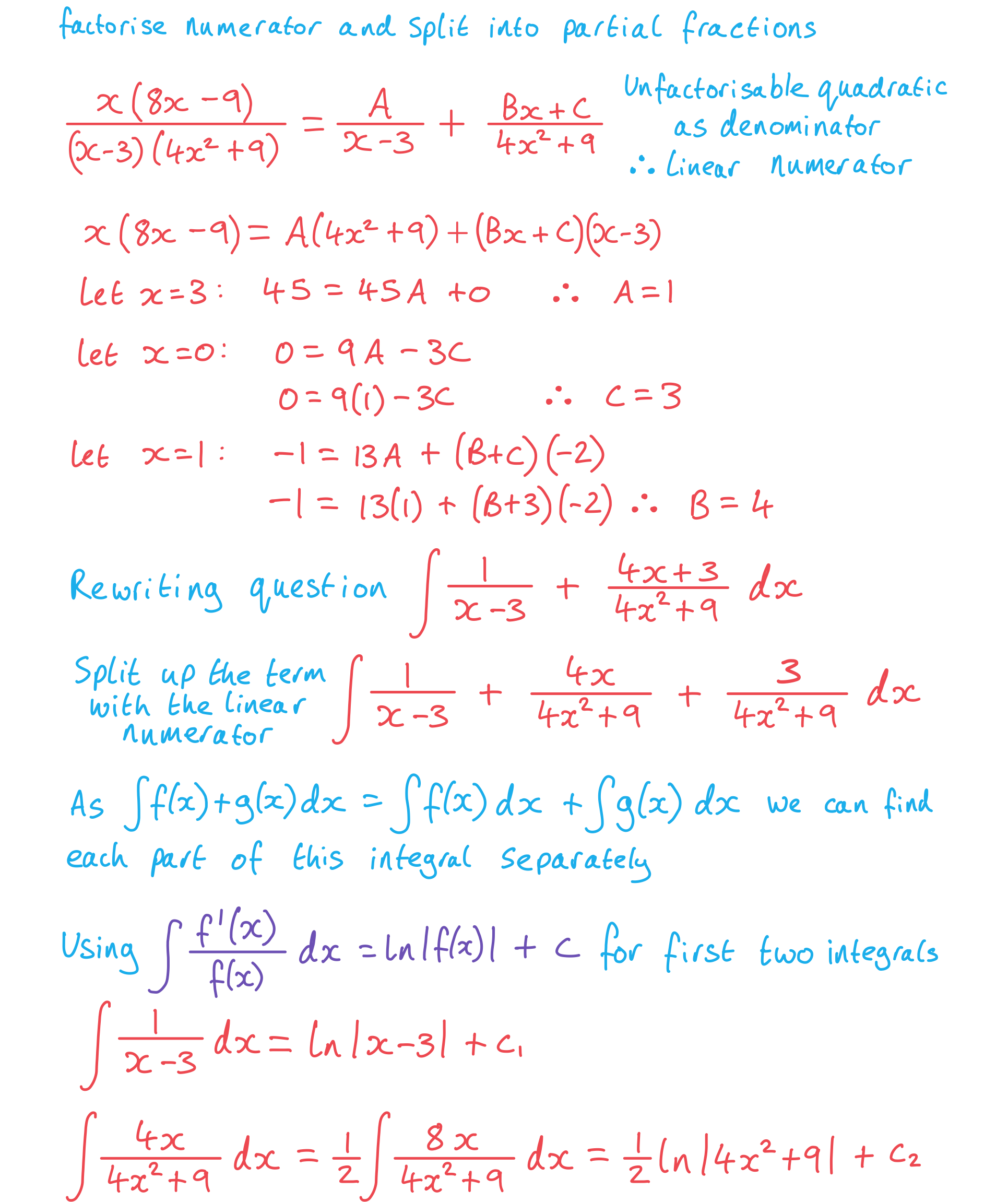
STEP 1 Factorise the denominator as far as possible (if not already done so)
Sometimes the numerator can be factorised too
STEP 2 Split the fraction into a sum with
the linear denominator having an (unknown) constant numerator
the quadratic denominator having an (unknown) linear numerator
STEP 3 Multiply through by the denominator to eliminate fractions
STEP 4 Substitute values into the identity and solve for the unknown constants
Use the root of the linear factor as a value of to find one of the unknowns
Use any two values for to form two equations to solve simultaneously
is a good choice if this has not already been used with the linear factor
STEP 5 Write the original as partial fraction
How do I integrate the fraction with the quadratic denominator?
The quadratic denominator will be of the form
If it is not then you can get it to look like this by completing the square
Split into to fraction
Integrate using logarithms to get
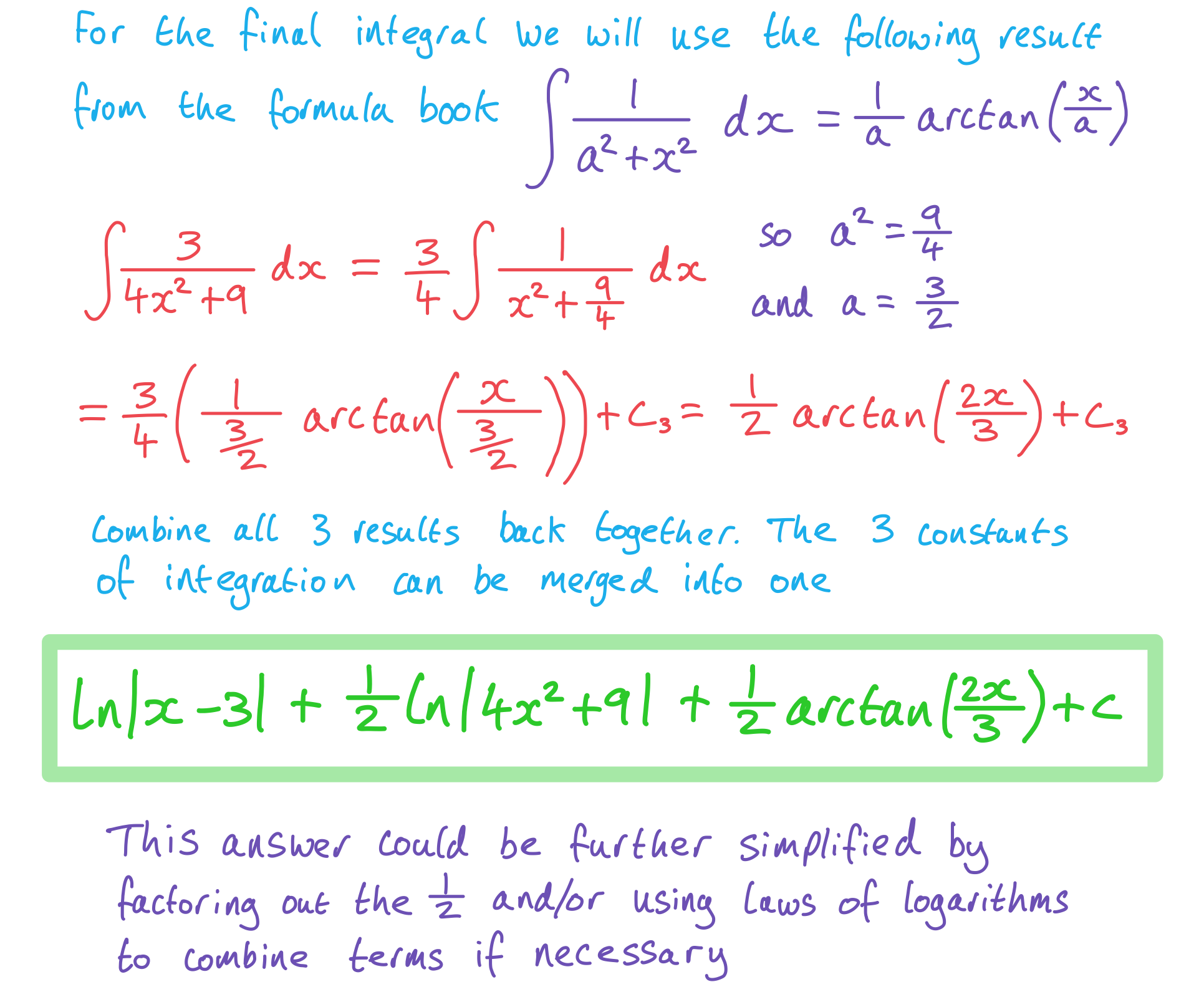
Integrate using the formula booklet or using a trigonometric or hyperbolic substitution
If a and c have the same sign then use
If a and c have different signs then use
Or in this case you can factorise using surds and then use partial fractions
Worked Example
Find

Unlock more, it's free!
Join the 100,000+ Students that ❤️ Save My Exams
the (exam) results speak for themselves:

Was this revision note helpful?
Build on this topic
