Angle between Lines (Edexcel A Level Further Maths: Core Pure): Revision Note
Exam code: 9FM0

Scalar product
The scalar product is an important link between the algebra of vectors and the trigonometry of vectors. We shall see that the scalar product is somewhat comparable to the operation of multiplication on real numbers.
What is the scalar (dot) product?
The scalar product between two vectors a and b is represented by
This is also called the dot product because of the symbol used
The scalar product between two vectors and is defined as
The result of taking the scalar product of two vectors is a real number
i.e. a scalar
For example,
and
The scalar product has some important properties:
The order of the vectors doesn’t affect the result:
In effect we can ‘multiply out’ brackets:
This means that we can do many of the same things with vectors as we can do when operating on real numbers – for example,
The scalar product between a vector and itself is equal to the square of its magnitude:
For example,
and
What is the connection between the scalar product and trigonometry?
There is another important method for finding involving the angle between the two vectors :
Here is the angle between the vectors when they are placed ‘base to base’
when the vectors are placed so that they begin at the same point
This formula can be derived using the cosine rule and expanding
The scalar product of two vectors gives information about the angle between the two vectors
If the scalar product is positive then the angle between the two vectors is acute (less than 90°)
If the scalar product is negative then the angle between the two vectors is obtuse (between 90° and 180°)
If the scalar product is zero then the angle between the two vectors is 90° (the two vectors are perpendicular)

How do I tell if vectors or lines are perpendicular?
Two (non-zero) vectors and are perpendicular if, and only if,
If the a and b are perpendicular then:
If then:
a and b are perpendicular
For example, the vectors and are perpendicular since
Examiner Tips and Tricks
When writing a scalar product, it’s important to write a distinctive dot between the vectors – otherwise your meaning will not be clear.
Worked Example
Find the value of t such that the two vectors and are perpendicular to each other.
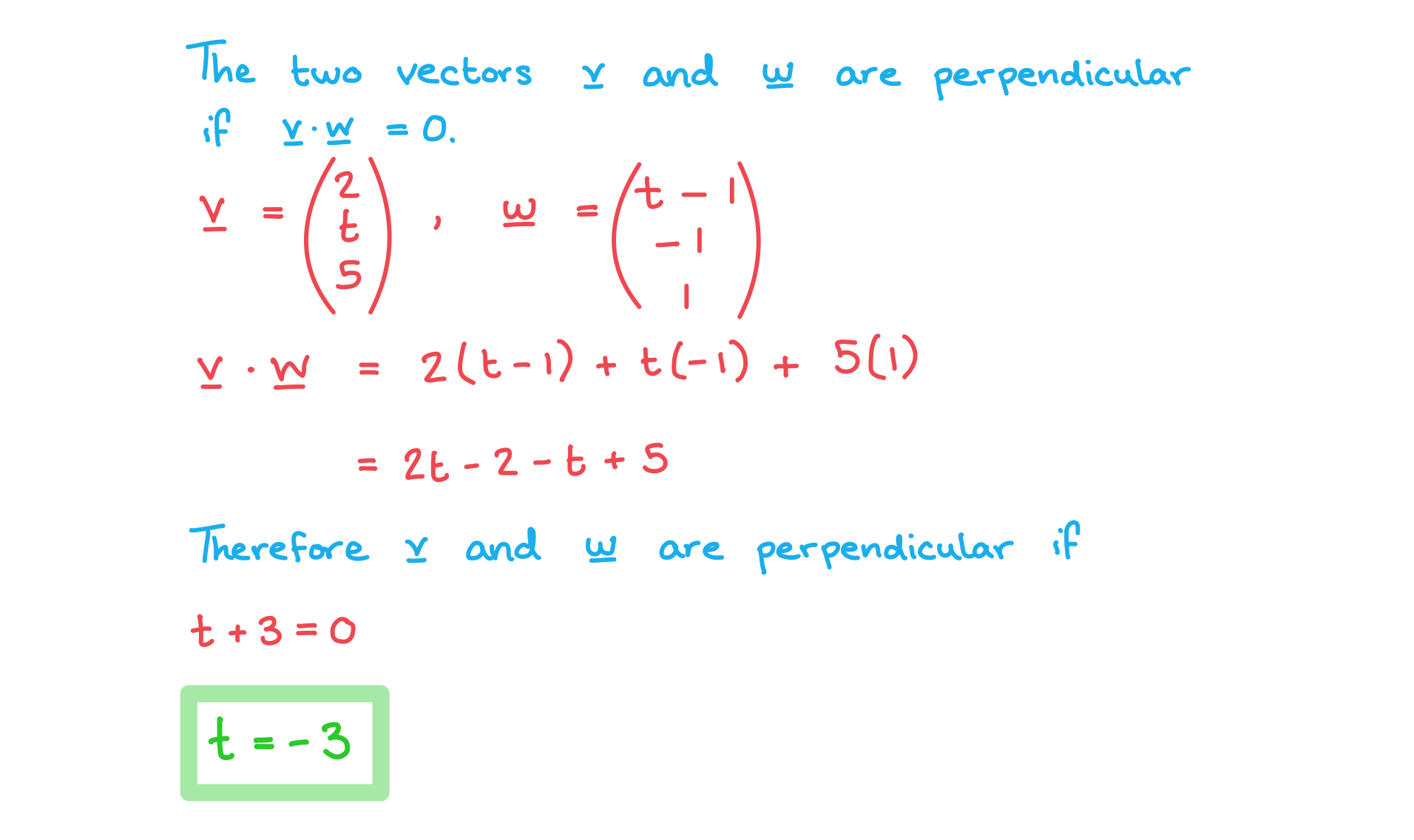
Angle between lines
How do I find the angle between two vectors?
Recall that a formula for the scalar (or ‘dot’) between vectors and is
where is the angle between the vectors when they are placed ‘base to base’
that is, when the vectors are positioned so that they start at the same point
We arrange this formula to make the subject:
To find the angle between two vectors
Calculate the scalar product between them
Calculate the magnitude of each vector
Use the formula to find
Use inverse trig to find
How do I find the angle between two lines?
To find the angle between two lines, find the angle between their direction vectors
For example, if the lines have equations and , then the angle between the lines is given by
Worked Example
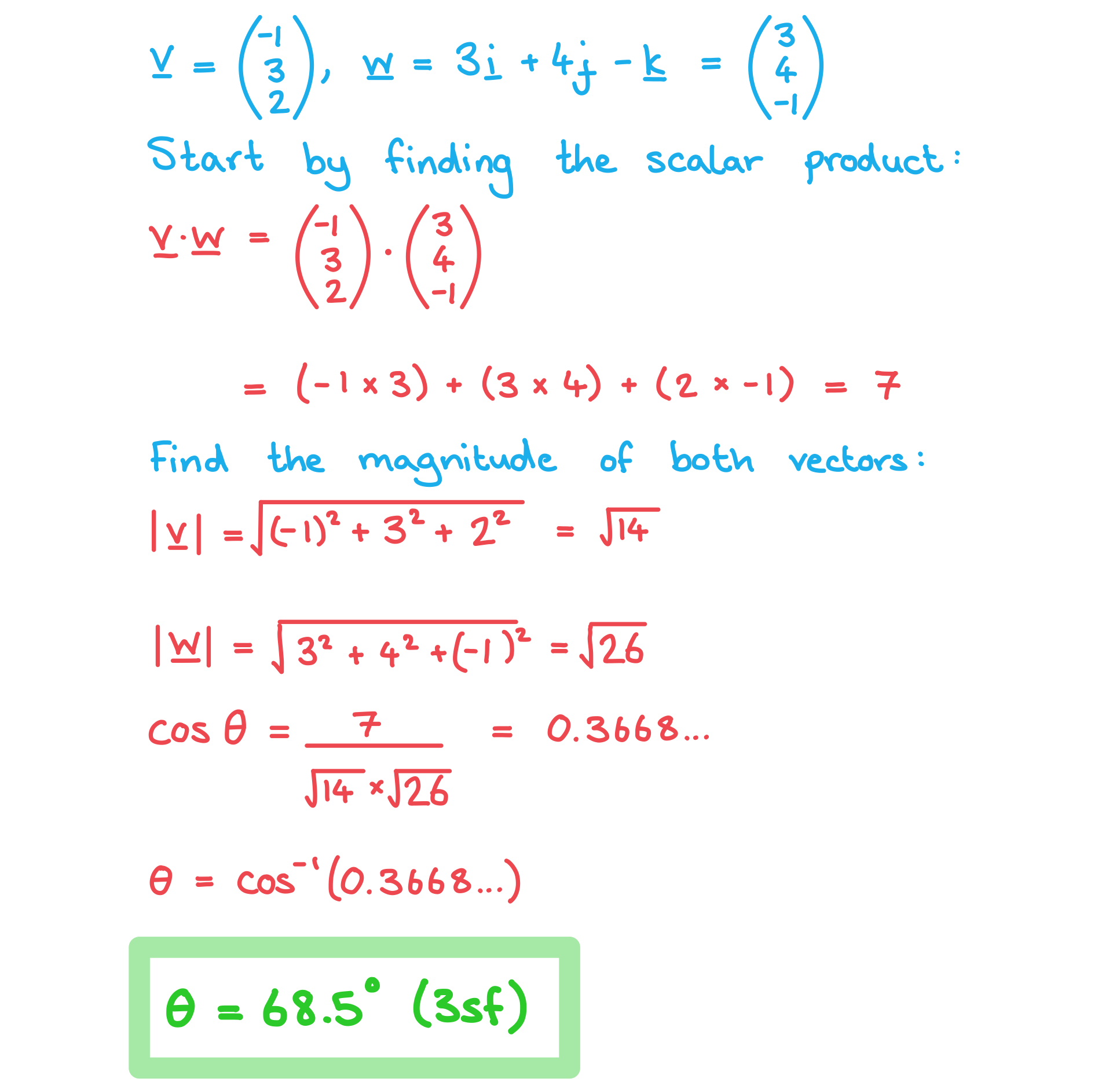
Calculate the angle formed by the two vectors and .

Unlock more, it's free!
Join the 100,000+ Students that ❤️ Save My Exams
the (exam) results speak for themselves:

Was this revision note helpful?
Build on this topic
