Equations of planes (Edexcel A Level Further Maths: Core Pure): Revision Note
Exam code: 9FM0

Equation of a plane in vector form
How do I find the vector equation of a plane?
A plane is a flat surface which is two-dimensional
Imagine a flat piece of paper that continues on forever in both directions
A plane in often denoted using the capital Greek letter Π
The vector form of the equation of a plane can be found using two direction vectors on the plane
The direction vectors must be
parallel to the plane
not parallel to each other
therefore they will intersect at some point on the plane
The formula for finding the vector equation of a plane is
Where r is the position vector of any point on the plane
a is the position vector of a known point on the plane
b and c are two non-parallel direction (displacement) vectors parallel to the plane
s and t are scalars
The formula can also be written as
Where r is the position vector of any point on the plane
a, b, c are the position vectors of known points on the plane
λ and μ are scalars
These formulae are given in the formula booklet but you must make sure you know what each part means
As a could be the position vector of any point on the plane and b and c could be any non-parallel direction vectors on the plane there are infinite vector equations for a single plane
How do I determine whether a point lies on a plane?
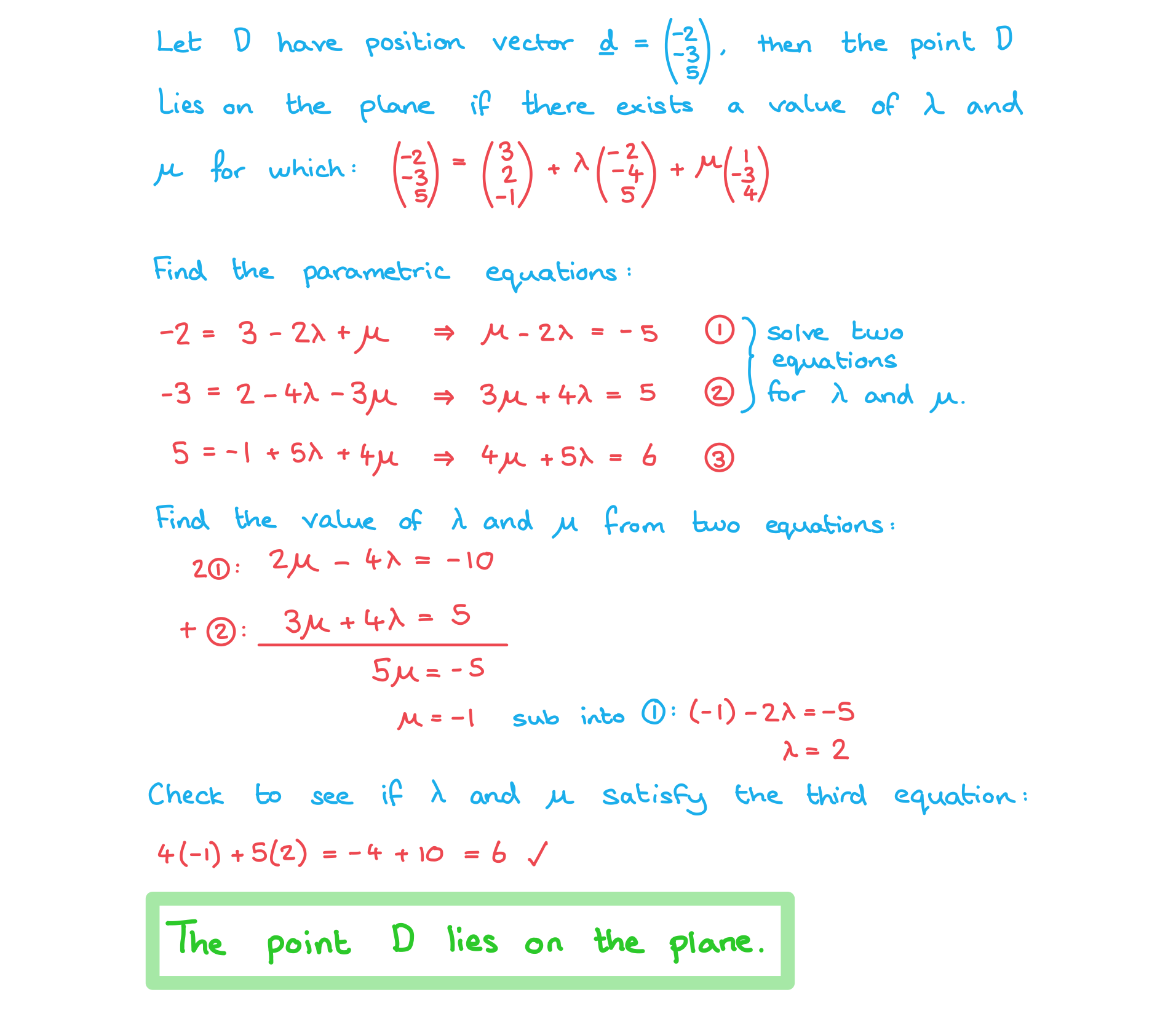
Given the equation of a plane then the point r with position vector is on the plane if there exists a value of λ and μ such that
This means that there exists a single value of λ and μ that satisfy the three parametric equations:
Solve two of the equations first to find the values of λ and μ that satisfy the first two equation and then check that this value also satisfies the third equation
If the values of λ and μ do not satisfy all three equations, then the point r does not lie on the plane
Examiner Tips and Tricks
The formula for the vector equation of a plane is given in the formula booklet, make sure you know what each part means
Be careful to use different letters, e.g. and as the scalar multiples of the two direction vectors
Worked Example
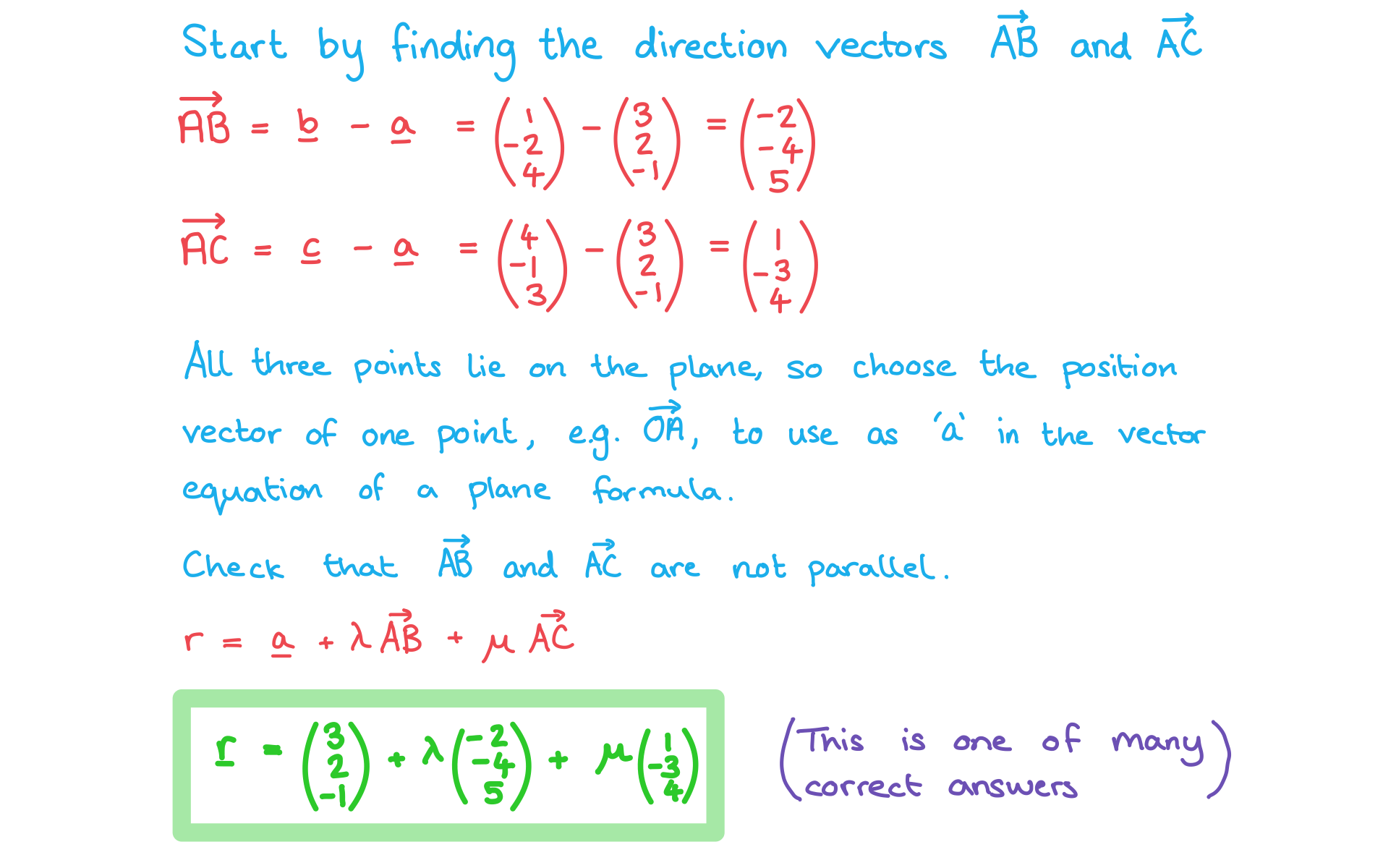
The points A, B and C have position vectors , , and respectively, relative to the origin O.
(a) Find the vector equation of the plane.
(b) Determine whether the point D with coordinates (-2, -3, 5) lies on the plane.
Equation of a plane in Cartesian form
How do I find the vector equation of a plane in cartesian form?
The cartesian equation of a plane is given in the form
This is given in the formula booklet
A normal vector to the plane can be used along with a known point on the plane to find the cartesian equation of the plane
The normal vector will be a vector that is perpendicular to the plane
The scalar product of the normal vector and any direction vector on the plane will be zero
The two vectors will be perpendicular to each other
The direction vector from a fixed-point A to any point on the plane, R can be written as r – a
Then n ∙ (r – a) = 0 and it follows that (n ∙ r) – (n ∙ a) = 0
This gives the equation of a plane using the normal vector:
n ∙ r = a ∙ n
Where r is the position vector of any point on the plane
a is the position vector of a known point on the plane
n is a vector that is normal to the plane
If the vector r is given in the form and a and n are both known vectors given in the form and then the Cartesian equation of the plane can be found using:
Therefore
This simplifies to the form
Where
This is given in the formula booklet
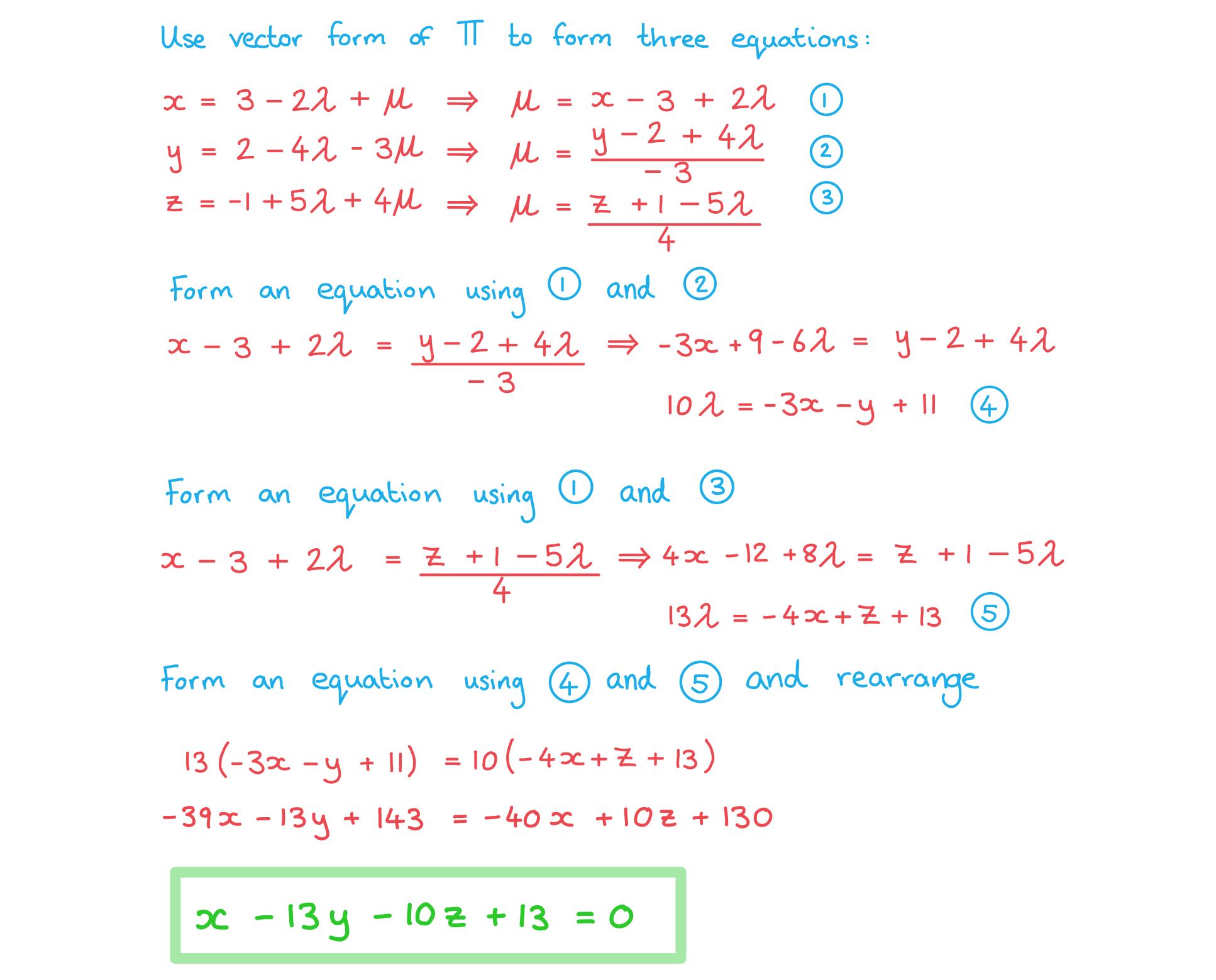
How do I find the equation of a plane in Cartesian form given the vector form?
Given the equation of the plane
Form three equations
Choose a pair of equations and use them to form an equation without μ
Choose another pair and form another equation without μ
Use your two expressions to form an equation without μ and λ
Rewrite the equation in the form
Examiner Tips and Tricks
In an exam, using whichever form of the equation of the plane to write down a normal vector to the plane is always a good starting point
Worked Example
A plane has equation . Find the equation of the plane in its Cartesian form.

Unlock more, it's free!
Join the 100,000+ Students that ❤️ Save My Exams
the (exam) results speak for themselves:

Was this revision note helpful?
Build on this topic
