Volumes of Revolution (Edexcel A Level Further Maths: Core Pure): Exam Questions

Exam code: 9FM0

40 mins4 questions
1a
1 mark
qp8a-9fm0_02_2019

Figure 1 shows the central vertical cross section ABCD of a paddling pool that has a circular horizontal cross section. Measurements of the diameters of the top and bottom of the paddling pool have been taken in order to estimate the volume of water that the paddling pool can contain.

Using these measurements, the curve BD is modelled by the equation

y = ln (3.6x  k)             1  x  1.18

as shown in Figure 2.

Find the value of k.

1b
Sme Calculator
2 marks

Find the depth of the paddling pool according to this model.

1c
Sme Calculator
5 marks

The pool is being filled with water from a tap.

Find, in terms of h, the volume of water in the pool when the pool is filled to a depth of h m.

1d
Sme Calculator
3 marks

Given that the pool is being filled at a constant rate of 15 litres every minute, find, in cm h1, the rate at which the water level is rising in the pool when the depth of the water is 0.2 m.

2a
2 marks
qp7a-9fm0_02-june-2020

Figure 1

A student wants to make plastic chess pieces using a 3D printer. Figure 1 shows the central vertical cross-section of the student’s design for one chess piece. The plastic chess piece is formed by rotating the region bounded by the y-axis, the x-axis, the line with equation x=1, the curve C1 and the curve C2 through 360° about the y-axis. The point A has coordinates (1, 0.5) and the point B has coordinates (0.5, 2.5) where the units are centimetres.

The curve C1 is modelled by the equation

x=ay+b        0.5y2.5

Determine the value of a and the value of b according to the model.

2b
Sme Calculator
9 marks

The curve C2 is modelled to be an arc of the circle with centre (0, 3).

Use calculus to determine the volume of plastic required to make the chess piece according to the model.

3a
4 marks
qp2a-9fm0-01-further-maths
Figure 2

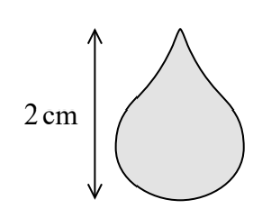
Figure 2 shows the image of a gold pendant which has height 2cm. The pendant is modelled by a solid of revolution of a curve C about the y-axis. The curve C has parametric equations

x=cos θ+12sin 2θ,    y=(1+sinθ)      0θ2π

Show that a Cartesian equation of the curve C is

x2=(y4+2y3)

3b
Sme Calculator
4 marks

Hence, using the model, find, in cm3, the volume of the pendant.

4a
2 marks
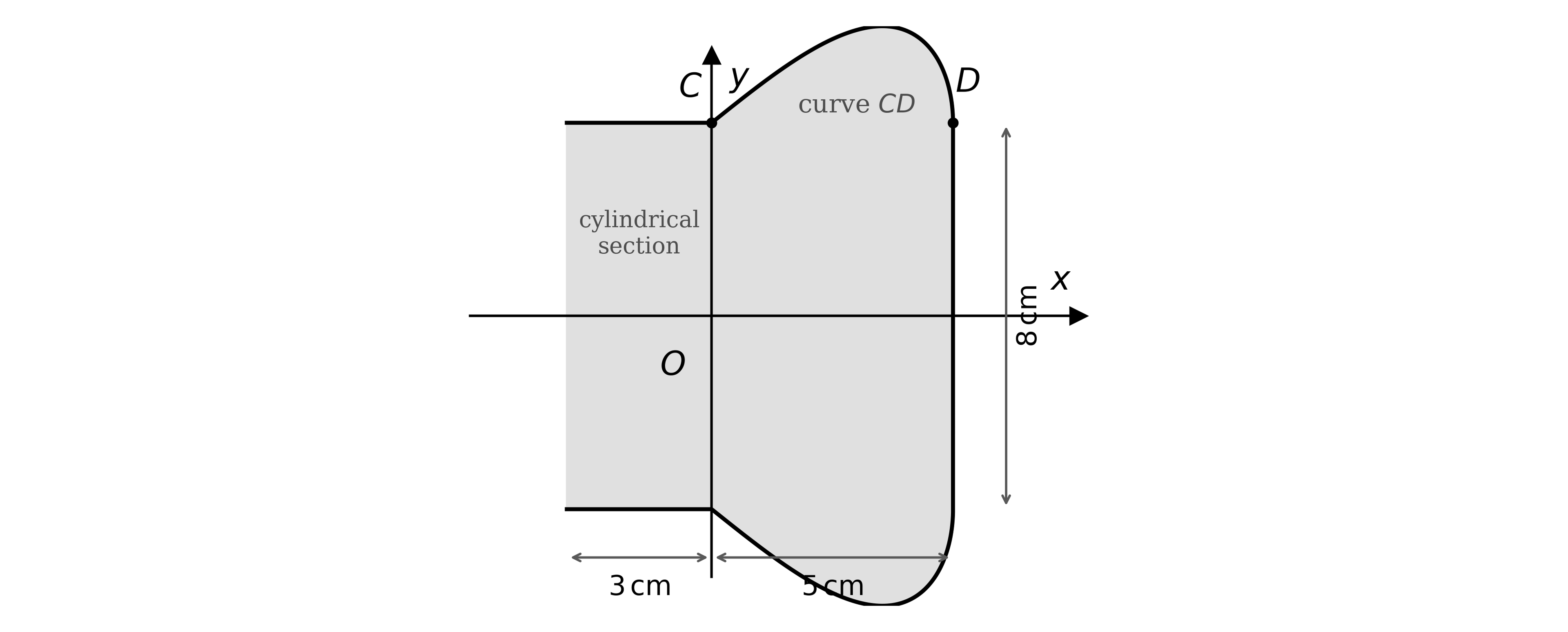
Cross-section of a wooden table leg lying horizontally along the x-axis: on the left a rectangular cylindrical section of radius 4 (diameter 8 cm) and length 3 cm meeting the y-axis at C; on the right a curved decorative section (the curve CD) that bulges out from radius 4 at C to a maximum before returning to radius 4 at the end D, of length 5 cm. The x-axis is the axis of revolution and O is the origin.

Figure 1 shows the vertical cross-section of a wooden table leg, which is modelled as a solid of revolution about the x-axis (the axis of the leg), where O is the fixed origin. The leg is formed from a plain cylindrical section together with a curved decorative section.

The circular cross-section at each end of the curved section has diameter 8 cm. The curved section has length 5 cm, and the cylindrical section, which has the same radius as the ends of the curved section, has length 3 cm.

The curved section is modelled by the curve CD with parametric equations

 y=a+2sin2t,  x=bcost,  0tπ2

where a and b are constants.

Determine the value of a and the value of b according to the model.

4b
Sme Calculator
7 marks

Using algebraic integration and showing all your working, determine the volume of the table leg, giving your answer to the nearest cm³.

4c
1 mark

State a limitation of the model.