Hyperbolic Identities & Equations (Edexcel A Level Further Maths: Core Pure): Revision Note
Exam code: 9FM0

Hyperbolic identities & equations
Are there identities linking the hyperbolic functions to the circular trig functions?
Yes - these can be seen using de Moivre's Theorem to write
Compare these with the definitions for the hyperbolic functions
Therefore they can be related using the identities
or
or
What are the hyperbolic identities?
In general, the hyperbolic identities are the same as the circular trigonometric identities except where there is a product of an even number of sinh terms, in which case the term changes sign
e.g. but
This is referred to as Osborn’s Rule
This occurs because of the connection with the imaginary number i
All the circular trigonometric identities can be used with hyperbolic functions
The main hyperbolic identities you are likely to need are
These are listed in the formulae booklet
Other identities include
The harmonic identities can also be used with hyperbolic functions
Hyperbolic identities involving tanhx exist
They are not normally used as it is easier to use sinhx, coshx and their definitions
If you do use tanhx identities, be careful with implied or ‘hidden’ products of sinhx (e.g. tanh2x)
You can prove these identities by using the definitions of the hyperbolic functions in terms of e
Do reciprocal hyperbolic functions and identities exist?
Yes! However, It is usually easier to deal with identities and equations involving these in terms of sinhx, coshx and their definitions
(Pronounced “coshec”)
(Pronounced “shec”)
(Pronounced “cough”)
How do I use hyperbolic identities to prove other identities?
Start with the LHS and use the hyperbolic identities to rearrange into the RHS
This approach can lead to what seems like a dead-end
In such cases simplify the LHS as far as possible, ideally so that it is in terms of sinhx and/or coshx only
Then use the sinhx and coshx definitions to write the LHS in terms of e
Repeat this for the RHS so that the LHS and RHS ‘meet in the middle’
How do I solve equations involving hyperbolic functions?
Use identities to create an equation in terms of sinhx or coshx only
This should be a familiar equation to solve – linear, quadratic, etc
Find exact answers in terms of natural logarithms
Using the inverse hyperbolic functions definitions
Use your calculator if exact answers are not required
As with circular trigonometric equations, do not cancel hyperbolic terms, rearrange so the equation equals zero and factorise
When solving equations be careful when solving coshx = k (for constant k)
cosh-1x is not necessarily the same as arcoshx
arcoshx is, strictly speaking, referring to the inverse function of coshx such that coshx is a one-to-one function
Using the graph you can see that the for k>1 there are two solutions to
This can be written in logarithmic form as
This can be shown to be equivalent to
If k=1 then the only solution to is x=0
If k<1 then there are no real solutions to
Examiner Tips and Tricks
You can use the A Level Maths section of the formula booklet to remind you of trigonometric identities (such as sin(A±B)) which you can then adapt for the hyperbolic trig functions – don’t limit yourself to just the Further Maths section
Worked Example
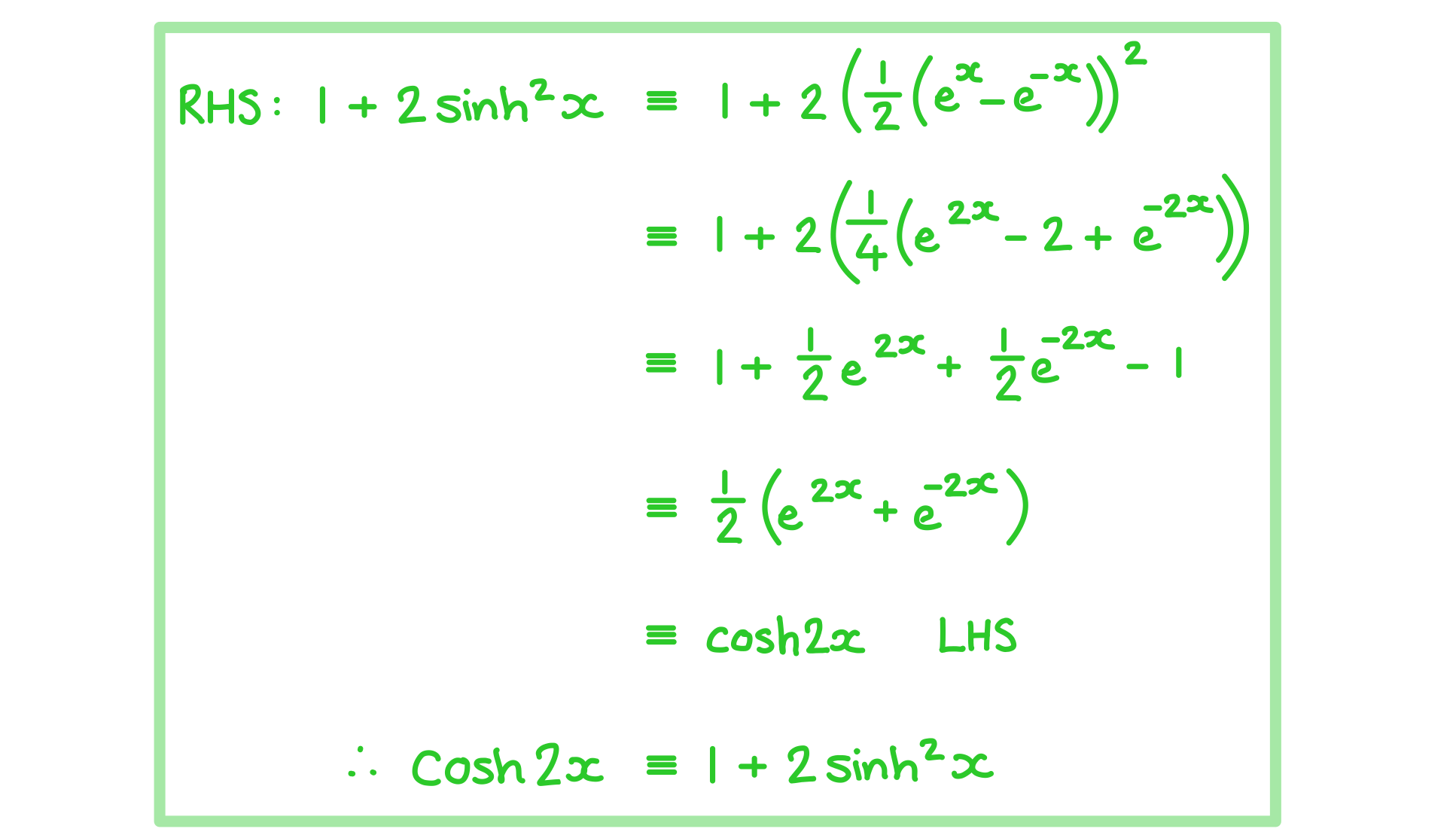
a) Using the definitions of and prove the identity .
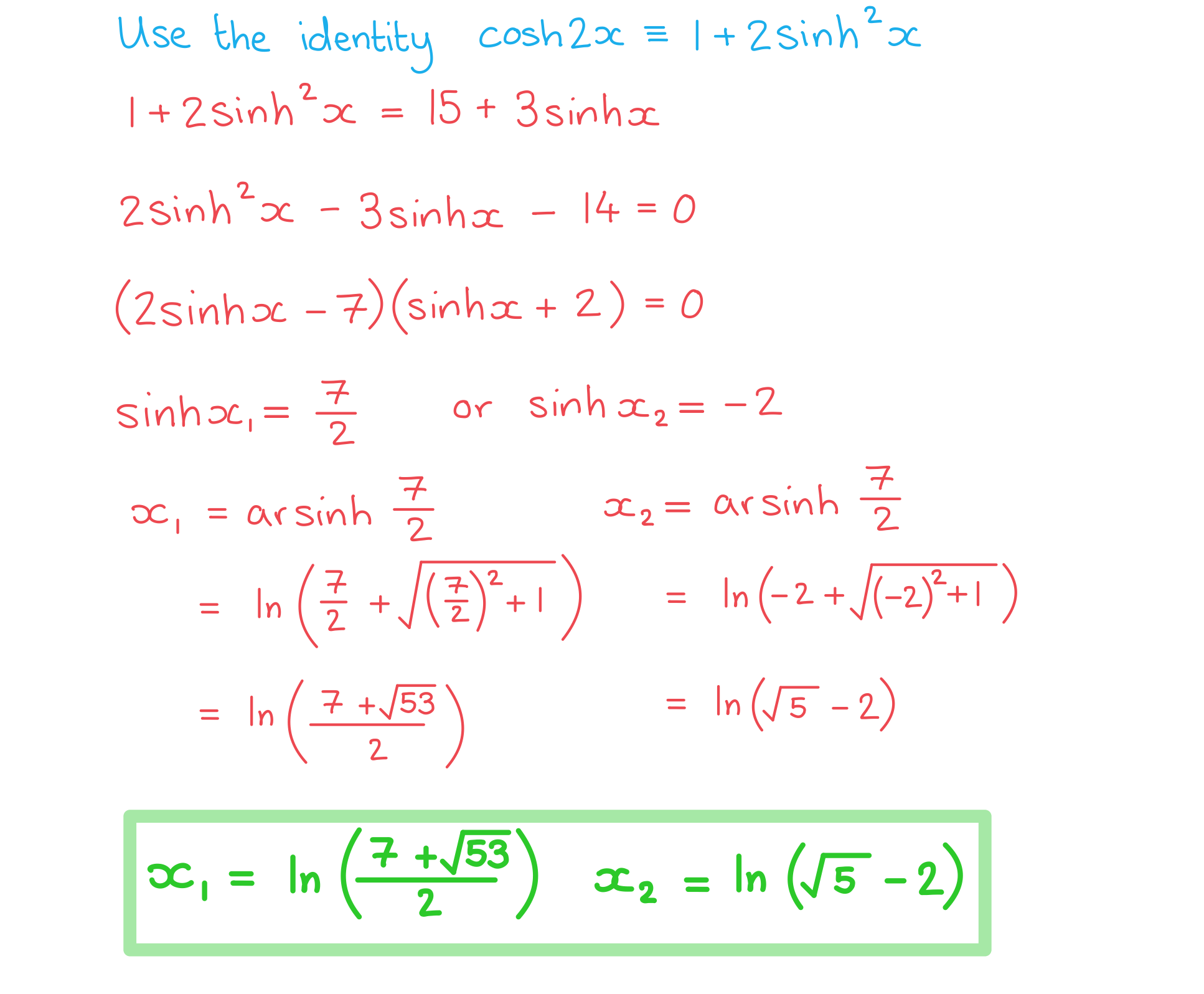
b) Find the real solutions, as exact values, to the equation .

Unlock more, it's free!
Join the 100,000+ Students that ❤️ Save My Exams
the (exam) results speak for themselves:

Was this revision note helpful?
Build on this topic
