Further Modelling with Functions (Cambridge (CIE) A Level Maths: Pure 3): Exam Questions

Exam code: 9709

1 hour12 questions
1
Sme Calculator
3 marks

Note: For this question ensure you are working in degrees.

The height, h cm, of water in a wave tank, at time t seconds after the tank is switched on, is measured according to the function

h(t)=20sin (15t)°

t0

The model is designed so that a height of 0 cm represents calm, still water.

(i) What is the maximum height the water will reach?

(ii) How long does it take the water to first reach its maximum height?

(iii) Find the height of the water after 8 seconds.

2a
Sme Calculator
1 mark

A business owner invests 30 000 dollars at an interest rate of 1.14% per year.

The value, V dollars, of the investment t years after the initial investment is modelled by the formula

V(t)=30000(1+1.14100)t

Find the value of the investment after 7 years.

2b
Sme Calculator
3 marks

Find the least number of whole years it will take before the value of the investment has doubled.

2c
1 mark

The value, W dollars, of a second investment t years after the initial investment is modelled in the same way, with an initial investment of 25 000 dollars at an interest rate of 1.3% per year.

Write down a formula for W in terms of t.

3a
Sme Calculator
2 marks

The flight of a hot air balloon ascending from the ground to its cruising altitude is modelled according to the function

a(t)=5t3+5t2

0t10

where t is the time of ascent in minutes and a is the altitude in feet.

Find the altitude of the hot air balloon after:

(i) 4 minutes,

(ii) 6 minutes.

3b
Sme Calculator
2 marks

Find the change in altitude of the hot air balloon between 5 minutes and 9 minutes.

3c
1 mark

Explain why the model should not be used for larger values of t.

4
Sme Calculator
5 marks

A gardener is modelling the number of hours of daylight his allotment receives at different times of the year using the function

h(t)=12+5sin (2πt365)

t0

where h is the number of hours of daylight on a given day, and t is the time measured in whole days. Note that t=0 corresponds to the first day of the model.

(i) Find the number of hours of daylight on the 100th day.

(ii) Write down the maximum and minimum number of daylight hours the model predicts.

(iii) Assuming the allotment is located in the UK, give a reason why the first day of the model most likely does not correspond to 1st January.

1a
Sme Calculator
2 marks

In a simple model of an investment account, the function

V(t)=I(1+r100)t

is used, where I is the initial amount invested, r % is the interest rate, and V is the value of the investment t years later.

For an initial investment of 1000 dollars, find the value after 12 years at an interest rate of 0.8%.

1b
Sme Calculator
3 marks

After investing 400 dollars for 8 years the value of the investment is 448.82 dollars.

Find the interest rate, correct to three significant figures.

1c
Sme Calculator
4 marks

Find the least number of years 20 000 dollars would need to be invested at an interest rate of 3.4% in order for its value to have doubled.

1d
1 mark

Describe a refinement to the model that would more realistically reflect the way savings and investment accounts work.

2a
3 marks

Note: For this question ensure you are working in degrees.

A wave tank is used to simulate the sea at high tide. At a certain point along the tank the height of water is measured relative to the calm water level, which has a height of 0 cm.

The height of water in the tank is modelled by the function

h(t)=12cos (20t)°

t0

where h cm is the height of water and t seconds is the time after the peak of the first wave passes the measuring point.

Sketch a graph of h against t for 0t54.

2b
Sme Calculator
4 marks

(i) What is the maximum height the water reaches according to the model?

(ii) How frequent are the waves generated by the tank?

(iii) How often is the water at its calm level?

(iv) When will the peak of the 12th wave pass the measuring point?

2c
1 mark

Comment on the suitability of using this model to simulate actual sea waves.

3
Sme Calculator
4 marks

A gardener wants to model the number of hours of daylight his allotment receives at different times of the year using a function of the form

h(t)=a+bsin (2π365t)

t0

where h is the number of hours of daylight on a given day, t is the time measured in whole days, and a and b are positive constants. Note that t=0 corresponds to the first day of the model.

(i) Given that the model needs to predict a maximum of 17 hours daylight and a minimum of 7 hours daylight, find the values of a and b.

(ii) Explain the significance of the value 2π365 in the model.

(iii) Suggest, with a reason, the date of the year that the model starts on.

1a
Sme Calculator
4 marks

A hot air balloon is modelled ascending from the ground to its cruising height according to the function

a(t)=8t3132t2+726t

0t11

where t is the time of ascent in minutes and a is the altitude in feet.

(i) It takes 11 minutes for the hot air balloon to reach its cruising altitude. Find the cruising altitude.

(ii) Show that the hot air balloon rises by just 250 feet between 3 and 8 minutes. What does this suggest about how the pilot flew the hot air balloon during its ascent?

1b
Sme Calculator
4 marks

Show that there is only one real solution to the equation a(t)=0 and hence explain why the model cannot be used indefinitely for the altitude of the hot air balloon.

2
Sme Calculator
5 marks

A gardener is modelling the number of hours of daylight his allotment receives at different times of the year using the function

h(t)=12asin (2πt365)

t0

where h is the number of hours of daylight on a given day, t is the time measured in whole days, and a is a positive constant.

(i) Given that the maximum amount of daylight predicted by the model is 16 hours, write down the value of a.

(ii) The gardener is also a keen golfer.

In order to have enough daylight to play golf after working in the garden there needs to be at least 9 hours daylight in the day.

On approximately how many days of the year can the gardener not play golf?

3a
Sme Calculator
4 marks

Note: For this question ensure you are working in degrees.

A wave tank is used to simulate the sea at high tide.

At a certain point along the tank the height of water is measured relative to the calm water level, which has a height of 0 cm.

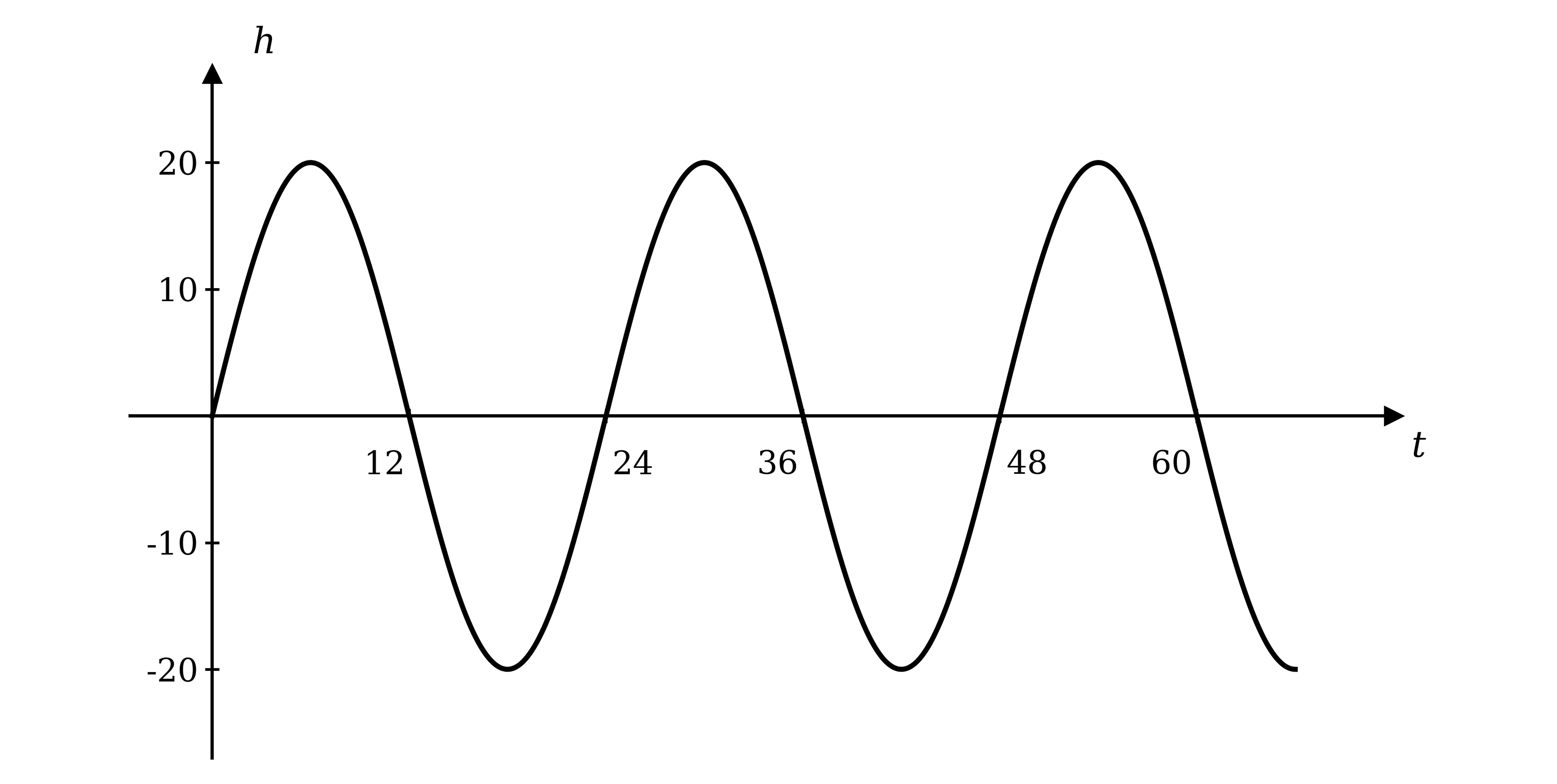
The graph of the height of water, h cm, against the time after the simulation is started, t seconds, is shown below.

Graph of h in centimetres against t in seconds showing a sine curve through the origin, rising to a peak of 20, with the curve crossing the horizontal axis at t equals 0, 12, 24, 36, 48 and 60

(i) According to the graph what is the maximum height the water will reach?

(ii) How frequent are the waves generated by the tank?

(iii) Use the graph to write down a function for the model in the form

h(t)=Asin (Bt)°

t0

3b
Sme Calculator
2 marks

Write down a model of the form h(t)=Asin (Bt)° that could be used to generate waves of double the amplitude and at a frequency of 15 waves per minute.

3c
1 mark

Suggest a way the model can be improved for simulating actual sea waves.

4a
Sme Calculator
3 marks

In a simple model of an investment account, the function

V(t)=I(1+r100)t

is used, where I is the initial amount invested, r % is the interest rate, and V is the value of the investment at the end of t years.

Find the interest rate required for an amount of money invested for 8 years to double in value.

4b
Sme Calculator
5 marks

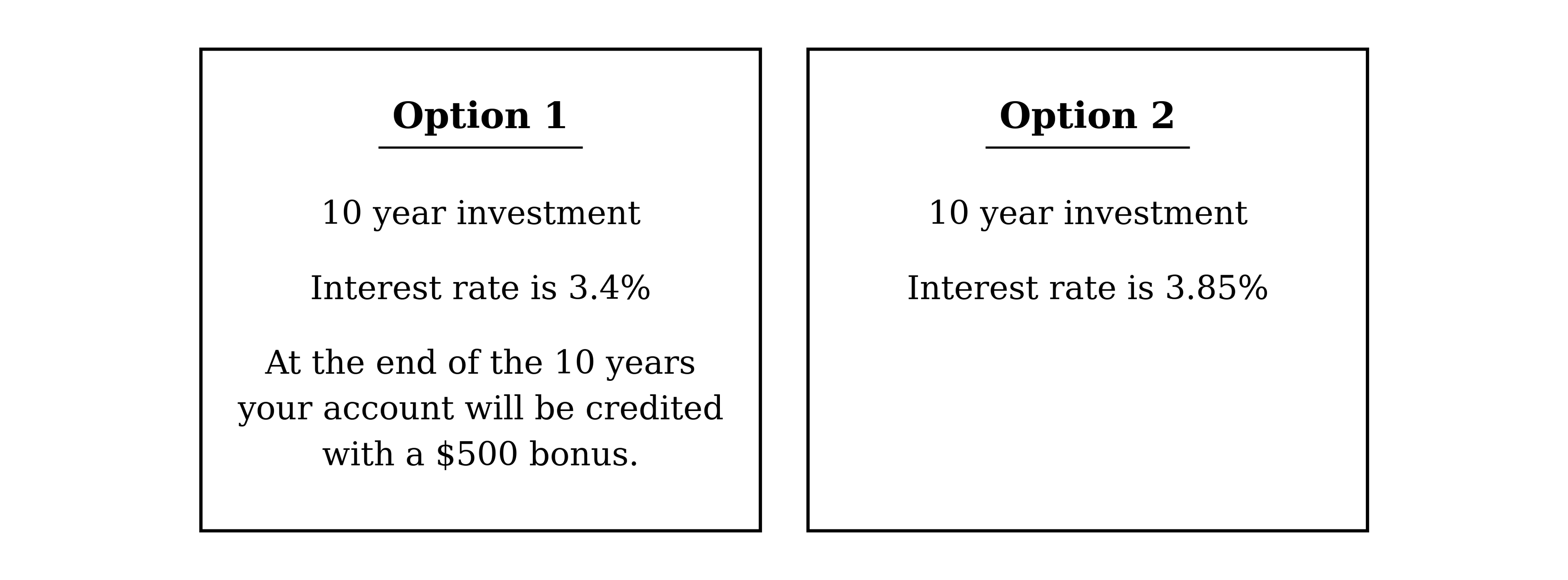
An investor is comparing two options offered by a local bank.

Two option cards side by side. Option 1 is a 10 year investment at an interest rate of 3.4 percent, with the account credited with a 500 dollar bonus at the end of the 10 years. Option 2 is a 10 year investment at an interest rate of 3.85 percent with no bonus

(i) Find the least amount of money an investor would need in order for Option 2 to give a greater return than Option 1.

(ii) What advice would you give to a customer with 8100 dollars to invest? Justify your answer.

1a
Sme Calculator
5 marks

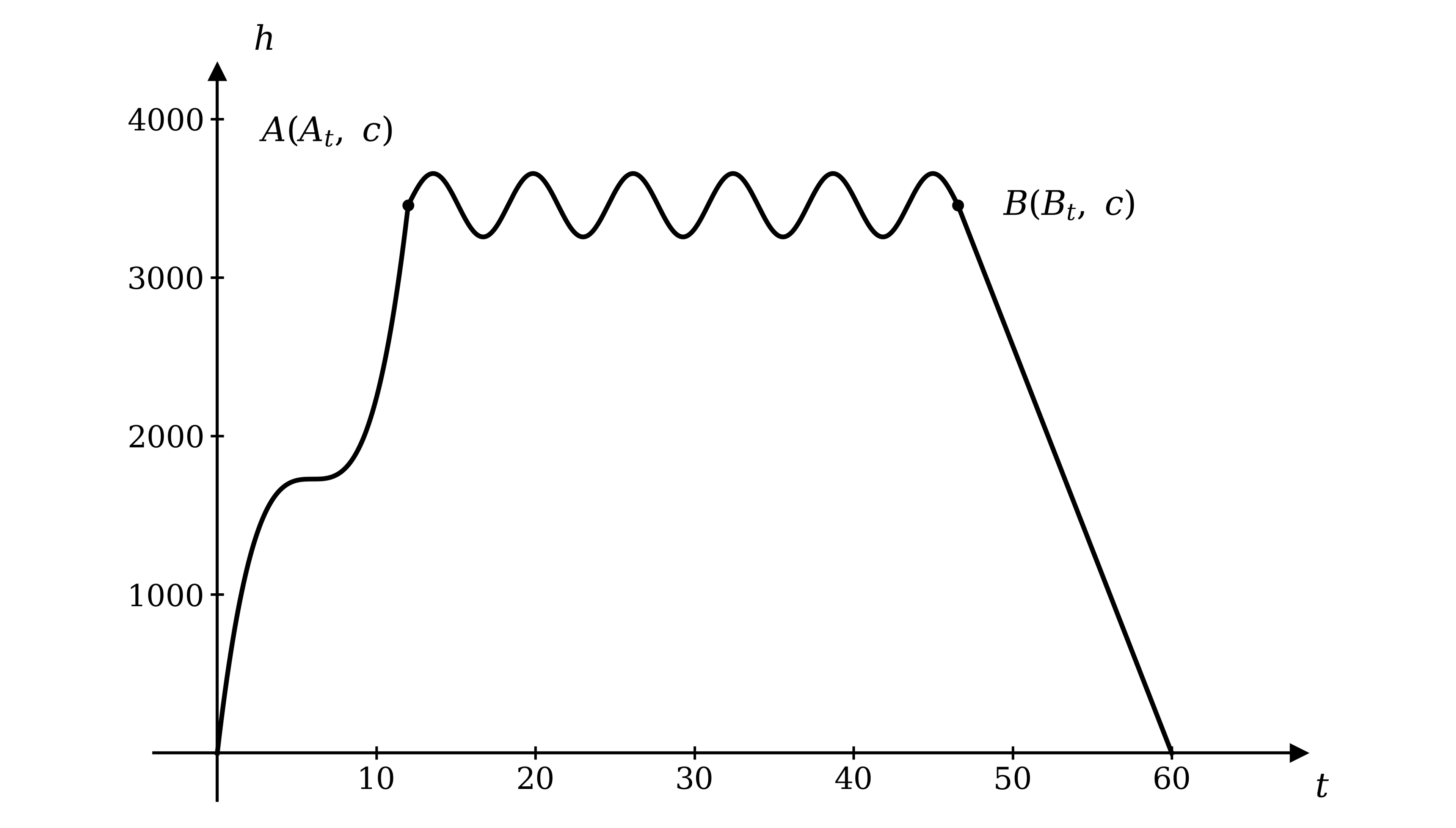
The flight path of a hot air balloon is planned according to the graph below.

The path is made up of three segments, ascent, cruising and descent.

Graph of altitude in feet against time t in minutes for a hot air balloon flight, showing a steep ascent, then a cruising section which rises and falls in a regular wave pattern with six peaks and five troughs, then a straight descent to the ground. The point A where the ascent meets the cruise and the point B where the cruise meets the descent are both labelled

Point A(At,c) is the point where the flight path changes from ascent to cruising.

Point B(Bt,c) is the point where the flight path changes from cruising to descent.

The functions for the ascent and cruising segments of the flight are given below.

Ascent: f(t)=8(t6)3+1728 for 0tAt

Cruise: g(t)=3456+200sin (t12) for AttBt

where f(t) and g(t) give the altitude in feet at a time t minutes after the commencement of the balloon's flight.

The balloon begins and ends the cruising segment of its flight at an altitude midway between its minimum and maximum cruising altitudes.

Use the information given to deduce

(i) the values of At, Bt and c,

(ii) the difference between the maximum and minimum cruising altitudes.

1b
Sme Calculator
4 marks

The total flight time is planned to be 60 minutes. The descent part of the journey is modelled by a linear function, h(t), where Btt60.

Find an equation for h(t).

1c
1 mark

Describe a problem with attempting to model hot air balloon flights in this manner.