15 marks
Explain why a business manager needs to understand the difference between capital expenditure and revenue expenditure.
Was this exam question helpful?
Exam code: 9609
Explain why a business manager needs to understand the difference between capital expenditure and revenue expenditure.
Was this exam question helpful?
Samira's Whiteboards (SW)
Samira left school at the age of 18 in country H. She had a small amount of savings and an idea to create a flexible, removable and reusable whiteboard. Samira created a prototype and received small orders from local retailers.
A local manufacturer batch produces stock when required. There is a two-week lead time for a minimum order of 500 units. Samira started to sell her whiteboards on her website and at trade shows. She has been trading for seven months. She has good cashflow but little working capital as production costs are high.
Samira has heard that OS, a large business that sells office equipment, is planning to sell their own version of Samira's whiteboard. She is keen to increase production quickly to take advantage of being first to market. However, Samira's manufacturer cannot supply enough product to meet the growth in potential demand for whiteboards.
Fig. 1.1 shows an inventory control chart for the first seven months of trade.
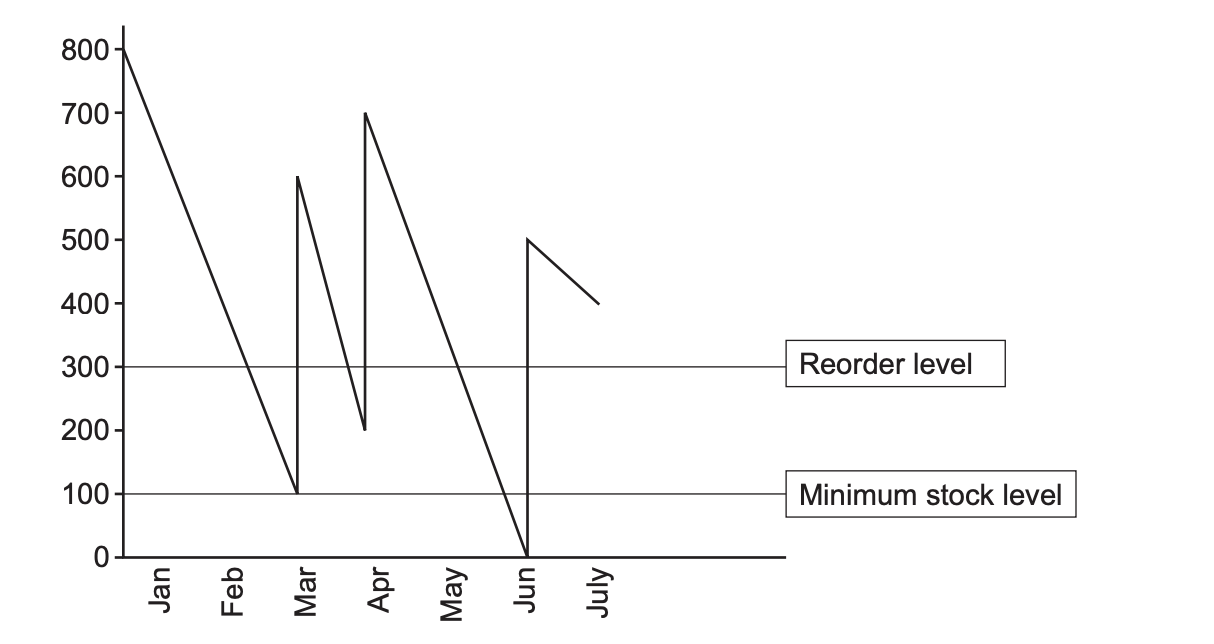
Fig. 1.1 is an inventory control chart showing SW's stock level (in units) over the first seven months of trade, January to July. The reorder level is 300 units and the minimum stock level is 100 units. Stock falls steadily as whiteboards are sold, then rises by 500 units (the minimum order quantity) each time a delivery is received. The stock level at each turning point of the chart is:
Point on the chart | Stock level (units) |
|---|---|
Opening stock (January) | 800 |
First low point, before delivery | 100 |
After first delivery | 600 |
Second low point, before delivery | 200 |
After second delivery | 700 |
Third low point, before delivery | 0 |
After third delivery | 500 |
Closing stock (July) | 400 |
Lara, a venture capitalist with experience of manufacturing, has approached Samira about making an investment. She would invest $100 000 to build a local mass production facility for SW. The facility would have a maximum output of 50 000 units per month. Lara wants to own 40% of the business.
Explain the term working capital.
Was this exam question helpful?
Priya’s Bookshop (PB)
Priya lives in town R which is situated in beautiful countryside with nice walks nearby. Many tourists visit town R.
The town’s council would like town R to become branded as a ‘booktown’, a town with many bookshops selling new and used books. The council announced a new financial scheme offering grants to attract entrepreneurs willing to open a bookshop.
Priya applied for a grant to start up Priya’s Bookshop (PB). Part of her grant application included a cash flow forecast, shown in Table 1.1.
Table 1.1: Cash flow forecast, first three months of trading ($000)
Month 1 | Month 2 | Month 3 | |
Cash in: | |||
Owner’s capital | 15 | 0 | 0 |
Grant | 20 | 0 | 0 |
Revenue | 4 | 6 | 11 |
Cash out: | |||
Initial set up costs | 20 | 0 | 0 |
Utilities (power, water etc) | 0 | 0 | 2 |
Employee costs | 1 | 1 | 3 |
Purchases | 6 | 3 | 4 |
Marketing | 10 | 5 | 4 |
Opening balance | 0 | 2 | -1 |
Closing balance | 2 | -1 | X |
Priya’s grant application was successful and she opened PB well aware of the need for both cash and profit.
Priya now wants to raise awareness of PB in town R. Priya did some market research and decided to use market segmentation. This will help her to decide on the promotional methods she could use for her bookshop. See Table 1.2.
Table 1.2: Age and gender of residents in town R
Age group (years) | Percentage of residents in age group | Percentage of age group who are female |
0-15 | 19% | 50% |
16-64 | 63% | 55% |
65+ | 18% | 60% |
Explain the difference between cash and profit (line 23).
Was this exam question helpful?
Evaluate whether working capital is the most important source of finance for a start-up furniture manufacturer.
Was this exam question helpful?
GT is a private limited company fully owned by the Gemini family. It owns a small theatre. This building is used to show live stage performances. Some of the performances are created by GT and some are created by visiting groups who rent the theatre.
Table 2.1: Planned performances for January 2021.
Name of performance | Created by | Number of performances | Ticket price | Percentage of tickets sold |
A Summer Dream | Visiting group | 9 | $40 | 100% |
Wise Owl | GT | 14 | $15 | 60% |
La Poeme Ballet | GT | 5 | $20 | 40% |
GT gains all the revenue from performances created by GT. Visiting groups must pay 50% of their total ticket revenue to GT. The theatre has a maximum of 250 tickets that can be sold for each performance.
GT uses cost-based pricing to set each ticket price for its own performances. Each performance makes a profit but the company often experiences cash flow problems.
GT needs to recruit a new Theatre Manager. The person hired will have many duties, including the responsibility for all of GT’s administration as well as some accounting. The Directors are considering two people who were both recently interviewed.
Table 2.2 contains information gained from the interview process
Nick | Portia |
|
Looking for a long-term career |
Explain the difference between ‘cash’ (line 15) and ‘profit’ (line 15).
Was this exam question helpful?