1a2 marks
The functions and are defined such that and .
Show that .
1b2 marks
Given that , find the value of .
1c2 marks
Show that
1d2 marks
Given that , find the value of .
Was this exam question helpful?
The functions and are defined such that and .
Show that .
Given that , find the value of .
Show that
Given that , find the value of .
Was this exam question helpful?
The graph of is shown below.

(i) Use the graph to write down the domain and range of .
(ii) Given that the point lies on the dotted line, write down the equation of the line.
On the diagram above, sketch the graph of .
Was this exam question helpful?
The values of two functions, and , for certain values of are given in the following table:
x | -2 | 0 | 3 |
f(x) | -12 | -4 | 8 |
g(x) | 0 | -12 | 30 |
Find the value of .
Find the value of
Given that is a linear function, find .
Was this exam question helpful?
The functions and are defined for by and .
Write down the range of .
Find
(i)
(ii) .
Solve the equation .
Was this exam question helpful?
The function is defined as
Show that can be written in the form
Explain why the inverse of does not exist and suggest an adaption to its domain so that the inverse does exist.
The domain of is changed to . Find an expression for and state its domain and range.
Was this exam question helpful?
The functions and are defined for by and .
Find
(i)
(ii) .
Hence write down , and state its domain and range.
Was this exam question helpful?
The function is defined by , for .
Find .
Find the range of .
Find the value of .
Write down the range of .
Was this exam question helpful?
Consider the function , for .
Find
(i)
(ii) the value of such that .
Find the range of .
Write down the domain of .
Was this exam question helpful?
Let , for .
(i) Write down the coordinates of the -intercept of the graph of .
(ii) Explain why the graph of has no -intercept.
(iii) Write down the range of .
Find the value of
Given that , find the domain and the range of .
Was this exam question helpful?
Let , where , .
Write down
(i) the value of
(ii) the range of .
For the graph of , write down the equation of
(i) the vertical asymptote
(ii) the horizontal asymptote.
Find .
For the graph of , find the equation of
(i) the horizontal asymptote
(ii) the vertical asymptote.
Was this exam question helpful?
Let for
Write down an expression for the inverse function .
Consider another function g, for where k is an integer to be found.
Given that the graph of g has an inverse, find the value of .
Sketch the graphs of and g, for the domain found in part (b), on the same set of axes, along with their inverses.
Was this exam question helpful?
Consider the function defined by , .
Sketch the graph of . Clearly label the points where the graph intersects the axes, along with any points that are local maxima or minima.
Let the function be defined by , .
Given that has an inverse:
(i) Write down the largest possible value of
(ii) Find the domain of for the value of found in part (b)(i)
(iii) Find the value of .
Let the function be defined by , .
Given that has an inverse:
(i) Write down the smallest possible value of
(ii) Find the domain of for the value of found in part (c)(i)
(iii) Find the value of .
Was this exam question helpful?
A function is called a self-inverse function if for all values of in the domain.
Let , where ≠ 0, .
Show that is a self-inverse function.
Let g, where ≠ ,.
Find the value of .
Show that g is a self-inverse function.
Was this exam question helpful?
Let and , where each function has its largest possible domain.
Write down the range of .
Write down the domain and range of .
Find
(i)
(ii) .
Solve the equation .
Was this exam question helpful?
The functions and are defined such that and .
Find , giving your answer in the form , where , and are constants to be found.
Hence, or otherwise, find the coordinates of the vertex of the graph of .
Find , giving your answer in the form where and are constants to be found.
Hence, or otherwise, find the coordinates of the -intercept of the graph of .
Was this exam question helpful?
The function is defined by , for .
Find the range of .
Find .
Write down the domain and range of .
Was this exam question helpful?
The following diagram shows the graph of , for . The graph passes through , and .

The function is made up of two linear pieces, the first for .
Find as a piecewise function.
On the grid above, sketch the graph of .
Was this exam question helpful?
A rectangle has length and width .
Find an expression, in terms of , for
(i) the perimeter of the rectangle
(ii) the area of the rectangle.
Show that .
The graph of , for , is shown on the following grid.
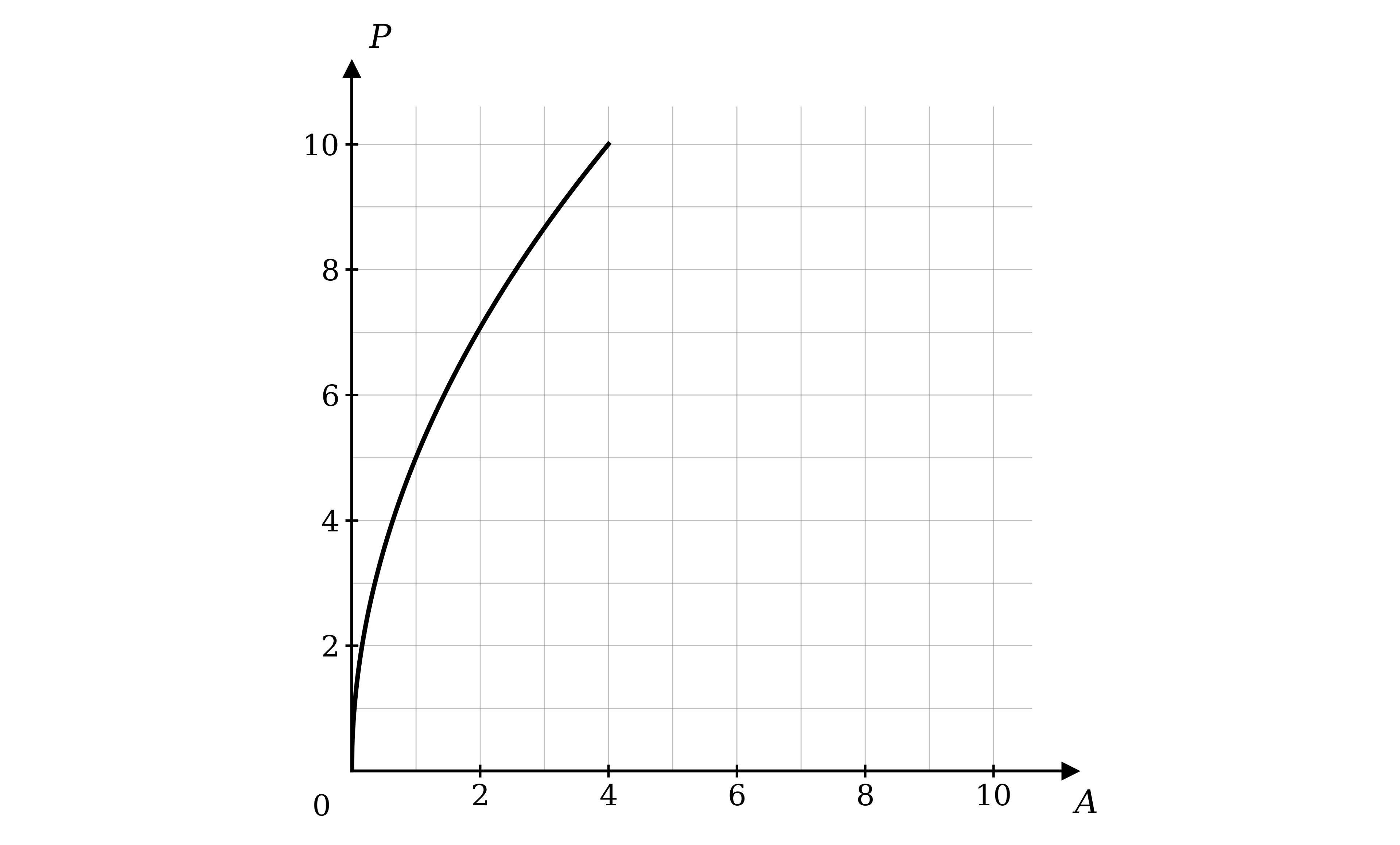
On the same grid, sketch the graph of .
Was this exam question helpful?
The perimeter, , and the area, , of a square with sides of length are given by and .
Find an expression for
(i) in terms of
(ii) in terms of .
Given that , find the value of .
Was this exam question helpful?
Let , for .
Find .
Let be a function such that exists for all real numbers.
Given that , find .
Was this exam question helpful?
Let , where has its largest possible domain.
Find the domain and range of .
(i) Find the values of for which .
(ii) Hence explain why does not have an inverse function.
Was this exam question helpful?
Let and , for .
Find
(i)
(ii) .
Find , giving your answer in the form .
Solve the equation .
Was this exam question helpful?
(i) Show that
(ii) Hence show that
Given that g and , find a possible expression for .
Was this exam question helpful?
(i) Sketch the graph of the function defined by , clearly labelling the minimum point with its coordinates.
(ii) Explain why the function does not have an inverse.
The function g defined by g has an inverse.
(i) Write down the smallest possible value of .
Given that takes its smallest possible value:
(ii) Find the domain and range of g−1.
(iii) Find the inverse function g−1.
Solve = 21.
Was this exam question helpful?
The function is defined by .
(i) Find .
It is always true that the graphs of a function and its inverse will be reflections of each other in the line .
(ii) Based on the answer to part (i), state what else will be true about the graphs of and .
Was this exam question helpful?
The functions and are defined for by and , where .
Find the range of .
Given that for all , determine the set of possible values of .
Was this exam question helpful?
The functions and are defined for by and .
Find, in the form ,
(i)
(ii) .
Describe a single transformation that maps the graph of onto the graph of .
Given that , find the value of .
Was this exam question helpful?
Consider the function defined by , , where is the largest value such that has an inverse.
(i) Write down the value of .
(ii) On the same set of axes, sketch the graphs of and .
(iii) Write down the domain and range of .
Find the inverse function .
Let the function be defined by , .
(i) Solve .
(ii) Solve .
Was this exam question helpful?
A part of the graph of the function is shown below.

Explain why does not have an inverse.
The domain of is now restricted to where and . and are chosen so that has an inverse and the interval is as large as possible.
Find the domain and range of
Was this exam question helpful?
The functions f and g are defined such that and , both for .
Find, giving your answer in the form .
Hence, or otherwise, find the x-intercepts of the graph of .
Let . Find the distance between the y-intercept of the graph of and the positive x-intercept of the graph of . Your answer should be given as an exact value.
Was this exam question helpful?
Let the function f be such that .
It is given that the inverse function f -1 exists, and that the domain of f is as large as possible,
suggest two possible domains for f and write down the corresponding ranges.
Find what the value of would be for each of the domains suggested in part (a).
Was this exam question helpful?
Let.
Write down the coordinates of the y-intercept of the graph of .
Given that f has the largest possible valid domain,
find the domain and range of f .
Was this exam question helpful?
Let the function f be defined by , where k is a constant and where f has the largest possible valid domain.
Find the domain of f.
Given that as gets large tends towards the value −7, find the value of .
Write down the equations of any vertical and/or horizontal asymptotes on the graph of .
Was this exam question helpful?
Consider the function defined by .
(i) Show that .
(ii) Hence show that .
Given that and that , find a possible expression for g.
Was this exam question helpful?
Let and , for .
Find
(i)
(ii) .
Find , giving your answer in the form .
Solve the equation .
Was this exam question helpful?