Festivals & Traditions (AQA GCSE French): Exam Questions

Exam code: 8652

12 mins3 questions
1a
1 mark

The end of slavery

You read this article about celebrations to mark the end of slavery in Martinique, an island in the Caribbean Sea.

Answer the questions that follow.
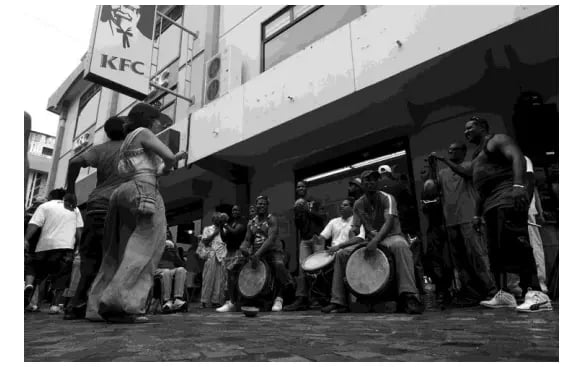
Black-and-white photograph of a street celebration in Martinique: drummers perform outside a fast-food restaurant while adults and children gather, watch and dance in the street.

Le 22 mai est devenu en Martinique un jour férié car en 1848, le gouvernement a réussi à terminer l’esclavage*. Chaque année, c‘est toute l’île, adultes et enfants, qui fait la fête.

Avant le déjeuner, on peut participer à des événements pour découvrir le passé du pays. Mais plus de gens vont préférer faire la fête. Pour ces gens, il y a des concerts dans les rues qui commencent l’après-midi. Ces concerts continuent jusqu’au lendemain.

*l'esclavage = slavery

Complete the sentence.

In Martinique, the 22nd May is celebrated by

  • everybody.

  • only adults.

  • only children.

1b
1 mark

Events about the history of the island take place

  • before lunch.

  • during lunch.

  • after lunch.

1c
1 mark

Compared to the history events, the concerts are

  • equally popular.

  • less popular.

  • more popular.

1d
1 mark

The concerts

  • begin in the morning.

  • carry on all night.

  • take place in the day.

2a
1 mark

Bastille Day

You read this article about Bastille Day, the French national day on the 14th of July.

Answer the questions that follow.

Night-time photograph of the Eiffel Tower in Paris, viewed from below and lit in blue, white and red bands, evoking the French flag against a dark sky, with its iron lattice clearly visible.

By Eric Niequist

Le 14 juillet est le jour national de la France. Ce jour célèbre la Révolution française de 1789. Tout le monde en France a un jour férié pour se souvenir de cet événement important. Pendant la journée, il y a un grand défilé militaire* à Paris sur les Champs-Élysées. Le président et beaucoup de touristes viennent le regarder. Les familles aiment passer du temps ensemble dans les parcs ou sur la plage. Le soir, il y a des feux d'artifice dans toutes les villes du pays. On chante La Marseillaise, la chanson nationale de la France.

*militaire = military

Complete the sentence.

The 14th of July is

  • a long weekend.

  • a religious event.

  • a public holiday.

2b
1 mark

Answer the following question in English.

What do people watch in Paris?

2c
1 mark

What do French families like to do during the day on the 14th of July?

2d
1 mark

Name one thing that happens in the evening on the 14th of July.

3a
1 mark

The Nice Carnival

You read this article about the famous Carnaval de Nice in the south of France.

Night-time photograph of Nice Carnival: enormous colourful illuminated floats and giant costumed figures parade before a dense crowd, with confetti covering the ground and bright lights against the dark sky.

By Tmilaret - Own work, CC BY-SA 4.0

Le Carnaval de Nice est l'une des plus anciennes et des plus importantes fêtes de France. Ayant commencé au quatorzième siècle, cette tradition fait venir chaque année un million de visiteurs dans le sud du pays.

La fête dure environ deux semaines, entre février et mars. Pendant le carnaval, on construit d'énormes chars* colorés pour les défilés dans les rues.

Chaque année, le carnaval a un thème différent. Le spectacle le plus attendu est la bataille de fleurs, où les participants lancent des milliers de fleurs au public.

Même si l'événement est gratuit pour les résidents de la région, les touristes doivent acheter un billet pour pouvoir entrer.

*char = chariot

Complete the sentence.

The Nice Carnival began in

  • the 12th century.

  • the 14th century.

  • the 16th century.

3b
1 mark

Answer the following question in English.

How long does the Carnival last?

3c
1 mark

What happens during the "battle of flowers"?

3d
1 mark

How does access to the Carnival differ between locals and tourists?