12 marks
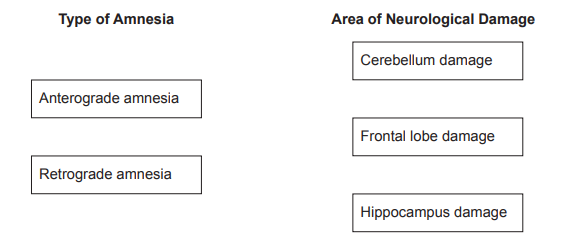
Draw one line from each type of amnesia to its relevant area of neurological damage.
Was this exam question helpful?
Exam code: J203
Draw one line from each type of amnesia to its relevant area of neurological damage.
Was this exam question helpful?
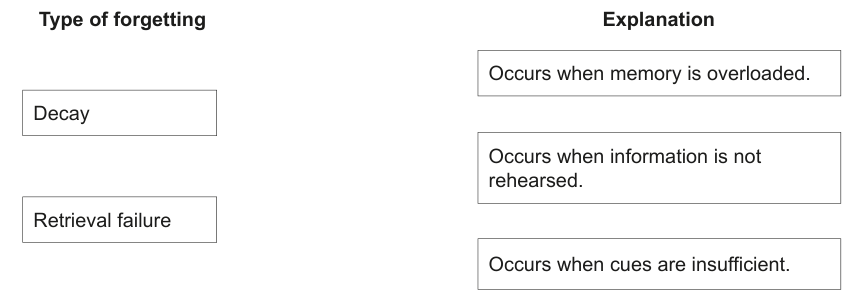
Match the terms to their correct explanations.
Draw one line from each type of forgetting to its correct explanation.
Was this exam question helpful?
Ling used to work as a taxi driver. Following a brain injury, Ling no longer remembers how to drive a car.
Explain how neurological damage to one area of the brain could have affected Ling’s procedural memory.
Was this exam question helpful?
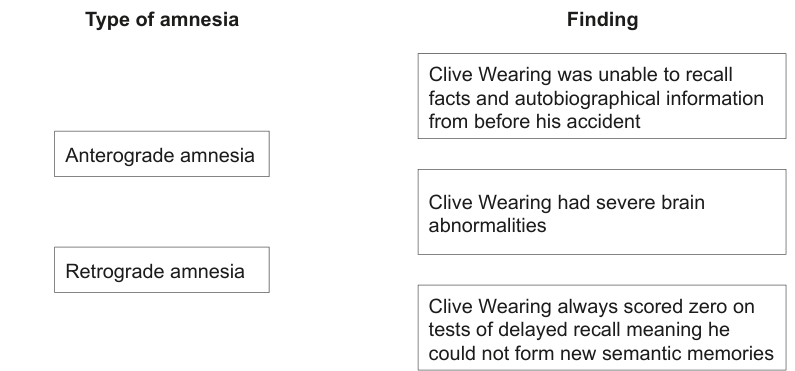
Wilson, Kopelman and Kapur’s (2008) study of prominent and persistent loss of past awareness in amnesia found that Clive Wearing suffered from both retrograde and anterograde amnesia.
Match the finding from Wilson, Kopelman and Kapur’s (2008) study with the correct type of amnesia.
Draw one line from each type of amnesia to its correct finding.
Wilson, Kopelman and Kapur (2008) used a case study.
Explain one strength of Wilson, Kopelman and Kapur (2008) using a case study.
Was this exam question helpful?
A psychologist investigated how decay can affect our ability to remember. Two groups of participants were read a list of 10 words at the same time. Group One recalled the word list immediately, whereas Group Two were asked to count backwards from 10 to 1 before recalling the word list (delayed recall).
The table below shows the total percentage of words recalled in both conditions. The psychologist concluded decay does affect our ability to remember.
Condition | Total percentage of words recalled |
|---|---|
Immediate recall | 74% |
Delayed recall | 59% |
State what is meant by decay.
Outline one other type of forgetting that may explain the results of this study.
Explain how using cues could have improved the participants’ recall of the words in this study.
Explain how the psychologist could have calculated the median number of words recalled in each condition.
Explain whether the psychologist used an independent measures or repeated measures experimental design in this study.
Was this exam question helpful?
Identify the part of the brain that is damaged in people who have anterograde amnesia.
cerebellum
frontal lobe
hippocampus
hypothalamus
Identify the part of the brain that is damaged in people who have retrograde amnesia.
cerebellum
frontal lobe
hippocampus
hypothalamus
Identify the part of the brain that, if damaged, affects a person’s procedural memory so they cannot learn new skills or improve old skills.
cerebellum
frontal lobe
hippocampus
hypothalamus
Was this exam question helpful?
Outline the role of the hippocampus in anterograde amnesia.
Was this exam question helpful?
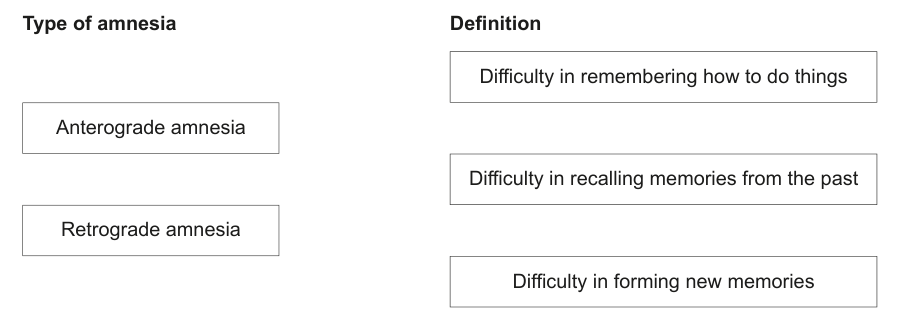
Amnesia is a condition which affects a person’s memory.
Draw a line to match each type of amnesia to its correct definition.
Was this exam question helpful?
Complete the following passage about the role of neuropsychology in amnesia.
You must choose a different part of the brain for each gap from the list below.
cerebellum, frontal lobe, hypothalamus, hippocampus
The part of the brain associated with anterograde amnesia is the 1. ______. This is because information from the short-term memory needs to pass through here to reach the long-term memory. Damage to the 2. ______ is associated with retrograde amnesia. Procedural memories, like knowing how to drive a car or play a musical instrument, can be affected by damage to the 3. ______.
Was this exam question helpful?
Identify the stage of information processing which involves the formatting of information.
encoding
input
output
storage
Identify the type of forgetting which occurs when memory is overloaded.
decay
displacement
interference
retrieval failure
Identify the part of the brain associated with procedural memory.
cerebellum
frontal lobe
hippocampus
temporal lobe
Was this exam question helpful?