Theories of Dreaming (OCR GCSE Psychology): Exam Questions

Exam code: J203

1 hour20 questions
1
3 marks

Complete the following passage about the Activation Synthesis Theory of Dreaming.

You must choose a different term for each gap from the list below.

bizarre, cerebral cortex, hypothalamus, midbrain, ordinary, pons

During REM sleep, intense brain activity driven by signals from the 1. ______ stimulates the limbic system. This random brain activity prompts dream synthesis in the 2. ______, often resulting in 3. ______ dreams.

2a
1 mark

Below is a conversation between Ling and Zayn.

Ling: I had an interesting dream yesterday.

Zayn: What was it?

Ling: I was lost in a large, unfamiliar city.

Zayn: Sounds like you wish for a new adventure in life.

Using the source:

State the manifest content of Ling’s dreams.

2b
1 mark

State the latent content of Ling’s dreams.

2c
3 marks

Explain one criticism of using the Freudian Theory of Dreaming to explain Ling’s dreams.

3
2 marks

Using an example, explain what repression means according to the Freudian Theory of Dreaming.

4
2 marks

Briefly explain why Williams et al.’s (1992) study into bizarreness in dreams and fantasies may lack representativeness.

5
2 marks

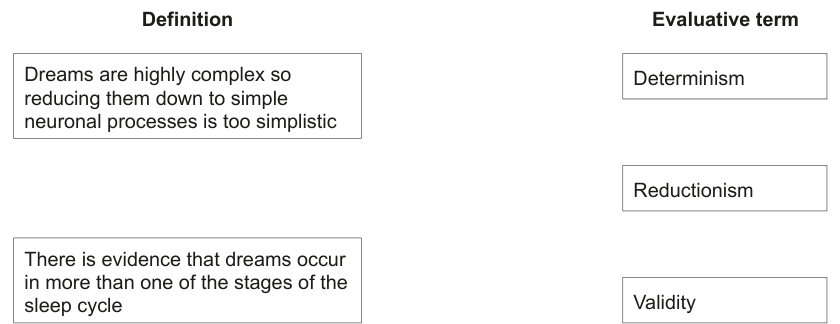
Evaluate the Activation Synthesis Theory of Dreaming by matching the terms to the correct definitions.

Draw one line from each definition to the correct evaluative term.

[Figure: Matching diagram with two columns. Left column headed "Definition" contains two boxes: "Dreams are highly complex so reducing them down to simple neuronal processes is too simplistic" and "There is evidence that dreams occur in more than one of the stages of the sleep cycle". Right column headed "Evaluative term" contains three boxes, from top to bottom: "Determinism", "Reductionism" and "Validity". Students draw one line from each definition to an evaluative term.]
6a
1 mark

Identify what the colour of the wolves represented in Freud’s (1918) Wolfman study.

  • white bedlinen

  • white hair

  • white snow

  • white wolves

6b
1 mark

Identify the nationality of the Wolfman from Freud’s (1918) study.

  • American

  • French

  • Russian

  • Spanish

6c
1 mark

Identify what the wolves in the tree represented in Freud’s (1918) Wolfman study.

  • father

  • himself

  • mother

  • sister

7a
1 mark

Amit and Ling are discussing the meaning of their dreams. Ling says that dreams are motivated by our unconscious urges and desires. Amit has recently been having dreams that focus on fighting with friends. Ling says that this is because Amit has been feeling unhappy at work and wants to leave. Ling also thinks the dreams will stop as soon as Amit leaves his job.

Using the source:

Give one example of the manifest content of Amit’s dreams.

7b
1 mark

Give one example of the latent content of Amit’s dreams.

7c
1 mark

Give one example of wish fulfilment from the source.

7d
3 marks

Describe one criticism of using the Freudian Theory of Dreaming to explain Amit’s dreams.

8
3 marks

Outline the role of the cerebral cortex in the Activation Synthesis Theory of Dreaming.

9a
1 mark

Identify the method used by Williams et al. (1992) in their study into bizarreness in dreams and fantasies.

  • field experiment and observation

  • field experiment and self-report

  • natural experiment and observation

  • natural experiment and self-report

9b
1 mark

Identify which of the following describes the sample in Williams et al.’s (1992) study.

  • ten male and two female American students

  • ten male and two female Australian students

  • two male and ten female American students

  • two male and ten female Australian students

9c
1 mark

Identify which of the following statements is true in relation to Williams et al.’s (1992) study.

  • An equal number of dreams and fantasies were analysed.

  • More dreams than fantasies were analysed.

  • Only dreams were analysed.

  • Only fantasies were analysed.

10
3 marks

Complete the following passage about the Freudian Theory of Dreaming.

You must choose a different term for each gap from the list below.

latent content, manifest content, repression, unconscious mind, wish fulfilment

Freud believed the 1. ______ contained desires, urges, and thoughts that are unacceptable to the conscious mind. According to Freud, the actual content of dreams including the images, thoughts and content contained in the dream is related to the 2. ______. Freud believed that this served to disguise the 3. ______ or the unconscious wishes of the dreamer.

11a
1 mark

Identify which of the following represents the actual subject matter of dreams according to the Freudian Theory of Dreaming.

  • latent content

  • manifest content

  • repression

  • wish fulfilment

11b
1 mark

Identify what the process of repression means in relation to the Freudian Theory of Dreaming.

  • pushing pleasant thoughts and experiences in to the conscious

  • pushing pleasant thoughts and experiences in to the unconscious

  • pushing unpleasant thoughts and experiences in to the conscious

  • pushing unpleasant thoughts and experiences in to the unconscious

11c
1 mark

Identify which of the following is a criticism relating to the validity of the Freudian Theory of Dreaming.

  • It ignores determinism.

  • It is overly scientific.

  • It is subjective.

  • It is too reductionist.

12
3 marks

Outline the role of neuropsychology in the Activation Synthesis Theory of Dreaming.

13a
1 mark

Identify the stage of sleep where most dream activity takes place, according to the Activation Synthesis Theory.

  • RAM

  • REM

  • ROM

  • RTM

13b
1 mark

Identify what the pons area of the brain does during sleep, according to the Activation Synthesis Theory.

  • blocks signals

  • redirects signals

  • sends signals

  • translates signals

13c
1 mark

Identify which part of the brain tries to give meaning to the electrical activity of the brain during sleep, according to the Activation Synthesis Theory.

  • brain stem

  • cerebral cortex

  • hypothalamus

  • pineal gland

14
2 marks

Explain how the Activation Synthesis Theory of Dreaming is criticised for being reductionist.

1
4 marks

Explain two criticisms of the sample used in Freud’s (1918) Wolfman study.

2a
4 marks

Outline four features of the procedure used in Williams et al.’s (1992) study into bizarreness in dreams and fantasies.

2b
2 marks

Outline one conclusion from Williams et al.’s (1992) study.

3
6 marks

Evaluate the Activation Synthesis Theory of Dreaming.

4
4 marks

Describe two criticisms of the Williams et al. (1992) study into the bizarreness in dreams.

1
13 marks

Use your knowledge and understanding from across the psychology course to explain how far you agree with the following statement:

‘Studying the brain and neuropsychology gives us the best understanding of human cognitions and behaviours.’

In your answer, refer to the Activation Synthesis Theory of Dreaming and at least one other theory or explanation from a different area of psychology you have studied.

2
13 marks

Use your knowledge and understanding from across the psychology course to explain how far you agree with the following statement:

“As human behaviour is complex, it needs to be broken down into smaller parts to be understood. This is known as reductionism.”

In your answer, you should refer to biological theories of sleep and dreaming and at least one other theory from a different area of psychology you have studied.