12 marks
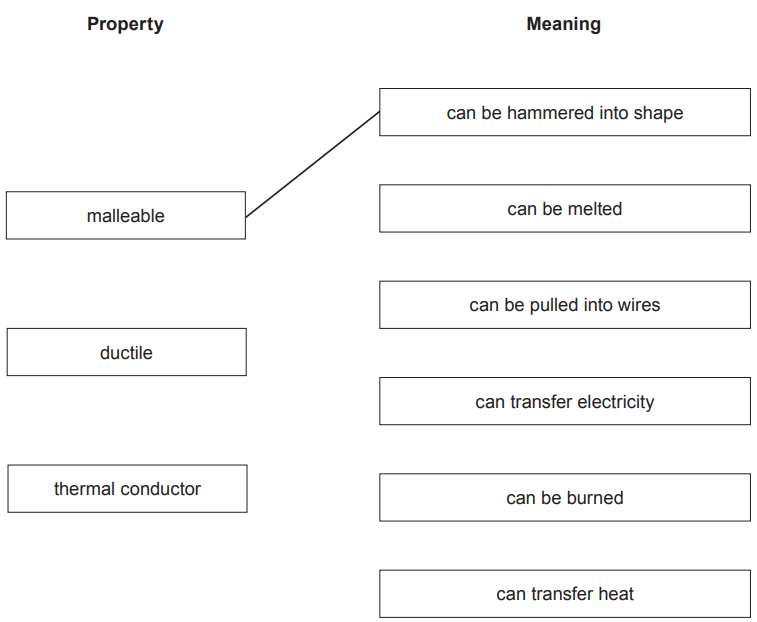
Draw a line to link each of the following metallic properties to its meaning.
One has been done for you.
Was this exam question helpful?
Exam code: 3430
Draw a line to link each of the following metallic properties to its meaning.
One has been done for you.
Was this exam question helpful?
Aluminium is extracted from its ore by electrolysis. The diagram shows a cross-section of the cell used for the extraction.
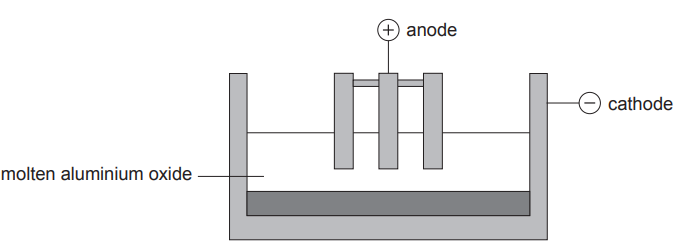
The overall equation for the extraction taking place inside the cell is given below.
2Al2O3 → 4Al + 3O2
Explain the movement of Al3+ and O2- ions inside the cell and how the reactions at each electrode demonstrate oxidation and reduction. Include electrode equations in your answer.
Was this exam question helpful?
Alternative methods of extracting copper
As the Earth's supply of high-grade copper ores continues to decline, alternative methods such as phytomining and bioleaching are becoming more commonly used to extract copper from low-grade ores.
Phytomining
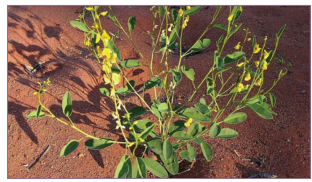
Phytomining involves growing plants in soils that contain low-grade copper ores. The plants absorb the copper ions through their roots and they are concentrated inside the plants' cells.
The plants are then harvested and burned. The ash that is left behind contains higher concentrations of copper ions than the low-grade ores in the soil.
The copper ions are washed out from the ash using sulfuric acid, forming a concentrated solution of copper(II) sulfate.
Scrap iron is then added to the copper(II) sulfate solution to allow the copper to be collected.
The main drawback to phytomining as an alternative method of copper extraction is that the process is dependent on the successful growth of the plants used for the extraction.
Bioleaching
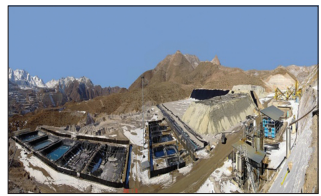
Bioleaching is a very simple process that uses bacteria to extract copper from the minerals found within the lowest grade copper ores.
The bacteria are added to tanks of water containing the ores. There they feed on the nutrients found within the minerals in these ores, causing the copper ions to separate out.
An acidic solution is formed during the process. This contains a higher concentration of copper ions than the low-grade ores.
The solution formed is called a leachate, which is why the process is called bioleaching.
Copper is collected from the leachate solution by mixing it with iron.
The main drawback to bioleaching as an alternative method of copper extraction is that the process is extremely slow and therefore not efficient.
(i) Tick (✓) the box next to the correct statement.
phytomining uses lower grade ores than bioleaching | |
bioleaching conserves supplies of the lowest grade metal ores | |
phytomining conserves supplies of high-grade metal ores | |
bioleaching uses high-grade metal ores | |
phytomining uses the lowest grade metal ores |
[1]
(ii) State whether you agree with the following statement. Give a reason for your answer.
'Phytomining and bioleaching both involve biological processes'
Agree Yes / No
Reason ..................................................................................................................
[1]
(iii) Suggest a reason why phytomining might not be a suitable method for extracting metals in some countries, even if they have supplies of the low-grade metal ores.
.........................................................................................
[1]
(iv) Although effective in extracting copper, suggest a reason why bioleaching is an extremely slow process.
.........................................................................................
[1]
Explain why iron can be used in the last stage of both the phytomining and bioleaching methods of copper extraction.
Was this exam question helpful?
The diagram shows a blast furnace which is used to extract iron.
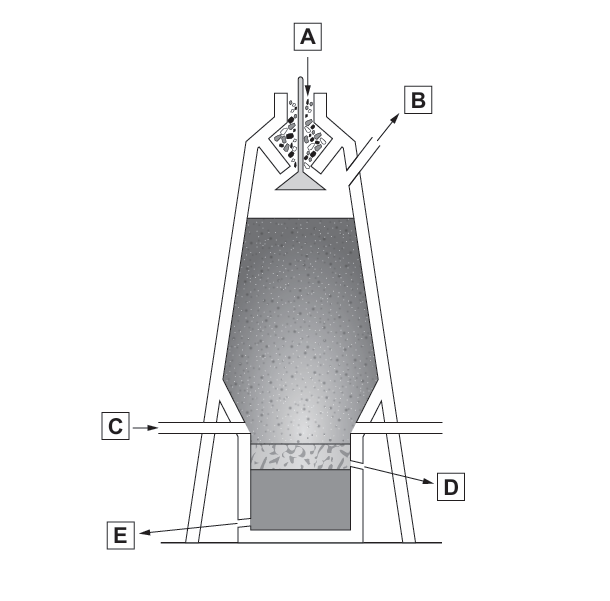
Labels A, B, C, D and E show where substances enter and leave the furnace.
(i) Give the letter, A, B, C, D or E, that shows where:
iron ore enters the furnace ................................................
waste gases leave the furnace ................................................
slag is removed ................................................
[3]
(ii) One of the main reactions inside the blast furnace is represented by the following equation.
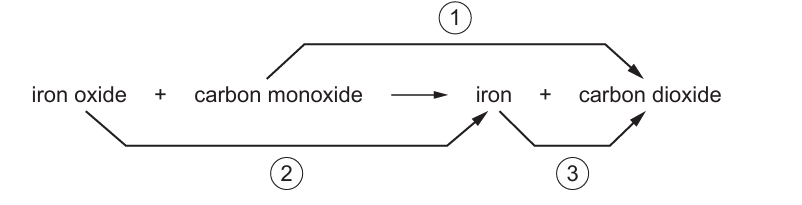
Give the number of the arrow that shows oxidation.
................................................
[1]
(iii) Limestone is added to the furnace to remove impurities.
The chemical name for limestone is calcium carbonate.
Calcium carbonate contains the ions Ca2+ and CO32-.
Circle the correct formula for calcium carbonate.
[1]
CaCO | Ca2CO3 | CaCO3 | Ca(CO3)2 |
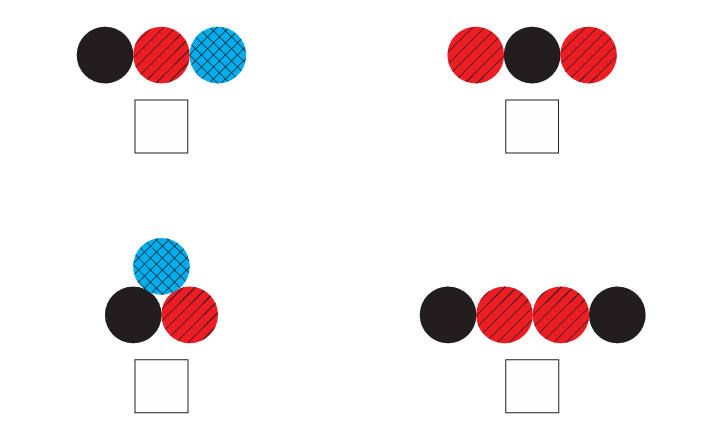
(iv) One of the waste gases that leaves the blast furnace is carbon dioxide, CO2.
Put a tick () in the box next to the diagram that best represents a carbon dioxide molecule.
[1]
The diagram shows an electrolysis cell used in the extraction of aluminium.
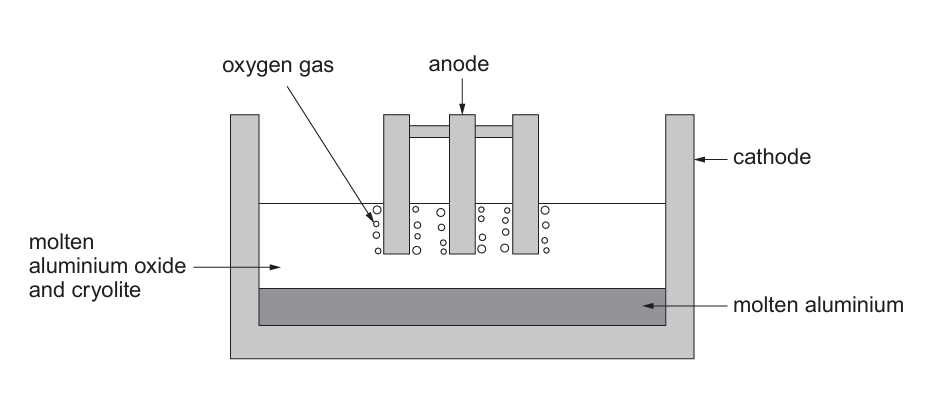
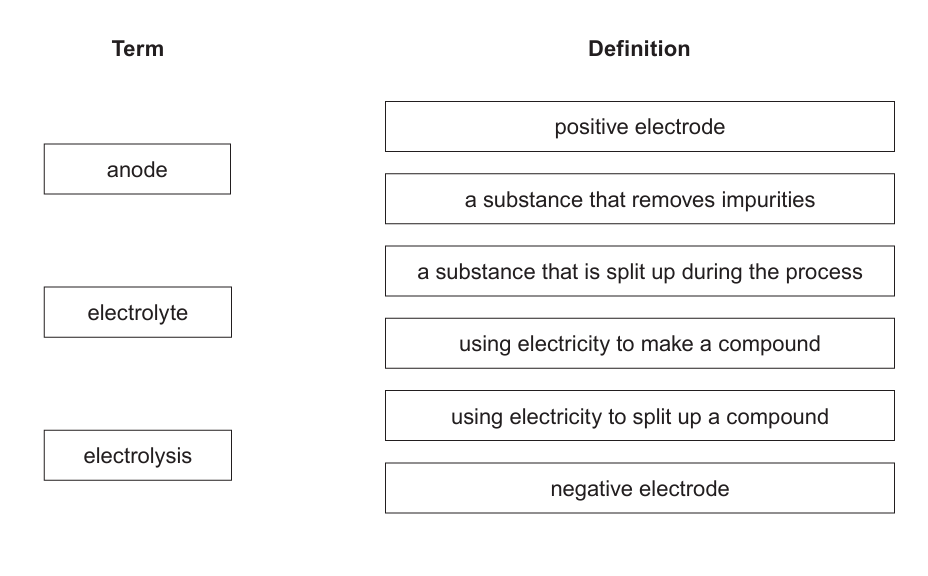
(i) Draw one line from each term to its correct definition.
(ii) Underline the correct word in the brackets to complete each sentence.
Cryolite is added to lower the (density / melting point / boiling point) of the electrolyte.
When choosing a location for an aluminium plant in the UK, it is important to be near a port to (import / export / clean) the aluminium ore.
At the temperature inside the cell, the aluminium is produced as a (solid / liquid / gas).
[3]
(iii) The equation for the reaction that takes place during the extraction of aluminium is given below.
2Al2O3 → [ ]Al + 3O2
Choose a number from the box to balance the equation.
2 | 4 | 6 | 13 |
................................................
[1]
Was this exam question helpful?
In experiment B, aluminium powder was mixed with zinc chloride solution. The reaction produced zinc metal and aluminium chloride solution.
Complete the symbol equation for the reaction by
writing the formula of aluminium chloride on the dotted line
putting a number in the box to balance the equation
2 Al + [ ] ZnCl2 → 2 ...................... + 3Zn
Was this exam question helpful?
The table shows some properties of aluminium, copper and titanium.
Metal | Melting point | Electrical conductivity | Thermal conductivity | Density | Resistance to corrosion |
aluminium | high | good | good | low | good |
copper | high | good | good | high | good |
titanium | high | good | good | low | good |
Describe how these properties are linked to the uses of aluminium, copper and titanium.
You should not give more than two uses for any one metal.
Was this exam question helpful?
The Red Metals
Copper, brass and bronze are known as the 'red metals'. This is because they stand out against other metals due to their characteristic reddish colour.
From construction and architecture to telecommunications and machinery, there is no denying the importance of these 'red metals' in our daily lives.
However, whilst they might all look similar, copper, brass and bronze have very different compositions and properties.
Copper
Most of the world's copper is extracted from copper ores. Once extracted, copper has many uses in its pure form.
In addition to its various applications, copper is present in the other red metals – brass and bronze.
Copper is best known for its electrical and thermal conductivity, malleability and ductility, and resistance to corrosion.
Today it is most commonly found in electrical materials, roofing, plumbing and industrial machinery.
Brass
Brass is made by adding varying amounts of zinc to copper.
Depending on the zinc content, different types of brass can be created and used for different applications.
The more zinc that is added to the brass, the stronger, more ductile, more malleable and lighter in colour it becomes.
Brass is commonly used in architecture for its decorative features as well as in manufacturing, construction and in the electrical and plumbing industries.
Bronze
Bronze is made by mixing copper with tin and other metals such as aluminium, zinc and manganese.
The properties of bronze vary, depending on its specific composition.
Bronze is commonly known for its hardness, as well as being highly ductile, brittle and corrosion resistant.
Bronze is used in architecture as well as for making sculptures, electrical contacts, machine tools and coins.
Tick (✓) to show whether the properties of copper, brass and bronze are fixed or can vary.
Properties are fixed | Properties can vary | |
copper | ||
brass | ||
bronze |
Tick (✓) the correct statement.
copper, bronze and brass are all metal alloys | |
copper and bronze are both metal alloys | |
copper and brass are both metal alloys | |
bronze and brass are both metal alloys |
Give the letter of the structure, A, B or C, that best represents brass.
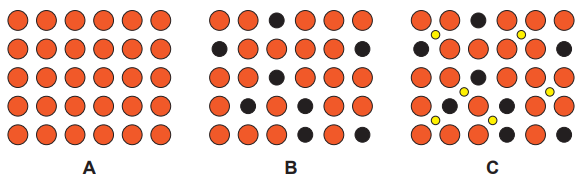
Structure .....................................................
Was this exam question helpful?
Iron is extracted from iron oxide inside the blast furnace.
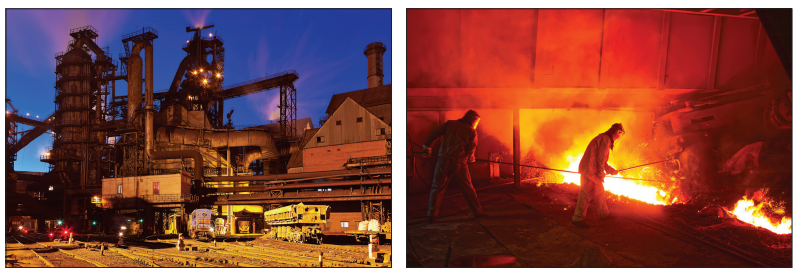
Iron oxide, coke and limestone are all fed in at the top of the furnace.
Describe the two main functions of coke in the furnace.
Limestone is added to the furnace to remove some of the impurities as slag. Their removal involves a two-stage process as shown in the following equations.
Stage 1: CaCO3 → CaO + CO2
Stage 2: CaO + SiO2 → slag
(i) A group of students were each asked to calculate the maximum mass of calcium oxide that could be produced from 8.0 g of calcium carbonate in stage 1.
The answers they calculated were as follows:
Student | Answer |
Yena | 4.4 g |
Charlie | 4.5 g |
Tomasz | 5.0 g |
Give the name of the student that has correctly calculated the mass of calcium oxide to one decimal place.
You must show your working.
Mr(CaCO3) = 100 Mr(CaO) = 56
Student ...................................................................................
[3]
(ii) In stage 2, the slag that is formed contains calcium silicate.
Calcium silicate is formed when calcium oxide (CaO) combines with silicon dioxide (SiO2) in a 1:1 ratio, with no other product formed.
Give the chemical formula of the calcium silicate formed in stage 2.
...................................................................................
[1]
Iron reacts with oxygen to form iron(III) oxide.
Complete and balance the equation for this reaction.
[ ]Fe + 3O2 → ........................
Was this exam question helpful?
The photograph shows what happens when a coil of copper wire is placed in silver nitrate solution.
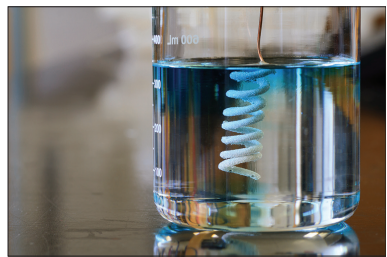
(i) Explain why the solution turns blue.
[2]
(ii) Complete and balance the equation for the reaction taking place.
[ ] AgNO3 + Cu → ...................................... + [ ] Ag
[2]
Was this exam question helpful?
The diagram shows a sequence of reactions from nitric acid.
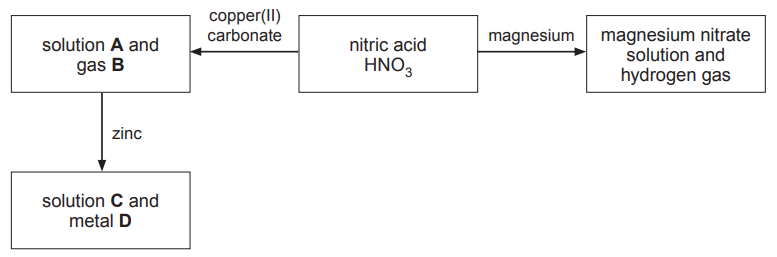
(i) Use the information in the diagram to name the following substances.
solution A ...................................................................................
gas B ...................................................................................
solution C ...................................................................................
metal D ...................................................................................
[3]
(ii) Write the balanced symbol equation for the reaction between magnesium and nitric acid.
[3]
(iii) Name the type of reaction that takes place between solution A and zinc.
...............................................................................................
[1]
Was this exam question helpful?
Corey and Bailey used the following apparatus to obtain copper from copper(II) chloride solution.
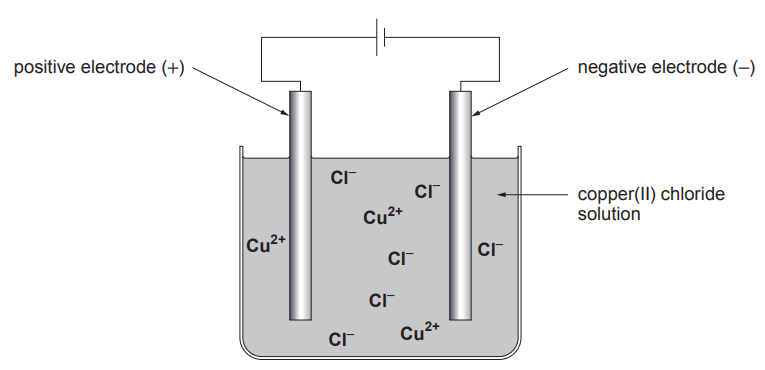
(i)
electrolysis copper anode
cathode chlorine displacement
copper(II) chloride neutralisation
Choose words from the box to complete the following sentences.
The electrolyte used in this process is ............................................................
Copper is formed at the negative electrode. This electrode is called the ........................................
The breaking down of a compound using an electric current is called .........................................
[3]
(ii) Copper(II) chloride contains the ions Cu2+ and Cl-.
Give the formula of copper(II) chloride.
.................................................................
[1]
(iii) During the process, copper ions become copper atoms by gaining electrons.
Tick (✓) the box next to the equation that shows this.
Cu − 2e- → Cu2+ | |
Cu + 2e- → Cu2+ | |
Cu2+ + 2e- → Cu | |
Cu2+ − 2e- → Cu |
[1]
The diagram represents the industrial extraction of aluminium from its ore.
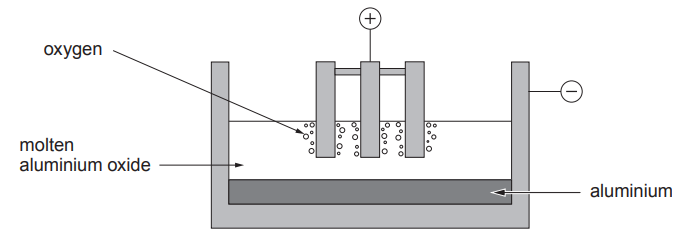
(i) Give the reason why the aluminium oxide must be molten during the extraction.
Tick (✓) the correct box.
to release the oxygen gas from the aluminium oxide | |
to allow the aluminium ions and oxide ions to move | |
to allow the aluminium to leave the cell | |
to speed up the process |
[1]
(ii) Put a number in the box to balance the equation that represents the overall reaction taking place.
2Al2O3 → [ ] Al + 3O2
[1]
(iii) Tick (✓) the boxes next to the two factors that are important when choosing the location for aluminium plants in the UK.
Aluminium plants in the UK should be close to
landfill sites | |
power stations | |
limestone quarries | |
oil refineries | |
coastal ports | |
coal mines |
[2]
Aluminium is commonly used to make overhead power cables.
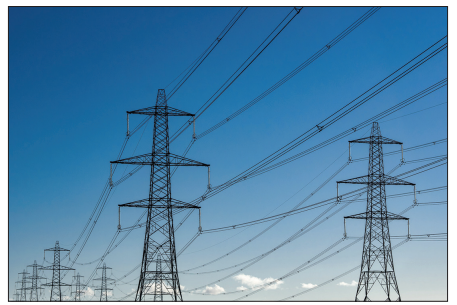
Other than being a good electrical conductor, give two properties which make aluminium a suitable material for making overhead power cables.
Property 1 ................................................................................................................................
Property 2 .................................................................................................................................
Was this exam question helpful?
When a mixture of iron(III) oxide and aluminium powder is heated, the following reaction takes place.
iron(III) oxide + aluminium → iron + aluminium oxide
The reaction is commonly called the thermite reaction. The photographs show the reaction taking place and how it is used in the repair of railway lines.
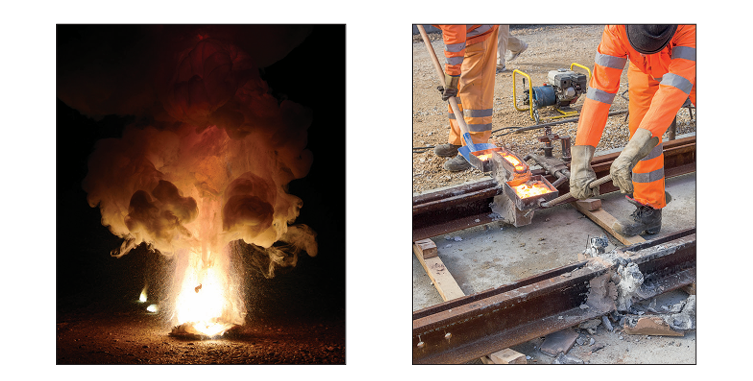
(i) Explain why iron is formed during the reaction.
....................................................................................................
[2]
(ii) Complete and balance the equation for the reaction.
Fe2O3 + 2Al → ...................................................................
[2]
(iii) Calculate the percentage by mass of iron in iron(III) oxide, Fe2O3.
Ar(Fe) = 56 Ar(O) = 16
Percentage = ........................................................ %
[2]
Clare and Frankie were investigating the reactivity of metals. They carried out a series of displacement reactions in a dropping tile. In each test they placed a small piece of metal into a solution of the nitrate of a different metal as shown.
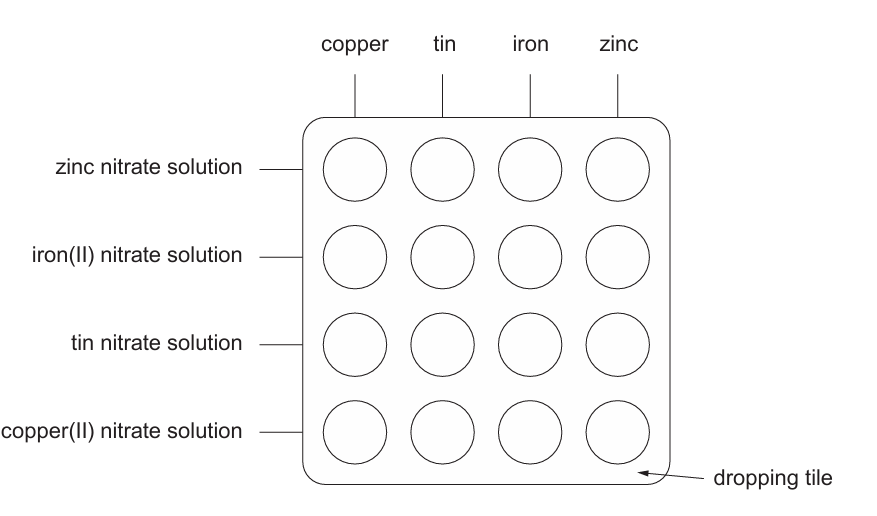
(i) It was not necessary to carry out all of the tests. Place crosses () on the diagram to show which tests did not need to be carried out.
Explain your choice.
.............................................................................................................
[2]
(ii) The equation shows the reaction between iron and copper(II) nitrate solution.
2Fe + 3Cu(NO3)2 → 2Fe(NO3)3 + 3Cu
Use the equation to calculate the maximum mass of copper that you would expect to be formed when 0.224 g of iron is added to excess copper(II) nitrate solution.
Ar(Fe) = 56 Ar(Cu) = 63.5
Maximum mass of copper = ........................................................ g
[3]
The photograph shows how the electrolysis of zinc chloride can be carried out in the laboratory.
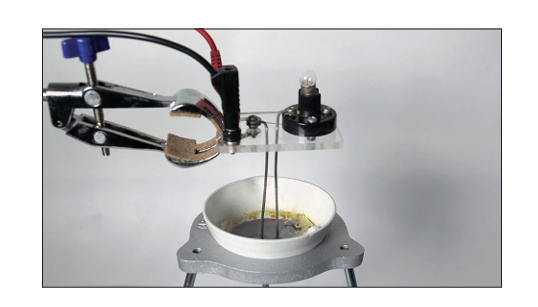
(i) Balance the equation that represents the reaction taking place at the anode.
Use the equation to explain the meaning of the term oxidation.
......Cl- → Cl2 + ......e-
......................................................................................
[2]
(ii) The following method can be used to calculate the mass of zinc produced during the process.
Record the mass of the cathode before placing it into the electrolyte
Allow the process to run to completion
Remove the cathode from the electrolyte and record its new mass
Calculate the increase in mass
I. It is often found that the increase in mass measured using this method is greater than expected. Suggest a reason for this.
.........................................................................................................
[1]
II. Suggest why this method cannot be used to measure the mass of chlorine produced during the process.
............................................................................................................
[1]
Was this exam question helpful?
The diagram shows a blast furnace used to extract iron from iron ore.
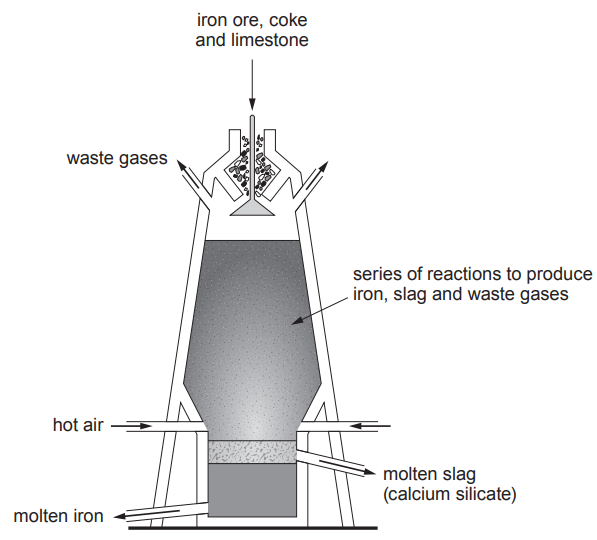
One of the reactions inside the furnace is the reaction between carbon dioxide and carbon, in the form of coke, to form carbon monoxide.
Give the symbol equation for this reaction.
....................................................................................
This equation represents one of the reactions that produce iron inside the furnace.
(i) Balance the equation.
[ ] Fe2O3 + 3C → [ ]Fe + [ ]CO2
[1]
(ii) Explain why this reaction shows that both oxidation and reduction take place.
Refer to oxygen in your answer.
[2]
The formation of slag inside the furnace involves a two-stage process as summarised by the following equations.
Stage 1:
Stage 2: CaO + SiO2 → calcium silicate
(i) Complete the name of the type of reaction taking place in stage 1.
thermal ....................................................................................................
[1]
(ii) Give the formula of calcium silicate, formed in stage 2.
.........................................................................................
[1]
Was this exam question helpful?
A group of students carried out an investigation into the electrolysis of copper(II) sulfate solution. They used the apparatus shown to test the hypothesis:
"the mass of copper that forms on the cathode increases as the time increases"
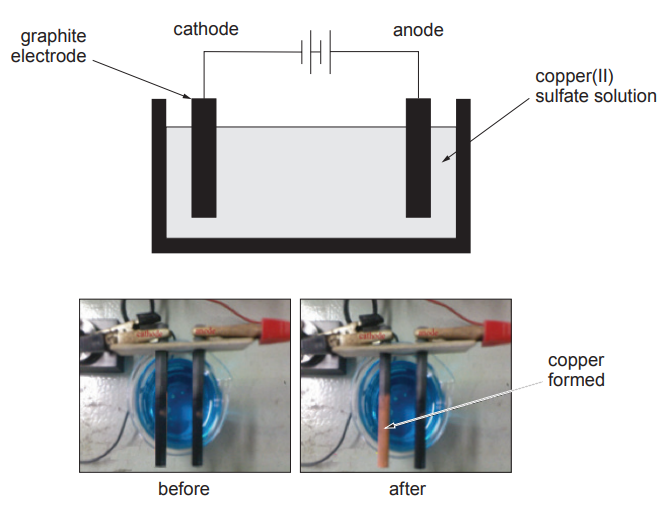
To test the hypothesis, they weighed the cathode before placing it into the copper(II) sulfate solution and then again after allowing electrolysis to take place for varying times.
Their results are shown below.
Time (s) | Mass of copper formed (mg) | ||
1 | 2 | Mean | |
0 | 0 | 0 | 0 |
10 | 2.8 | 3.2 | 3.0 |
20 | 4.8 | 5.0 | 4.9 |
30 | 8.2 | 7.8 | 8.0 |
40 | 10.8 | 11.2 | 11.0 |
50 | 12.9 | 13.1 | 13.0 |
60 | 15.8 | 16.0 | 15.9 |
On the grid below, plot the mean mass of copper formed against time. Draw a suitable line.
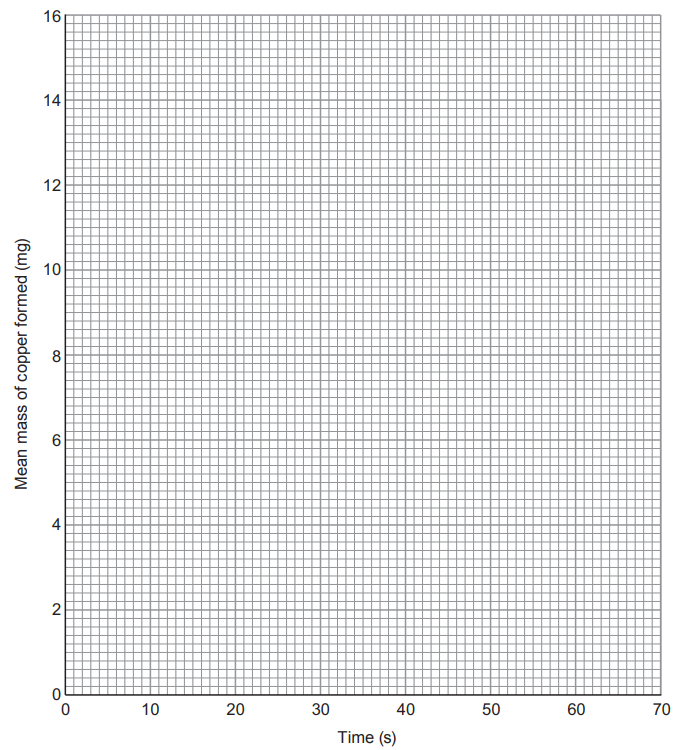
(i) Use the results collected at 30 s and the following equation to calculate the percentage variation in these measurements.
percentage variation =
Percentage variation = …....................…… %
[2]
(ii) The mass of copper formed is lower than expected. Give the most likely reason for this difference.
[1]
(i) Aluminium is extracted from molten aluminium oxide by electrolysis.
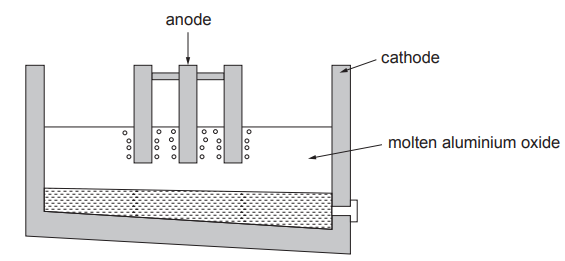
I. Explain why aluminium forms at the cathode.
[2]
II. Complete and balance the equation for the overall reaction that takes place.
2Al2O3 → [ ]............................ + [ ]............................
[2]
(ii) Potassium can also be extracted through electrolysis of potassium carbonate.
Write the formula of potassium carbonate to complete the equation for the overall reaction.
2...................... → 4K + 2CO2 + O2
[1]
Was this exam question helpful?
Iron is extracted from iron oxide inside the blast furnace.
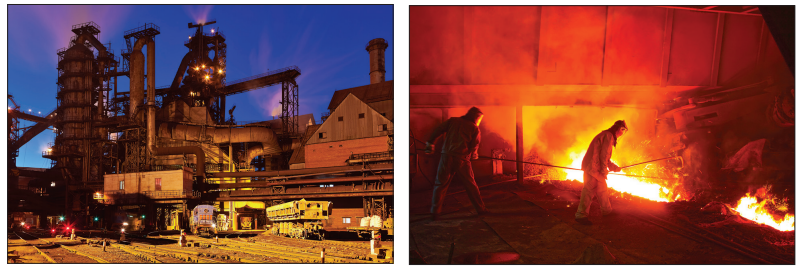
iron ore steel limestone hot air
slag iron coke waste gases
Choose substances from the box to complete the following sentences.
Iron oxide, coke and ................................................................... are the materials fed in at the top of the furnace.
The furnace is heated by burning the coke in ................................................................... .
Balance the symbol equation that represents the main reaction taking place inside the furnace.
Fe2O3 + 3CO → [ ]Fe + 3CO2
Was this exam question helpful?
Iron is extracted from iron(III) oxide, Fe2O3, inside the blast furnace using coke.
(i) Write a balanced symbol equation for one of the reactions that show the reduction of iron(III) oxide inside the furnace.
[2]
(ii) An iron ore contains 22% by mass of iron(III) oxide. Calculate the maximum mass of iron that could be obtained from 5 × 10⁵ tonnes of this ore. Give your answer in standard form.
Mass = …...........................…… tonnes
[3]
Was this exam question helpful?
Nathan and Simon were investigating the reactivity of metals.
In one experiment, they investigated the effect of adding dilute hydrochloric acid to four different metals, A, B, C and D.
The diagram shows the observations made.
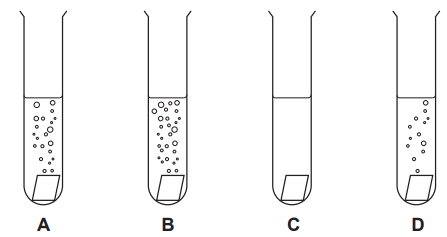
(i) They used the same volume of acid in each tube. Give two other ways they controlled the dilute hydrochloric acid to ensure a fair test.
[2]
(ii) Use the observations to list the metals in order of their reactivity. Give the reason for your choice.
Most reactive ...................................
...................................
...................................
Least reactive ...................................
Reason ........................................................................................
[2]
In a second experiment, Nathan and Simon used the following apparatus to investigate the temperature rise when metals A, B, C and D were added to hydrochloric acid.
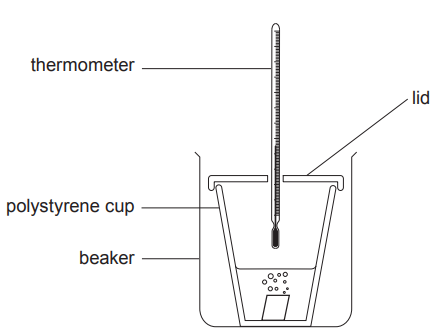
(i) Identify the error in the way the apparatus is set up and state how this would affect the results collected.
Error .............................................................................................
Effect ................................................................................................
[2]
(ii) Once they had set up their apparatus correctly, they obtained the following results.
Metal | Temperature rise (°C) | |||
Test 1 | Test 2 | Test 3 | Mean | |
A | 22 | 21 | ...................... | 22 |
B | 40 | 38 | 36 | 38 |
C | 0 | 0 | 0 | 0 |
D | 15 | 9 | 13 | 14 |
I. Identify the anomalous result from metals B, C and D.
Metal .................................................... Test .....................................................
[1]
II. Calculate the missing result for metal A.
Temperature rise for test 3 = ....................................................... °C
[1]
III. Zinc is more reactive than metals C and D but less reactive than metals A and B. Use this information to predict the temperature rise that would be expected for zinc.
Temperature rise for zinc ....................................................... °C
[1]
Was this exam question helpful?
The Transition Metals
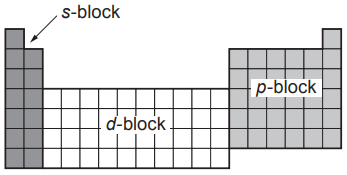
The elements in the Periodic Table can be divided into three blocks: the s-block, the d-block and the p-block.
The s-block and d-block contain only metallic elements. The p-block contains both metallic and non-metallic elements.
The transition metals are found within the d-block and are the metallic elements that serve as a bridge or 'transition' between the two sides of the table. They include the elements iron, silver, gold, vanadium and titanium.
The transition metals have similar properties to each other. These include high melting point, high density, good conductivity and malleability. The transition metals also have unique properties, making them different from the main group metals, including the ability to form compounds with different colours and different oxidation states.
Table 1 gives the properties of some transition metals and some Group 1 metals.
Table 1
Element | Melting point (°C) | Boiling point (°C) | Oxidation states | Colours of compounds formed |
iron | 1536 | 2861 | +2, +3 | green and brown |
lithium | 180 | 1342 | +1 | white |
potassium | 63 | 760 | +1 | white |
sodium | 98 | 883 | +1 | white |
titanium | 1660 | 3287 | +3, +4 | violet and white |
vanadium | 1910 | 3407 | +3, +4, +5 | green, blue and yellow |
Tick (✓) the statement that best describes where metals are positioned within the Periodic Table.
the s-block, p-block and d-block | |
the s-block and p-block only | |
the s-block only | |
the d-block and p-block only | |
the p-block only |
Name the element in Table 1 that is a liquid over the biggest temperature range.
Tick (✓) the two statements that correctly describe the oxidation states of the metals listed in Table 1.
the Group 1 metals and transition metals all have a +1 oxidation state | |
the transition metals all have a +3 oxidation state | |
the Group 1 metals all have a +1 oxidation state | |
iron and lithium have the same oxidation states | |
the Group 1 metals and transition metals all have a +4 oxidation state |
Consider the following statement.
'It is possible to tell the Group 1 and transition metals apart by the colour of the compounds they form.'
Use the information in Table 1 to give one reason to agree and one reason to disagree with this statement.
Reason to agree ...............................................................................
Reason to disagree .............................................................................................................
Was this exam question helpful?
Seren and Ethan carried out an experiment to compare the reactivities of three metals.
The table shows the results obtained when each metal was placed into solutions of the nitrates of the other metals.
A tick () indicates that a reaction took place and a cross () indicates that no reaction took place.
magnesium | iron | copper | |
magnesium nitrate | |||
iron(II) nitrate | |||
copper(II) nitrate |
Use the results to give the order of reactivity of the metals. Explain your answer in terms of the reactions taking place. Include equations in your answer.
Was this exam question helpful?
An alloy is a material composed of a mixture of elements, at least one of which is a metal. The table lists the composition and common uses of different alloys containing silver and gold.
Name of alloy | Composition of alloy by mass (%) | Uses of alloy |
amalgam | mercury 48 %, silver 25 %, tin 15 %, copper 12 % | dental fillings, mining |
green gold | gold 75 %, silver 6-24 %, copper ................ % | Nobel Prize medals, decoration |
nordic gold | gold 89 %, aluminium 5 %, zinc 5 %, tin 1 % | coins, decoration |
solder | tin 90 %, silver 5 %, copper 5 % | joining electrical components |
sterling silver | silver 92.5 %, platinum 4 %, germanium 1.5-3 %, zinc 0.5-2 % | decoration, plumbing, instruments, jewellery |
white gold | gold 75 %, palladium 10 %, nickel 10 %, zinc 5 % | decoration, jewellery |
Circle the number of alloys that contain an element from Group 4 of the Periodic Table.
0 1 2 3 4 5 6
Circle the correct percentage range for the mass of copper that can be found in green gold.
0-25% 1-19% 19-25% 6-24%
Tick () the statement that best describes the composition of the alloys listed.
Statement | Tick |
the alloys all contain at least one metal | |
the alloys all contain at least two metals | |
the alloys all contain at least three metals | |
the alloys all contain at least four metals |
Tick () the statement that best describes the decorative uses of the alloys listed.
Statement | Tick |
all of the alloys are used for decorative purposes | |
all of the alloys containing gold are used for decorative purposes | |
all of the alloys containing silver are used for decorative purposes | |
none of the alloys containing silver are used for decorative purposes |
A solder joint in an electrical circuit contains 0.00011 kg of silver.
Use this information and the composition of solder given in the table to calculate the mass of tin in the solder joint.
Mass = .......................................... kg
Was this exam question helpful?
Metal ores are the materials found in the Earth's crust from which metals can be extracted. The following table gives information about some common metal ores.
Name of metal ore | Metal extracted from ore | Formula of ore |
anglesite | lead | PbCl2 |
copper pyrite | copper | CuFeS2 |
cryolite | aluminium | Na3AlF6 |
salt petre | potassium | KNO3 |
syberite | gold | AgAuTe2 |
tin pyrite | tin | Cu2FeSnS4 |
Use the information in the table to give
(i) the total number of atoms shown in the formula of cryolite,
..................................................................
[1]
(ii) the name of the ore that contains a ratio of 1:4 metal to non-metal atoms.
..................................................................
[1]
The following diagram shows how the electrolysis of anglesite (lead chloride) can be carried out in the laboratory.
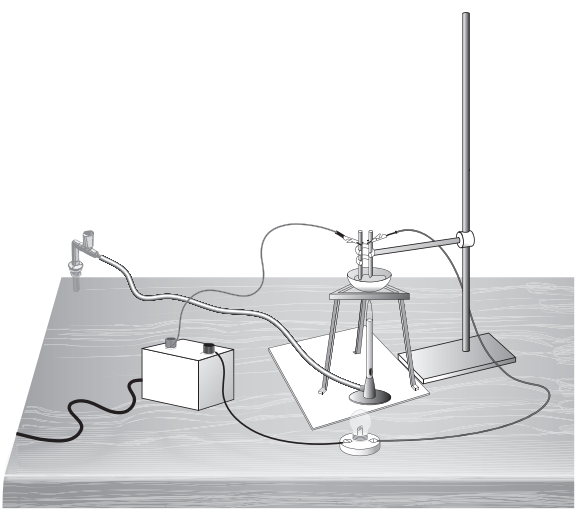
(i) Give the reason why lead chloride needs to be melted for electrolysis to take place.
[1]
(ii) Explain why the chloride ions move towards the positive electrode.
[2]
(iii) The process occurring at the negative electrode is shown by the following equation.
Pb2+ + 2e- → Pb
Use this equation to state what is meant by reduction.
[1]
(iv) Tick () the equation that shows the reaction taking place at the positive electrode.
2Cl- + 2e- → 2Cl | |
Cl- + e- → Cl2- | |
2Cl- → Cl2 + 2e- | |
Cl- + e- → Cl | |
Cl- → Cl2 + 2e- |
[1]
The following diagram shows a proposed location for a new aluminium works in Wales.
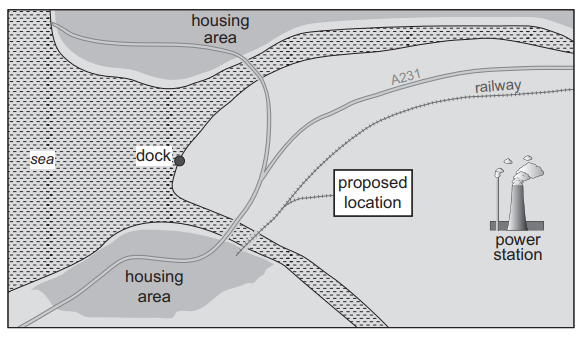
Use the information in the diagram to explain why this would make a suitable location for an aluminium works.
Was this exam question helpful?
When two different metals are connected in a cell, the metal with the higher reactivity transfers its electrons to the other metal.
The potential difference produced between pairs of metals can be used to place them in order of reactivity. The bigger the potential difference, the bigger the difference in reactivity.
The following apparatus was used to investigate the reactivity of four different metals, A, B, C and D, compared with copper.
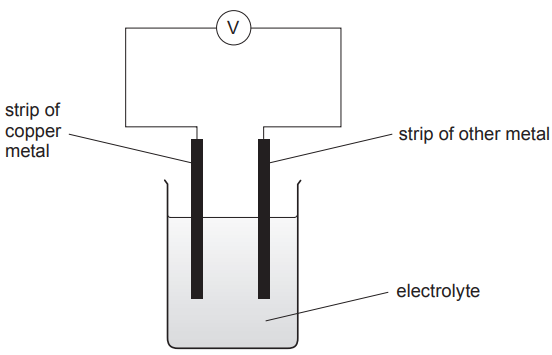
Each metal was placed separately into a cell with a copper strip. The potential difference was recorded for each metal and the results are shown below.
Metal | Potential difference (V) | Direction of electron flow |
A | 0.3 | copper → metal A |
B | 0.6 | metal B → copper |
C | 1.1 | metal C → copper |
D | 0.8 | copper → metal D |
Use the information to place metals A, B, C and D in order of their reactivity in relation to copper.
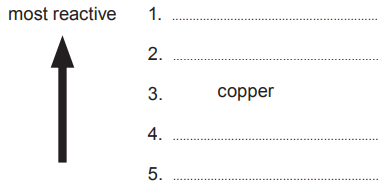
The reactivity of four other metals, W, X, Y and Z, was also investigated using the same apparatus. Some of the results are shown in the following table.
Pair of metals in the cell | Potential difference (V) | Direction of electron flow |
W and X | 1.2 | W → X |
W and Y | 0.9 | Y → W |
W and Z | 0.8 | |
Y and Z | Y → Z |
The order of reactivity of these four metals is as follows.
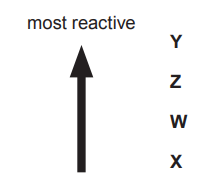
Use this information to give
(i) the direction of the electron flow when W and Z are placed in the cell,
[1]
(ii) the potential difference for the cell with metals Y and Z.
............................................................ V
[1]
When copper and zinc are placed into the cell, the following reaction takes place.
Cu2+ + Zn → Zn2+ + Cu
Explain how this reaction shows both oxidation and reduction.
Was this exam question helpful?
Magnesium, zinc and iron powders were each added separately to 100 cm3 of copper(II) sulfate solution, to see which gave the greatest temperature change.
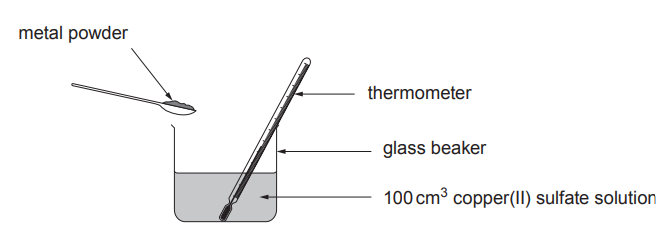
The temperature was recorded before and after each reaction. The results are shown in the table.
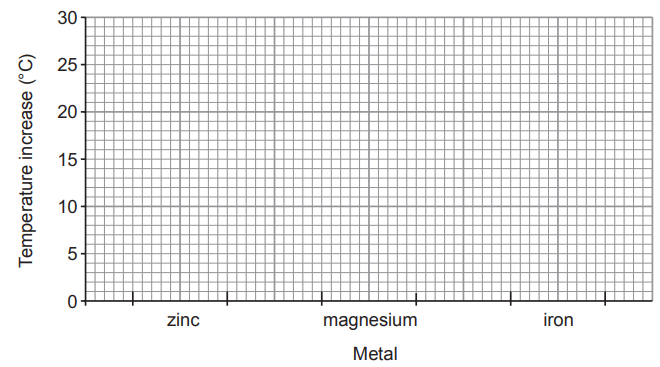
Metal | Temperature before the reaction (°C) | Temperature after the reaction (°C) | Temperature increase (°C) |
zinc | 20 | ................................... | 14 |
magnesium | 19 | 39 | 20 |
iron | 19 | 24 | 5 |
Calculate the temperature after the reaction with zinc.
Temperature = .................................................. °C
Plot a bar chart to show the temperature increase for each metal.
(i) Calculate the energy released in the reaction with magnesium.
Use the following equation.
Energy released = ..................................................... J
[2]
(ii) In this reaction magnesium sulfate, MgSO4, is formed. What is the relative formula mass (Mr) of magnesium sulfate?
Ar(Mg) = 24 Ar(S) = 32 Ar(O) = 16
Mr = .....................................................
[2]
Was this exam question helpful?
Copper is able to displace silver from a solution of silver nitrate. The equation for this reaction is given below.
silver nitrate + copper → copper(II) nitrate + silver
A teacher demonstrated this reaction to her class. The photographs show the beaker before and after the reaction had taken place.
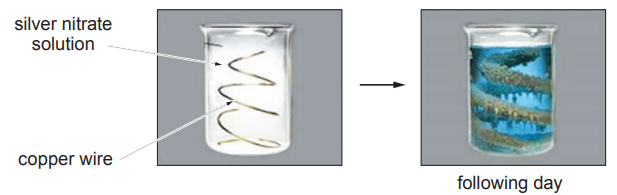
(i) Explain how the changes show that this chemical reaction has taken place.
[2]
(ii) Complete the symbol equation for the reaction by
giving the formula for silver nitrate
balancing the overall equation
[ ]................. + Cu → Cu(NO3)2 + [ ] Ag
[2]
Was this exam question helpful?