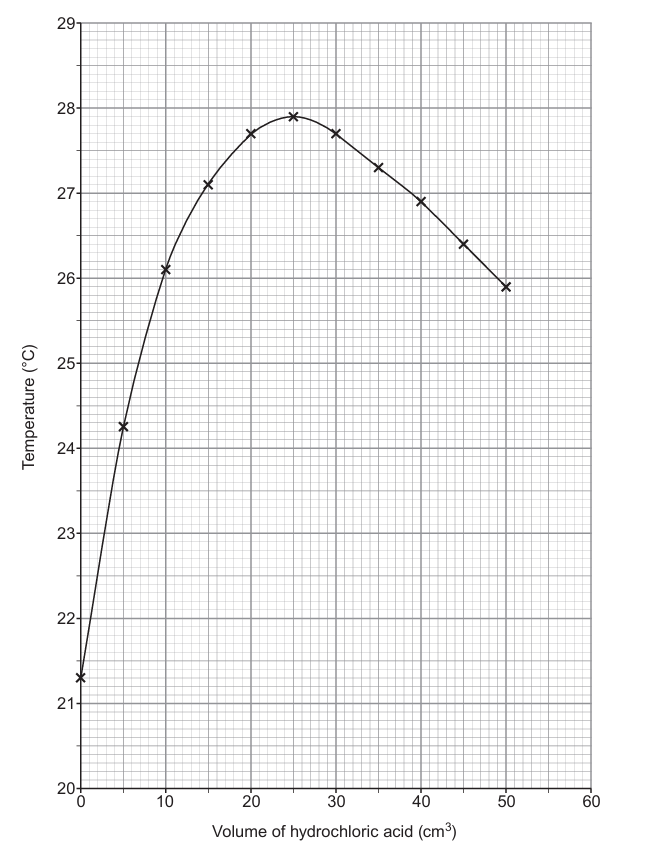
In another experiment, Carys and Pavel investigated the temperature rise when dilute hydrochloric acid neutralises sodium hydroxide solution.
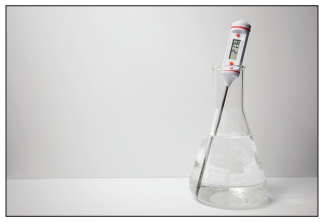
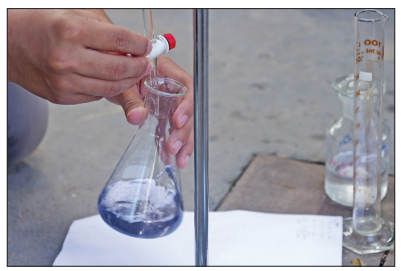
The acid was added 5 cm3 at a time to 25 cm3 of sodium hydroxide solution. They recorded the highest temperature reached after each addition using a digital thermometer.
They obtained the following results. The result for 15 cm3 of acid is missing.
Volume of acid added (cm3) | Temperature (°C) |
|---|
0 | 20.4 |
5 | 21.9 |
10 | 23.4 |
15 | ...................................... |
20 | 26.4 |
25 | 26.3 |
30 | 25.9 |
35 | 25.5 |
40 | 25.1 |
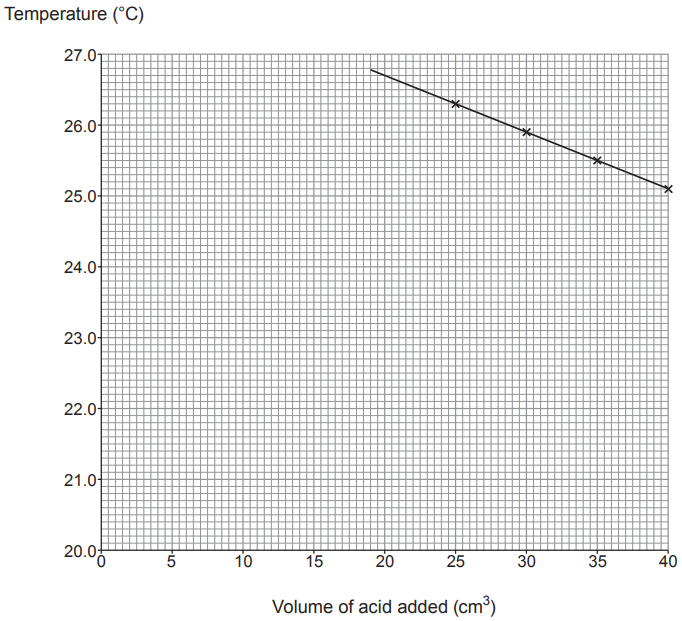
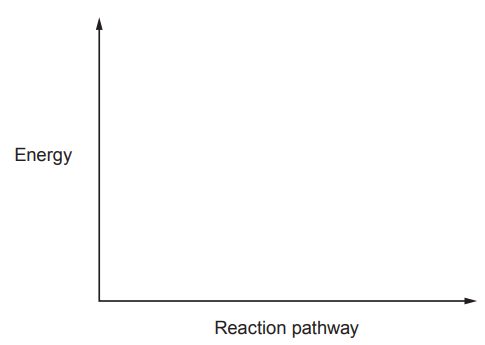
(i) The last four results have been plotted on the grid below and a straight line drawn through the points.
Plot the remaining four points and draw a straight line through them so that it intersects the line already drawn.
[3]
(ii) I. Use your graph to give the temperature that would have been recorded when 15 cm3 of acid was added.
............................................ °C
[1]
II. Carys and Pavel concluded that the volume of acid needed to just neutralise all the sodium hydroxide solution was somewhere between 20 cm3 and 25 cm3.
Use the graph to suggest the exact volume of acid needed.
......................................... cm3
[1]
(iii) The temperatures recorded are slightly lower than expected.
Tick (✓) to show which two improvements to the method would enable Carys and Pavel to obtain results closer to the expected values.
use a beaker instead of a flask |
|
repeat the method |
|
add the acid in smaller intervals |
|
wrap cotton wool around the flask |
|
use a larger flask |
|
place a lid on the flask |
|
[2]