Acids, Bases & Salts (WJEC GCSE Science (Double Award): Chemistry): Exam Questions

Exam code: 3430

2 hours10 questions
1
3 marks

The reaction of a metal with an acid is summarised by the following equation.

metal + acid → salt + hydrogen

(i) Complete the equation for the reaction between magnesium and hydrochloric acid by

  • giving the formula of the salt magnesium chloride,

  • balancing the equation.

Mg + [ ] HCl → ................................. + H2

[2]

(ii) Give the name of the salt formed when magnesium reacts with nitric acid.

............................................................................................................

[1]

2a
2 marks

Salts can be produced by reacting acids with alkalis.

(i) Complete the following equation for the reaction between an acid and alkali.

acid + alkali → salt + ……....................……

[1]

(ii) Circle the word which best describes the reaction between an acid and an alkali.

displacement neutralisation oxidation reduction

[1]

2b
3 marks

Indigestion can be caused by excess hydrochloric acid in the stomach. To treat indigestion, antacid powders are commonly used.

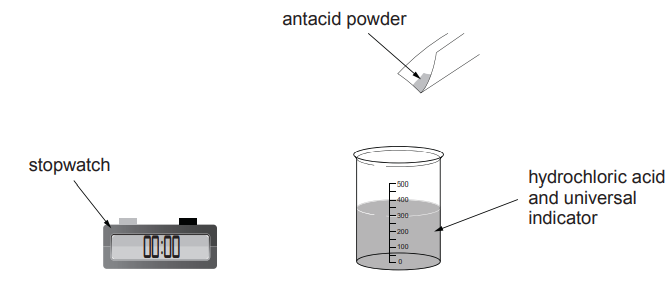
A group of pupils used the following apparatus to compare three brands of antacid powder, to see which was the most effective at treating acid indigestion.

Figure: Diagram of the apparatus — a beaker containing hydrochloric acid and universal indicator, with antacid powder added, and a stopwatch (reading 00:00) used to time how long it takes for the indicator to turn green.

They added an equal mass of each of the antacid powders to separate beakers, containing equal amounts of hydrochloric acid and universal indicator.

They stirred the mixture and recorded the time taken for the universal indicator to turn green in each beaker. They carried out the test three times for each antacid powder. Their results are shown in the table.

Antacid powder

Time taken for the universal indicator to turn green (min : s)

Mean

Result 1

Result 2

Result 3

Brand 1

5 : 25

5 : 36

5 : 14

5 : 25

Brand 2

4 : 28

3 : 20

4 : 32

4 : 30

Brand 3

2 : 28

2 : 30

2 : 44

2 : 34

(i) State which two results were used to calculate the mean value for brand 2.

…......................…… and …......................……

[1]

(ii) Convert the mean time for brand 2 into seconds.

Mean time = …......................…… s

[1]

(iii) Give the reason why the results suggest that brand 3 is the best powder for treating acid indigestion.

[1]

3a
6 marks

Carys and Pavel prepared crystals of zinc sulfate by reacting zinc carbonate with an acid.

(i) Give the name of the acid they used.

.........................................................................................

[1]

(ii) In the first stage of their preparation, they added excess zinc carbonate to the acid.

I. Give the observation that immediately shows a reaction is taking place.

.........................................................................................

[1]

II. State why they added excess zinc carbonate.

.........................................................................................

[1]

(iii) Describe the remaining two stages they carried out to obtain a pure sample of zinc sulfate crystals.

[2]

(iv) Give the chemical formula of zinc sulfate.

.........................................................................................

[1]

3b
7 marks

In another experiment, Carys and Pavel investigated the temperature rise when dilute hydrochloric acid neutralises sodium hydroxide solution.

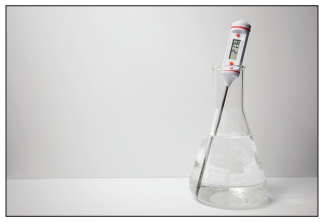
Figure: Photograph of a conical flask containing a clear solution, with a digital thermometer probe inserted into the liquid

The acid was added 5 cm3 at a time to 25 cm3 of sodium hydroxide solution. They recorded the highest temperature reached after each addition using a digital thermometer.

They obtained the following results. The result for 15 cm3 of acid is missing.

Volume of acid added (cm3)

Temperature (°C)

0

20.4

5

21.9

10

23.4

15

......................................

20

26.4

25

26.3

30

25.9

35

25.5

40

25.1

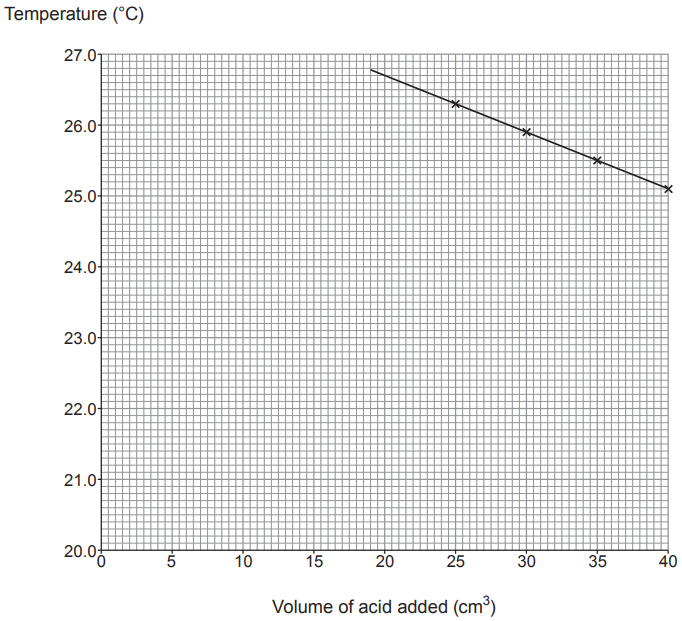
(i) The last four results have been plotted on the grid below and a straight line drawn through the points.

Plot the remaining four points and draw a straight line through them so that it intersects the line already drawn.

Figure: Grid with x-axis "Volume of acid added (cm3)" from 0 to 40 in steps of 5, and y-axis "Temperature (°C)" from 20.0 to 27.0 in steps of 1.0. The last four data points (25, 26.3), (30, 25.9), (35, 25.5), (40, 25.1) are already plotted with a straight line of best fit drawn through them, extended back to about (19, 26.8). The first four points (0, 20.4), (5, 21.9), (10, 23.4), (20, 26.4) are not yet plotted

[3]

(ii) I. Use your graph to give the temperature that would have been recorded when 15 cm3 of acid was added.

............................................ °C

[1]

II. Carys and Pavel concluded that the volume of acid needed to just neutralise all the sodium hydroxide solution was somewhere between 20 cm3 and 25 cm3.

Use the graph to suggest the exact volume of acid needed.

......................................... cm3

[1]

(iii) The temperatures recorded are slightly lower than expected.

Tick (✓) to show which two improvements to the method would enable Carys and Pavel to obtain results closer to the expected values.

use a beaker instead of a flask

□

repeat the method

□

add the acid in smaller intervals

□

wrap cotton wool around the flask

□

use a larger flask

□

place a lid on the flask

□

[2]

3c
2 marks

In a different experiment, it was found that the maximum temperature was reached when 40 cm3 of hydrochloric acid was added to 20 cm3 of sodium hydroxide solution.

State what this means in terms of the relative concentrations of the solutions used.

4a
4 marks

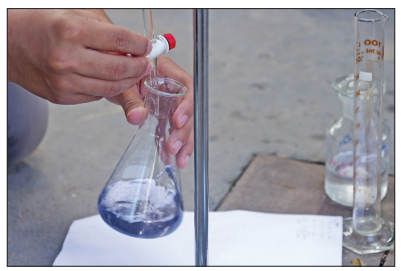
The first stage in the preparation of a salt from an acid and an alkali often involves carrying out a titration.

A dropper adds a few drops of indicator to the solution in a conical flask during a titration. A graduated burette containing liquid is visible beside the flask.

A-F below are the steps of the method that can be used to prepare a salt from an acid and an alkali. However, these steps are not in the correct order.

A

Repeat without the indicator using the same volumes of alkali and acid

B

Add 2-3 drops of indicator

C

Allow the solution to cool and crystallise naturally

D

Place the salt solution into an evaporating dish and heat until half the volume of solution remains

E

Add the acid to the alkali until the indicator changes colour

F

Measure 25.0 cm3 of alkali into a conical flask

(i) Place the steps of the method into the correct order. The first and last steps have already been added.

F → ...... → ...... → ...... → ...... → C

[2]

(ii) Give the letter of the step where error is most likely to occur. Give the reason for your choice.

Step ....................................................................

Reason ................................................................

[2]

4b
2 marks

The reaction between an acid and an alkali produces a salt and water. The following equation shows how potassium sulfate is produced from an acid and an alkali.

potassium hydroxide + .......................................... → potassium sulfate + water

(i) Give the name of the missing acid.

...........................................................

[1]

(ii) Give the chemical formula of potassium sulfate.

..........................................................

[1]

5a
4 marks

The reactions of acids with metals, bases and carbonates are summarised in the following equations.

  • acid + metal → salt + hydrogen

  • acid + base → salt + water

  • acid + carbonate → salt + water + carbon dioxide

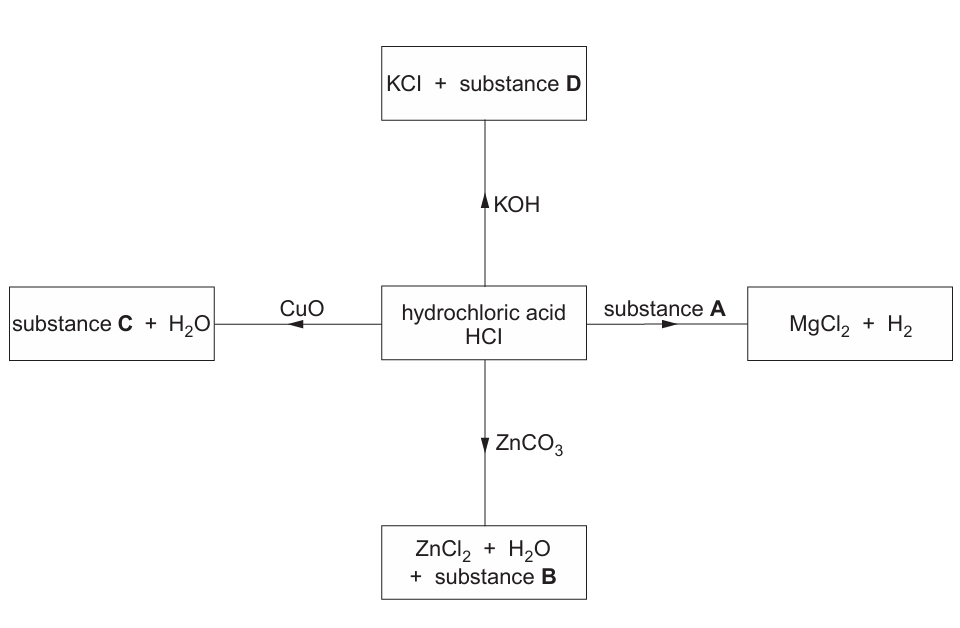
The diagram shows some reactions of hydrochloric acid, HCl.

Reaction scheme diagram with "hydrochloric acid, HCl" in a central box. An arrow labelled "KOH" points up from the central box to a box reading "KCl + substance D". An arrow labelled "CuO" points left from the central box to a box reading "substance C + H₂O". An arrow labelled "substance A" points right from the central box to a box reading "MgCl₂ + H₂". An arrow labelled "ZnCO₃" points down from the central box to a box reading "ZnCl₂ + H₂O + substance B".

(i) Give the names of substances A and B.

Substance A ...........................................................................................................

Substance B ...........................................................................................................

[2]

(ii) Give the formulae of substances C and D.

Substance C ................................................

Substance D ................................................

[2]

5b
2 marks

Complete the equation for the reaction between hydrochloric acid and sodium carbonate by:

  • writing the formula of sodium carbonate on the dotted line

  • putting a number into the box to balance the equation

[ ]HCl + .................... → 2NaCl + H2O + CO2

5c
2 marks

Silver nitrate solution is used to identify the chloride ions present in hydrochloric acid.

(i) Give the observation made when silver nitrate solution is added to hydrochloric acid.

...................................................................................

[1]

(ii) Put a tick (✓) in the box next to the correct ionic equation for the reaction between silver nitrate and hydrochloric acid.

[1]

Ag+(aq)+Cl-(aq) → AgCl(aq)

□

Ag-(aq)+Cl+(aq) → AgCl(aq)

□

Ag+(aq)+Cl-(aq) → AgCl(s)

□

Ag+(s)+Cl-(s) → AgCl(s)

□

Ag-(aq)+Cl+(aq) → AgCl(s)

□

6a
6 marks

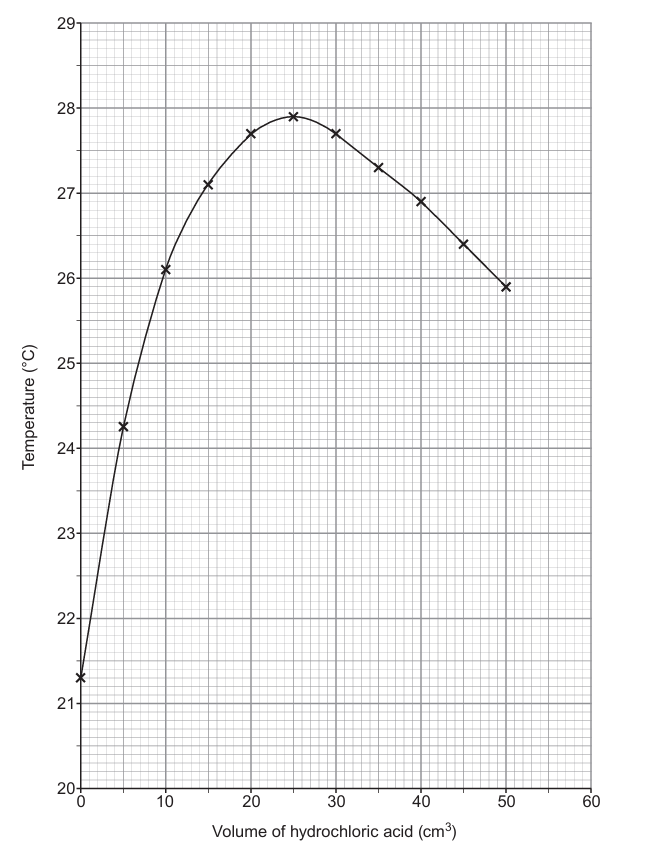
The graph shows how the temperature changes when dilute hydrochloric acid is added gradually to sodium hydroxide solution.

Line graph. X-axis "Volume of hydrochloric acid (cm³)" from 0 to 60. Y-axis "Temperature (°C)" from 20 to 29. The curve starts at (0, 21.3), rises steeply through (5, 24.3), (10, 26.1), (15, 27.1), (20, 27.7), reaching a peak at (25, 27.9), then falls gradually through (30, 27.7), (35, 27.3), (40, 26.9), (45, 26.4), ending at (50, 25.9)

The pH of the solution also changes as the hydrochloric acid is added to the sodium hydroxide.

Explain the temperature changes shown on the graph and relate these to the change in pH during the reaction. You do not need to include equations in your answer.

6b
1 mark

The reaction between hydrochloric acid and sodium hydroxide produces sodium chloride and water.

Give the ionic equation to show how water is formed during this reaction.

..........................................................................................................................

7a
4 marks

A teacher was marking the exercise book of a student who had completed a topic of work on acids and alkalis.

The table below shows the results the student had recorded from an experiment to investigate the pH values of some common laboratory chemicals.

The teacher has circled three errors for the student to correct.

Chemical name

Chemical formula

Colour with universal indicator

pH

Acid, alkali or neutral

sulfuric acid

H2SO4

green

1

acid

ethanoic acid

CH3COOH

orange

4

alkali (error 1)

calcium hydroxide

Ca(OH)2

purple

12

alkali

water

H2O

green

5 (error 2)

neutral

sodium carbonate

NaCO3 (error 3)

blue

10

alkali

(i) Correct the errors the teacher has circled.

Correction to error 1 ..................................................................

Correction to error 2 ..................................................................

Correction to error 3 ..................................................................

[3]

(ii) There is another error in the table that the teacher has not spotted.

Circle this error in the table.

[1]

7b
3 marks

Another piece of work in the exercise book showed the results of some tests that the student had carried out to identify some of the ions in the chemicals being investigated. However the table had not been fully completed by the student.

Ion being identified

Test

Result

carbonate, CO32-

add hydrochloric acid

bubbles formed as ................................. gas is produced

sulfate, SO42-

add ...................................... solution

white precipitate is formed

(i) Use the names of chemicals from the box below to complete the table.

silver nitrate hydrogen sodium hydroxide

barium chloride oxygen

universal indicator carbon dioxide chlorine

[2]

(ii) Describe the test that can be used to identify the gas produced when hydrochloric acid is added to a compound containing carbonate ions.

[1]

7c
3 marks

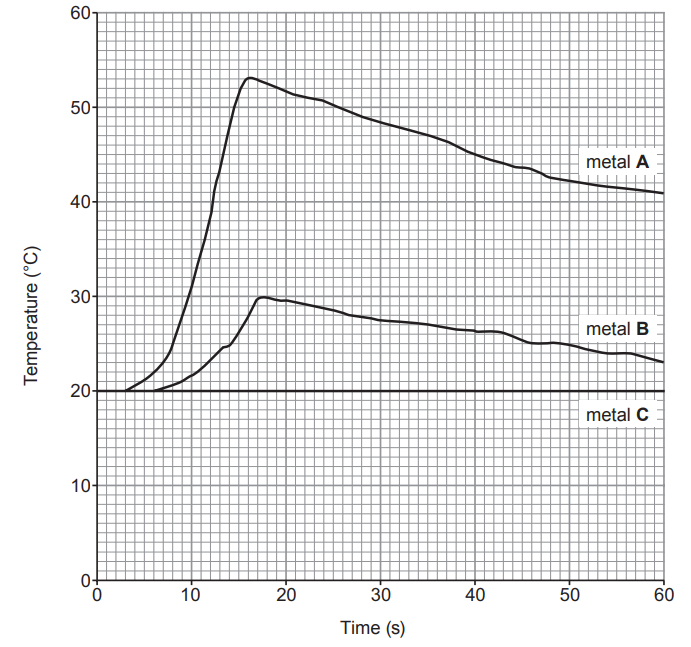
The final piece of work marked by the teacher was an experiment that had been completed to investigate the temperature change when different metals react with hydrochloric acid.

The graphs of the results obtained by the student are shown below.

Figure: Graph showing temperature (°C) on the y-axis from 0 to 60 and time (s) on the x-axis from 0 to 60, with three curves labelled metal A, metal B and metal C. Metal A rises steeply from around 20°C to a peak before levelling off; metal B rises more gradually to a lower peak; metal C stays flat at the starting temperature throughout, showing no reaction.

(i) Use the graphs to give

I. the letter of the metal that did not react with hydrochloric acid.

..................................................................

II. the maximum temperature rise for metal A.

.................................................................. °C

[2]

(ii) State the term used to describe a reaction that gives out heat.

[1]

7d
4 marks

When metals react with acids they form a salt and hydrogen gas.

(i) Complete the word equation for the reaction between magnesium and sulfuric acid.

magnesium + sulfuric acid → ............................................. + hydrogen

[1]

(ii) Give the test that can be used to identify hydrogen gas. Include the expected observation.

[1]

(iii) The salt formed when zinc reacts with hydrochloric acid is zinc chloride.

I. Give the formulae of the ions present in zinc chloride.

............................................. and ...............................................

II. Give the formula of zinc chloride.

..................................................................

[2]

8a
2 marks

In a class experiment, Dylan and Joel were given a solution of sodium carbonate containing 5.23 g of sodium carbonate powder dissolved in 500 cm3 of water.

The relative formula mass (Mr) of sodium carbonate is 106.

Use this information to calculate the number of moles of sodium carbonate in the 5.23 g of the powder. Give your answer correct to two decimal places.

Number of moles = ........................................................ mol

8b
6 marks

Dylan and Joel were asked to use the sodium carbonate solution to prepare a sample of sodium sulfate crystals in a three-stage process.

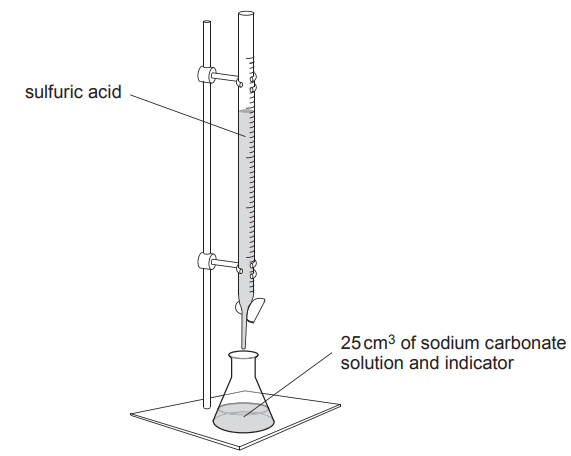
In the first stage of their preparation, they used the following apparatus to carry out a titration.

Figure: Diagram of a titration setup — a burette containing sulfuric acid clamped above a conical flask containing 25 cm³ of sodium carbonate solution and indicator.

The equation for the reaction taking place is as follows.

Na2CO3 + H2SO4 → Na2SO4 + H2O + CO2

(i) A trial run was carried out and the titration repeated three times. The volume of acid added each time was recorded.

Trial

1

2

3

Volume of sulfuric acid added (cm3)

30.20

27.55

27.75

27.65

I. State the purpose of carrying out a trial run.

[1]

II. State whether the sulfuric acid or the sodium carbonate solution is the more concentrated. Give the reason for your answer.

[1]

(ii) Use all of the information provided to describe in detail the other two stages Dylan and Joel carried out to obtain pure sodium sulfate crystals.

[4]

8c
5 marks

Sodium sulfate solution is also formed when sodium hydroxide solution reacts with copper(II) sulfate solution.

(i) Give the balanced symbol equation for this reaction.

[3]

(ii) Describe tests that can be carried out to identify both of the ions in sodium sulfate solution. Give the expected observation for both tests.

[2]

8d
2 marks

The reaction occurring between solutions of sodium carbonate and magnesium sulfate forms a precipitate of magnesium carbonate.

Write the ionic equation for the formation of magnesium carbonate.

....................................... + ................................... → ..........................................

9
6 marks

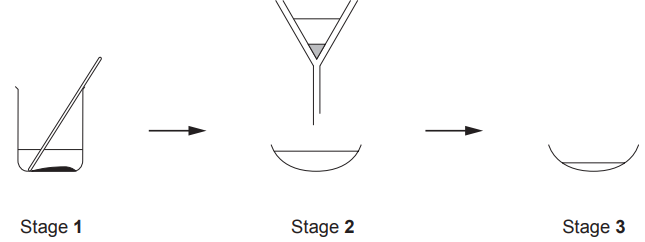
The diagram shows the three stages used in the preparation of copper(II) sulfate crystals from copper(II) carbonate and sulfuric acid.

Figure: Three-stage diagram of the preparation. Stage 1 shows copper(II) carbonate powder being added to sulfuric acid in a beaker, with fizzing/bubbling shown and the mixture turning blue. Stage 2 shows the resulting mixture being poured through filter paper in a funnel into a conical flask, separating a blue filtrate from unreacted solid residue. Stage 3 shows the blue filtrate in an evaporating basin being gently heated/left to stand, with crystals forming.

Describe and explain each stage of the preparation. Include an equation in your answer.

10a
5 marks

Potassium chloride and potassium sulfate are salts that can be made from the reactions of acids. Becky and David carried out experiments to prepare both salts.

To make a sample of potassium chloride, they reacted potassium carbonate powder with dilute hydrochloric acid, HCl. They used the following method.

Stage 1 – add potassium carbonate powder to dilute hydrochloric acid

Stage 2 – filter the mixture

Stage 3 – leave the remaining mixture in a warm place overnight

(i) David said it was important to know the volume of acid in stage 1.

Circle whether you agree or disagree with his statement and explain your answer.

Agree / Disagree

Explanation

[2]

(ii) Give the balanced symbol equation for the reaction taking place in stage 1.

[3]

10b
4 marks

To make a sample of potassium sulfate, they reacted potassium hydroxide solution with dilute sulfuric acid, H2SO4. They used the following method.

Stage 1 – measure out 25.0 cm3 of potassium hydroxide solution into a flask

Stage 2 – add 4-5 drops of indicator

Stage 3 – record the volume of sulfuric acid required to neutralise the solution

Stage 4 – repeat without the indicator, using the volume of acid used in stage 3

Stage 5 – leave the remaining mixture in a warm place overnight

(i) Becky was concerned that carrying out stages 1-3 only once would mean that the volume of sulfuric acid used in stage 4 would be larger than that actually needed to neutralise the potassium hydroxide solution. Suggest the reason for her concern.

[1]

(ii) Write the ionic equation to show how water is formed during this reaction and state the source of each of the ions.

Equation

Source of ions

[2]

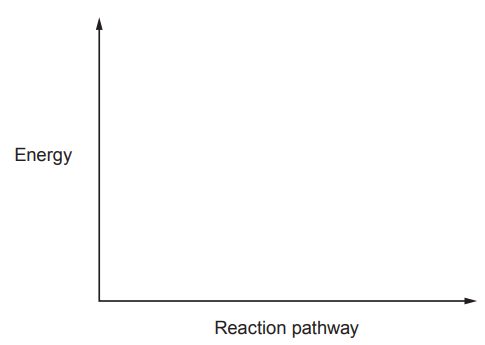
(iii) The reaction is exothermic. Sketch the energy profile diagram for this reaction.

Figure: Blank axes labelled "Energy" (y-axis) and "Reaction pathway" (x-axis), for the candidate to sketch an energy profile diagram.

[1]

10c
3 marks

Becky and David carried out a series of tests to identify the ions present in their salts.

(i) They carried out a flame test on each of the salts. Give the reason why the results of this test could not be used to identify the salts.

[1]

(ii) Describe a test that enabled them to tell the salts apart. Give the results seen with both salts.

[2]