Features of Waves (WJEC GCSE Science (Double Award): Physics): Exam Questions

Exam code: 3430

2 hours18 questions
1a
Sme Calculator
2 marks

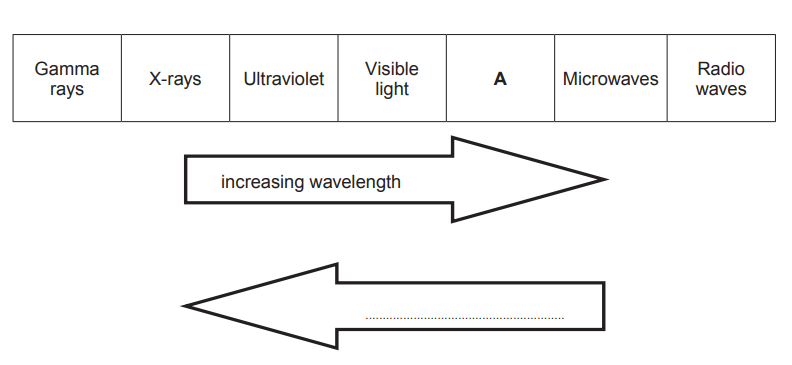
The diagram shows the 7 regions of the electromagnetic (em) spectrum in order.

Diagram of the electromagnetic spectrum: gamma rays, A, B, visible light, infra-red, microwaves, radio waves, with an arrow showing increasing wavelength

Use only the words given in the box below to answer the following questions.

cosmic rays

X-rays

ultrasound

water

ultraviolet

(i) Name the region labelled A. ..................................

[1]

(ii) Name the region labelled B. .................................

[1]

1b
Sme Calculator
4 marks

Use the electromagnetic spectrum diagram from part (a) to answer part (b).

(i) Complete the following sentence by underlining the correct word in the bracket.

[1]

The arrow shown on the electromagnetic spectrum above represents increasing (amplitude / wavelength / frequency).

(ii) Waves in the electromagnetic spectrum all travel at the same speed in a vacuum.

Tick (✓) the three correct statements that describe other properties of em waves.

[3]

box enclose space space space space space space end enclose All transverse.

box enclose space space space space space space end enclose All ionising.

box enclose space space space space space space end enclose All transfer energy.

box enclose space space space space space space end enclose All longitudinal.

box enclose space space space space space space end enclose All travel through space.

box enclose space space space space space space end enclose All given out by radioactive materials.

2a
Sme Calculator
8 marks

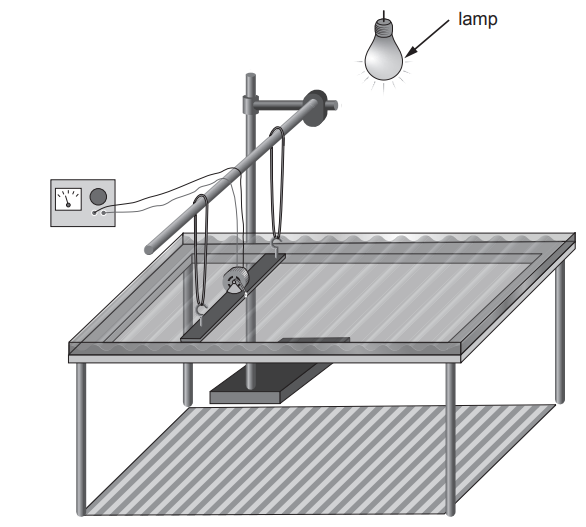
A teacher demonstrates waves using a ripple tank.

She changes the frequency of the waves produced and the class observes the effect on their wavelength.

Laboratory setup with a movable lamp and solar cell on a sloping surface, connected by wires to a meter, showing investigation of light intensity on output

Next, the class investigates the link between frequency and wavelength using a virtual ripple tank simulation.

The table below shows their results.

Frequency (Hz)

\frac{1}{\text{frequency}} (s)

Wavelength (cm)

20.0

0.05

1.0

10.0

0.10

2.0

6.7

0.15

3.0

5.0

0.20

4.0

4.0

0.25

5.0

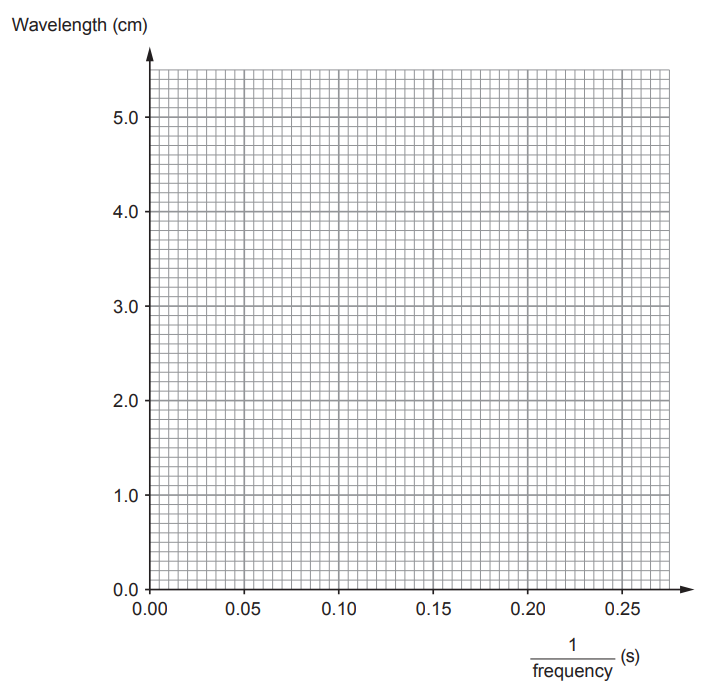
(i) Plot the data on the grid below and draw a suitable straight line.

[3]

Blank graph with gridlines, x-axis labelled 1/frequency in seconds from 0.00 to 0.25, y-axis labelled wavelength in centimetres from 0.0 to 5.0

(ii) Complete the following sentences by underlining the correct word or phrase in the brackets.

[2]

I. As \frac{1}{\text{frequency}} increases the wavelength [increases / decreases / stays the same].

II. As frequency increases the wavelength [increases / decreases / stays the same].

(iii)

I. Use data from the table to state the wavelength of the waves at a frequency of 10 Hz.

[1]

Wavelength = .......... cm

II. Use the equation:

wave speed = frequency × wavelength

to determine the speed of the waves at a frequency of 10 Hz.

[2]

Speed = .......... cm/s

2b
Sme Calculator
9 marks

(i) Electromagnetic waves are used to communicate with satellites. Some satellites remain above the same point on the Earth to allow constant communication.

Complete the following sentences about communications satellites by underlining the correct word or phrase in the brackets.

[4]

Electromagnetic waves are (longitudinal / parallel / transverse) waves.

TV signals are sent to satellites in (geothermal / geosynchronous / geostationary) orbits using (microwaves / visible light / gamma rays).

These satellites orbit above the (poles / equator / axis) of the Earth.

(ii) A satellite orbits the Earth in a circular orbit, once every 24 hours. The radius of its orbit is 42 164 km.

I. Use the equation:

circumference of a circle = 2 pi r (where r = radius and pi = 3.14)

to calculate the distance the satellite travels in one orbit.

[1]

Distance = .......... km

II. Use the equation:

speed = \frac{\text{distance}}{\text{time}}

to calculate the speed of the satellite in km/h.

[2]

Speed = .......... km/h

(iii) Maddie suggests that the satellite orbits at the same speed as a point on the Earth's surface moves, so that it always stays above the same point on the Earth.

Explain whether or not you agree.

[2]

3
Sme Calculator
6 marks

Name the different regions found within the electromagnetic spectrum and describe how they are similar to and different from, one another.

4a
Sme Calculator
2 marks

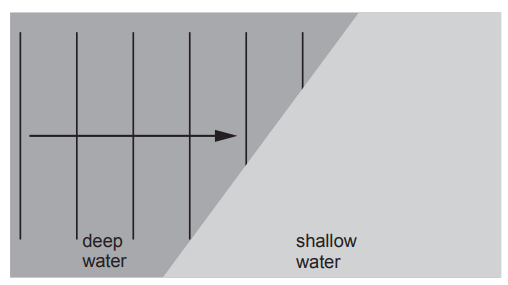
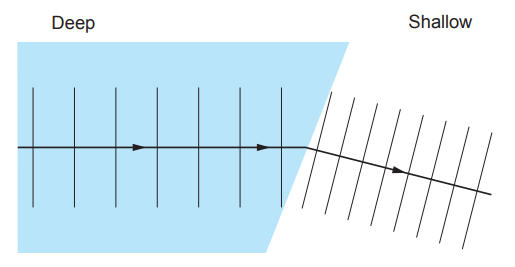
A physics teacher demonstrates the refraction of water waves in a ripple tank.

Complete the diagram below to show the wavefronts in the shallow water.

Diagram of wavefront lines moving from deep to shallow water across a sloping boundary, with an arrow showing wave direction in the deep region
4b
Sme Calculator
3 marks

The wave generator in the deep water produces 5 waves in 10 s. Use an equation v = fλ and a measurement from the diagram to determine the speed of the waves in the deep water. Give your answer in m/s.

Wave speed = .......... m/s

4c
Sme Calculator
3 marks

State how the frequency, wavelength and wave speed will compare in deep and shallow water.

5a
2 marks

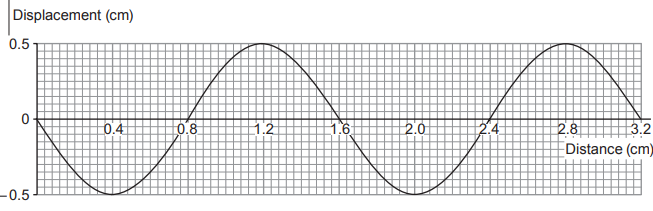
A teacher demonstrates water waves in a ripple tank. The diagram represents the waves.

Graph of a transverse wave showing displacement versus distance in centimetres, with two full cycles between 0 and 3.2 cm and amplitude of 0.5 cm

(i) State the wavelength of the wave.

[1]

wavelength = .......... cm

(ii) State the amplitude of the wave.

[1]

amplitude = .......... cm

5b
Sme Calculator
4 marks

It is observed that 10 waves pass a point in the tank in 2 s.

(i) Underline the correct value for the frequency of the waves.

[1]

2 Hz

5 Hz

10 Hz

20 Hz

(ii) Select an equation v = fλ and use it to calculate the wave speed.

[3]

Wave speed = .......... cm/s

5c
2 marks

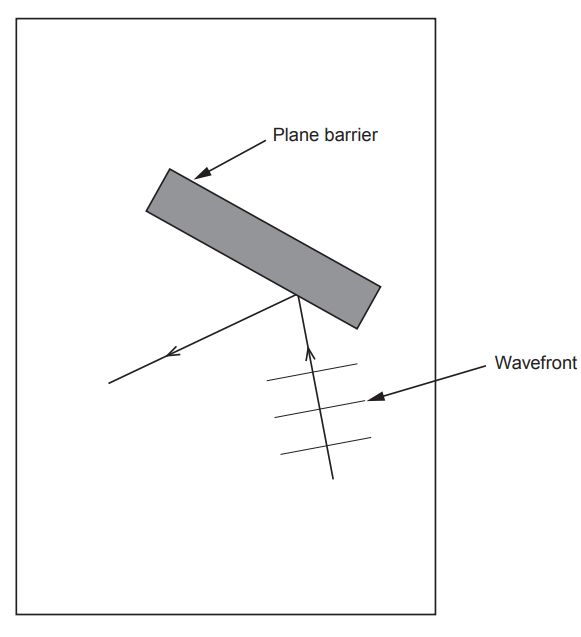
The waves are made to reflect off a plane barrier. Complete the diagram to show the reflected wavefronts.

Diagram of a sloping plane barrier reflecting an incoming wave, showing incident and reflected rays with perpendicular wavefront lines on the right side
6a
Sme Calculator
4 marks

Microwaves travel through space at a speed of 3 × 10⁸ m/s and are one part of the electromagnetic spectrum.

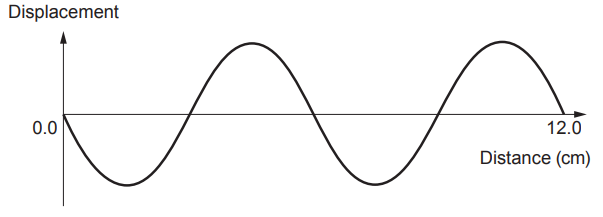
The diagram represents microwaves produced at a certain frequency.

Graph of a transverse sine wave showing displacement versus distance from 0 to 12 cm, with the wave crossing the horizontal axis at equal intervals

(i) Use the information in the diagram to calculate the wavelength of these microwaves.

[1]

Wavelength = .......... cm

(ii) Use your answer above and the equation:

wave speed = wavelength × frequency

to calculate the frequency of these microwaves.

[3]

Frequency = .......... Hz

6b
Sme Calculator
3 marks

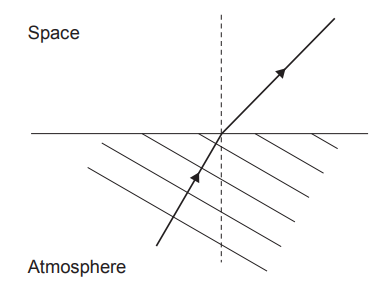
Microwaves are refracted as they travel from the atmosphere into space.

Diagram of a light ray bending at the boundary between atmosphere and space, showing refraction towards the normal line as it enters denser air

Complete the diagram to show the refracted wavefronts in space.

6c
Sme Calculator
5 marks

Geostationary artificial satellites are used to send microwave signals around the world.

(i) Explain why a satellite in a geostationary orbit above the equator appears to stay in a fixed place above the surface of the Earth even though both the satellite and the Earth are constantly moving.

[2]

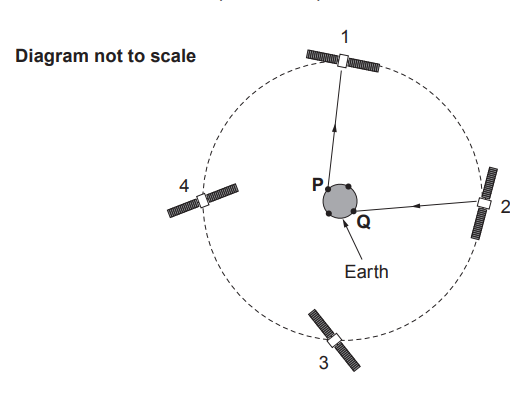
(ii) The diagram shows 4 satellites in geostationary orbit around the Earth.

A signal is to be sent from Earth station P to Q using the satellites 1 and 2.

The first and last parts of the path are shown.

Diagram of Earth at centre with points P and Q and four numbered satellites orbiting on a dashed circular path, arrows showing directions towards Earth

Use an equation time = distance ÷ speed to calculate the time taken for the signal to travel from P to Q.

The height of a geostationary satellite above the Earth is 3.6 × 10⁷ m.

[3]

(Speed of light, c = 3 × 10⁸ m/s)

Time = .......... s

(iii) It was suggested that if the signal had been sent in the opposite direction from Q to P via satellites 3 and 4 then it would have arrived quicker.

Explain whether you agree with this suggestion.

[1]

7a
2 marks

Various types of radiation form a continuous spectrum called the electromagnetic (em) spectrum.

The diagram shows the regions of the em spectrum.

Diagram of the electromagnetic spectrum from gamma rays to radio waves, with wavelength increasing rightwards and a blank leftwards arrow for increasing frequency.

(i) Complete the arrow above, using only one of the following phrases.

  • decreasing speed

  • increasing speed

  • increasing frequency

  • decreasing energy

[1]

(ii) Name the em radiation labelled A in the diagram.

[1]

7b
2 marks

(i) Name the ionising em wave given out by some radioactive materials.

[1]

(ii) State why ionising em radiation is dangerous to humans.

[1]

8a
3 marks

Electromagnetic (em) waves are used extensively in a wide variety of applications. The table below gives information about different regions of the electromagnetic (em) spectrum. It shows ranges for wavelengths and frequencies.

Region

Wavelength (m)

Frequency (Hz)

radio

> 1 cross times 10-1

..........

microwave

1 cross times 10-3 to 1 cross times 10-1

3 cross times 109to 3 cross times 1011

infra-red

..........

3 cross times 1011 to 4 cross times 1014

visible

..........

4 cross times 1014 to 7.5 cross times 1014

ultraviolet

1 cross times 10-8 to 4 cross times 10-7

7.5 cross times 1014to 3cross times 1016

X-ray

1 cross times 10-11 to 1 cross times 10-8

3 cross times 1016 to 3cross times 1019

gamma ray

< 1cross times 10-11

..........

Complete the table above using the ranges below.

(7.5 cross times 10⁻⁷ to 1cross times 10⁻³)     (< 3 cross times 109)     (> 3 cross times 1019)     (4 cross times 10⁻⁷ to 7.5 cross times 10⁻⁷)

8b
1 mark

All em waves transfer energy. The shortest waves are the most ionising. The table below shows energy values in an incorrect order. Arrange the energy values in the correct order.

Region

Energy (J) in incorrect order

Energy (J) in correct order

radio

> 2 cross times 10-14

..........

microwave

3 cross times 10-19 to 5cross times 10-19

..........

visible

2 cross times 10-17 to 2 cross times 10⁻¹⁴

..........

X-ray

2 cross times10-24 to 2 cross times 10-22

..........

gamma ray

< 2 cross times 10-24

..........

9a
Sme Calculator
2 marks

Satellites in orbit around the Earth are used for a variety of purposes. One use is communications between base stations and satellites. Satellites for communications are usually put into geostationary orbits, orbiting above the equator. Satellites for other uses such as weather forecasting can be put in polar orbits. The speed of the satellite and therefore its orbital period, the time for one orbit of the Earth, is determined by its orbit height.

Another kind of orbit is a geosynchronous orbit. State one similarity and one difference between a geostationary and a geosynchronous orbit.

9b
Sme Calculator
6 marks

The table below gives data on the orbits of different satellites.

Satellite

Height above Earth (km)

Period (hours)

1

21 450

12.9

2

24 000

15

3

36 000

24

4

507

1.6

5

1 090

1.8

6

20 200

12

(i) State which satellite is in geostationary orbit.

[1]

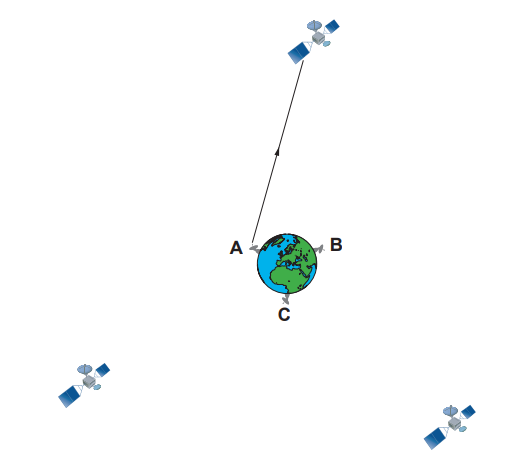
(ii) A signal is sent from base station A to a geostationary satellite and is received at another base station after a time delay of 0.48 s.

Diagram of Earth labelled A, B and C with three surrounding satellites; one satellite connects to point A via an arrow, indicating a communication link

Use an equation distance = speed × time to calculate the distance the signal has travelled. The speed of light, c = 3 × 10⁸m/s.

[3]

Distance = .......... m

(iii) Use your answer to (ii) and the information in the table to determine which base station, A, B or C, finally receives the signal. Show all your workings.

[2]

Receiving base station = .......................................

10a
2 marks

Electromagnetic (em) waves are widely used in a variety of ways. Satellites rely on microwaves to communicate with Earth as the microwaves penetrate through the upper layers of our atmosphere. Infra-red waves have a higher frequency than microwaves and are used widely in communications. X-rays and gamma rays are ionising radiation and are both used in medicine; gamma rays can be used in cancer treatment, shrinking tumours. Radio waves are used to transmit TV and radio signals.

The diagram shows an incomplete em spectrum. Complete the diagram to show the em spectrum in order.

Radio waves

..........

..........

Visible light

UV light

..........

Gamma rays

10b
2 marks

All em waves are transverse. Describe what is meant by a transverse wave.

10c
2 marks

Tick (✓) the boxes alongside the two correct statements about em waves below.

Only radio waves and microwaves transmit information box enclose space space space space space space end enclose

All em waves travel at the same speed in a vacuum box enclose space space space space space space end enclose

All em waves are a form of radiation box enclose space space space space space space end enclose

All em waves have the same frequency box enclose space space space space space space end enclose

Radio waves have the smallest wavelength box enclose space space space space space space end enclose

10d
2 marks

A student suggests that radio waves are just as harmful to humans as gamma rays. Explain whether or not you agree with this statement. [2]

11a
Sme Calculator
1 mark

A ripple tank is used to demonstrate what happens to water waves as they travel from deep water into shallow water.

The results are shown in the diagram below.

Diagram showing wavefront refraction as straight waves travel from deep water into shallow water, changing direction and wavelength at the boundary

The water waves change direction at the boundary between deep and shallow water.

State the name of this effect.

11b
Sme Calculator
2 marks

Tick (✓) the boxes next to the two correct statements that describe the water waves.

The frequency of the waves is higher in shallow waterbox enclose space space space space space space end enclose

The amplitude of the waves is the same in deep and shallow water box enclose space space space space space space end enclose

The wave speed is less in shallow water box enclose space space space space space space end enclose

The wavelength decreases as the waves pass from deep to shallow water box enclose space space space space space space end enclose

11c
Sme Calculator
2 marks

In deep water the waves have a wavelength of 3 cm and a frequency of 5 Hz. Use this information and an equation v = fλ to calculate the wave speed.

Wave speed = .......... cm/s

12a
2 marks

Water waves on the sea where the water is shallower than \frac{1}{20} of their wavelength are known as shallow water waves. The speed of shallow water waves is described by the equation:

v = 3.13\sqrt{d}

where v is the wave speed (in m/s) and d is the depth of the water (in m).

This equation applies to sea waves whose wavelengths range between 10 m and 150 m.

In regions of the sea where the depth is small, for example near the shore, the speed noticeably changes but the frequency of the waves remains constant.

A shallow water wave is an example of a transverse wave.

Describe what is meant by a transverse wave.

12b
Sme Calculator
8 marks

(i) Use the equation v = 3.13\sqrt{d} to complete the table below.

[2]

Depth of water, d (m)

\sqrt{d}

Wave speed, v (m/s)

0

0

0

0.5

0.71

2.21

1.0

1.00

3.13

1.5

..........

3.83

2.5

1.58

4.95

3.0

1.73

5.42

3.5

1.87

..........

4.0

2.00

6.26

(ii) Chris suggests that if the depth of the water increases four times, the wave speed doubles. Use data in the table opposite above to explain whether or not this statement is true.

[2]

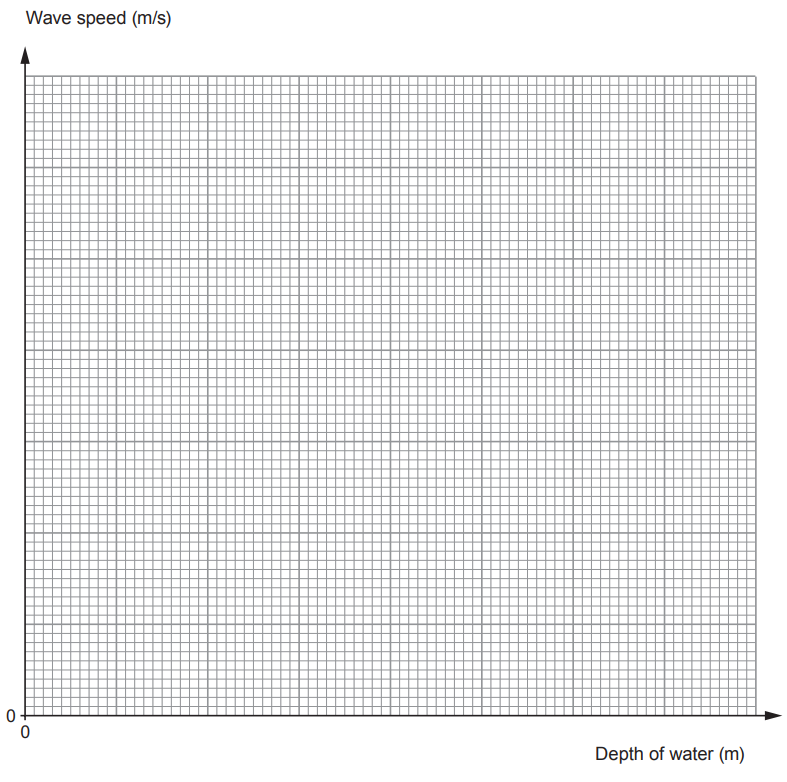
(iii) Plot the data on the grid below and draw a suitable line.

[4]

Blank grid graph with horizontal axis labelled “Depth of water (m)” and vertical axis labelled “Wave speed (m/s)”, both starting from zero at the origin
12c
Sme Calculator
5 marks

(i) Use the graph and the equation:

\text{wavelength} = \frac{\text{wave speed}}{\text{frequency}}

to calculate the wavelength of water waves that have a frequency of 0.2 Hz in water that is 2.0 m deep.

[3]

Wavelength = .......... m

(ii) Chris now suggests that as the depth increases, the wavelength decreases. Explain whether this statement is correct.

[2]

13a
Sme Calculator
6 marks

A teacher demonstrates water waves in a ripple tank.

The diagram represents the waves produced at a particular frequency.

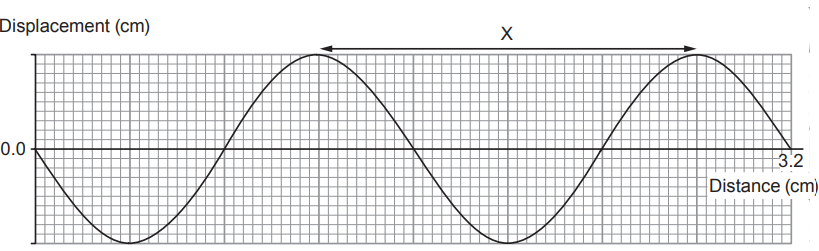
Graph of a transverse wave showing displacement against distance in centimetres, with one full wavelength X marked and a distance label of 3.2 cm.

(i) Use the information in the diagram to calculate the distance X.

[2]

X = .......... cm

(ii) A wave takes 5 s to travel 40 cm along the surface of the water in the ripple tank. Use equations and the information above to calculate the frequency of the wave.

[4]

Frequency = .......... Hz

13b
2 marks

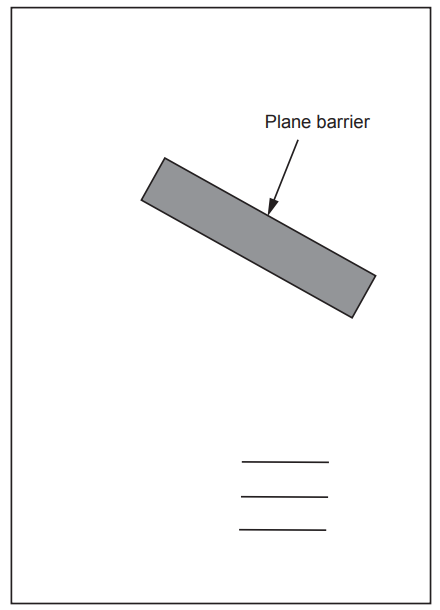
Wavefronts travel towards a plane barrier. Complete the diagram to show the path of the wavefronts as they are incident on and reflect off the barrier.

Diagram showing a grey rectangular plane barrier tilted diagonally, labelled with an arrow, above three short horizontal lines on a blank background.
14a
Sme Calculator
2 marks

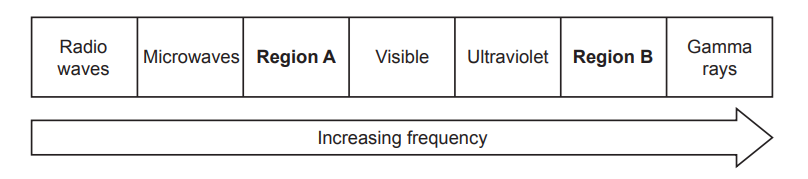
The diagram shows some of the regions in the electromagnetic (em) spectrum in order of increasing frequency.

EM spectrum diagram showing regions from left to right in order of increasing frequency: Radio waves, Microwaves, Region A, Visible, Ultraviolet, Region B, Gamma rays. Arrow below pointing right labelled 'Increasing frequency'

Name region A and region B.

Region A is ..........

Region B is ..........

14b
Sme Calculator
3 marks

Tick (✓) the boxes next to the 3 correct statements below:

em waves all travel at different speeds in a vacuum box enclose space space space space end enclose

Gamma rays transfer the least energy box enclose space space space space end enclose

Region A has a longer wavelength than visible light box enclose space space space space end enclose

em waves are all transverse waves box enclose space space space space end enclose

Radio waves are a type of ionising radiation box enclose space space space space end enclose

Microwaves are used to send mobile phone signals box enclose space space space space end enclose

14c
Sme Calculator
1 mark

Some regions of the em spectrum are ionising.

State why ionising radiation is harmful.

15a
Sme Calculator
1 mark

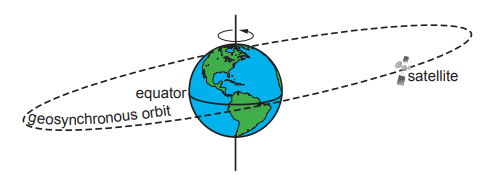
The diagram shows an example of a satellite in geosynchronous orbit around the Earth.

Diagram of Earth’s rotation axis, equator and a dashed geosynchronous orbit path with a satellite circling above the equator.

State one way in which a geostationary orbit is different to the one shown above.

15b
Sme Calculator
7 marks

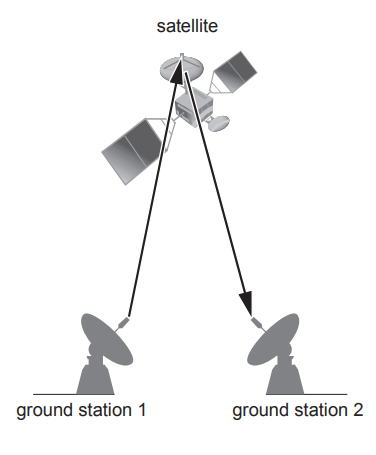
The diagram shows a signal sent from one ground station to a satellite which is then received back at a second ground station.

Diagram of a satellite relaying signals via arrows between two dish aerials labelled ground station 1 and ground station 2

(i) Use the equation:

\text{time} = \frac{\text{distance}}{\text{speed}}

to calculate the time interval between a microwave signal being sent from Earth to one of the satellites 36 000 000 m away and it being received back again.

[3]

(speed of light, c = 3 cross times108m/s)

time = .......... s

(ii) Microwaves travel at the speed of light and have a range of wavelengths between 0.002 m and 1 m.

Use an equation v = fλ to calculate the maximum frequency of microwave signals.

[3]

maximum frequency = .......... Hz

(iii) Name one type of electromagnetic radiation which has frequencies smaller than those of microwaves.

[1]

16a
Sme Calculator
2 marks

An incomplete diagram of the electromagnetic (em) spectrum is shown below.

Region

Radio waves

Microwaves

Infra-red

Visible

Wavelength (m)

.....................

.....................

.....................

.....................

The wavelength of a wave in each of the regions shown is given below.

Complete the table by using the wavelength values below.

2 × 10⁻² m

4 × 10² m

5 × 10⁻⁷m

3 × 10⁻⁵ m

16b
Sme Calculator
2 marks

The ionising regions of the em spectrum are not included on the diagram.

(i) Name the missing regions.

[1]

(ii) State what is meant by the term ionising radiation.

[1]

16c
Sme Calculator
1 mark

All waves in the em spectrum are transverse.

State one other property they have in common.

16d
Sme Calculator
3 marks

Electromagnetic radiation is used in communications.

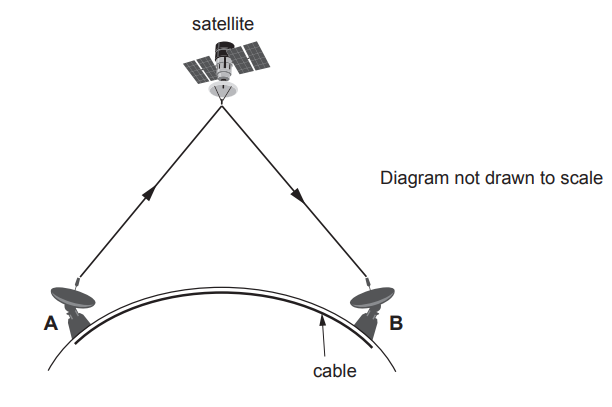
A and B are two points on the Earth's surface.

To send a signal from A to B, it can either be sent as a signal in a cable or as a signal via a satellite in geostationary orbit.

Diagram of a satellite linking two ground dishes A and B on Earth’s curved surface, with a separate cable connection shown along the ground.

Information about both methods is given in the table below.

Speed of signal to satellite

3 × 10⁸ m/s

Speed of signal in cable

2 × 10⁸ m/s

Distance from A to B through the cable

6 × 10⁶ m

Distance from A to B via the satellite

7.2 × 10⁷ m

Owain states that it is better to send the signal by satellite as it travels faster so it will arrive in a shorter time.

Use data from the table to explain whether you agree.

17a
Sme Calculator
4 marks

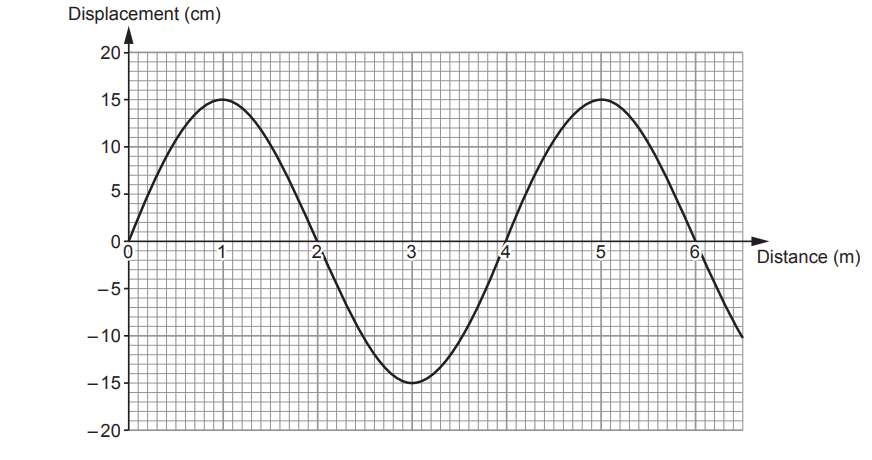
The diagram shows a water wave.

Sinusoidal wave diagram. x-axis labelled 'Distance (m)', range 0–6 in steps of 1; y-axis labelled 'Displacement (cm)', range –20 to 20 in steps of 5. Wave shows approximately 1.5 complete cycles, with one complete cycle spanning 4 m

(i) State the wavelength of the wave.

[1]

.......... m

(ii) The wave speed is 6 m/s.

Use the equation:

\text{frequency} = \frac{\text{wave speed}}{\text{wavelength}}

to determine the frequency of the wave.

Give the correct unit with your answer.

[3]

frequency = ..........

unit = ..........

17b
Sme Calculator
6 marks

Students investigate the speed of water waves.

They measure the time taken for the waves to travel 100 cm in different depths of water.

Their results are shown below:

Depth of water (cm)

Time (s)

Mean time (s)

Mean wave speed (cm/s)

Trial 1

Trial 2

Trial 3

0.5

4.57

4.58

4.52

4.56

21.9

1.0

3.22

3.24

2.61

3.02

33.1

1.5

2.61

2.62

2.64

2.62

38.1

2.0

2.29

2.28

2.24

2.27

44.1

2.5

2.01

2.02

1.98

2.00

50.0

(i) State the independent variable in this experiment.

[1]

(ii) The students conclude that one of the time values they had recorded is anomalous.

Circle the anomalous result in the table.

[1]

(iii) Explain how you know that this result is anomalous.

[1]

(iv) Determine a more accurate value for the mean time for the depth in which there is an anomalous result.

[2]

mean time = .......... s

(v) State a conclusion about the relationship between depth of water and wave speed.

[1]

17c
Sme Calculator
1 mark

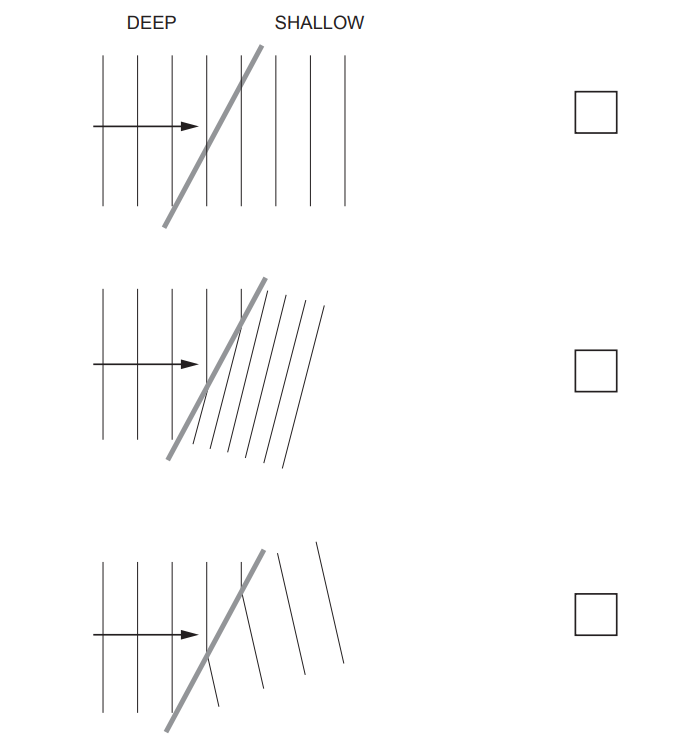
Water waves refract when their speed decreases at a boundary between deep and shallow water.

Tick (✓) the box next to the diagram that correctly shows the refraction of these water waves.

Three diagrams each showing DEEP water on the left and SHALLOW water on the right, with parallel wavefronts approaching the boundary. Diagram 1: wavefronts continue straight with no change. Diagram 2: wavefronts bend towards the normal as they enter shallow water — wavelength decreases and direction changes. Diagram 3: wavefronts bend away from the normal as they enter shallow water.
18a
Sme Calculator
3 marks

Students study refraction of waves in a ripple tank.

They set up the tank to show waves going from shallow water into deeper water.

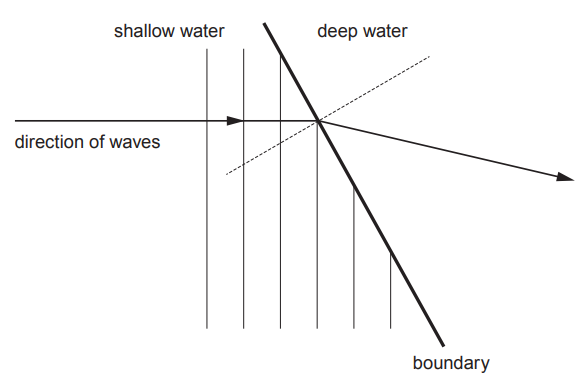
The diagram shows a number of wavefronts approaching a boundary between shallow and deep water.

The first four wavefronts have reached the boundary.

Diagram of plane waves crossing a sloping boundary from shallow to deep water, showing refraction: wavefronts bend and travel faster in the deep region

Complete the diagram to show the wavefronts in the deep water

18b
Sme Calculator
3 marks

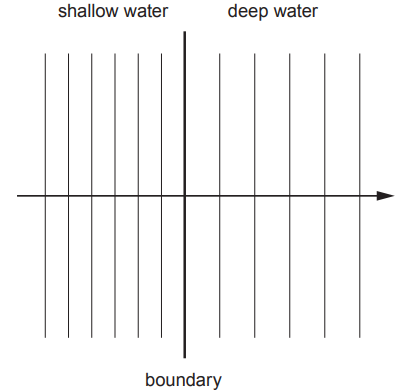
In a separate experiment, the wavefronts pass over the boundary in the way shown below.

Diagram of wavefronts crossing a vertical boundary from shallow water on the left to deep water on the right, with horizontal direction arrow to the right

Sam says that the speed of the waves is greater in deep water than shallow water.

Explain whether you agree with his statement.