12 marks
On the axes below, sketch the lines with equations and
On your sketch, show the coordinates of the points where the lines cross the coordinate axes.
Was this exam question helpful?
Exam code: 4PM1
On the axes below, sketch the lines with equations and
On your sketch, show the coordinates of the points where the lines cross the coordinate axes.
Was this exam question helpful?
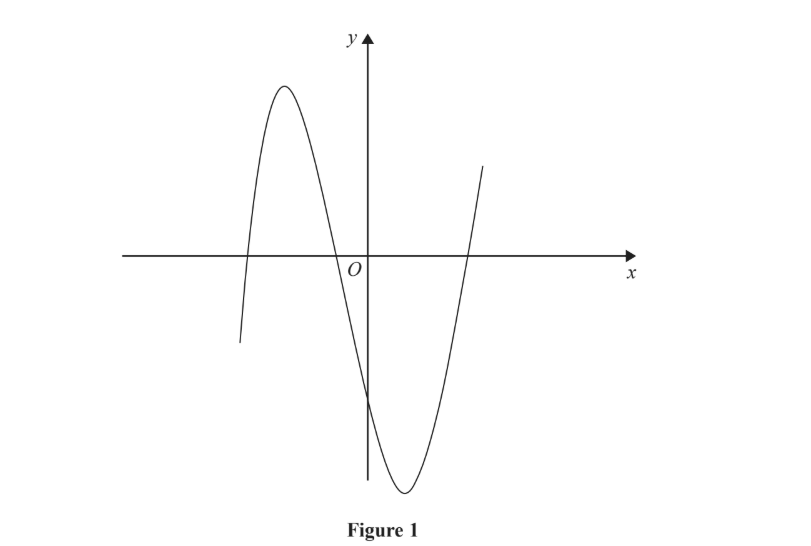
Figure 1 shows the curve with equation
The point , with coordinate −2, lies on and line is the tangent to at the point .
Find an equation for
The point lies on and the line is the tangent to at the point .
Given that and are parallel,
find an equation for
The normal to at meets at the point .
Find the coordinates of .
Find the exact length of the line .
The tangent and normal at and the tangent and normal at form a rectangle.
Find the exact area of this rectangle.
Was this exam question helpful?
The line passes through the point with coordinates and the point with coordinates
The point with coordinates lies on such that
Find the value of and the value of
The line is perpendicular to and passes through the point
Show that an equation of is
The line crosses the -axis at the point
Find the exact length of
The point with coordinates lies on such that
area of triangle = 80 units2
Given that
find the value of and the value of
Was this exam question helpful?
On the grid below, draw the line with equation
(i)
(ii)
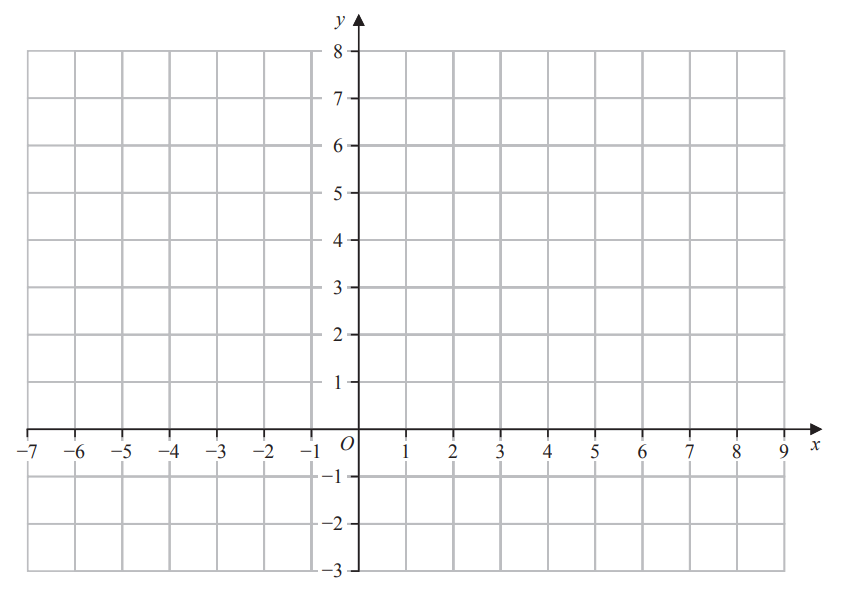
Show, by shading on the grid, the region defined by the inequalities
Label the region
Was this exam question helpful?
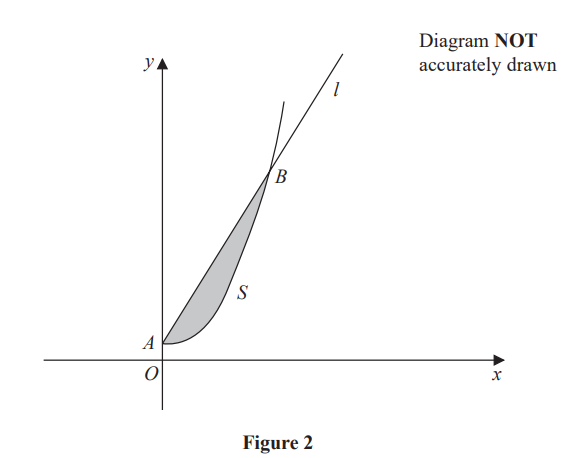
The curve with equation where and the line with equation where intersect at the points and , as shown in Figure 2.
(i) Show that the coordinates of point are (0, 2)
(ii) Find the coordinates of the point
The finite region bounded by and , shown shaded in Figure 2, is rotated through radians about the -axis.
Use algebraic integration to find the volume of the solid generated.
Give your answer in terms of
Was this exam question helpful?
On the grid opposite draw the line with equation
(i)
(ii)
(iii)
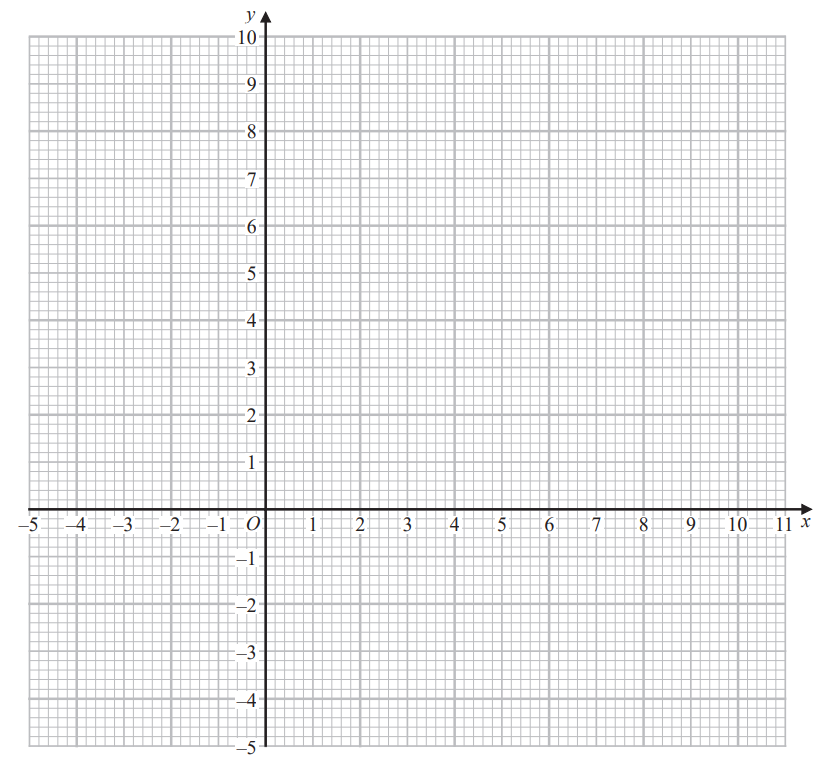
Show, by shading, the region defined by the inequalities
For all points in with coordinates
Using your graph, find the least value of
Was this exam question helpful?
The point with coordinates and the point with coordinates where is a constant, lie on the straight line with equation where is a constant.
Find the value of and the value of
The line is perpendicular to and passes through the point , which lies on such that
Find an equation for in the form where , and are integers to be found.
Was this exam question helpful?
On the axes opposite, draw the line with equation
(i)
(ii)
(iii)
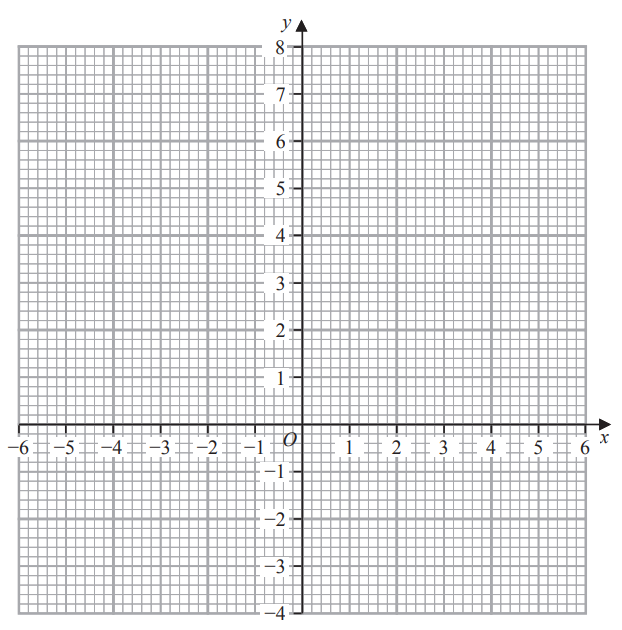
Show, by shading on your graph, the region defined by the inequalities
and and
For all points in , with coordinates
Find
(i) the greatest value of
(ii) the least value of
Was this exam question helpful?
The point has coordinates (–5, 3), the point has coordinates (4, 0) and the point has coordinates (–1, 5).
The line passes through and is perpendicular to .
Find an equation of .
Give your answer in the form where , and are integers.
The line intersects at the point .
Show that the coordinates of are (-2, 2).
The point has coordinates (–5, 3), the point has coordinates (4, 0) and the point has coordinates (–1, 5).
Show that is not the perpendicular bisector of .
Find the value of .
Give your answer in its simplest form.
Was this exam question helpful?