11 mark
What is the unit of electromotive force?
Joule
Volt
Ampere
Watt
Was this exam question helpful?
Exam code: 0625 & 0972
What is the unit of electromotive force?
Joule
Volt
Ampere
Watt
Was this exam question helpful?
The diagram shows two light, silver-coated balls labelled X and Y hanging from threads near to each other.

Which line identifies the possible charges on X and Y?
| X | Y |
A | neutral | neutral |
B | negative | negative |
C | negative | positive |
D | positive | negative |
Was this exam question helpful?
Extended tier only
What is the correct unit of charge?
Ampere
Coulomb
Newton
Volt
Was this exam question helpful?
Which pair of quantities have the same units?
Current and potential difference
Current and resistance
Electromotive force and potential difference
Electromotive force and resistance
Was this exam question helpful?
Which line correctly states the equation for electrical energy?
Was this exam question helpful?
A large battery is labelled with various items of information about the battery.
12 V | 30 kg | 216 kJ | 680 A |
One of these items of information is the electromotive force (e.m.f.) of the battery.
What is the e.m.f. of the battery?
12 V
30 kg
216 kJ
680 A
Was this exam question helpful?
Extended Tier Only
Which unit is equivalent to a volt (V)?
A/Ω
J/C
J/s
W/C
Was this exam question helpful?
Which particles move to cause a current in a copper wire?
copper atoms
electrons from the copper atoms
protons from the copper nuclei
neutrons from the copper nuclei
Was this exam question helpful?
A wire has a uniform circular cross-sectional area.
Which statement is correct?
The resistance of the wire is directly proportional to its cross-sectional area and inversely proportional to its diameter.
The resistance of the wire is directly proportional to its cross-sectional area and inversely proportional to its length.
The resistance of the wire is directly proportional to its length and inversely proportional to its cross-sectional area.
The resistance of the wire is directly proportional to its length and inversely proportional to its diameter.
Was this exam question helpful?
The diagrams show the voltage–time graphs for two electrical power supplies, X and Y.
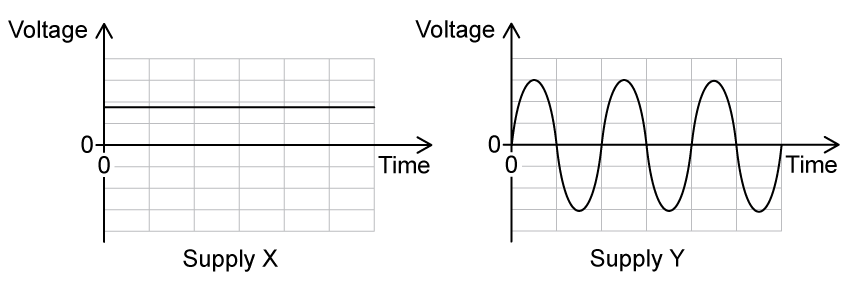
Which row correctly identifies the type of current provided by each supply?
supply X | supply Y | |
|---|---|---|
A | alternating current (a.c.) | direct current (d.c.) |
B | alternating current (a.c.) | alternating current (a.c.) |
C | direct current (d.c.) | direct current (d.c.) |
D | direct current (d.c.) | alternating current (a.c.) |
Was this exam question helpful?
The electromotive force (e.m.f.) of a battery is
the charge that flows through the battery per unit time
the energy transferred per unit charge in driving charge around a complete circuit
the force that pushes electrons through the circuit
the potential difference across the terminals of the battery when no current flows
Was this exam question helpful?
A PVC (plastic) rod is rubbed with a nylon cloth. This process causes electrons to be transferred between the rod and the cloth, causing both objects to become charged.
Which row gives the correct nature of the charges on both the cloth and the rod, and the effect the objects have on each other after becoming charged?
| Charges on rod and cloth | Effect |
A | the same | repel |
B | the same | attract |
C | opposite | repel |
D | opposite | attract |
Was this exam question helpful?
A student wants to charge up some rods by rubbing them with a cloth made from a suitable material.
He has a number of rods to choose from: a copper rod, a PVC rod, an aluminium rod and a glass rod.
Which two of the rods would hold a charge when rubbed with an appropriate cloth?
Aluminium and PVC
Glass and copper
Aluminium and copper
Glass and PVC
Was this exam question helpful?
Extended tier only
A student considers how changing the diameter and length of a wire affects its resistance.
Which row shows the changes that could be made to the length and diameter of the wire to decrease its resistance?
| Change to length | Change to diameter |
A | increase | increase |
B | increase | decrease |
C | decrease | increase |
D | decrease | decrease |
Was this exam question helpful?
A student rubs an acetate rod with a cloth, giving it a negative charge. She then holds it near an earthed, conducting sphere as shown in the diagrams below.
Which diagram shows the correct distribution of charges on the conducting sphere?

Was this exam question helpful?
Extended tier only
A student has four copper wires, of different dimensions.
Which of the following wires has the largest resistance?
| Length of wire / cm | Diameter of wire / mm |
A | 100 | 0.2 |
B | 300 | 0.1 |
C | 50 | 0.4 |
D | 30 | 0.5 |
Was this exam question helpful?
A plastic rod is rubbed with a cloth. The rod becomes positively charged.
What happens to the plastic rod and what is the charge on the cloth?
plastic rod | charge on cloth | |
A | gains electrons | negative |
B | gains electrons | positive |
C | loses electrons | negative |
D | loses electrons | positive |
Was this exam question helpful?
The electromotive force (e.m.f.) of a mobile phone battery is 3.7 V.
What does this mean?
3.7 J is the maximum energy the battery can provide in 1.0 s.
3.7 J is the total energy the battery can provide before it has to be recharged.
3.7 J of energy is provided by the battery to drive a charge of 1.0 C around a complete circuit.
3.7 J of energy is provided by the battery to drive a current of 1.0 A around a complete circuit.
Was this exam question helpful?
A water heater is connected to a 230 V supply and there is a current of 26 A in the heater.
It takes 20 minutes to heat the water to the required temperature.
How much energy is supplied by the heater?
6.0 103 J
1.0 104 J
1.2 105 J
7.2 106 J
Was this exam question helpful?
The diagram shows a charged plastic rod and an uncharged metal sphere. The metal sphere is suspended by an insulating thread.

The plastic rod is then moved close to the metal sphere.
Which row is correct?
| observation | the overall state of the metal sphere |
A | The rod attracts the sphere. | charged |
B | The rod attracts the sphere. | uncharged |
C | The rod repels the sphere. | charged |
D | The rod repels the sphere. | uncharged |
Was this exam question helpful?
The circuit shown is being used to measure the resistance of resistor Z.

What is the correct combination of meters to determine the resistance of resistor Z?
| meter X | meter Y |
A | ammeter | ammeter |
B | ammeter | voltmeter |
C | voltmeter | ammeter |
D | voltmeter | voltmeter |
Was this exam question helpful?
A plastic rod is brought near to a small plastic sphere suspended from a stand. The sphere is repelled by the rod.
Why is this?
The rod and the sphere have like charges.
The rod and the sphere have unlike charges.
The rod is charged and the sphere is uncharged.
The rod is uncharged and the sphere is charged.
Was this exam question helpful?
A resistor converts 360 J of energy when there is a current of 3.0 A in it. The potential difference across the resistor is 6.0 V.
For how long is there this current in the resistor?
0.05 s
20 s
180 s
720 s
Was this exam question helpful?
A plastic rod is rubbed with a cloth.

The rod and the cloth both become charged as electrons move between them.
The rod becomes negatively charged.
Which diagram shows how the rod becomes negatively charged and shows the final charge on the cloth?

Was this exam question helpful?
Four students draw a circuit diagram of the apparatus used to measure the resistance of resistor R.
Which circuit is correct?

Was this exam question helpful?
The diagram shows the current–voltage graph for a metal wire.

What can be deduced from the graph?
As voltage increases, the temperature of the wire increases.
As voltage increases, the temperature of the wire decreases.
As voltage increases, the resistance of the wire increases.
As voltage increases, the resistance of the wire remains constant.
Was this exam question helpful?
A battery is connected to a circuit. It is switched on for 1.0 minute. During that time, there is a current of 0.40 A in the circuit and the battery supplies a total of 48 J of energy.
Which row gives the charge that passes and the electromotive force (e.m.f.) of the battery?
charge that passes in 1.0 minute / C | e.m.f. of the battery / V | |
|---|---|---|
A | 0.40 | 2.0 |
B | 0.40 | 120 |
C | 24 | 2.0 |
D | 24 | 120 |
Was this exam question helpful?
A student rubs a plastic rod with a cloth. The rod becomes negatively charged.
Which statement about the rod is correct?
It gains electrons from the cloth and is attracted by a positively charged object.
It gains electrons from the cloth and is repelled by a positively charged object.
It loses electrons to the cloth and is attracted by a negatively charged object.
It loses electrons to the cloth and is repelled by a negatively charged object.
Was this exam question helpful?
A plastic rod is rubbed with a cloth. The rod becomes negatively charged.
What has happened during the charging process?
Protons have been transferred from the rod to the cloth.
Electrons have been transferred from the rod to the cloth.
Protons have been transferred from the cloth to the rod.
Electrons have been transferred from the cloth to the rod.
Was this exam question helpful?
A current of 0.50 A flows through a lamp for 4.0 minutes.
What is the charge that flows through the lamp?
2.0 C
8.0 C
60 C
120 C
Was this exam question helpful?
Extended tier only
What is the definition of an electric field?
A region in space in which a mass experiences a force due to the Earth’s mass.
A region in space through which electromagnetic radiation is passing.
A region in space in which a compass needle experiences a force.
A region in space in which an electric charge experiences a force.
Was this exam question helpful?
Extended tier only
Four current-voltage graphs are given below.

Which graph shows an ohmic resistor and which shows a filament lamp?
| Filament lamp | Ohmic resistor |
A | Q | S |
B | R | Q |
C | P | Q |
D | Q | R |
Was this exam question helpful?
Extended tier only
Which diagram shows the correct electric field pattern between two oppositely charged parallel plates?

Was this exam question helpful?
Extended tier only
Which row in the table gives the correct units for charge and e.m.f.?
| Charge | EMF |
A | Q | E |
B | C | V |
C | A | J |
D | J | ᘯ |
Was this exam question helpful?
Extended tier only
A student sets up a circuit as shown in the diagram.

A charge of 4.9 C flows through the resistor in 0.7 s.
Which row shows the correct current, direction of electron flow and direction of conventional current through the resistor?
| current / A | direction of electron flow | direction of conventional current |
A | 7.00 | Left to right | Right to left |
B | 3.43 | Left to right | Right to left |
C | 7.00 | Right to left | Right to left |
D | 3.43 | Right to left | Right to left |
Was this exam question helpful?
A student connects a 6 V power supply to a 3 Ω resistor. The resistor is left connected to the power supply for 1 minute.
How much power is dissipated by the resistor?
2 W
12 W
720 J
18 W
Was this exam question helpful?
A 3.0 Ω resistor is connected to a 15 V power supply as shown in the diagram. The ammeter reads 5 A throughout the experiment.

How much energy is dissipated as heat by the resistor in 2 minutes?
9.0 kJ
150 J
600 J
5.0 kJ
Was this exam question helpful?
A 2.0 Ω resistor is connected to meter X and meter Y as shown in the diagram.

Which row in the table shows possible values for the two meters?
| X | Y |
A | 4.0 | 8.0 |
B | 2.0 | 2.0 |
C | 4.0 | 2.0 |
D | 1.0 | 1.0 |
Was this exam question helpful?
A student wants to measure the power dissipated by a 10 kΩ resistor.
What equipment should the student use to determine the power dissipated?
A voltmeter and an ammeter
A voltmeter, an ammeter and a stopwatch
A voltmeter only
An ammeter and a stopwatch
Was this exam question helpful?
An electric heater with a power rating of is switched on for . The cost of of electricity is .
What is the total cost of using the heater?
Was this exam question helpful?