Electromagnetic Spectrum (Cambridge (CIE) IGCSE Co-ordinated Sciences (Double Award): Physics): Flashcards
Exam code: 0654 & 0973
1/230Still learning
Know0
True or False?
The electromagnetic spectrum is arranged in a specific order based on the wavelengths or frequencies.

Was this flashcard helpful?
Cards in this collection (23)
True or False?
The electromagnetic spectrum is arranged in a specific order based on the wavelengths or frequencies.
True.
The electromagnetic spectrum is arranged in a specific order based on the wavelengths or frequencies.
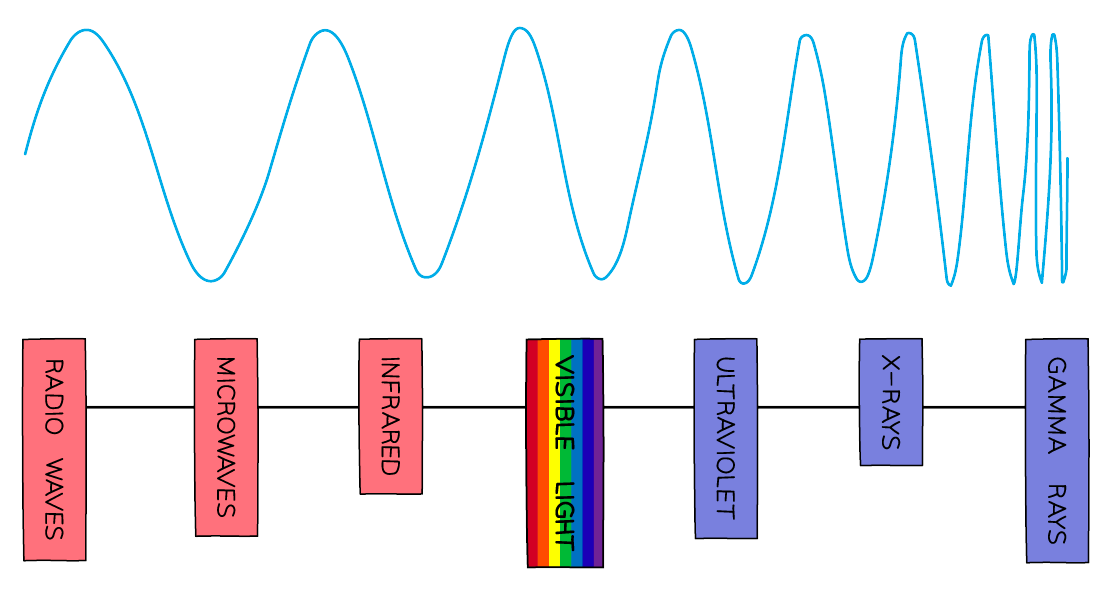
What is the order of the electromagnetic spectrum from longest to shortest wavelength?
The order of the electromagnetic spectrum from longest to shortest wavelength is:
Radio waves
Microwaves
Infrared
Visible light
Ultraviolet
X-rays
Gamma rays
What are the properties of electromagnetic waves?
All electromagnetic waves share the following properties:
transverse
transfer energy from the source of the waves to an absorber
travel at the same high speed in a vacuum
form a continuous spectrum
Define the term electromagnetic waves.
Electromagnetic waves are transverse waves that transfer energy from the source of the waves to an absorber.
True or False?
The speed of electromagnetic waves in air is the same as in a vacuum. (Extended Tier Only)
True.
The speed of electromagnetic waves in air can be approximated to the speed of electromagnetic waves in a vacuum because the difference in speed is so small.
What is the speed of electromagnetic waves in a vacuum? (Extended Tier Only)
The speed of electromagnetic waves in a vacuum is 3.0 × 10^8^ m/s.
Identify using the diagram the electromagnetic radiation type with the shortest wavelength.
The electromagnetic radiation type with the shortest wavelength is gamma rays.
Identify using the diagram the electromagnetic radiation type with the highest frequency.
The electromagnetic radiation type with the highest frequency is gamma rays.
What are typical uses of radio waves?
Typical uses of radio waves are:
radio and television transmissions
radar
What are typical uses of microwaves?
Typical uses of microwaves are:
satellite television
mobile (cell) phones
microwave ovens
True or False?
Thermal imaging cameras use infrared radiation.
True.
Typical uses of infrared radiation are thermal imaging and television remote controllers.
What are typical uses of gamma rays?
Typical uses of gamma rays are:
detection of cancer
treatment of cancer
True or False?
Detecting fake banknotes is an application of X-rays.
False.
Detecting fake banknotes is an application of ultraviolet radiation. X-rays are used for medical scanning and security scanners.
True or False?
Visible light is the only part of the electromagnetic spectrum that human eyes can see.
True.
Human eyes can only detect wavelengths of electromagnetic radiation in the visible light section of the electromagnetic spectrum. Typical uses of visible light are vision and photography.
True or False?
Remote controls are one application of ultraviolet radiation.
False.
Television remote controllers are an application of infrared radiation.
State the type of radiation used in the device in the diagram.
The device in the diagram is a microwave oven and uses microwaves.
True or False?
As the frequency of electromagnetic waves increases, so does the energy and the danger associated with them.
True.
As the frequency of electromagnetic waves increases, the energy they transfer increases, and therefore so does the danger associated with them.
What is the main danger associated with ultraviolet, X-rays and gamma rays?
Ultraviolet, X-rays and gamma rays can all ionise atoms, which can damage cells and cause mutations, which can lead to cancer.
True or False?
Ultraviolet radiation can be harmful to humans.
True.
Ultraviolet radiation can damage surface cells and eyes, leading to skin cancer, premature ageing and eye conditions.
True or False?
X-rays and gamma rays are the most ionising types of electromagnetic waves.
True.
X-rays and gamma rays can penetrate the body and cause internal damage. They can cause the mutation of DNA, causing cancer.
True or False?
Sunscreen absorbs ultraviolet light, preventing it from damaging the skin.
True.
Sunscreen absorbs ultraviolet light, preventing it from damaging the skin.
True or False?
Ionising forms of electromagnetic radiation have a higher frequency than visible light.
True.
The ionising forms of electromagnetic radiation are ultraviolet, X-rays and gamma rays, all of which have higher frequencies than visible light.
True or False?
The longer the wavelength, the more ionising the electromagnetic radiation.
False.
The shorter the wavelength (and therefore, the higher the frequency), the more ionising the electromagnetic radiation.


Sign up to unlock flashcards
or