The Characteristic Properties of Acids & Bases (Cambridge (CIE) IGCSE Combined Science: Chemistry): Exam Questions

Exam code: 0653

10 mins3 questions
1
1 mark

The products of a reaction are water, calcium chloride and carbon dioxide only.

Which reaction mixture gives these products?

  • calcium and hydrochloric acid

  • calcium hydroxide and hydrochloric acid

  • calcium carbonate and hydrochloric acid

  • calcium oxide and hydrochloric acid

2
1 mark

Which row identifies the formulas of an acidic oxide and a basic oxide?

acidic oxide

basic oxide

A

NO2

CaO

B

SO2

CO2

C

CuO

Na2O

D

Li2O

SiO2

    3a
    1 mark

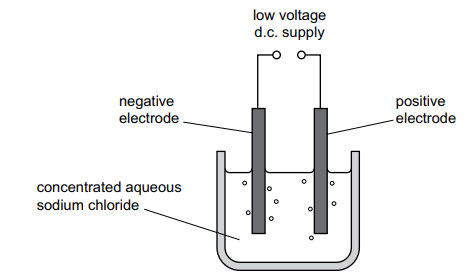
    Fig. 4.1 shows the electrolysis of concentrated aqueous sodium chloride using inert electrodes.

    Diagram of electrolysis: two electrodes in concentrated aqueous sodium chloride linked to a low-voltage d.c. supply, labelled positive and negative.

    State the name of the positive electrode.

    3b
    2 marks

    Identify the gases produced at the electrodes.

    positive electrode: ..................

    negative electrode: ..................

    3c
    2 marks

    The electrolysis of concentrated aqueous sodium chloride produces a solution containing an alkali.

    (i) State what is meant by an alkali.

    [1]

    (ii) State what colour change is observed when methyl orange is added to a solution containing an alkali.

    from orange to ...........................................................

    [1]

    3d
    3 marks

    The electrolysis shown in Fig. 4.1 produces the alkali sodium hydroxide.

    Aqueous sodium hydroxide reacts with dilute sulfuric acid.

    (i) Complete the word equation for this reaction.

    Diagram of a word equation: sodium hydroxide plus sulfuric acid arrow blank box plus blank box, for students to fill in the reaction products.

    [1]

    (ii) The reaction between aqueous sodium hydroxide and dilute sulfuric acid is exothermic.

    State what is meant by an exothermic reaction.

    [2]