Acceleration (Cambridge (CIE) IGCSE Combined Science: Physics): Revision Note
Exam code: 0653

Acceleration
An object can change its speed by:
speeding up
slowing down
When an object speeds up, it is accelerating
When an object slows down, it is decelerating
Calculating acceleration
Extended Tier Only
When an object moves in a straight line, its acceleration can be defined as:
The change in speed per unit time
In other words, acceleration is the rate of change of speed
The acceleration of an object often changes throughout an object's journey
Therefore, it is often useful to know the average acceleration
Where:
= acceleration in metres per second squared (m/s2)
= change in speed in metres per second (m/s)
= time taken in seconds (s)
Formula triangle for acceleration, change in speed and change in time

To use a formula triangle, simply cover up the quantity you wish calculate and the structure of the equation is revealed
Change in speed
The change in speed is the difference between the initial and final speed:
Where:
= change in speed in metres per second (m/s)
= final speed in metres per second (m/s)
= initial speed in metres per second (m/s)
If an object speeds up, its acceleration is positive
If an object slows down, its acceleration is negative
Acceleration is positive if it is in the same direction as the motion of the object
Acceleration of different objects
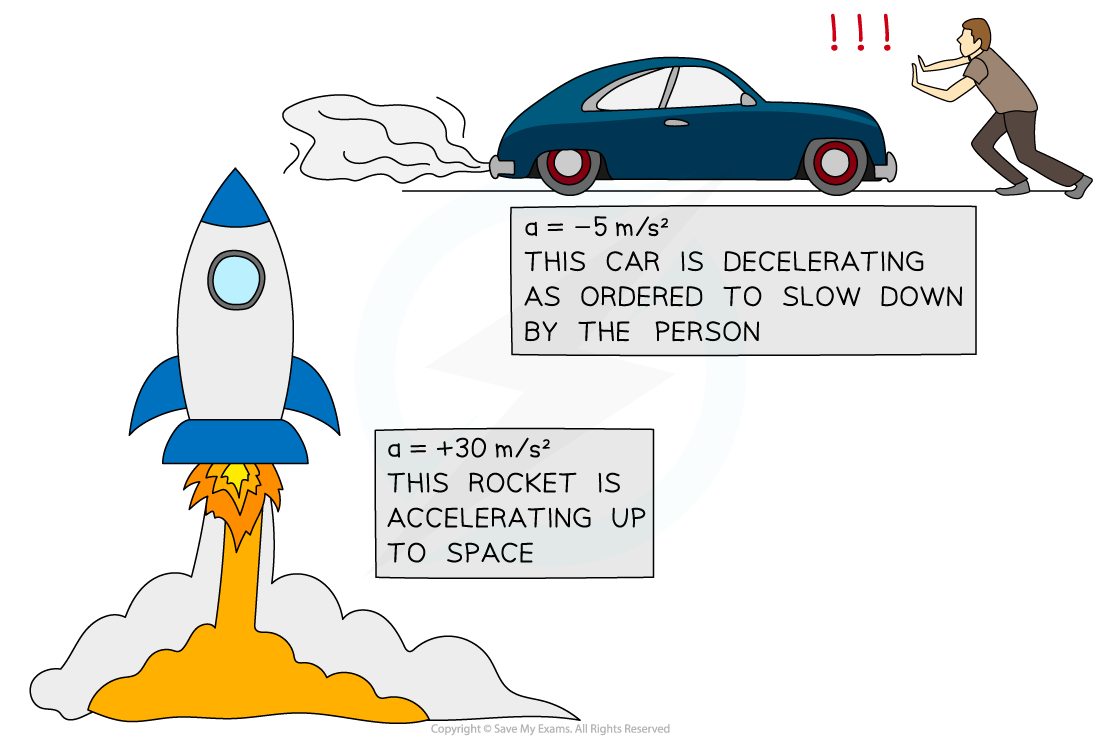
A rocket speeding up (accelerating) and a car slowing down (decelerating)
Worked Example
A Japanese bullet train decelerates at a constant rate in a straight line. The speed of the train decreases from 50 m/s to 42 m/s in 30 seconds.
(a) Calculate the change in speed of the train.
(b) Calculate the deceleration of the train, and explain how your answer shows the train is slowing down.
Answer:
Part (a)
Step 1: List the known quantities
Initial speed,
Final speed,
Step 2: Write the equation for change in speed
Step 3: Substitute values for final and initial speed
Part (b)
Step 1: List the known quantities
Change in speed,
Time taken,
Step 2: Write the equation for acceleration
Step 3: Substitute the values for change in speed and time
Step 4: Interpret the value for deceleration
The answer is negative, which indicates the train is slowing down
Examiner Tips and Tricks
Remember, the units for acceleration are metres per second squared, m/s2. In other words, acceleration measures how much the speed (m/s) changes every second, so the units are metres per second per second (m/s/s).
You may see the term "velocity" also used to describe speed. Speed means how fast something is going (e.g. 5 m/s), whereas velocity means how fast something is going and in which direction (e.g 5 m/s in a north direction). You don't need to know about velocity for IGCSE GCSE Combined Science.

Unlock more, it's free!
Join the 100,000+ Students that ❤️ Save My Exams
the (exam) results speak for themselves:

Was this revision note helpful?
Build on this topic
