14 marks
Modern humans have less body hair than their ancestors.
Explain how this evolutionary change was brought about by natural selection.
Was this exam question helpful?
Exam code: 4XSD1
Modern humans have less body hair than their ancestors.
Explain how this evolutionary change was brought about by natural selection.
Was this exam question helpful?
Gregor Mendel was an Austrian monk who studied inheritance. In one of his investigations, Mendel looked at inheritance of seed colour in sweet peas.
The pea pod colours are controlled by a single gene with two alleles. The resulting phenotypes were either pea plants with yellow seeds or pea plants with green seeds.
Give a definition of the term allele.
The image below shows one of the crosses carried out by Gregor Mendel in which a homozygous plant with yellow seeds was crossed with a homozygous plant with green seeds. All of the offspring had yellow seeds.

Using the information in the diagram, state which allele of the seed colour gene is dominant.
Two heterozygous pea plants with yellow seeds were crossed as shown in the diagram above to produce the F2 generation.
(i) Complete the Punnett square to show the genotypes that are produced in this cross.
Yy | |||
............ | ............ | ||
Yy | Y | ............ | ............ |
y | ............ | ............ | |
[2]
(ii) State the phenotypic ratio produced in this cross.
[1]
Seed colour in sweet peas is a trait determined by a single gene.
Give the term used to describe a trait which is determined by multiple genes.
Was this exam question helpful?
State why mitosis is important in multicellular organisms.
The image shows the nucleus of a male gamete from a frog.

State the diploid number of chromosomes for a body cell in a frog.
Complete the table to identify which statements about mitosis are true and which are false.
Statement | True | False |
|---|---|---|
Mitosis produces genetically identical cells |
|
|
A cell divides twice in the process of mitosis |
|
|
Daughter cells from mitosis are haploid |
|
|
DNA is replicated before a cell can divide |
|
|
Was this exam question helpful?
The bacterium H. pylori causes stomach ulcers.
The diagram shows this bacterium.

Use the theory of evolution by natural selection to explain how H. pylori bacteria could have evolved to produce urease.
[4]
The bacterium H. pylori causes stomach ulcers.
Which of these is found in this bacterium?
Cellulose
Chitin
Cytoplasm
Nucleus
The bacterium H. pylori has evolved to release an enzyme called urease.
The action of the bacterium neutralises the acid in the stomach.
What is the pH changed to?
1
2
7
12
Probiotics are live microorganisms that can have health benefits when consumed.
Scientists investigate the ability of probiotics and cranberry juice to reduce the growth of H. pylori.
The scientists give various treatments to a group of people who have H. pylori.
The treatments are given daily for three weeks.
The scientists measure the mean percentage reduction of H. pylori for each treatment.
The table shows the scientists' results.
Treatment | Mean percentage (%) reduction in H. pylori |
|---|---|
Probiotics | 14.9 |
Cranberry juice | 16.9 |
Probiotics and cranberry juice | 22.9 |
Control | 1.5 |
Give two conclusions from these results.
[2]
Was this exam question helpful?
The diagram shows a fetus in the uterus of a woman.

The umbilical cord transports blood from the placenta to the fetus.
This blood contains molecules from the mother that are needed by the developing fetus.
(i) Explain how some of these molecules allow active transport to occur in cells of the fetus.
[3]
(ii) Explain how one type of molecule from the mother helps to protect the fetus from infection.
[2]
The amniotic fluid contains cells from the fetus.
It is possible to look at chromosomes in these cells.
A diagram of the chromosomes is called a karyotype.
The diagram shows the karyotype of a fetus cell.

Give two conclusions you can make from this karyotype.
Doctors recommend that pregnant women obtain more of some dietary components than women who are not pregnant.
The table shows the recommended percentage increase of some dietary components in the diet of a woman who is pregnant compared to a woman who is not pregnant.
Component | Percentage increase of some dietary components in the diet of a woman who is pregnant compared to a woman who is not pregnant (%) |
|---|---|
Energy in kJ | 10 |
Calcium in g | 71 |
Iron in mg | 50 |
Protein in g | 14 |
Vitamin D in µg | 300 |
(i) Explain why a woman who is pregnant requires more of each of the dietary components listed in the table.
[4]
(ii) The actual mass of additional iron needed by the pregnant woman was 9.0 mg per day. Calculate the actual total mass of iron needed by the pregnant woman.
[3]
Was this exam question helpful?
Cleft chin is a phenotype believed to be controlled by a single gene that has two alleles.
The dominant allele, N, codes for cleft chin and the recessive, n, allele codes for the absence of the cleft chin.
With reference to the example of cleft chin, state what is meant by the following terms
(i) Phenotype
[1]
(ii) Gene
[1]
(iii) Allele
[1]
A woman with a cleft chin has a child with a man who also has a cleft chin. The child does not have a cleft chin.
(i) Use a genetic diagram to show the genotypes of the parents, the gametes they can produce and all the possible genotypes and phenotypes of their children.
[4]
(ii) The parents then have a second child.
Calculate the probability that this child will be female and not have a cleft chin.
[2]
(iii) Sometimes a cleft chin does not develop even if the individual inherits the dominant allele.
Suggest what might cause this.
[1]
Most inherited conditions are not controlled by a single gene, but by many genes.
Describe how a scientist could distinguish between a genetic condition in rats controlled by a single gene and one controlled by many genes.
Was this exam question helpful?
A scientist studies hair colour in mice.
Mice can have grey hair or white hair.
The hair colour is determined by a gene with two alleles.
In the first cross, a male mouse with white hair is mated with a female mouse with grey hair.
All the offspring have grey hair.
(i) State what is meant by the term gene.
[1]
(ii) State the phenotype coded for by the dominant allele.
[1]
A male mouse and a female mouse with grey hair were chosen from the offspring of the first cross. These mice are mated in a second cross.
Some of the offspring of this second cross has grey hair and some have white hair.
Use a genetic diagram to show the second cross.
You should give the genotypes of the parents and the gametes formed. You should also give the genotypes and ratio of phenotypes of the offspring.
The scientist concludes that a mouse with grey hair could have two possible genotypes.
Explain how the scientist could use a cross to determine the genotype of a mouse with grey hair.
Albino mice have white hair. These mice also have pink eyes as they do not have pigment in their irises.
They are also less likely to explore a new area when compared to mice with grey hair.
This is an example of one gene having many effects.
Describe how the genetic control of most phenotypic features differs from this example.
Was this exam question helpful?
Hypertrophic myopathy is a heart condition that can affect some cats. It is caused by a dominant allele.
Hypertrophic myopathy causes the left ventricle wall of the heart to be less elastic.
(i) Explain why cats with hypertrophic myopathy are unable to run quickly.
[2]
(ii) State what is meant by a dominant allele.
[1]
(iii) The diagram shows a family pedigree for cats with and without hypertrophic myopathy.
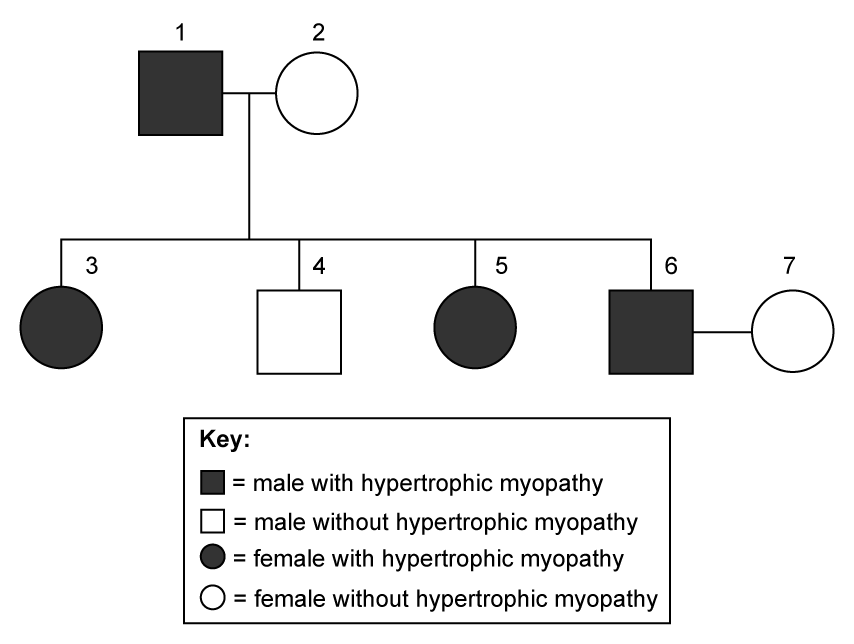
Draw a genetic diagram to show the possible genotypes and phenotypes of the offspring produced by individuals 6 and 7.
Use H as the allele for hypertrophic myopathy and h as the allele for normal heart development.
[4]
(iv) Calculate the probability that the next offspring produced by individuals 6 and 7 is male and has hypertrophic myopathy.
[1]
Cat breeders often try to remove harmful alleles from populations by selective breeding.
Suggest why it is more difficult to remove harmful recessive alleles from populations than harmful dominant alleles from populations.
Was this exam question helpful?
Alkaptonuria is an inherited condition caused by the presence of recessive alleles.
State what is meant by a recessive allele.
Alkaptonuria is first diagnosed in children when it is noticed that they produce very dark urine that turns black when exposed to air.
A woman and a man do not have alkaptonuria. They have a child who has the condition.
The woman and the man are expecting a second child.
(i) Draw a genetic diagram to show the genotypes of the woman and the man, the gametes they produce and the possible phenotypes and genotypes of the second child.
[4]
(ii) Calculate the probability that the second child is male and does not have the condition.
[1]
Alkaptonuria is caused by the body being unable to break down the amino acids tyrosine and phenylalanine.
This leads to a build-up of a toxin that causes damage to joints and tendons and can also lead to heart valve damage in later life.
A new drug treatment is being tested that can slow the damage to the joints and tendons.
Scientists selected 40 adults who all had alkaptonuria. They placed each patient into one of two groups. One group was given the drug treatment and the other group acted as a control.
The scientists then compared the symptoms of the patients in each group after three years.
(i) Describe what is meant by the control group.
[1]
(ii) The table compares the control group with the drug treatment group.
It shows the numbers starting and completing the trial and those showing harmful effects.
It also compares improvements in two symptoms of alkaptonuria.
| Control group | Drug group |
|---|---|---|
Number of patients starting trial | 20 | 20 |
Number of patients completing trial | 17 | 16 |
Number of patients showing adverse effects | 0 | 2 |
Number of patients that died | 0 | 1 |
Decrease in time taken to stand up and walk 3 m in seconds | 0.54 | 1.33 |
Increase in distance in metres walked in 6 minutes | 6.7 | 51.5 |
Evaluate whether the new drug should be recommended as an effective treatment for alkaptonuria.
[5]
Other scientists have suggested that eating fewer proteins that contain tyrosine and phenylalanine would reduce the symptoms of alkaptonuria.
Suggest why eating fewer of these proteins may be difficult.
Was this exam question helpful?
Inherited conditions may be caused by a dominant allele (D) or by a recessive allele (d).
The diagram shows a family pedigree for an inherited condition.
The shaded circle shows a female with the condition.
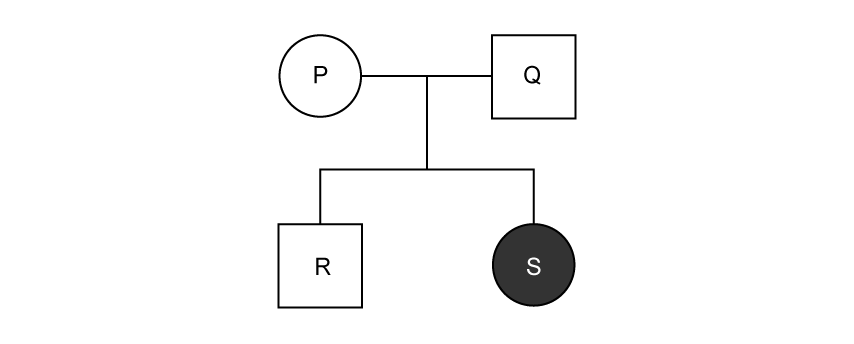
Complete the table by giving the genotype of each individual.
One has been done for you.
Individual | Genotype |
|---|---|
P | |
Q | |
R | Dd |
S |
The parents have a third child.
Calculate the probability that this third child is female and has the condition.
The graphs show changes in the concentrations of the hormones testosterone and oestrogen in child R and in child S between the ages of 11 to 15.

Explain how the changes in hormone concentrations affect the development of each child.
Was this exam question helpful?