11 mark
Which of these formulae is that of an alkane?
C6H11
C8H16
C10H22
C12H28
Was this exam question helpful?
Exam code: 4XSD1
Which of these formulae is that of an alkane?
C6H11
C8H16
C10H22
C12H28
Was this exam question helpful?
The table shows the displayed formulae of some organic compounds.

Which two are not classed as alkanes?
R and S
S and T
P and Q
R and T
Was this exam question helpful?
What is the correct chemical formula of butane?
C3H6
C3H8
C4H8
C4H10
Was this exam question helpful?
The structure of a molecule of propane is shown as

Give the names of the elements combined together in propane.
Propane can burn completely in oxygen to form carbon dioxide and water.
i) Write the word equation for this reaction.
[2]
ii) Propane is a fuel. Give the reason why fuels are burned.
[1]
Which product is formed when there is incomplete combustion of propane?
sulfur dioxide
oxygen
hydrogen
carbon monoxide
Which of the following is the formula of an alkane?
C6H5OH
CH3CH2CH2CH3
H2C=CHCH2CH3
C6H12
Was this exam question helpful?
This question is about alkanes. Draw one line from the name of the alkane to the correct displayed formula.

What is the general formula of alkanes?
CnH2n
CnH2n+1
CnH2n+2
What type of bond is formed between the carbon and hydrogen atoms in an alkane?
Ethane can react with chlorine in a substitution reaction where one of the hydrogen atoms in ethane is replaced by a chlorine atom.
i) Complete the equation for the reaction
ethane + ......................... → ........................................... + hydrogen chloride
[2]
ii) What condition is necessary for this reaction to occur?
[1]
☐ | A | a catalyst |
☐ | B | 30 °C and no oxygen |
☐ | C | ultraviolet radiation |
☐ | D | none - it will occur at room temperature and pressure |
Was this exam question helpful?
The table shows the molecular formulae of six organic compounds, A, B, C, D, E and F.
A | B | C | D | E | F |
C2H4 | C2H6 | C3H6 | C3H8 | C4H8 | C4H10 |
i) Explain which homologous series compound B belongs to.
[2]
ii) Give the letter of the compound that has the same empirical formula as its molecular formula.
[1]
iii) Compound F exists as two isomers.
Explain what is meant by the term isomers.
Include the structures of the two isomers of compound F in your answer.
[3]
Describe how compound D can be obtained from crude oil using the industrial process of fractional distillation.
Compound C can be used to make a polymer.
i) State the type of polymer formed from compound C.
[1]
ii) Name the polymer formed from compound C.
[1]
iii) Draw the structure of this polymer.
Include the displayed formula of the repeat unit.
[2]
Was this exam question helpful?
This question is about alkanes and alkenes.
i) Complete the boxes by giving the missing information about the alkane with the molecular formula C2H6
molecular formula | C2H6 |
name | |
empirical formula | |
displayed formula |
[3]
ii) Complete the chemical equation for the complete combustion of the alkane C2H6
[1]
...........C2H6 + ...........O2 → ...........CO2 + ...........H2O
iii) Incomplete combustion occurs when the air supply is limited.
Give the names of two products of incomplete combustion.
[2]
i) Draw displayed formulae for two different alkenes with the molecular formula C4H8
[2]
|
|
ii) State the term used for compounds with the same molecular formula but different structural formulae.
[1]
An alkene with molecular formula C4H8 reacts with bromine to form a compound with molecular formula C4H8Br2
What is the name of this type of reaction?
addition
decomposition
precipitation
substitution
The alkene C3H6 can be polymerised to form the polymer poly(propene).
i) Complete the equation for this polymerisation reaction.
[2]

ii) Two ways of disposing of polymers such as poly(propene) are:
burying them in landfill sites
burning them to release heat energy
Discuss the environmental problems caused by these two methods of disposal.
[3]
Was this exam question helpful?
Ethane and bromine can react in the following reaction:

What name is given to this type of reaction?
Substitution
Addition
Dehydration
Thermal decomposition
Was this exam question helpful?
Methane and bromine react to form bromomethane and hydrogen bromide.
What does this reaction occur in the presence of?
Infrared radiation
Visible light
Ultraviolet radiation
Ozone
Was this exam question helpful?
Alkanes are hydrocarbons. The structure of a molecule of butane is shown.

Which of the following is the empirical formula for butane?
CH
CH2
C2H5
C4H10
The graph below shows the boiling points of some alkanes plotted against the number of carbon atoms in one molecule of each alkane.

A molecule of pentane contains five carbon atoms. Use the graph to estimate the boiling point of pentane.
boiling point of pentane = .............................................................. °C
When pentane reacts with bromine in the presence of ultraviolet radiation, bromopentane is produced.
i) State the name of the other product formed in this reaction.
[1]
ii) Give the molecular formula of bromopentane.
[1]
Draw the displayed formula of the three isomers of bromopentane.
isomer 1 | isomer 2 | isomer 3 |
|
|
|
Was this exam question helpful?
This question is about alkanes and alkenes.
The alkane, C4H10, has two isomers.
i) Calculate the relative formula mass (Mr) of C4H10.
Mr of C4H10 = ..............................................................
[1]
ii) Explain the meaning of the term isomers.
[2]
iii) This is the displayed formula of one of the isomers:
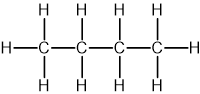
State the name of this isomer.
[1]
iv) Draw the displayed formula of the other isomer.
[1]
Bromine will react with C4H10 and C4H8.
Explain the difference in the reactions of each substance with bromine.
Refer to the conditions, the products, and the types of reaction involved.
Was this exam question helpful?
There are three isomers with the molecular formula C5H12
One of these isomers is pentane.
The displayed formula for pentane is

i) State what is meant by the term isomers.
[2]
ii) Draw the displayed formula for another isomer of C5H12
[2]
Pentane reacts with bromine in the presence of ultraviolet radiation.
i) Complete the equation for this reaction.
[2]
C5H12 + Br2 → .................... + ....................
ii) Give the name of this type of reaction.
[1]
Was this exam question helpful?
Hexane and cyclohexane are both hydrocarbons containing six carbon atoms. Their structures are shown below.

Compare the structures of hexane and cyclohexane.
A sample of one of these structures was found to contain 83.72% carbon.
i) Calculate its empirical formula.
Show your working.
[3]
ii) Deduce whether the sample was hexane or cyclohexane.
[1]
i) Give the molecular formula of cyclohexane.
[1]
ii) Draw the displayed formula of an isomer of cyclohexane.
[1]
In the presence of ultraviolet radiation, hexane will react with chlorine to form hydrogen chloride and another compound, X. Compound X will undergo a further substitution reaction when heated with sodium hydroxide solution to form sodium chloride and a compound with the formula CH3(CH2)5OH.
Cyclohexane will also react with chlorine in the presence of ultraviolet radiation to form hydrogen chloride and compound Y. When heated with sodium hydroxide solution, compound Y will undergo a further substitution reaction to form sodium chloride and another product, Z. Give the names of compounds X, Y and Z.
Compound X | ................................................. |
Compound Y | ................................................. |
Compound Z | ................................................. |
Was this exam question helpful?
Three consecutive straight-chain members of the same homologous series are pentane, hexane and heptane.
Pentane is the compound containing the least number of carbon atoms.
Suggest the molecular formula of heptane.
Draw one line from each alkane to its boiling point.

Alkynes are hydrocarbons with the general formula CnH2n-2. The alkyne containing 2 carbon atoms is ethyne, C2H2.
State, with a reason, whether the boiling point of ethyne would be expected to be higher or lower than the boiling point of ethane, C2H6.
Complete the dot-and-cross diagram for a molecule of ethyne, C2H2.

Was this exam question helpful?