Elements, compounds & mixtures (Edexcel IGCSE Science (Double Award) (Modular): Chemistry Unit 1): Exam Questions

Exam code: 4XSD1

3 hours23 questions
1a
4 marks

Substances can be classified as elements, compounds or mixtures.

Each of the boxes in the diagram represents either an element, a compound or a mixture.

Six labelled boxes, each showing the particles present in one substance. Box 1 contains three separate He atoms. Box 2 contains three H-H molecules. Box 3 contains one He atom and two H-H molecules. Box 4 contains three H-O-H molecules. Box 5 contains two H-H molecules and one H-O-H molecule. Box 6 contains three H-O-O-H molecules.

i) Explain which two boxes represent an element.

[2]

ii) Explain which two boxes represent a mixture.

[2]

1b
3 marks

The list gives the names of some methods used in the separation of mixtures:

  • chromatography

  • crystallisation

  • distillation

  • filtration

Use names from the list to choose a suitable method for each separation. Each name may be used once, more than once or not at all.

i) Separating water from sodium chloride solution.

[1]

ii) Separating the blue dye from a mixture of blue and red dyes.

[1]

iii) Separating potassium nitrate from potassium nitrate solution.

[1]

2a
3 marks

The box gives some methods used in the separation of mixtures.

chromatography

crystallisation

evaporation

filtration

fractional distillation

simple distillation

Use words from the box to answer these questions.

i) Identify the method used to obtain pure water from sea water.

[1]

ii) Identify the method used to separate the dyes in a food colouring.

[1]

iii) Identify the method used to obtain ethanol from a mixture of ethanol and water.

[1]

2b
3 marks

Complete the sentences by writing a suitable word in each blank space.

When salt is added to water and stirred until no more will ............................................ , a saturated solution forms.

The salt is the ........................................................ .

The water is the ......................................................... .

3a
1 mark

The box lists some substances. Choose substances from the box to answer these questions.

Each substance may be used once, more than once or not at all.

air

bromine

carbon

copper

glucose


nitrogen

oxygen

sulfur

water

Name a metallic element.

3b
1 mark

Name a compound.

3c
1 mark

Name a mixture.

3d
1 mark

Name an element that is a gas at room temperature.

3e
1 mark

Name an element that forms a basic oxide.

3f
1 mark

Name two elements that are in the same group of the Periodic Table.

4a
1 mark

Name the technique used to separate the mixture of colours in black ink.

4b
3 marks

The box gives the names of some substances.

air

bromine

magnesium

neon

sodium chloride

sulfur

i) Choose substances from the box to answer these questions. Identify the compound.

[1]

ii) Identify the mixture.

[1]

iii) Identify the non‐metal element that is a solid at room temperature.

[1]

5a
1 mark

A student is given a mixture of salt solution and sand. She wants to obtain pure water from the mixture.

She separates the sand from the salt solution. Which method of separation should she use?

  • crystallisation

  • filtration

  • fractional distillation

  • simple distillation

5b
4 marks

The student then uses this apparatus to obtain pure water from the salt solution.

Line diagram of simple distillation apparatus. A round-bottomed flask, labelled flask, holds salt solution and is heated from below, shown by an upward arrow labelled heat. A vertical thermometer labelled X is fitted through the neck of the flask with its bulb just below the side arm. A long sloping water-jacketed tube labelled Y runs down to the right from the side arm, with water in entering at its lower right end and water out leaving at its upper left end. The open delivery tube at the end of Y points down into an open rectangular container labelled Z.

i) Name the pieces of apparatus labelled X, Y and Z.

[3]

X ..........................................................................................................

Y ..........................................................................................................

Z ..........................................................................................................

ii) State what remains in the flask when the separation is complete.

[1]

6a
1 mark

Substances can be classified as elements, mixtures or compounds.

Each box represents an element, a mixture or a compound.

Five labelled boxes, each showing the particles in one substance. Box 1 has five separate open circles. Box 2 has five joined pairs of filled circles and three separate open circles. Box 3 has six joined pairs of filled circles. Box 4 has three identical molecules, each an open circle joined to two smaller filled circles. Box 5 has one large connected network of filled circles joined by bonds to smaller open circles.

Which box represents a mixture?

  • 1

  • 2

  • 3

  • 4

6b
1 mark

Which two boxes represent elements?

  • 1 and 2

  • 2 and 3

  • 1 and 3

  • 3 and 4

6c
2 marks

Explain why Box 5 represents a compound.

[2]

6d
1 mark

The Periodic Table contains all the known elements.

How are the elements arranged in the Periodic Table?

  • increasing mass number

  • Increasing number of neutrons

  • increasing number of protons

  • increasing reactivity

6e
1 mark

Elements in the same group have the same number of

  • electrons in outer shell

  • electron shells

  • neutrons

  • protons

7
1 mark

The diagram below represents a sample of air:

A square box containing eight molecules, each drawn as two joined circles: five pairs of filled black circles and three pairs of open white circles. A key beside the box shows a filled black circle labelled nitrogen atom and an open white circle labelled oxygen atom.

What correctly describes this sample of air?

  • an element

  • a compound

  • a mixture of elements

  • a mixture of compounds

8a
3 marks

This question is about mixtures and compounds.

The box gives some methods used to separate mixtures.

chromatography

crystallisation

fractional distillation

simple distillation

Choose methods from the box to answer the following questions.

Each method may be used once, more than once or not at all.

i) Identify a method to separate a single food dye from a mixture of food dyes.

[1]

ii) Identify a method to separate gasoline from crude oil.

[1]

iii) Identify a method to separate water from copper(II) sulfate solution.

[1]

8b
2 marks

The diagram represents a molecule.

A molecule drawn as two overlapping circles of different sizes and shadings. A smaller grey shaded circle on the left overlaps a larger unshaded circle on the right, so the two circles are joined.

Explain why this molecule is a compound.

8c
2 marks

The molecular formula of another compound is C3H5N3O9

i) State the number of different elements in C3H5N3O9

[1]

ii) Determine the number of atoms in a molecule of C3H5N3O9

[1]

1a
4 marks

A student uses this apparatus to investigate the colours in four different inks, A, B, C and D.

Line diagram of a chromatography experiment. A tall open beaker holds water, with the water level drawn as a horizontal line across the beaker and labelled water. A rectangular sheet of chromatography paper, labelled chromatography paper, hangs inside the beaker with its lower edge below the water level. A horizontal line labelled baseline drawn in ink runs across the paper below the water level, and four ink spots sit on this line, labelled A, B, C and D from left to right.

Explain two mistakes the student made when setting up the experiment.

1b
4 marks

Another student does the experiment but does not make any mistakes.

The diagram shows her results.

Chromatogram on a rectangular sheet of chromatography paper. A horizontal line labelled baseline runs across the sheet near the bottom, with four lanes marked A, B, C and D from left to right below it. Lane A has one spot at a middle height. Lane B has two spots, one high and one low. Lane C has a single spot that has not moved off the baseline. Lane D has three spots, one high, one at a middle height and one low. The spot in lane A is level with the middle spot of lane D, and the two spots in lane B are level with the top and bottom spots of lane D.

i) State how many colours ink D contains.

[1]

ii) State which of the inks tested could be mixed together to make ink D.

[1]

iii) Explain which of the inks tested is insoluble in water.

[2]

2
1 mark

The diagram shows four pieces of apparatus for separating mixtures:

Four line drawings of laboratory apparatus, labelled A, B, C and D. A is a Y-shaped glass tube with a dashed line marking the join. B is a shallow curved dish with one lip turned up. C is a round-bottomed flask closed with a stopper, with a side arm leading down into a long condenser. D is a round-bottomed flask topped by an upright column packed with beads, with a thermometer through the stopper at the top and a side arm leading down into a long condenser.

Which one would be most suitable for separating a mixture of alcohol and water?

    3a
    2 marks

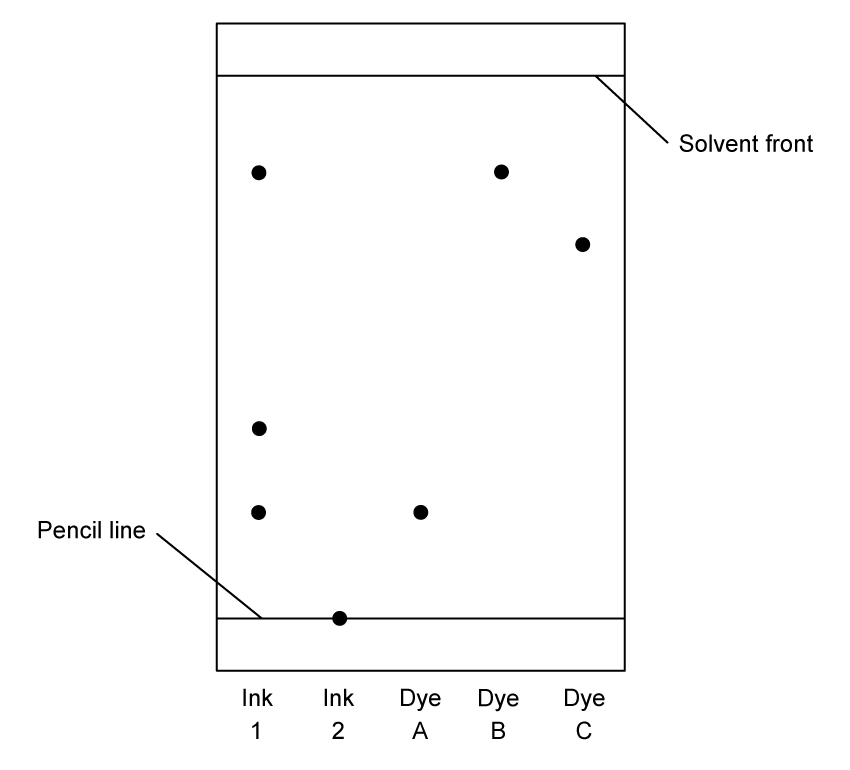
    A student does a chromatography experiment using ink 1, ink 2, and three known dyes A, B and C. The student uses water as the solvent.

    The diagram shows the student’s chromatogram.

    A chromatogram on a rectangular sheet of paper. A pencil line runs across near the bottom and the solvent front runs across near the top. Five lanes are labelled below the pencil line, reading left to right: ink 1, ink 2, dye A, dye B, dye C. Ink 1 has three spots, one high up near the level of dye B, one about halfway up and one lower down. Ink 2 has a single spot still sitting on the pencil line. Dye A has one spot level with the lowest of the ink 1 spots. Dye B has one spot level with the highest of the ink 1 spots. Dye C has one spot a little below the level of dye B, not level with any ink 1 spot.

    Deduce what conclusions can be made about the composition of ink 1.

    3b
    2 marks

    i) Give one conclusion that can be made about ink 2.

    [1]

    ii) Suggest how the student could change the experiment to find the composition of ink 2.

    [1]

    3c
    3 marks

    Calculate the Rf value of dye C, giving your answer to 2 significant figures.

    Rf value = ...............................................

    4a
    7 marks

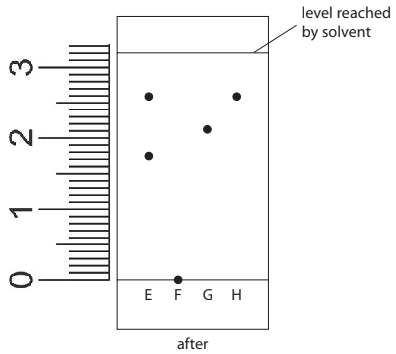
    A student uses paper chromatography in an experiment to separate the dyes in four different food colourings, E, F, G and H.

    The diagram shows the appearance of the paper before and after the experiment.

    Two diagrams of the same sheet of chromatography paper, labelled before and after. In the before diagram a start line runs across near the bottom with four spots on it, labelled E, F, G and H. In the after diagram a line near the top is labelled level reached by solvent. Lane E now has two spots, one high up and one about halfway. Lane F still has a single spot sitting on the start line. Lane G has one spot a little below the height of E's top spot. Lane H has one spot level with E's top spot, the highest spots on the paper.

    i) Describe how the student should complete the experiment after putting a spot of each food colouring on the paper.

    [3]

    ii) Deduce the number of dyes in food colouring H.

    [1]

    iii) Suggest why food colouring F does not move during the experiment.

    [1]

    iv) Explain which two food colourings contain the dye that is likely to be the most soluble in the solvent.

    [2]

    4b
    3 marks

    Determine which food colouring contains a dye with Rf value closest to 0.67 

    Diagram of chromatography results showing solvent level at 3 cm and sample spots E to H along baseline, with distances marked by a ruler.

    Show your working.

    5a
    2 marks

    This question is about chromatography.

    Two students carry out separate chromatography experiments to find the Rf values for five different food dyes, A, B, C, D and E.

    State two things that should be the same in both experiments so that the students can compare their results fairly.

    5b
    3 marks

    After doing the experiments the students calculate the Rf value for each food dye.

    The table shows their results.

    Dye

    Student 1 Rf value

    Student 2 Rf value

    A

    0.45

    0.45

    B

    0.63

    0.64

    C

    0.00

    0.00

    D

    0.83

    1.20

    E

    0.30

    0.30

    i) State what can be concluded about dye C.

    [1]

    ii) Explain which Rf value cannot be correct.

    [2]

    5c
    3 marks

    The diagram shows a chromatogram for a different food dye.

    Some distances are shown on the diagram.

    A narrow strip of chromatography paper standing upright, with distances marked by brackets down the left-hand side. Reading from the top: 2.0 cm from the top of the paper down to the solvent front, then 2.3 cm from the solvent front down to a single spot, then 9.7 cm from that spot down to the start line, then 1.0 cm from the start line down to the bottom of the paper.

    Calculate the Rf value for this food dye.

    Give your answer to two significant figures.

    6
    1 mark

    A student obtained the following chromatogram for substance A.

    Diagram of a chromatogram beside a vertical ruler. A tall narrow rectangular strip has a horizontal line near its foot labelled Baseline, with the letter A written on the strip below that line. A second horizontal line near the top of the strip is labelled Solvent front. One small grey oval spot sits on the strip between the two lines, roughly a third of the way up. A ruler stands upright beside the strip with its zero at the bottom, its centimetre scale numbered 1 to 10 going upwards and an inches scale numbered 1 to 4 alongside it. Read against the centimetre scale, the baseline is at 0.8 cm, the centre of the spot is at 3.3 cm and the solvent front is at 7.9 cm.

    Determine the Rf value of substance A.

    • 0.66

    • 0.26

    • 0.35

    • 0.43

    7a
    1 mark

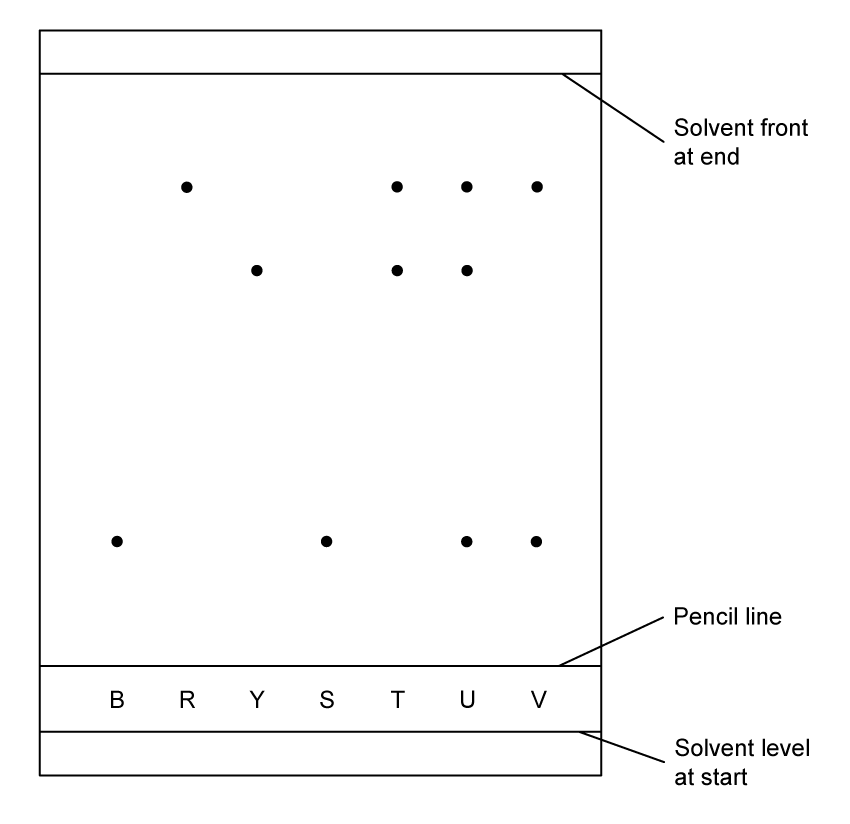
    In a chromatography experiment a student uses samples of three pure food dyes, blue (B), red (R) and yellow (Y). He also uses samples of four unknown substances, S, T, U and V. The student puts a small drop of each substance on the pencil line. The diagram shows the student’s chromatogram at the end of the experiment.

    A chromatogram. A pencil line runs across near the bottom and the solvent front near the top, with the solvent level at the start marked below the pencil line. Seven lanes are labelled below the pencil line: B, R, Y, S, T, U and V. B has one spot low down. R has one spot high up. Y has one spot a little below R's. S has one spot level with B's. T has two spots, level with R's and Y's. U has three spots, level with R's, Y's and B's. V has two spots, level with R's and B's.

    Which of the unknown substances contains only one food dye?

    • substance S

    • substance T

    • substance U

    • substance V

    7b
    2 marks

    Explain which pure food dyes are in substance V.

    7c
    5 marks

    i) Calculate the Rf value of the yellow food dye Y.

    [3]

    Rf = ..............................................................

    ii) State how the chromatogram suggests that the yellow food dye Y is less soluble in the solvent than the red food dye R.

    [2]

    8a
    2 marks

    Chromatography is used to analyse mixtures.

    A student does a chromatography experiment to analyse the composition of green food colouring in sweets.

    She places four known dyes, A, B, C and D, and the green food colouring on chromatography paper.

    The diagram shows the student’s apparatus at the start of her experiment.

    Line diagram of a chromatography experiment. A beaker with rounded lower corners holds water, and the water surface is drawn as a horizontal line across the beaker. A rectangular sheet of chromatography paper hangs vertically inside the beaker, reaching from above the rim down almost to the base. A horizontal start line is drawn across the paper below the water surface and is labelled start line drawn in ink. Five spots sit on the start line, labelled from left to right A, B, C, D and Green. The water surface is labelled water and lies above the start line and its spots.

    The diagram shows that the student makes two mistakes when setting up her apparatus.

    State the two changes that the student should make so that her experiment works.

    8b
    7 marks

    Another student does the chromatography experiment correctly.

    The diagram shows her chromatogram at the end of the experiment.

    Chromatogram on a rectangular sheet of chromatography paper. A horizontal line near the top is labelled solvent front. A horizontal start line runs across the bottom, with five lanes labelled from left to right A, B, C, D and Green. Lane A has a single spot sitting on the start line. Lane B has one spot about a third of the way up the paper. Lane C has one spot a little over half way up. Lane D has one spot just below the solvent front. The Green lane has three spots: the highest is level with the spot in lane D, the middle one is a little lower and level with no other lane, and the lowest is level with the spot in lane B.

    i) Explain what the chromatogram shows about the composition of the green food colouring.

    [3]

    ii) The distance between the start line and the spot for dye C is 6.2 cm. Calculate the Rf value of dye C.

    Rf value = ..............................................................

    [3]

    iii) Suggest why dye A does not move.

    [1]

    9a
    5 marks

    This question is about elements, compounds, and mixtures.

    i) Table 1 shows nine substances, which are elements, compounds, or mixtures.

    [3]

    brass

    salt

    crude oil

    buckminsterfullerene

    air

    water

    iodine

    concrete

    kerosene

    Table 1

    Complete table 2 below using the words from table 1. Every word in table 1 must appear in one of the boxes in table 2.

    Element

    Compound

    Mixture

    Table 2

    ii) Suggest, with a reason, which substance(s) in table 1 has/have a fixed melting and boiling point.

    [2]

    9b
    1 mark

    Which statement correctly describes the contents of the box?

    A box containing five single unfilled circles and four pairs of joined black circles, scattered randomly.
    • a mixture of elements

    • a mixture of compounds

    • a mixture of elements and compounds

    • a compound

    9c
    5 marks

    Fractional distillation is used to obtain many fractions from crude oil.

    The diagram shows a fractionating column.

    i) Complete the missing labels on the diagram.

    [2]

    Distillation column diagram showing separation of heated crude oil into refinery gases, gasoline, diesel, and bitumen through distinct outlets. From the top down the outlets are labelled refinery gases, gasoline, a blank label, diesel, a blank label and bitumen

    ii) Explain how crude oil is separated using a fractionating column.

    [3]

    9d
    2 marks

    An organic compound has the formula (CH3COO)2Ca

    i) Determine the number of different elements in (CH3COO)2Ca.

    [1]

    ii) Determine the number of atoms in the formula of (CH3COO)2Ca.

    [1]

    10
    1 mark

    A student set up the following apparatus to investigate the colours in three different food colourings.

    A chromatography experiment set up in a beaker. Labels point to a lid across the top of the beaker, the beaker itself, a sheet of chromatography paper hanging inside it, a start line drawn across the paper near the bottom carrying three spots labelled A, B and C, and water in the base of the beaker, its level below the start line.

    What are the stationary and mobile phases for this experiment?

    • stationary: chromatography paper

      mobile: water

    • stationary: beaker

      mobile: start line

    • stationary: water

      mobile: food colourings

    • stationary: start line

      mobile: chromatography paper

    1a
    1 mark

    A salt can be made by reacting an acid with an insoluble base.

    A student has a sample of copper(Il) oxide.

    The student uses this method.

    • Stage 1 pour 50 cm3 of dilute sulfuric acid into a beaker

    • Stage 2 warm the acid using a Bunsen burner

    • Stage 3 add a small amount of copper(II) oxide to the warm acid and stir the mixture

    • Stage 4 add further amounts of copper(II) oxide until copper(II) oxide is in excess

    • Stage 5 filter the mixture

    • Stage 6 obtain crystals from the filtrate

    State why the acid is warmed in stage 2.

    1b
    1 mark

    State how the student would know that the copper(II) oxide is in excess in stage 4.

    1c
    1 mark

    State why the mixture is filtered in stage 5.

    1d
    1 mark

    State the colour of the filtrate obtained in stage 5.

    1e
    5 marks

    Describe how the student could obtain a pure, dry sample of hydrated copper(II) sulfate crystals from the filtrate in stage 6.

    1f
    5 marks

    The overall equation for the formation of hydrated copper(ll) sulfate crystals from copper(II) oxide is

    CuO (s) + H2SO4 (aq) + 4H2O (I) → CuSO4.5H2O (s)

    i) In an experiment, a student completely reacts 9.54 g copper(II) oxide.

    Show that the maximum possible mass of CuSO4.5H20 crystals that can be obtained is about 30 g.

    [Mr of CuO = 79.5 Mr of CuSO4.5H2O = 249.5]

    Give your answer to an appropriate number of significant figures.

    [3]

    mass = .............................. g

    ii) In this experiment, the actual yield of CuSO4.5H2O crystals is 23.92 g.

    Calculate the percentage yield of CuSO4.5H2O

    [2]

    2a
    2 marks

    The table gives information about some lead compounds.

    Compound

    Formula

    Appearance

    Solubility in water

    lead(II) oxide

    PbO

    yellow solid

    insoluble

    lead(IV) oxide

    PbO2

    brown solid

    insoluble

    red lead oxide

    Pb3O4

    red solid

    insoluble

    lead(II) nitrate

    Pb(NO3)2

    white solid

    soluble

     When a sample of red lead oxide is heated, it changes into a yellow solid and a gas forms that relights a glowing splint.

    Complete the word equation for this reaction.

    red lead oxide → ........................................ + ........................................ 

    2b
    3 marks

    A sample of one of the oxides of lead contains 86.6% lead and 13.4% oxygen by mass.

    Show by calculation that the sample is lead(IV) oxide, PbO2 

    [Ar of Pb = 207   Ar of O = 16]

    2c
    8 marks

    Red lead oxide reacts with warm dilute nitric acid.

    i) Complete the chemical equation for the reaction.

    Pb3O4 (..........) + 4HNO3 (..........) → ..........Pb(NO3)2 (aq) + PbO2 (s) + ..........H2O (l)

    [2]

    ii) A student is given a sample of solid red lead oxide and some dilute nitric acid.

    Describe how the student could obtain a pure dry sample of lead(II) nitrate crystals.

    [6]

    3a
    4 marks

    This question is about the separation of mixtures.

    The box gives some methods used to separate mixtures.

    crystallisation

    filtration

    fractional distillation

    simple distillation

    Complete the table by giving the correct method from the box for each separation. Each method can be used once, more than once or not at all.

    Separation

    Method

     insoluble solid from a liquid


     pure water from a solution


     liquid from a mixture of liquids with different boiling points


     soluble solid from a solution


    3b
    4 marks

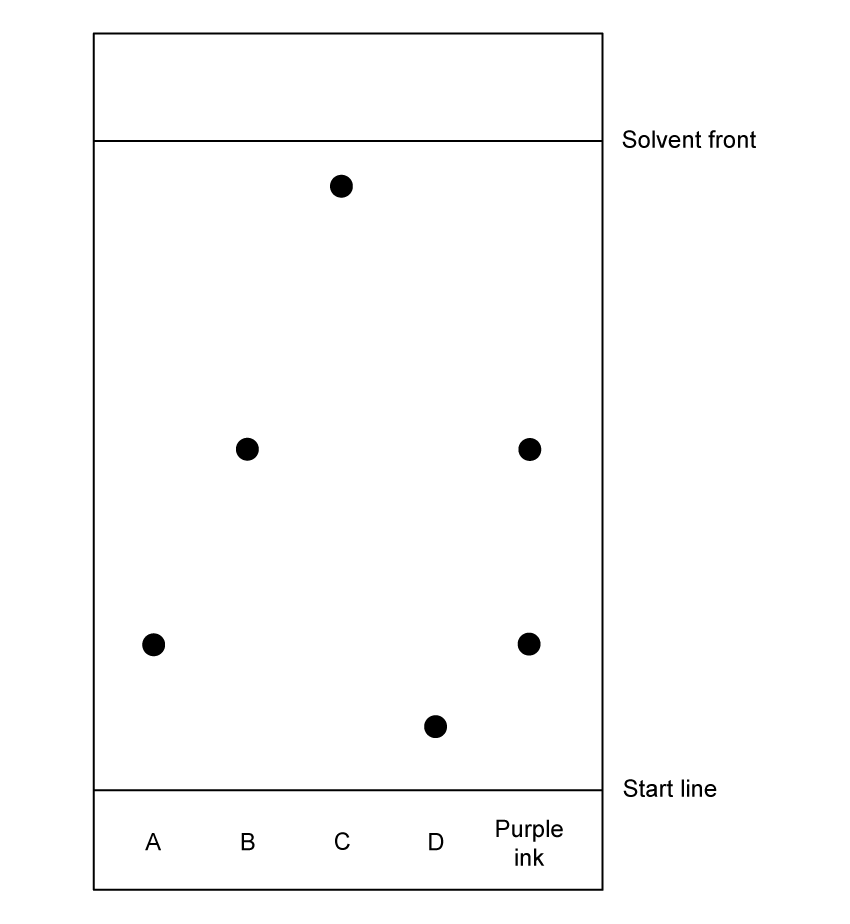
    A student uses chromatography to analyse the composition of purple ink. The diagram shows the student’s chromatogram at the end of the experiment.

    A chromatogram. A start line runs across near the bottom and the solvent front near the top. Five lanes are labelled below the start line: A, B, C, D and purple ink. A has one spot low down. B has one spot about halfway up. C has one spot high up, close to the solvent front. D has one spot just above the start line, the lowest on the paper. The purple ink lane has two spots, one level with B's spot and one level with A's spot.

    i) Explain which dyes are contained in the purple ink.

    [2]

    ii) Explain which dye is least soluble in the solvent.

    [2]

    3c
    2 marks

    A different chromatography experiment is set up.

     A spot of food colouring is placed on the start line. 

    A food dye in the colouring has an Rf value of 0.72 

    The distance between the start line and the solvent front is 120 mm. 

    Calculate the distance the food dye moves from the start line. 

    distance = .............................................................. mm

    4a
    1 mark

    This question is about soluble and insoluble compounds.

    A precipitate is an insoluble compound formed when solutions of soluble compounds react after mixing.

    Different solutions are mixed in separate test tubes.

    • Tube 1 copper(II) sulfate solution and calcium chloride solution

    • Tube 2 magnesium nitrate solution and potassium sulfate solution

    • Tube 3 sodium carbonate solution and copper(II) sulfate solution

    In which of the tubes will a precipitate form?

    • 1 and 2 only

    • 2 and 3 only

    • 1 and 3 only

    • 1, 2 and 3

    4b
    7 marks

    A student mixes solutions, containing equal amounts in moles, of silver nitrate and sodium chloride.

    The equation for the reaction between silver nitrate solution and sodium chloride solution is

    AgNO3 (aq) + NaCl (aq) → AgCl (s) + NaNO3 (aq)

    i) State the colour of the precipitate of silver chloride.

    [1]

    ii) The student wants to obtain pure, dry crystals of sodium nitrate.

    Crystals of sodium nitrate decompose at temperatures above 300 °C.

    Describe a method the student could use to obtain pure, dry crystals of sodium nitrate.

    [5]

    iii) Give an advantage of mixing solutions containing equal amounts, in moles, of silver nitrate and sodium chloride

    [1]

    5a
    4 marks

    A student uses paper chromatography to investigate the dyes in five different inks, V, W, X, Y and Z.

    This is what she uses.

    • a beaker

    • a piece of chromatography paper with a pencil line drawn near the bottom of the paper

    • a solvent

    • inks V, W, X, Y and Z

    Describe how the student should set up and carry out her experiment.

    You may draw a diagram to help with your answer.

    5b
    2 marks

    Explain why the line on the paper is drawn in pencil rather than in ink.

    5c
    6 marks

    The chromatogram shows the results for inks V, W, X, Y and Z.

    A chromatogram. A start line runs across near the bottom and the solvent front near the top. Five lanes are labelled below the start line: V, W, X, Y and Z. V has a single spot sitting on the start line. W has one spot about a third of the way up. X has two spots, one level with W's spot and one high up near the solvent front. Y has three spots, one low down and two close together about two thirds of the way up. Z has four spots spread from low down to high up, its highest spot level with X's highest spot.

    i) Explain which ink contains a dye that is insoluble in the solvent.

    [2]

    ii) Explain which two inks contain the dye that is likely to be the most soluble in the solvent.

    [2]

    iii) Explain which two inks may contain only one dye.

    [2]

    5d
    3 marks

    One dye in ink Y moves 4.3 cm when the solvent front moves 6.5 cm. Calculate the Rf value for this dye. Give your answer to 2 significant figures.