11 mark
What numbers will balance the following equation?
_Fe (s) + _O2 (g) → _Fe2O3 (g)
2,3,4
4,3,2
2,3,1
1,2,3
Was this exam question helpful?
Exam code: 4XSD1
What numbers will balance the following equation?
_Fe (s) + _O2 (g) → _Fe2O3 (g)
2,3,4
4,3,2
2,3,1
1,2,3
Was this exam question helpful?
A company produces tin from an ore called cassiterite, which is mainly tin oxide.
What is the relative formula mass (Mr) of tin oxide, SnO2?
[Ar of Sn= 119; O= 16 ]
135
151
270
1904
Was this exam question helpful?
What is the relative formula mass of hydrated magnesium carbonate, MgCO3.2H2O?
[Ar of Mg= 24; H= 1; O=16; C=12]
84
102
112
120
Was this exam question helpful?
A student wanted to make 15.0 g of zinc chloride. The equation for the reaction is:
ZnCO3 + 2HCl → ZnCl2 + CO2 + H2O
What mass of zinc carbonate should the student add to the hydrochloric acid to make 15.0 g of zinc chloride?
[Ar of C = 12; Zn = 65; O = 16; Cl = 35.5; H = 1]
11.0 g
13.8 g
15.0 g
22.0 g
Was this exam question helpful?
How many moles are present in 9 kg of glucose, C6H12O6?
[Mr of C6H12O6 = 180 ]
0.02 mol
0.05 mol
20 mol
50 mol
Was this exam question helpful?
The boxes show the displayed formulae of six organic compounds, P, Q, R, S, T and U.

Use the letters P, Q, R, S, T and U to answer these questions. Each letter may be used once, more than once or not at all.
i) Give the letter of the compound that is not a hydrocarbon.
[1]
ii) Give the letters of the two compounds that have the same empirical formula.
[1]
iii) Give the letter of the compound that is used to manufacture poly(propene).
[1]
Describe a test that can be used to distinguish between compounds Q and T.
test ....................................................................................................
result with compound Q ....................................................................................................
result with compound T ....................................................................................................
Compounds P, Q and R are members of the same homologous series. Give two characteristics of a homologous series.
This is the displayed formula of an alkene, V.

i) Give the name of alkene V.
[1]
ii) Draw the displayed formula of another alkene that is an isomer of alkene V.
[1]
An organic compound has the percentage composition by mass
C = 36.36% H = 6.06% F = 57.58%
i) Show that the empirical formula of the compound is CH2F
[2]
ii) The relative molecular mass (Mr) of the compound is 66. Determine the molecular formula of the compound.
[2]
molecular formula = ......................................................................
Was this exam question helpful?
What is the mass of 0.25 moles of hydrated copper(II) sulfate, CuSO4.5H2O?
Relative formula mass (Mr): H2O = 18 CuSO4 = 160
40.0 g
44.5 g
62.5 g
1000 g
Was this exam question helpful?
Sodium hydroxide dissolves in water, forming a strongly alkaline solution.
Ammonia dissolves in water, forming a slightly less alkaline solution.
Identify the ion that makes the sodium hydroxide solution alkaline.
Ammonia dissolves in water, forming a solution that is slightly less alkaline than sodium hydroxide solution.
What is a possible pH of ammonia solution?
3
6
11
14
When ammonia solution reacts with sulfuric acid, a neutralisation reaction occurs and ammonium sulfate forms.
How does the sulfuric acid act in this reaction?
as a neutron donor
as a neutron acceptor
as a proton donor
as a proton acceptor
The diagram shows a beaker containing some ammonia solution and a few drops of phenolphthalein indicator.

Dilute sulfuric acid is added to the beaker until it is in excess.
What are the colours of the phenolphthalein indicator before and after adding excess sulfuric acid?
orange → red
yellow → red
pink → colourless
colourless → pink
Ammonium sulfate is used by gardeners as a fertiliser because it contains nitrogen.
i) Explain why the chemical formula of ammonium sulfate is (NH4)2SO4
Refer to the charges on the ions in your answer.
[2]
ii) Calculate the relative formula mass of ammonium sulfate, (NH4)2SO4
[1]
relative formula mass = ..............................................................
iii) Calculate the mass, in grams, of nitrogen in 1.0 kg of ammonium sulfate.
[3]
mass = .............................................................. g
Was this exam question helpful?
When zinc oxide reacts with dilute nitric acid, zinc nitrate is produced. The equation for the reaction is:
ZnO + 2HNO3 → Zn(NO3)2 + H2O
0.200 mol of nitric acid reacts with excess zinc oxide. A mass of 15.3 g of zinc nitrate is produced. Calculate the percentage yield of zinc nitrate. [Mr of zinc nitrate = 189]
26%
37%
81%
65%
Was this exam question helpful?
The diagram shows the displayed formula of the organic compound methanol, CH3OH

i) Determine the number of atoms in one molecule of methanol.
[1]
ii) State why methanol is not a hydrocarbon.
[1]
The atoms in methanol are held together by covalent bonds.
i) State what is meant by the term covalent bond.
[2]
ii) Draw a dot-and-cross diagram to show the bonding in a molecule of methanol. Show only the outer electrons of each atom.
[2]
Another organic compound has the percentage composition by mass
C = 38.7% H = 9.7% O = 51.6%
i) Calculate the empirical formula of this compound.
[3]
empirical formula = ..............................................................
ii) The relative molecular mass (Mr) of the compound is 62 Determine the molecular formula of the compound.
[2]
molecular formula = ........................................................
Was this exam question helpful?
A piece of magnesium ribbon is ignited and placed in a gas jar of oxygen. The equation for the reaction is
2Mg + O2 → 2MgO
i) Give two observations that would be made in this reaction.
[2]
ii) State why this is an oxidation reaction.
[1]
A second piece of magnesium ribbon is ignited and placed in a gas jar of carbon dioxide. A very exothermic reaction occurs, forming magnesium oxide and carbon.
i) State what is meant by the term exothermic.
[1]
ii) Give the chemical equation for this reaction.
[1]
iii) A fire starts in a warehouse where magnesium is stored. Suggest why it would not be suitable to use a carbon dioxide fire extinguisher to put out this fire.
[1]
A student uses this apparatus to find the mass of magnesium oxide that forms when a known mass of magnesium is heated.

This is his method.
find the mass of the crucible and lid
place some magnesium ribbon in the crucible
find the mass of the crucible, lid and magnesium
heat the crucible with the lid on for a few minutes
find the mass of the crucible, lid and magnesium oxide
Using this method, the mass of magnesium oxide formed is less than expected. Explain two changes that the student should make to his method to obtain a mass of magnesium oxide closer to the expected mass.
Was this exam question helpful?
Halon 1301 is a compound used in some fire extinguishers.
Halon 1301 has the percentage composition by mass of 8.05% C, 53.69% Br and 38.26% F.
Calculate the empirical formula of Halon 1301.
[Ar of C = 12; Br = 80; F = 19]
CBrF
CBrF3
CBr3F
CBr2F2
Was this exam question helpful?
The diagram shows the displayed formula of succinic acid.

What is the empirical formula for this compound?
C4H6O4
CH2O
C2H3O2
CHO
Was this exam question helpful?
Many different salts can be prepared from acids.
The table shows the reactants used in two salt preparations. Complete the table to show the name of the salt formed and the other product(s) in each case.
Reactants | Name of salt formed | Other product(s) |
zinc + hydrochloric acid |
|
|
calcium carbonate + nitric acid |
|
|
A student uses the reaction between aluminium hydroxide and dilute sulfuric acid to prepare a pure, dry sample of aluminium sulfate crystals. The equation for the reaction used to prepare this salt is:
2Al(OH)3 + 3H2SO4 → Al2(SO4)3 + 6H2O
The diagram shows the steps in the student’s method.

i) State two ways to make sure that all the acid is reacted in step 2.
[2]
ii) State the purpose of filtration in step 3.
[1]
iii) In step 5, the basin is left to cool to room temperature to allow crystals of aluminium sulfate to form.
State one method of drying these crystals.
[1]
The student records this information about the reagents she uses in her preparation.
mass of aluminium hydroxide = 3.9 g
amount of sulfuric acid = 0.090 mol
Determine which reagent is in excess, making use of this information and the equation in part (b).
reagent used in excess = ..............................................................
Another student prepares 0.025 mol of aluminium sulfate. The formula of aluminium sulfate is Al2(SO4)3
Calculate the mass of aluminium sulfate prepared.
mass = .............................................................. g
The equation for another reaction used to prepare a sample of a salt is:
PbO + 2HNO3 → Pb(NO3)2 + H2O
In one experiment, the amount of lead(II) oxide used was 0.75 mol and the amount of nitric acid used was 1.5 mol. At the end of the experiment, the mass of lead(II) nitrate obtained was 209 g.
Calculate the percentage yield of lead(II) nitrate in this experiment.
[Mr of lead(II) nitrate = 331]
percentage yield = .............................................................. %
Was this exam question helpful?
Sodium hydrogencarbonate (NaHCO3) is also known as baking soda.
Baking soda can be used to make cakes increase in size in an oven.
This is the equation for the reaction that takes place when baking soda is heated.
2NaHCO3 (s) → Na2CO3 (s) + CO2 (g) + H2O (g)
i) What type of reaction is this?
[1]
☐ | A | combustion |
☐ | B | decomposition |
☐ | C | oxidation |
☐ | D | reduction |
ii) Suggest why the reaction makes the cakes increase in size.
[1]
A student uses this apparatus to investigate the reaction that takes place when sodium hydrogencarbonate is heated.

This is the student’s method.
Weigh a crucible and record the mass
Add some sodium hydrogencarbonate to the crucible, reweigh it and record the mass
Heat the crucible and contents for five minutes, then allow to cool before weighing and recording the mass
Heat the crucible and contents again for a further three minutes, then allow to cool before weighing and recording the mass
i) Give a reason why the crucible and contents are heated for a further three minutes.
[1]
ii) The student considered using a lid on the crucible in the experiment.
Suggest an advantage and a disadvantage of using a lid on the crucible.
[2]
advantage ....................................................................................................
disadvantage ....................................................................................................
The table shows some of the student’s results.
mass of crucible and sodium hydrogencarbonate in g | 29.75 |
mass of empty crucible in g | 26.50 |
i) Calculate the mass of sodium hydrogencarbonate that the student uses.
[1]
mass = ..............................................................g
ii) Using this equation, calculate the maximum mass of sodium carbonate (Na2CO3) that could form in the student’s reaction.
2NaHCO3 (s) → Na2CO3 (s) + CO2 (g) + H2O (g)
[Mr of NaHCO3 = 84 Mr of Na2CO3 = 106]
[3]
maximum mass = .............................................................. g
In a second experiment, the student uses a larger mass of sodium hydrogencarbonate.
She calculates that she should obtain 4.8 g of sodium carbonate.
She actually obtains 4.2 g of sodium carbonate.
i) Calculate the percentage yield from the student’s experiment.
[2]
percentage yield = ..............................................................%
ii) Other than spillages, suggest a possible reason why the student’s actual yield is less than expected.
[1]
Was this exam question helpful?
This question is about alkanes.
The graph shows the boiling points of several unbranched alkanes.
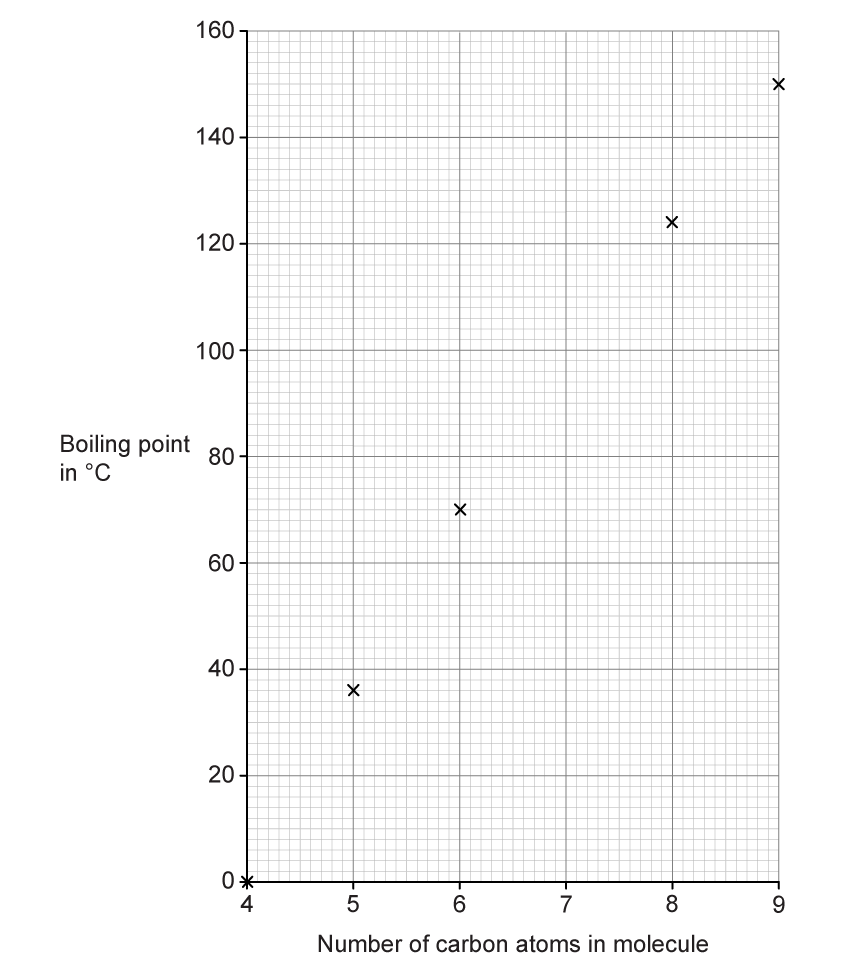
i) Draw a curve of best fit.
[1]
ii) Use the graph to find the boiling point of the alkane with 7 carbon atoms in its molecule.
Show on the graph how you obtain your answer.
[2]
boiling point = .............................................................. °C
iii) Explain the trend shown by the graph.
[3]
The diagram represents two isomers with the formula C5H12

Explain why these compounds are isomers.
i) An alkane contains 82.8% carbon and 17.2% hydrogen by mass. Show by calculation that the empirical formula of this alkane is C2H5
[2]
ii) Deduce the molecular formula of this alkane.
[1]
The equation for the complete combustion of one mole of an alkane can be represented by
alkane + ZO2 → XCO2 + YH2O
Complete combustion of one mole of the alkane produces 308 g of carbon dioxide and 144 g of water.
X, Y and Z are the numbers used to balance the equation.
Calculate the values of X, Y and Z.
[Mr of CO2 = 44, Mr of H2O = 18]
X = ................................
Y = ................................
Z = ................................
Was this exam question helpful?
A student uses this apparatus to heat crystals of hydrated zinc sulfate and collect the liquid produced.

i) Describe a chemical test to show that the colourless liquid contains water.
[2]
ii) Describe a physical test to show the colourless liquid is pure water.
[2]
The equation for the decomposition of hydrated zinc sulfate is
ZnSO4·7H2O (s) → ZnSO4 (s) + 7H2O (l)
The student records these masses.
mass of boiling tube = 41.64 g
mass of boiling tube + ZnSO4·7H2O = 54.46 g
Calculate the maximum volume, in cm3, of pure water that could be produced.
Give your answer to 1 decimal place.
[1.00 cm3 of pure water has a mass of 1.00 g]
[Mr of ZnSO4·7H2O = 287 Mr of H2O = 18]
maximum volume of pure water = .............................. cm3
In an experiment using a different mass of ZnSO4·7H2O the maximum volume of pure water that could be produced is 8.5 cm3.
The student collected the pure water and calculated the percentage yield to be 20.3%.
i) Calculate the volume, in cm3, of pure water collected.
[1]
volume of pure water = .............................. cm3
ii) Explain an improvement to the apparatus that would increase the percentage yield of pure water.
[2]
Was this exam question helpful?
This question is about the reduction of metal oxides.
Solid oxides of copper can be reduced by reacting them with methane gas.
Complete the equation for the reaction between copper(II) oxide and methane. Include state symbols.
.....CuO (.....) + .....CH4 (.....) .....Cu (.....) + .....CO2 (.....) + .....H2O (.....)
A teacher uses this apparatus to demonstrate the reaction between a different oxide of copper and methane.

The teacher heats the oxide of copper until the reaction is complete. The table shows the teacher’s results.
Mass in g | |
empty weighing boat | 15.05 |
weighing boat + oxide of copper | 18.63 |
weighing boat + copper | 18.23 |
i) Use the teacher’s results to show that the empirical formula of this oxide of copper is Cu2O
[4]
ii) The teacher wears safety glasses and a lab coat during the demonstration. Give one other safety precaution that she should take.
[1]
Iron forms when iron(III) oxide is heated with carbon. The equation for the reaction is:
Fe2O3 + 3C → 2Fe + 3CO
i) State how the equation shows that iron(III) oxide is reduced.
[1]
ii) State why carbon monoxide should not be released into the atmosphere.
[1]
iii) Calculate the maximum mass, in tonnes, of iron that can be produced when 30.0 tonnes of iron(III) oxide are reacted with an excess of carbon.
[1 tonne = 1.0 × 10⁶ g]
[4]
mass = .............................................................. tonnes
iv) A mixture of 25 000 mol of iron(III) oxide and 840 000 g of carbon is heated. Use this equation to show that the iron(III) oxide is in excess.
Fe2O3 + 3C → 2Fe + 3CO
[2]
Was this exam question helpful?
A student uses the reaction between zinc and dilute sulfuric acid to prepare some zinc sulfate crystals.
i) Complete the equation for this reaction by giving the correct state symbols.
[1]
Zn (........) + H2SO4 (........) → ZnSO4 (........) + H2 (........)
ii) State what would be observed during this reaction.
[1]
The student adds excess zinc to a beaker of dilute sulfuric acid.
i) Explain why it is necessary to add excess zinc.
[2]
ii) Draw a diagram of the apparatus the student should use to remove the unreacted zinc and collect the zinc sulfate solution.
[2]
The student obtains a pure, dry sample of zinc sulfate crystals. The formula of zinc sulfate crystals is ZnSO4.7H2O
i) Calculate the relative molecular mass (Mr) of zinc sulfate crystals.
[2]
Mr = ..............................................................
ii) The student uses 0.0200 mol of dilute sulfuric acid in her preparation. Show that the maximum mass of zinc sulfate crystals that the student could obtain is about 6 g.
[2]
iii) The student obtains a mass of 4.28 g of zinc sulfate crystals. Calculate the percentage yield of the zinc sulfate crystals. Give your answer to three significant figures.
[3]
percentage yield = ..............................................................%
Was this exam question helpful?
Explain the meaning of the term thermal decomposition.
The equation for the thermal decomposition of potassium hydrogencarbonate is
2KHCO3 → K2CO3 + H2O + CO2
Calculate the maximum mass of K2CO3 that could be produced from the thermal decomposition of 2.50 g of KHCO3
Was this exam question helpful?
The diagram shows the apparatus a teacher uses to determine the formula of an oxide of lead.

This is the teacher’s method.
Find the mass of the reduction tube
Add some of the lead oxide to the reduction tube
Find the mass of the reduction tube and lead oxide
Pass hydrogen gas over the lead oxide and ignite the hydrogen at the hole
Heat the lead oxide strongly for 10 minutes
Keep passing hydrogen through the reduction tube until the tube and contents are cool
Find the new mass of the reduction tube and its contents
i) Give a reason why hydrogen is passed through the reduction tube until the tube and contents are cool.
[1]
ii) Describe what the teacher should do next to make sure all the lead oxide has been reduced to lead.
[2]
The teacher completes the experiment and obtains these results.
mass of reduction tube = 23.50 g
mass of tube + lead oxide = 28.64 g
mass of tube + lead = 28.16 g
i) Calculate the mass of lead formed.
[1]
mass of lead = .............................. g
ii) Calculate the mass of oxygen removed from the lead oxide.
[1]
mass of oxygen = .............................. g
iii) Determine the empirical formula of the lead oxide.
[4]
empirical formula of the lead oxide ..............................
The insoluble salt lead(II) chloride (PbCl2) can be prepared by reacting a solution of lead(II) nitrate with dilute hydrochloric acid.
i) Complete the equation for the reaction by adding the state symbols.
[1]
Pb(NO3)2 (..........) + 2HCl (..........) → PbCl2 (..........) + 2HNO3 (..........)
ii) Show that the maximum mass of lead(II) chloride that can be made from 0.0370 mol of hydrochloric acid is about 5 g.
[Mr of PbCl2 = 278]
[3]
maximum mass = .............................. g
Was this exam question helpful?
A student is given a pure sample of sodium carbonate crystals and is told that the formula of the crystals is Na2CO3.xH2O
State what xH2O in the formula shows about the sodium carbonate crystals.
The student uses this apparatus to find the value of x in Na2CO3.xH2O

This is the student’s method.
Find the mass of an empty crucible without a lid
Add some sodium carbonate crystals Na2CO3.xH2O to the crucible
Find the total mass of the crucible and sodium carbonate crystals
Heat the crucible to remove water from the crystals
Allow the crucible and contents to cool down
Find the mass of the cold crucible and its contents
These are the student’s results.
Mass in grams | |
empty crucible | 22.75 |
crucible and sodium carbonate crystals, Na2CO3.xH2O | 29.71 |
cold crucible and contents | 25.93 |
i) Calculate the mass of sodium carbonate left after heating and cooling.
[1]
mass of sodium carbonate = .............................................................. g
ii) Calculate the mass of H2O lost from the sodium carbonate crystals during heating.
[1]
mass of H2O = .............................................................. g
iii) Show that the student’s results suggest that the formula of the sodium carbonate crystals is Na2CO3.7H2O
[Mr of Na2CO3 = 106 Mr of H2O = 18]
[3]
The student’s teacher says that the correct formula of the sodium carbonate crystals is Na2CO3.10H2O
i) The student did not make any mistakes in their measurements.
Explain what could have caused the student’s value for x to be too low.
[2]
ii) Describe how the student could improve the method to obtain a more accurate value for x.
[2]
Was this exam question helpful?