Work, Power & Energy Resources (Edexcel IGCSE Science (Double Award) (Modular): Physics Unit 1): Exam Questions

Exam code: 4XSD1

2 hours22 questions
1
1 mark

An electric kettle is connected to the 230 V mains supply. The power of the kettle is 960 W.

Photograph of a black electric kettle with a hinged lid and a handle on its right-hand side. A cable runs from the base of the kettle up to a black three-pin plug pushed into the left socket of a double wall socket; the right socket is empty.

A power of 960 watts is the same as

  • 960 joules per coulomb

  • 960 joules per second

  • 960 newtons per metre

  • 960 newtons per second

2
1 mark

When a book from a low shelf is placed on a higher shelf, the book gains

  • gravitational potential energy

  • mass

  • weight

  • work

3
2 marks

A soldering iron is a tool used when joining electronic components in a circuit. It has an electric heater.

Soldering iron A operates when connected to the mains supply.

Photograph of an electric soldering iron with a black handle, a white ceramic barrel and a pointed metal tip, its coiled black cable ending in a moulded mains plug. A leader line runs from a printed band near the top of the barrel to a box reading 230 V, 30 W.

Soldering iron A

Soldering iron A is labelled 230 V, 30 W.

What does 30 W tell you about the energy transfer in the soldering iron?

1
1 mark

Which unit is the same as a power of 1 watt?

  • 1 joule per coulomb (1 J/C) 

  • 1 joule per second (1 J/s) 

  • 1 newton per square metre (1 N/m2)

  • 1 newton per kilogram (1 N/kg) 

2
4 marks

The photograph shows equipment used for generating electricity from renewable sources.

Photograph of a small single-storey brick building with a flat roof, standing in long grass with trees behind it. A tall mast fixed at the left-hand end of the building carries a small multi-bladed wind turbine, labelled wind turbine. A flat rectangular panel is mounted at an angle on the front of the building, above the brickwork, labelled panel of solar cells.

On a windy day, the wind turbine transfers 78 W of power.

(i) State the equation linking power, energy transferred and time.

[1]

(ii) Calculate the amount of energy the turbine transfers in 10 s.

[3]

3a
1 mark

Supermarkets use conveyer belts to move shopping at the till. The diagram shows a carton of milk being pulled along by a horizontal conveyer belt.

Side view of a horizontal conveyor belt looped around a cylindrical roller at each end, with a curved arrow at each roller showing both turning clockwise. A tall carton labelled milk stands upright on the top surface of the belt, towards the left-hand end. To the right of the carton a straight horizontal arrow points to the right, labelled movement of belt. A label reading belt has a leader line pointing to the top surface of the belt.

The horizontal force on the carton from the belt is 1.7 N. The carton moves a distance of 0.46 m.

State the equation linking work done, force and distance.

3b
3 marks

(i) Calculate the work done moving the carton.

[2]

Work done = ..................... J

(ii) State how much energy is transferred to the carton.

[1]

Energy transferred = ........................ J

4a
3 marks

The photograph shows a machine at a coal mine.

Black and white photograph of a coal mine. A tall steel lattice tower stands beside a two-storey brick engine house, with a large spoked wheel mounted at the top of the tower, angled bracing legs running down to the ground and an external staircase up one side. Grass covers the foreground and an overhead cable crosses the sky.

© Andrew Curtis

The machine lifts a load weighing 400 000 N through 190 m.

(i) State the relationship between work done, force and distance moved.

[1]

(ii) Calculate the work done on the load.

[2]

Work done on load = ....................... J

4b
4 marks

The machine uses an average (mean) power of 1.9 MW to do 67 MJ of work.

(i) Calculate the time needed to do this work.

[3]

Time = .................. s

(ii) State the effect of using a lower average power to do this work.

[1]

5a
4 marks

A flying squirrel is an animal that can glide through the air. It spreads out its limbs to stretch out a membrane that helps it to glide.

Pen and ink drawing of a flying squirrel in mid-glide, viewed from above, with all four limbs stretched out sideways so that the membrane between them is spread flat, and a long broad flattened tail trailing behind

© Robert Savannah

The mass of a flying squirrel is 0.19 kg. It climbs 17 m up a tree.

(i) State the equation linking gravitational potential energy (GPE), mass, g and height.

[1]

(ii) Calculate the GPE gained by the squirrel during this climb.

[2]

GPE = .................. J

(iii) State the amount of work done against the force of gravity by the squirrel during this climb.

[1]

Work done = .................... J

5b
5 marks

The flying squirrel glides from P to Q with a velocity of 13 m/s.

Side view diagram, not to scale, of two tree trunks standing on a horizontal line labelled ground level. Point P is marked high on the left hand trunk and point Q lower down on the right hand trunk. A dashed straight line slopes downwards from P to Q, with the flying squirrel drawn part way along it. A vertical double headed arrow from the ground level line up to the height of P is labelled 17 m

(i) Add labelled arrows to the diagram to show the directions of the forces of weight and drag acting on the squirrel.

[2]

(ii) State the equation linking kinetic energy (KE), mass and velocity.

[1]

(iii) Calculate the KE of the squirrel as it glides.

[2]

KE = ..................... J

6a
3 marks

A resistance band is a stretchy plastic band that is used when doing exercises. The diagram shows a student exercising his leg by stretching a resistance band fixed to a wall.

Line diagram of a student standing upright on a floor beside a vertical wall. A resistance band runs horizontally from a labelled fixing point at the base of the wall, past the near leg, to the ankle of the far leg. A horizontal arrow drawn on the floor below the student points away from the wall and is labelled 34 cm.

The student moves his leg 34 cm sideways as shown. The average resistance force is 23 N.

(i) State the relationship between work done, force and distance moved.

[1]

(ii) Calculate the work done when the student moves his leg sideways once.

[2]

Work done = ........................ J

6b
3 marks

The student repeats this movement 15 times in 1 minute. Calculate the average power of the student during this exercise.

Power = ....................... W

7a
1 mark

A shopping centre has escalators to move people between floors.

Black and white photograph of the interior of a shopping centre, showing pairs of escalators crossing in a zig-zag pattern between three floors, with shoppers standing on the balconies and shopfronts behind them

A man of mass 78 kg steps on to an escalator. The escalator lifts him a height of 5.0 m.

State the equation linking gravitational potential energy, mass, g and height.

7b
4 marks

(i) Show that the gravitational potential energy gained by the man is about 4000 J.

[2]

(ii) State the work done on the man and give the unit.

[2]

Work done = ............................... Unit ..............................

8a
3 marks

A student investigates the energy transfers in a small generator. She connects the generator to a circuit that includes a lamp. She hangs a mass from a string wound around the axle. The lamp lights as the mass falls to the ground.

A lamp in a holder stands on a bench, connected by wires to two meters with rectangular display windows, which are wired in turn to a cylindrical generator. A string wound around the generator's axle passes over the edge of the bench and hangs down, with a mass on a hook at its lower end. A vertical ruler stands on the floor beside the hanging mass. Labels point to the generator, the axle, the ruler and the mass.

The table shows the student’s results.

height that mass falls

0.61 m

mass

2.75 kg

time taken for mass to fall

1.3 s

average current in the lamp

0.46 A

average voltage across the lamp

12.7 V

(i) State the equation linking gravitational potential energy, mass, g and height.

[1]

(ii) Calculate the gravitational potential energy, GPE, lost by the mass.

[2]

GPE = .................................. J

8b
4 marks

(i) Explain why only some of the gravitational potential energy of the mass is transferred to the lamp.

[2]

(ii) Calculate the energy transferred to the lamp.

[2]

Energy transferred = ................................ J

9a
4 marks

A car pulls a caravan along a horizontal road.

Line drawing of a car towing a caravan along a horizontal road, with the caravan's hitch coupled to a towbar at the rear of the car. No quantities are labelled.

The car pulls the caravan with a resultant force of 170 N for a distance of 110 m.

(i) State the equation linking work done, force and distance.

[1]

(ii) Calculate the work done by the car on the caravan.

[2]

work done = ....................J

(iii) State how much energy is transferred to the caravan.

[1]

energy transferred = ....................J

9b
4 marks

The mass of the car is 1650 kg.

The mass of the caravan is 950 kg.

(i) State the equation linking kinetic energy, mass and velocity.

[1]

(ii) Calculate the total kinetic energy when the car and caravan travel together at a constant speed of 23 m/s.

[3]

Total kinetic energy = .................J

10a
2 marks

The diagram shows a roller-coaster ride. The car is pulled slowly from the start to point B and then released.

Side view of a roller-coaster track drawn as a line above a horizontal ground line and supported by a lattice framework. At the far left, labelled start, a small car sits on a short flat section of track raised a little above the ground. The track then climbs steeply to the highest peak, labelled B at its top, with point A marked partway up the rising slope. The track falls to a dip labelled C, rises again to a second, lower peak labelled D, then descends to the far right where it levels out at ground height, with point E marked at the foot of this final descent.

Choose letters from the diagram to complete this sentence.

The car has the most gravitational potential energy at point ........................... and it goes fastest at point ......................... .

10b
7 marks

The mass of the car is 900 kg. The maximum speed of the car is 15 m/s.

(i) State the relationship between momentum, mass and velocity.

[1]

(ii) Calculate the maximum momentum of the car. Give the unit.

[3]

(iii) State the equation linking kinetic energy (KE), mass and speed.

[1]

(iv) Calculate the maximum KE of the car.

[2]

11a
3 marks

A ball has a mass of 0.25 kg. A student holds the ball 1.75 m above the ground.

A small ball, labelled 0.25 kg, drawn as a filled dot above a horizontal hatched line representing the ground. A vertical double-headed arrow runs from the ball down to the ground and is labelled 1.75 m

(i) State the equation linking gravitational potential energy (GPE), mass, g and height.

[1]

(ii) Calculate the gravitational potential energy of the ball.

[2]

11b
1 mark

The student lets the ball fall.

State the value of the kinetic energy (KE) of the ball just before it hits the ground.

Assume that there is no air resistance. 

11c
4 marks

Another ball with the same mass has a kinetic energy of 3.1 J.

(i) State the equation linking kinetic energy, mass and speed.

[1]

(ii) Calculate the speed of the ball.

[3]

1a
3 marks

The photograph shows a small aeroplane, of mass 600 kg.

Black and white photograph of a small single-propeller light aeroplane in flight just above a runway, with a high straight wing, a T-shaped tail, fixed tricycle landing gear and the registration EC-003 on the fuselage.

This aeroplane has an electric motor powered by fuel cells. Fuel cells use hydrogen gas and provide an electric current.

The velocity of the aeroplane is 28 m/s.

(i) State the equation linking kinetic energy, mass and velocity.

[1]

(ii) Calculate the kinetic energy of the aeroplane.

[2]

Kinetic energy = ......................... J

1b
7 marks

The aeroplane takes off and climbs to a height of 1000 m.

(i) State the equation linking gravitational potential energy (GPE), mass, g and height.

[1]

(ii) Calculate the gravitational potential energy gained by the aeroplane.

[2]

(iii) The fuel cells provide a maximum total power of 24 kW. The aeroplane also carries a large rechargeable battery.

Show, by calculation, that the aeroplane needs this extra source of power to climb to 1000 m in 3 minutes.

[2]

(iv) The aeroplane uses fuel cells connected together in series in a “stack”. The voltage of each fuel cell is 0.6 V. The maximum current in each fuel cell is 30 A. Show that there must be more than 1300 fuel cells in the stack.

[2]

2a
3 marks

A student has a bicycle with a dynamo (generator) that supplies electricity for its lights. The friction wheel, W, presses against the bicycle tyre. When the student pedals, the friction wheel turns and causes part Y to rotate.

Cross-section of a bicycle dynamo. On the left a small wheel labelled W is joined by a shaft labelled X, which passes through a bracket into a metal casing, labelled by a leader line to the outside of the casing. Inside the casing a cylindrical block labelled Y sits on the shaft, and immediately to its right is a tightly wound cylindrical component labelled Z. Two terminals on the right-hand side of the casing are connected by wires to a lamp, drawn as a circle with a cross inside it.

The student cycles for 290 s. Her dynamo produces a constant useful power output of 3.1 W and is 72% efficient.

Calculate the total useful energy output.

Useful energy output = ............................. J

2b
4 marks

(i) State the relationship between efficiency, useful energy output and total energy input.

[1]

(ii) Calculate the total energy input.

[3]

Total energy input = ............................. J

3a
3 marks

The photograph shows a type of rollercoaster.

The car is launched from point A in the photograph, accelerates to point B and then rises over point C.

Black and white photograph of a rollercoaster, taken from behind the loading station. A label A points to the straight, level launch track at the bottom of the picture, where a train of cars full of riders is waiting. A label B points to the far end of that level track, at the foot of a very tall vertical tower. A label C points to the top of the same tower, where the track curves over. A second, lower arched hill of track rises on the left of the picture.

Each loaded car has a mass of 2000 kg.

C is 128 m above B.

(i) State the equation linking gravitational potential energy, mass, height and gravitational field strength.

[1]

(ii) Show that the gravitational potential energy gained by the car when it rises from B to C is about 2.6 MJ.

[2]

3b
5 marks

The car gains kinetic energy when work is done on it by the launching system between A and B.

Assume there are no energy losses.

(i) State the minimum kinetic energy that the car must have at B for it to reach C.

[1]

(ii) How is the kinetic energy gained related to the work done?

[1]

(iii) Write down the equation linking work done, force and distance.

[1]

(iv) The launching system provides a force of 32 kN.

Calculate the minimum length of track needed between A and B for the car to reach C.

[2]

Length of track = ............................................................ m

3c
2 marks

Sometimes the car does not reach C, but rolls backwards to the start.

This can happen when it becomes windy or the track becomes wet.

Explain why these conditions could cause the car to stop before it reaches C.

4a
4 marks

In 1971, astronaut Alan Shepard hit a golf ball on the surface of the Moon.

A greyscale drawing of an astronaut in a spacesuit with a life-support backpack, standing on the pale grey surface of the Moon against a black sky. The astronaut leans forward holding a golf club, with the club head resting on the ground just behind a small white golf ball.

The golf ball had a mass of 50 g and he transferred 56 J of energy to it.

(i) State the equation linking kinetic energy, mass and velocity.

[1]

(ii) Calculate the initial velocity of the ball.

[3]

initial velocity = .............................................................. m/s

4b
4 marks

At its highest point the ball had gained 12 J of gravitational potential energy.

(i) State the kinetic energy of the ball at its highest point.

[1]

kinetic energy = .............................................................. J

(ii) State the equation linking gravitational potential energy, mass, g and height.

[1]

(iii) Calculate the maximum height that the ball reached.

(gravitational field strength on the Moon, g = 1.6 N/kg)

[2]

maximum height = .............................................................. m

4c
2 marks

Suggest why the ball travelled further on the Moon than it would have done on Earth.

5a
4 marks

The diagram shows a motor lifting a 130 g mass.

Laboratory apparatus for lifting a mass with a motor. An ammeter and a voltage supply stand on a bench and are connected by wires to a motor at the right-hand end of the bench. A thread wound onto the motor's spindle passes over the edge of the bench and hangs down, supporting a small slotted mass with a hook. A vertical ruler with an evenly spaced scale stands on the floor beside the hanging mass.

The current in the motor is 2.1 A and the voltage across it is 12 V. The motor takes 1.5 s to lift the mass.

(i) Calculate the electrical energy transferred to the motor as it lifts the mass. Give your answer to two significant figures.

[3]

Energy = ............................ J

(ii) State the equation linking gravitational potential energy, mass, g and height.

[1]

5b
4 marks

(i) The motor lifts a 130 g mass to a height of 63 cm. Calculate the gravitational potential energy (GPE) gained by the 130 g mass.

[2]

GPE = ...................... J

(ii) Why is the amount of GPE gained by the mass less than the amount of electrical energy transferred to the motor?

[2]

6a
5 marks

An underground train enters a station.

A black and white photograph looking along the platform of an underground station. A train is arriving along the track to the right of the platform with its headlights lit. Passengers sit on a bench at the far side of the platform and destination display boards hang from the curved tunnel ceiling. The photograph is credited to Tom Page.

The mass of the train and its passengers is 250 000 kg.

The total kinetic energy is 18 MJ.

(i) State the relationship between kinetic energy (KE), mass and velocity.

[1]

(ii) Calculate the velocity of the train as it enters the station.

[3]

velocity = ......................................... m/s

(iii) The driver applies the brakes to stop the train.

State what happens to the kinetic energy of the train.

[1]

6b
6 marks

The diagram shows a section through the station.

A cross-section through an underground station. A horizontal line labelled street level runs across the top, with a row of nine small houses standing on it. A vertical lift shaft containing two people runs down from one of the buildings at street level to the station below. A second line, labelled tunnel level, runs horizontally at a low depth on the left, rises up a slope to the station, runs level past a train standing at the platform level, then descends a matching slope back down to tunnel level on the right.

(i) The passengers who use the station are carried from platform level to street level in a lift. Explain why these passengers gain gravitational potential energy in the lift, even when they are below ground.

[2]

(ii) The tunnel is designed so that the trains go up a slope as they enter the station and go down a slope as they leave.

The driver uses brakes to stop the train in the station and a motor to make the train move away.

Explain how the sloping parts of the tunnel affect the amount of work that needs to be done on the train by the brakes and by the motor.

[4]

7
6 marks

A student investigates how the energies of a ball and spring change when the ball and spring vibrate together. The diagrams and bar charts show how the energies of the ball and spring vary with the position of the ball.

The ball has a mass of 1 kg.

Three pairs of diagrams, each showing a ball hanging from a spring fixed to a horizontal support with a ground level line below, beside a bar chart of energy in J on a scale from 0 to 30 with bars labelled GPE, KE, EPE and Total. Top pair: the ball is at the top, close to the support, with the spring barely stretched; the bars read GPE 25, KE 0, EPE 1, Total 26. Middle pair: the ball is in the middle, with the spring stretched about half way down to the ground; the bars read GPE 15, KE 4, EPE 7, Total 26. Bottom pair: the ball is at the bottom, just above ground level, with the spring stretched to its greatest length; the bars read GPE 5, KE 0, EPE 21, Total 26.

GPE = gravitational potential energy of the ball (zero at ground level)
KE = kinetic energy of the ball
EPE = elastic potential energy of the spring

Use information from the diagrams and the bar charts to describe what happens to the energy, speed and position of the ball as it vibrates on the spring.

8a
6 marks

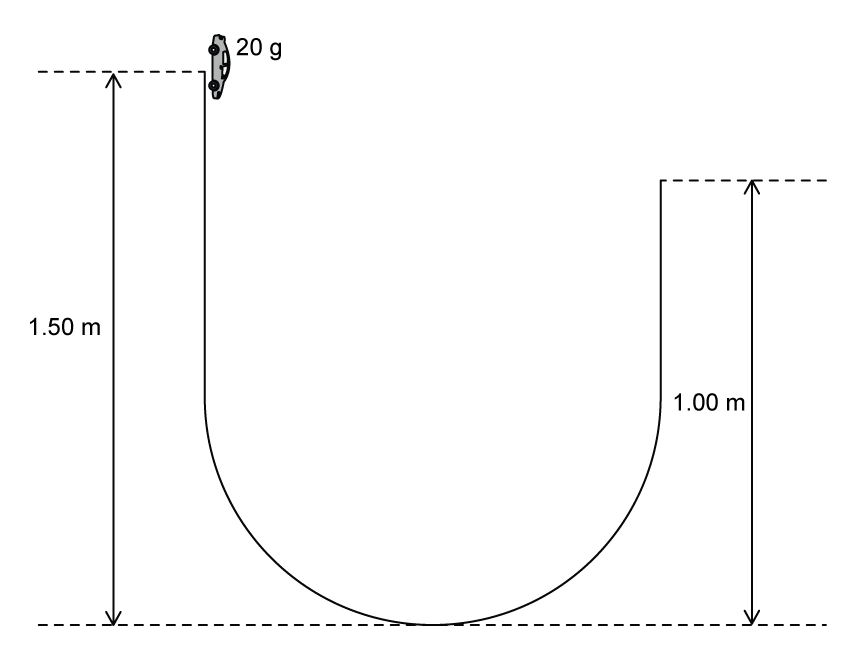
A child is playing with a toy car on a racetrack.

Racetrack as described in question with a toy car placed at the top of the first vertical section, 1.50 m above the ground. The track is vertically downwards initially but flattens out until horizontal. At this point the track is in contact with the floor. The track then curves back upwards until vertical again. The track ends 1.00 m above the floor.

The child holds the toy car at the top of the track, then releases it. The car experiences friction and air resistance as it travels along the track to the lowest point. Upon reaching the end of the track, the car leaves the track and continues up in the air.

Describe the energy transfers from just before the child releases the car to the point where the car reaches its highest point above the end of the track.

8b
5 marks

The racetrack begins at a height of 1.50 m above the floor and ends at a height of 1.00 m above the floor.

The toy car has a mass of 20 g and is released from rest at the top of the track.

For the following calculations, you may ignore the effects of friction and air resistance.

(i) On the diagram, draw a cross at the position where the speed of the car is greatest.

[1]

(ii) Calculate the amount of energy in the car's gravitational store before it is released.

[2]

(iii) State the amount of energy in the car's kinetic store where you have drawn a cross on the diagram.

[1]

(iv) The car leaves the track and rises into the air before falling again.

Determine the maximum height reached by the car above the end of the racetrack.

[1]