Gas Exchange, Cell Membranes & Transport (Edexcel International AS Biology): Exam Questions

Exam code: XBI11

1 hour6 questions
1a
Sme Calculator
3 marks

The structure and properties of the cell membrane are important in controlling which molecules can enter and leave a cell.

The image shows part of a cell membrane, as seen using an electron microscope.

q5a-unit-1-january-2021-edexcel-ial-biology1

The width of this cell membrane is 5.00 nm.

A phosphate head of a phospholipid is between 0.8 and 0.9 nm in diameter and the fatty acid tails are between 1.25 and 1.75 nm long.

Explain how this electron micrograph provides evidence for the structure of the cell membrane.

Use the information given to support your answer.

1b
Sme Calculator
3 marks

Cell membranes contain cholesterol.

The molecular formula of cholesterol is C27H46O.

The diagram shows a cholesterol molecule.


q5b-unit-1-january-2021-edexcel-ial-biology


Explain the location of cholesterol in cell membranes.

Use the information in the diagram to support your answer.

1c
Sme Calculator
6 marks

The diagram shows the permeability of cell membranes to some chemicals.

q5c-unit-1-january-2021-edexcel-ial-biology

The sodium and chloride ions, glucose and water are polar chemicals.

A steroid is a non-polar chemical.

(i) Describe the dipolar nature of water.

(2)

(ii) Explain the permeability of cell membranes to each chemical shown in the diagram.

(4)

2a
Sme Calculator
4 marks

Gas exchange surfaces have specific adaptations.

Lungs contain the gas exchange surfaces of humans.

Smoking causes lung damage.

(i) The graph shows that there is a correlation between smoking and death rate from lung cancer in men.

q6ai-unit-1-january-2021-edexcel-ial-biology

Explain how this graph shows that there is a correlation between smoking and death rate from lung cancer in men.

(2)

(ii) Smoking is a cause of emphysema.

People with emphysema have weakened alveoli that can collapse, creating fewer but larger alveoli.

Explain how this will affect gas exchange in people with emphysema.

(2)

2b
Sme Calculator
6 marks

Bird embryos develop inside hard-shelled eggs.

Gas exchange occurs across the shell of the egg. The oxygen diffuses into the bloodstream of the developing embryo and carbon dioxide diffuses back out.

The diagram shows a section through the shell of an egg.

q6b-unit-1-january-2021-edexcel-ial-biology

The thickness of the egg shell is 0.5 mm. The density of the pores in the shell varies from 40 to 400 per cm2.

Explain the factors that would determine the rate of diffusion of gases between the air and the tissues of the embryo.

Use the information in the diagram, the question and your own knowledge to support your answer.

3a
Sme Calculator
3 marks

The structure of the cell membrane affects the properties of the cell membrane.

The diagram shows the structure of part of a cell membrane.

q8-unit-1-june-2021-edexcel-ial-biology

(i) The magnification of this diagram is 1×10⁷.

The structure labelled T is 2 units long.

What is this unit?

(1)

A

cm

B

mm

C

μm 

D

nm

(ii) Which structures contain a phosphate group?

(1)

A

Q and R

B

Q and T 

C

R and S

D

S and T 

(iii) Which ratio of the structures affects the fluidity of this membrane?

(1)

A

Q:T

B

R:Q 

C

R:T

D

S:T

3b
Sme Calculator
4 marks

Explain the role of the primary structure in determining the properties of the protein labelled in the diagram.

3c
Sme Calculator
6 marks

The diagram and table give information about some molecules found inside and outside a cell.

q8c-1-unit-1-june-2021-edexcel-ial-biology
q8c-2-unit-1-june-2021-edexcel-ial-biology

Explain why each of these molecules enters the cell by a different mechanism.

Use the information in the table and the diagram to support your answer.

4a
Sme Calculator
3 marks

The cell membrane controls which substances can move into the cell or out of the cell.

Processes by which substances can move into a cell or out of a cell include diffusion, facilitated diffusion, active transport and osmosis.

A Venn diagram can be used to show the similarities and differences between diffusion, facilitated diffusion and active transport.

Statements about similarities can be written in the numbered parts of the circles that overlap.

For example, statements about similarities shared by all three processes would be written in Part IV.

Statements about differences can be written in the numbered parts of the circles that do not overlap.

q6a-unit-1-january-2022-edexcel-ial-biology

(i) Which part would contain the statement: uses proteins?

(1)

A

II

B

III

C

IV

D

VII

(ii) Which part would contain the statement: needs energy in the form of ATP?

(1)

A

II

B

V

C

VI

D

VII

(iii) Which part would contain the statement: solutes can only move down a concentration gradient?

(1)

A

II

B

III

C

V

D

VII

4b
Sme Calculator
3 marks

Osmosis can be defined as the movement of free water molecules through a partially permeable membrane, down a water potential gradient.

Explain this definition.

4c
Sme Calculator
6 marks

The photograph shows a Chinese mitten crab.

chinese-mitten-crab

Christian Fischer, CC BY-SA 3.0 <https://creativecommons.org/licenses/by-sa/3.0>, via Wikimedia Commons

Mitten crabs spend most of their lives in fresh water and only return to the sea to breed.

In an investigation, mitten crabs were kept in fresh water and then moved into sea water.

The water content and amino acid content in the muscle cells of these crabs were measured for 15 days after moving them from fresh water into sea water.

The graph shows the results of this investigation.

q6c-2-unit-1-january-2022-edexcel-ial-biology

Sea water has a higher concentration of salt than fresh water.

Explain the changes in water content and amino acid content in the muscle cells of the crabs in this investigation.

5a
2 marks

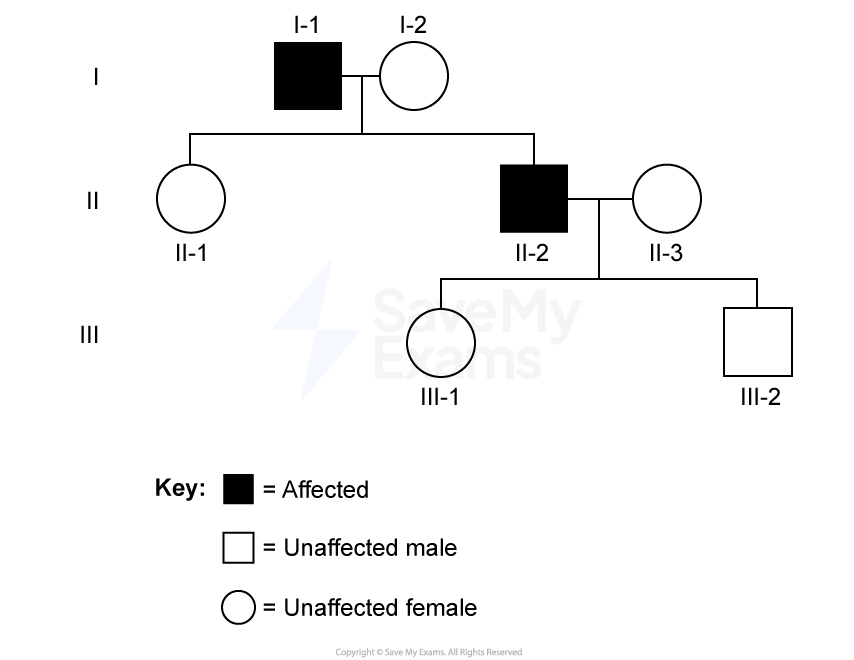
Phenylketonuria (PKU) is an autosomal recessive condition caused by a mutation in the gene encoding the enzyme phenylalanine hydroxylase. Affected individuals cannot metabolise the amino acid phenylalanine, leading to neurological damage if untreated.

A family pedigree for a family affected by PKU is shown in the diagram.

Pedigree diagram showing genetic inheritance over three generations with affected males, unaffected males, and unaffected females.

Using the symbols P and p, state the genotypes of I-1 and I-2, and explain how the pedigree supports your conclusions.

5b
2 marks

Phenylketonuria (PKU) and red-green colour blindness are both genetic disorders caused by mutations.

Explain why PKU affects males and females equally, whereas red-green colour blindness affects males more frequently than females.

5c
1 mark

III-1 has been confirmed by genetic testing to be a carrier. III-1's partner has no family history of PKU and has been confirmed by genetic testing to be homozygous dominant.

Which of the following correctly states the probability that a child of III-1 and their partner will be affected by PKU?

  • 0%

  • 25%

  • 50%

  • 100%

5d
6 marks

III-1 has been confirmed by genetic testing to be a carrier of the PKU allele. This finding has implications for other members of the family.

Evaluate the use of genetic screening for members of this family.

6a
Sme Calculator
3 marks

Pulmonary fibrosis is a condition in which collagen accumulates in the walls of the alveoli, progressively reducing lung function.

The table below shows the mean alveolar diameter and mean alveolar wall thickness in healthy individuals and in individuals with pulmonary fibrosis.

Feature

Healthy

Pulmonary fibrosis

Mean alveolar diameter (μm)

200

120

Mean alveolar wall thickness (μm)

0.5

3.2

An alveolus can be modelled as a sphere.

Using the data in the table and the formulae below, calculate the surface area to volume ratio of a healthy alveolus.

  • Surface area = 4πr²

  • Volume = (4 over 3)πr³

Give your answer to 3 significant figures.

6b
6 marks

Individuals with pulmonary fibrosis often experience fatigue.

*Using Fick's Law and the data in the table, explain how the changes to the alveolar membrane in pulmonary fibrosis affect diffusion and the saturation of haemoglobin, and how this leads to fatigue.