1a2 marks
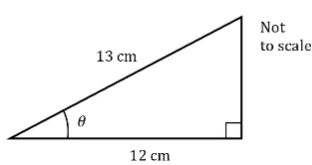
Work out the length of the missing side in the following right-angled triangle.
1b3 marks
Using your answer from part (a) to help, write down the values of the following:
(i)
(ii)
(iii)
Was this exam question helpful?
Exam code: XMA01
Work out the length of the missing side in the following right-angled triangle.
Using your answer from part (a) to help, write down the values of the following:
(i)
(ii)
(iii)
Was this exam question helpful?
Show that
Was this exam question helpful?
Solve the equation
Was this exam question helpful?
Solve the equation
Hence, or otherwise, solve the equation for
Was this exam question helpful?
Solve the equation for , giving your answers to one decimal place.
Was this exam question helpful?
Sketch the graph of for
Solve the equation for
Was this exam question helpful?
Solve the equation for
Was this exam question helpful?
Solve the equation for
Was this exam question helpful?
Find all the solutions to the equation for
Was this exam question helpful?
Find all solutions to the equation in the interval , giving your answers in radians as multiples of
Find all solutions to the equation in the interval , giving your answer in radians to three significant figures.
Was this exam question helpful?
Show that the equation can be written in the form , where and are integers to be found.
Hence, or otherwise, solve the equation for
Was this exam question helpful?
Given that , find the possible values of and
Was this exam question helpful?
Solve the equation for
Was this exam question helpful?
Solve the equation for
Was this exam question helpful?
A right-angled triangle has hypotenuse 8 cm. One of its other sides is 5 cm.
Find exact values for and , where is the smallest angle in the triangle.
Was this exam question helpful?
Solve the equation for
Was this exam question helpful?
Show that
Hence, or otherwise, solve the equation for , giving your answers to 1 decimal place where appropriate.
Was this exam question helpful?
A seagull sits on the surface of the sea and moves up and down as waves pass.
Its height, metres, above its position in calm water is modelled by the function where is the time in seconds after timing commences.
Sketch a graph of against for showing the coordinates of the points of intersection with the - axis
How many times in the first minute after timing commences is the seagull 0.25 metres above its calm water position?
Find the time at which the seagull is first 0.25 m above its calm water position and moving downwards. Give your answer to 3 significant figures.
Was this exam question helpful?
Solve the equation for , giving your answers to 3 significant figures.
Was this exam question helpful?
Solve the equation for
Was this exam question helpful?
Given that the angle is obtuse and that , find the exact value of .
Was this exam question helpful?
Solve the equation for
Was this exam question helpful?
Solve the equation for
Was this exam question helpful?
An isosceles triangle has sides 8 cm, 8 cm and 4 cm and equal base angles .
Find exact values for , and .
Was this exam question helpful?
Find all the solutions to the equation in the interval , giving your answers in radians as multiples of .
Find all the solutions to the equation in the interval , giving your answers in radians to three significant figures.
Was this exam question helpful?
Show that satisfies the equation .
Hence solve the equation for .
Was this exam question helpful?
A seagull sits on the surface of the sea and moves up and down as waves pass.
Its height, metres, above its position in calm water is modelled by the function where is the time in seconds after timing commenced.
Find the first time the seagull is 0.3 metres above its calm water position.
Give your answer to 2 decimal places.
How many times in the first minute after timing commences is the seagull 0.3 metres above its calm water position?
Was this exam question helpful?
Solve the equation in the interval , giving your answers to 3 significant figures.
Was this exam question helpful?
Solve the equation for , giving your answers to 1 decimal place where appropriate.
Was this exam question helpful?
Given that the angle is reflex and that , find the exact value of .
Was this exam question helpful?
Solve the equation for .
Was this exam question helpful?
Solve the equation for , giving your answers to 1 decimal place where appropriate.
Was this exam question helpful?
For the triangle in the diagram, find exact values for , and .

Was this exam question helpful?
Find all the values of in the range which satisfy the equation
, giving your answers to 1 decimal place.
Was this exam question helpful?
Find all the solutions to the equation
in the interval , giving your answers in radians as multiples of .
Find all the solutions to the equation in the interval , giving your answers in radians to three significant figures.
Was this exam question helpful?
A seagull sits on the surface of the sea and moves up and down as waves pass.
Its height, metres, above its position in calm water is modelled by the function where is the time in seconds after timing commences.
Find the amount of time the seagull is more than 0.5 metres above its calm water position in the first 20 seconds after timing commences.
Give your answer correct to 3 significant figures.
Was this exam question helpful?