GCSE Maths Topics by Exam Board and Tier: Full List
Contents
The three most popular exam boards for GCSE Maths in England are:
AQA (opens in a new tab)
Edexcel (Pearson) (opens in a new tab)
OCR (opens in a new tab)
Every exam board has to follow the national curriculum, which is set by the Department of Education. This means the content that you cover in your Maths GCSE will be the same regardless of which exam board you are studying for.
The differences between the three exam boards are more to do with question style, exam structure and marking.
However, in terms of content, there are major differences between the Foundation and Higher tiers.
This article breaks down every GCSE Maths topic, tier by tier, so you can see the full picture in one place and build a revision plan around it.
Key Takeaways
GCSE Maths content is set by the Department for Education and is identical across AQA, Edexcel and OCR - only the exam structure and question style differ.
Content is grouped into five broad areas: Number, Algebra, Ratio & Proportion, Geometry & Measures, and Probability & Statistics.
Higher tier includes everything in Foundation plus extra content, and pushes several shared topics into greater depth.
You can use the topic tables below as a checklist to track what you've covered and spot the areas that need more work.
The key GCSE Maths topics that are covered by every exam board lie within the broader areas of:
Number
Algebra
Ratio, Proportion and Rates of Change
Geometry and Measures
Probability and Statistics
The proportion of content within the exam papers for each area at both Foundation and Higher can be seen in the bar chart below.
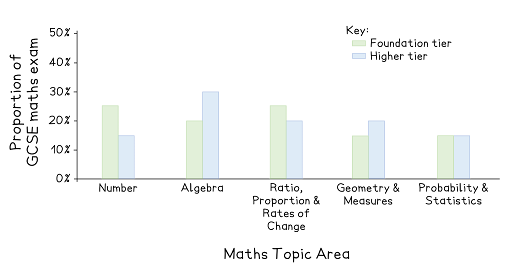
Dual bar chart showing the proportion of the GCSE maths exam dedicated to each topic area
1. Number
Number is a fundamental topic in GCSE Maths, as it forms the core of numerical literacy. Number topics cover essential skills including:
Arithmetic operations
Fractions
Decimals
Percentages
This, in turn, underpins more advanced concepts such as powers, standard form, and number properties.
The table below summarises the different number topics covered at GCSE. It is very similar between both Foundation and Higher, but there are some key differences between the tiers.
Although in the Foundation tier you are expected to use exact values – e.g. you should be able to calculate exact values using fractions or leave answers in terms of 𝜋 – in the Higher tier you are also required to be able to use surds within calculations.
Approximately 15% of the exam paper questions for the Higher tier examine number content, and for the Foundation tier, it’s a whopping 25%.
Number Topics | |
|---|---|
Foundation | Higher |
|
|
2. Algebra
Algebra is another major component of the GCSE Maths curriculum.
Although there are many Algebra topics that are covered at both Foundation and Higher, there are more that appear in the Higher tier exams only. For example, equations of circles and transformations of graphs.
And, even within the overlapping content between the tiers, topics will often be studied in greater depth at Higher level than they are at Foundation. For example, algebraic reasoning is required at Foundation, which is extended into formal algebraic proof at Higher level.
Approximately 30% of the Higher tier exams focus on algebraic content, compared to 20% of the Foundation tier exams. A summary of the algebra topics examined within the Maths GCSE is given in the table below.
Use our algebra revision guide to hone your equation and factorising skills.
Algebra Topics | |
|---|---|
Foundation | Higher |
|
|
3. Ratio, Proportion and Rates of Change
Approximately 25% of the Foundation paper content and 20% of the Higher paper content focuses on ratio, proportion and rates of change. These are questions that look at the relationships between quantities.
Students at both Foundation and Higher learn to express and manipulate ratios and solve proportion problems, as well as understand unit conversions and compound measures. The content for both tiers is the same, as summarised in the table below, but questions in the Higher tier could be more challenging.
For example, Foundation students will be expected to solve problems involving direct and inverse proportion with different quantities, but Higher tier students will be expected to solve problems that also include quantities to a given power.
Ratio, Proportion and Rates of Change Topics | |
|---|---|
Foundation | Higher |
|
|
4. Geometry and Measures
Within geometry and measures at Maths GCSE level, all students explore the fundamentals of this area including topics such as properties of 2D and 3D shapes, transformations, and Pythagoras’ theorem.
Again, there are some topics that are tested at Higher level only, e.g. circle theorems and area and volume of similar shapes.
Approximately 15% of the Foundation paper content and 20% of the high paper content cover these geometry and measures topics, and the breakdown of these is shown in the table below.
Geometry and Measures Topics | |
|---|---|
Foundation | Higher |
|
|
5. Probability and Statistics
Probability and statistics are distinct areas of maths, but are often grouped together. In fact, only approximately 15% of the content within both the Foundation paper content and the Higher paper content cover both of these areas.
Content is similar across the Foundation and Higher tiers, but Foundation students won’t cover conditional probability, or some statistical diagrams including histograms, cumulative frequency diagrams and box plots.
Probability and Statistics Topics | |
|---|---|
Foundation | Higher |
|
|
What is Covered in the Different GCSE Maths Papers?
Any topic from the specification could be tested on any one of the papers.
The external assessment for each of the three main boards - AQA, Edexcel and OCR - consists of three papers: one non-calculator and two calculator papers.
Certain topics naturally suit non-calculator questions, such as fraction calculations, expanding and factorising brackets, and Higher tier topics like surds.
Other topics require the use of a calculator, including compound interest and Higher tier concepts such as iteration.
However, it’s important to note that the majority of topics could be tested within either a calculator or a non-calculator paper, so students must be prepared for all topics in the course for each paper in order to achieve success in their GCSE Maths exam.
How to Use Topic Lists for Revision
A topic list only helps if you use it to plan your Maths revision, rather than just reading through it once.
Turn it into a checklist. Go through each table above and mark every topic as confident, needs practice, or don't understand. This gives you a clear, honest picture of where your revision time should go, instead of revising what feels comfortable.
Prioritise by weighting and confidence. Algebra carries the most marks at Higher tier, and Number carries the most at Foundation, so weak spots in those areas are worth tackling first. Within that, prioritise the topics you've marked as weakest.
Build a revision timetable around it. Once you know your weak areas, block out revision sessions for each one rather than working through topics in the order they appear in a textbook.
Track progress over time. Revisit the checklist every few weeks. Moving topics from "needs practice" to "confident" is a much clearer sign of progress than simply ticking off hours spent revising.
Test yourself with topic-specific questions. Once you've revised a topic, use exam-style questions on that exact topic to check whether the knowledge has actually stuck, before moving on to full past papers closer to exams.
Frequently Asked Questions
Do I need to revise all GCSE Maths topics for the exam?
Yes. Since any topic can appear on any exam paper, you can't safely skip a topic on the assumption it won't come up. Focus your time proportionally - topics that carry more marks, like Algebra and Number, deserve more revision time than smaller areas.
Are Maths topics the same across all exam boards?
Yes. GCSE Maths content is set by the Department for Education and is common to AQA, Edexcel and OCR. What differs between boards is paper structure, question style, and - in OCR's case - where the non-calculator paper sits in the sequence.
How do I know which topics I struggle with most?
The most reliable way is to work through topic-specific exam questions for each area and mark your own answers against a mark scheme. Patterns in where you lose marks - rather than how a topic feels while you're revising it - are the clearest sign of a genuine weak spot.
Boost Your GCSE Maths Grade with Save My Exams
The full GCSE Maths specification can look overwhelming, but it's built from five manageable areas, each with a clear tier structure.
Use the tables above as your master checklist and let your weak spots - not the order topics appear in a textbook - set your revision priorities.
At Save My Exams, we have a huge bank of examiner-written GCSE Maths revision resources specific to each exam board and tier. You’ll never have to wonder if you’re revising the right content. Instead, you can focus on nailing your target grade.
Explore our AQA, Edexcel, and OCR GCSE Maths resources.
References
AQA GCSE Maths Specification (opens in a new tab)
Edexcel GCSE Maths Specification (opens in a new tab)
OCR GCSE Maths Specification (opens in a new tab)
Was this article helpful?
Sign up for articles sent directly to your inbox
Receive news, articles and guides directly from our team of experts.

Share this article

 written revision resources that improve your